

Are you the author? Sign in to claim
Claude Code skills that make Claude (Fable) the conductor of AI worker fleets: many parallel OpenAI Codex workers plus O



Claude Code skills that make Claude (Fable, or Opus when Fable is unavailable) the conductor of an AI worker fleet. The conductor surveys and plans, dispatches many parallel OpenAI Codex CLI workers for implementation and Claude Opus agents for design judgment, then integrates, reviews, and verifies what comes back.
One session directs the whole effort: workers spend their own context on implementation while the conductor's stays free for judgment, git worktrees let many writers land in parallel without collisions, and campaign state lives in the repo so any later session resumes mid-campaign without setup.
Runs a project as an orchestrated campaign.
assets/campaign-hq/ into docs/campaign-hq/: CAMPAIGN.md for the plan
and fleet table, LEARNINGS.md for distilled lessons, preferences.md for
worker routing, and schemas/worker-result.json for reports. It also adds a
pointer to the project's CLAUDE.md so later sessions resume from repo state.preferences.md, and persist across sessions.references/ and load only when needed.examples/campaign-hq/ shows the state files
mid-campaign, including a worked worker brief and the report schema.
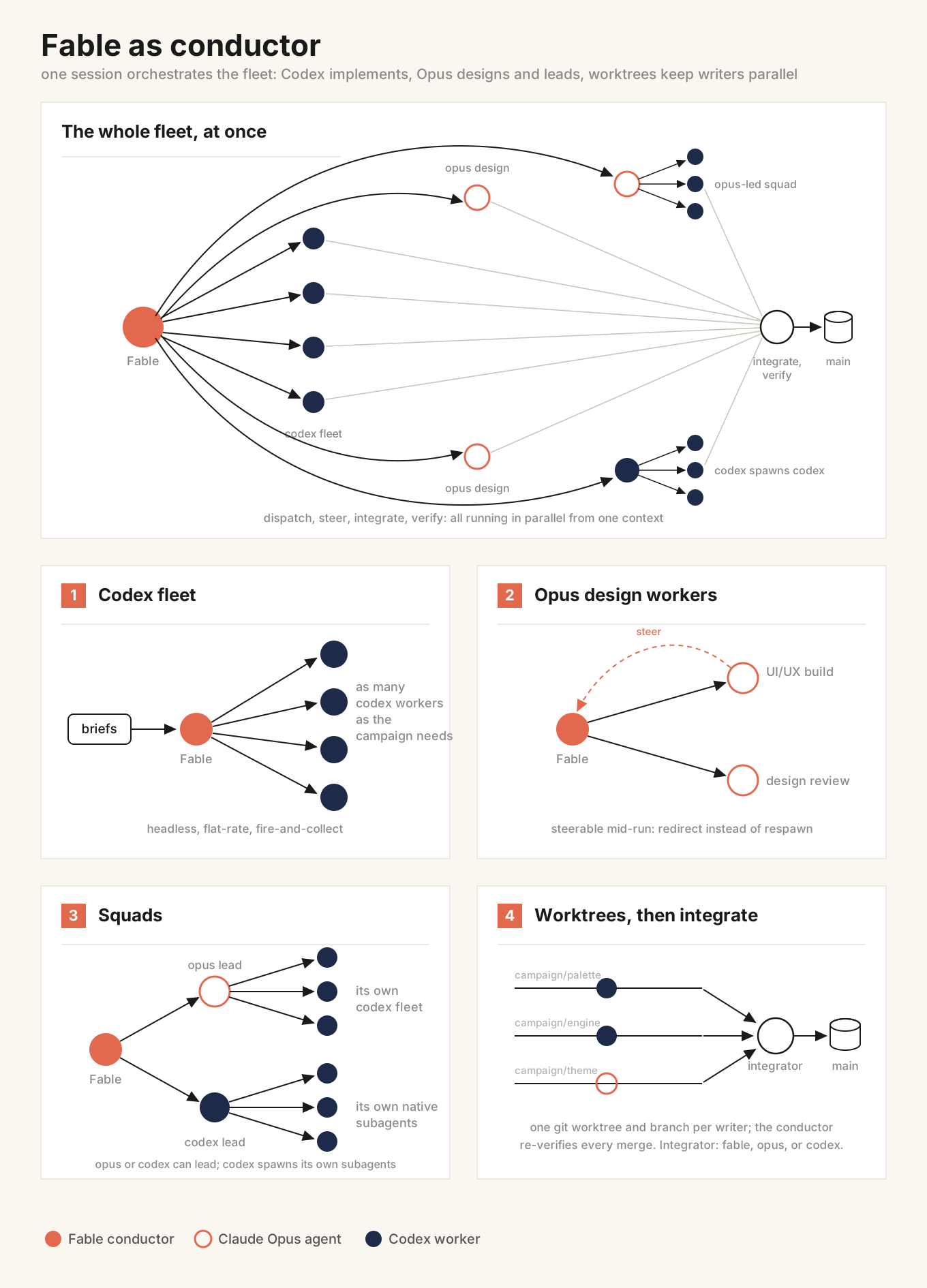
The panels are worked examples. Any capable worker can lead, integrate, or review, and a campaign composes whatever shape the work needs.
Squads nest the fan-out: a squad lead (Opus or Codex) dispatches its own parallel workers, integrates their branches, and hands the conductor one verified branch. Tested end to end both ways: a spawned Opus lead ran Codex workers in parallel worktrees, each landing its own commit, and a Codex lead fanned out its native subagents inside one workspace.
flowchart TD
    C[Fable conductor] -->|sub-goal briefs| S1[Squad lead · Opus]
    C --> S2[Squad lead · Codex]
    S1 --> A1[Codex] & A2[Codex] & A3[Codex]
    S2 --> B1[Codex] & B2[Codex] & B3[Codex]
    A1 & A2 & A3 --> I1[campaign/search<br>integration branch]
    B1 & B2 & B3 --> I2[campaign/billing<br>integration branch]
    I1 --> V[Conductor merges,<br>re-verifies]
    I2 --> V
    V --> M[(main)]
Campaign state lives in the project, so any later session resumes it:
docs/campaign-hq/
├── CAMPAIGN.md      plan, phases, fleet table
├── LEARNINGS.md     standing rules + dispatch log
├── preferences.md   worker routing, permission envelope
├── briefs/          one file per dispatch
├── out/             collected worker reports
└── schemas/         worker-result.json
npx skills add jvogan/a-fable-of-codexes --skill campaign-conductor
or manually:
git clone --depth 1 https://github.com/jvogan/a-fable-of-codexes.git /tmp/afoc
cp -r /tmp/afoc/skills/campaign-conductor ~/.claude/skills/
Install the skill, then say in any project:
start a campaign
Claude bootstraps docs/campaign-hq/, sizes the plan to the project, and
begins dispatching workers. From then on, every session in that repo picks up
the campaign automatically. Direct it in plain language:
preferences.md)Claude Code. The skill uses the Agent and Workflow tools.
OpenAI Codex CLI (github.com/openai/codex).
Install with npm install -g @openai/codex (or brew install codex), then
run codex login. ChatGPT-plan auth consumes plan usage and limits vary by
plan; API-key auth is token-priced. Size worker waves to your available
limits and spend tolerance. Set the default worker model and reasoning
effort in ~/.codex/config.toml, for example:
model = "gpt-5.6-sol"
model_reasoning_effort = "high"
Reasoning runs a ladder (low, medium, high, xhigh, max, ultra),
and the model ships in frontier, balanced, and fast variants. high on the
frontier model is a sound default; reserve max/ultra for the hardest
architecture and debugging. Override per task in plain language ("use ultra
Codex for this wave", "send the mechanical refactor to the fast model"): the
conductor writes the request to preferences.md, where it persists.
Without Codex installed, the skill runs Claude-only fleets: Sonnet workers take the implementation role, Opus keeps design and squad-lead duty, and the briefs, worktrees, squads, and reports stay the same.
Codex plugin for Claude Code (optional,
github.com/openai/codex-plugin-cc).
Adds /codex:review, /codex:adversarial-review, and background-delegation
slash commands for single interactive tasks. Install inside Claude Code:
/plugin marketplace add openai/codex-plugin-cc
/plugin install codex@openai-codex
python3 scripts/validate.py
npx --yes skills add . --list
Checks every skill against the
Agent Skills spec: frontmatter
fields, name format, and description length, plus this repo's 500-line body
limit and relative-link integrity. The skills command verifies that the
package is discoverable by the installer. CI runs both commands on every push
and pull request.
MIT
⚠️ Experimentelle Skill-Sammlung für deutsches Recht (Arbeits-, Gesellschafts-, Insolvenz-, Datenschutz-, Prozessrecht u
Manage multiple Claude Code agents from TUI or Web with tmux and git worktrees
Project management using GitHub Issues + Git worktrees for parallel agent execution
Core skills library for Claude Code with 20+ battle-tested skills including TDD, debugging, and brainstorming
