

Are you the author? Sign in to claim
Persistent engineering memory for coding agents over MCP.




Your coding agent should not rediscover the same project decisions every session.
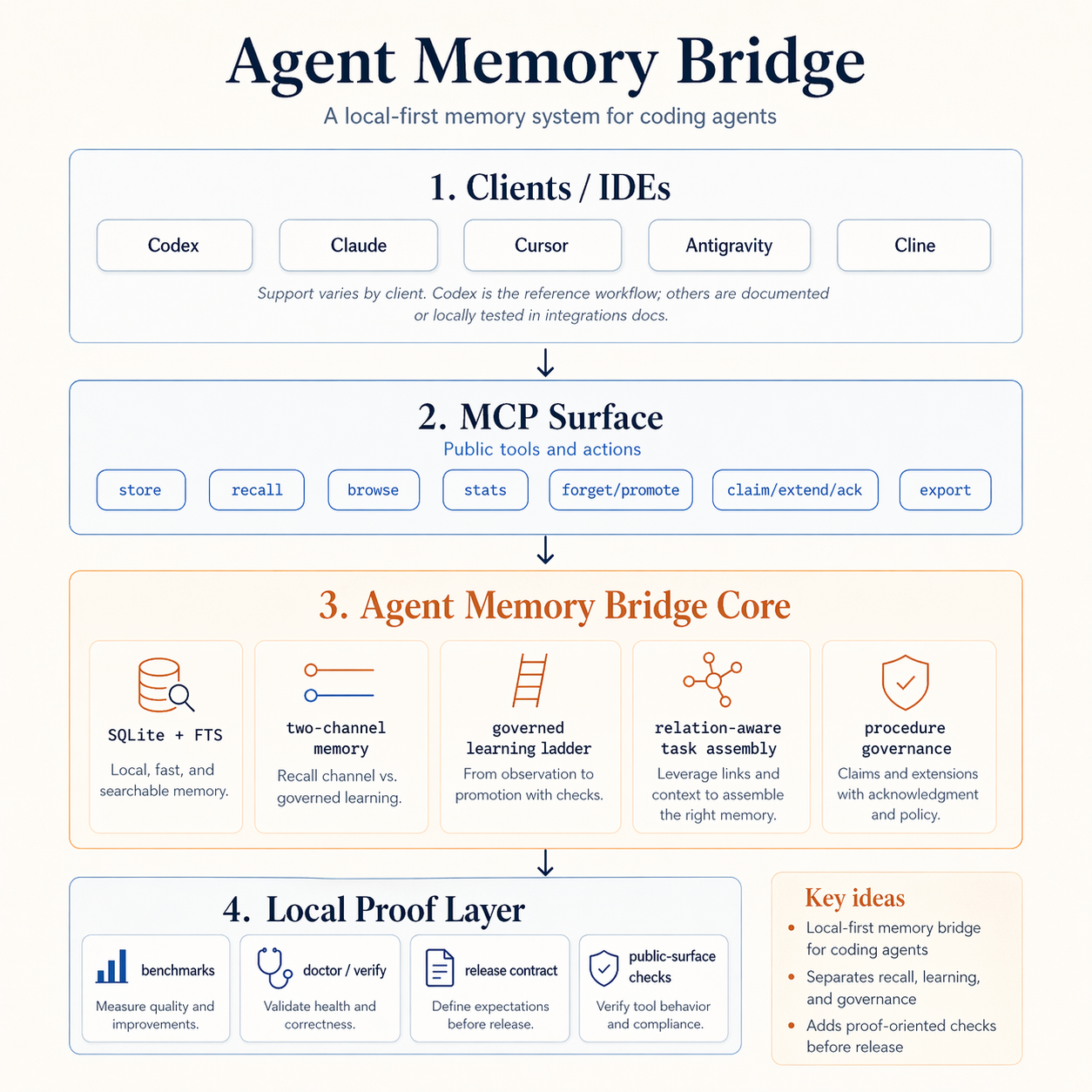
Agent Memory Bridge is persistent engineering memory for coding agents: a local-first MCP memory layer and context compiler with SQLite/WAL as the durable store, FTS5 for lexical recall, and an optional local embedding sidecar for semantic or hybrid retrieval. It captures durable repo decisions, gotchas, procedures, and handoffs while keeping short-lived coordination separate.
Codex is the reference workflow, not the product boundary. If a client can launch a local stdio MCP server, it can use Agent Memory Bridge.
Most agent memory either feels too shallow or too heavy:
AMB takes a smaller path: local SQLite authority, explicit namespaces, inspectable records, benchmarked lexical/hybrid recall, and a signal lifecycle for lightweight coordination.
claim -> extend -> ack / expire / reclaim without pretending to be a scheduler.289 passed.Requirements:
One-command GitHub smoke test with uvx:
uvx --from git+https://github.com/zzhang82/Agent-Memory-Bridge agent-memory-bridge verify
Local editable install:
python -m venv .venv
# Activate the virtual environment for your shell, then:
python -m pip install -e .
agent-memory-bridge doctor
agent-memory-bridge verify
Generate a placeholder-safe client config:
agent-memory-bridge config --client generic --example
agent-memory-bridge config --client codex --example
agent-memory-bridge config --client cursor --example
Dockerized stdio works too when you want an isolated runtime:
docker build -t agent-memory-bridge:local .
docker run --rm -i -e AGENT_MEMORY_BRIDGE_HOME=/data/agent-memory-bridge -v /path/to/bridge-home:/data/agent-memory-bridge agent-memory-bridge:local
Client-specific notes live in docs/INTEGRATIONS.md. Runtime configuration lives in docs/CONFIGURATION.md. Authority and correction rules live in docs/AUTHORITY-CONTRACT.md. Security guidance lives in SECURITY.md. Agents that are installing the bridge should start with INSTALL_FOR_AGENTS.md.
Session 1 discovers a project rule:
store(
  namespace="project:demo",
  kind="memory",
  content="claim: Use WAL mode for concurrent SQLite readers."
)
Session 2 asks about the same project:
recall(namespace="project:demo", query="SQLite concurrent readers")
The agent gets the rule back without the user typing it again.
For coordination, use signals:
store(namespace="project:demo", kind="signal", content="release note review ready")
claim_signal(namespace="project:demo", consumer="reviewer-a", lease_seconds=300)
extend_signal_lease(id="<signal_id>", consumer="reviewer-a", lease_seconds=300)
ack_signal(id="<signal_id>")
The short version:
WITHOUT AMB
user> We hit this last time too: run the generator after schema edits.

WITH AMB
agent> I found the previous gotcha: run the generator after schema edits.
The terminal demo and the before/after gotcha story are in examples/demo, with the story source at examples/demo/before-after-gotcha.cast.md.
Status labels are intentionally narrow.
| Client | Status | Notes |
|---|---|---|
| Generic stdio MCP | supported | Any client that can launch a local stdio server |
| Codex | verified | Reference workflow and deepest dogfood path |
| Claude Code | documented | CLI or project-level stdio MCP config |
| Claude Desktop | documented | Local stdio server config; remote/extension flows are separate |
| Cursor | documented | JSON mcpServers config |
| Cline | documented | JSON mcpServers config |
| Antigravity | locally tested | Exercised in a local setup; UI/config details can vary |
The bridge exposes 10 public MCP tools:
store, recall, browse, statsforget, promote, exportclaim_signal, extend_signal_lease, ack_signalThe richer behavior stays behind that surface: reflex promotion, consolidation, startup/task-time assembly, procedure governance, telemetry summaries, signal contention checks, and learning-candidate review queues. There are no separate task_packet, startup_packet, or learning_candidate MCP tools.
For normal always-on service use, Codex-log watcher capture, reflex promotion, and strong consolidation are disabled by default. That lets multi-runtime installs run governance checks and embedding sidecar maintenance without silently promoting raw session/process chatter into durable memory.
Some MCP clients generate one static input schema per tool and may send signal-only fields on kind="memory" paths: for example ttl_seconds or expires_at on store, and signal_status on recall, browse, or export. AMB drops those fields at the MCP transport boundary before creating or querying memory records. The lower-level memory store contract stays strict: durable memory and coordination signals remain separate lanes, and real signal lifecycle fields still belong only to kind="signal" operations.
0.14.2 is the service automation hardening patch over the governed learning-candidate release while keeping the public tool surface stable.
| Track | Current signal |
|---|---|
| Retrieval | memory_expected_top1_accuracy = 1.0, file_scan_expected_top1_accuracy = 0.636 |
| Calibration | classifier_exact_match_rate = 0.875, fallback_exact_match_rate = 0.062 |
| Procedure governance | governed_case_pass_rate = 1.0, governed_blocked_procedure_leak_rate = 0.0 |
| Learning candidates | policy-gated staging records are suppressed from normal recall, browse, export, and stats unless explicitly queried with review tags; candidates are not durable authority until reviewed/promoted |
| Signal contention | signal_contention_case_pass_rate = 1.0, duplicate_active_claim_count = 0 |
| Adversarial memory governance | adversarial_case_count = 6, adversarial_task_count = 7, adversarial_governed_task_pass_rate = 1.0, adversarial_governed_blocked_record_leak_rate = 0.0 |
| Test suite | 289 passed |
Snapshot facts checked by the release contract:
question_count = 11
memory_expected_top1_accuracy = 1.0
memory_mrr = 1.0
file_scan_expected_top1_accuracy = 0.636
file_scan_mrr = 0.909

sample_count = 16
classifier_exact_match_rate = 0.875
fallback_exact_match_rate = 0.062
classifier_better_count = 13
fallback_better_count = 2
classifier_filtered_low_confidence_count = 2

case_count = 7
flat_case_pass_rate = 0.429
governed_case_pass_rate = 1.0
flat_blocked_procedure_leak_rate = 1.0
governed_blocked_procedure_leak_rate = 0.0
governed_governance_field_completeness = 1.0

signal_contention_case_count = 5
signal_contention_case_pass_rate = 1.0
unique_active_claim_rate = 1.0
duplicate_active_claim_count = 0
active_reclaim_block_rate = 1.0
stale_ack_blocked_rate = 1.0
stale_reclaim_success_rate = 1.0
pending_under_pressure_claim_rate = 1.0
initial_hard_expiry_cap_rate = 1.0

adversarial_case_count = 6
adversarial_task_count = 7
adversarial_governed_task_pass_rate = 1.0
adversarial_governed_blocked_record_leak_rate = 0.0
Full proof details are in benchmark/README.md.
AMB is not a graph database, hosted memory platform, scheduler, worker runtime, distributed lock, exactly-once coordination system, packet API, or automatic durable writeback path from raw transcripts. It is a small local bridge for reusable engineering memory and lightweight coordination.
For alternatives and trade-offs, see docs/COMPARISON.md.
MIT. See LICENSE.
Run Claude Code as an MCP server so any agent can delegate coding tasks to it
 @microsoft✓ Official
Browser automation using accessibility snapshots instead of screenshots
 @googleapis✓ Official
Google's universal MCP server supporting PostgreSQL, MySQL, MongoDB, Redis, and 10+ databases
 @github✓ Official
Official GitHub integration for repos, issues, PRs, and CI/CD workflows