

Are you the author? Sign in to claim
MCP server + CLI that turns the task manager you already use — TickTick or Obsidian — into persistent agent memory for C
Your task manager is the best agent memory you're not using.


ats is an MCP server and CLI that gives your AI agent memory and execution context from the task system you already use — TickTick, Taskmaster, Beads, or an Obsidian vault. It combines adapter-aware retrieval fused by Reciprocal Rank Fusion (RRF) with portable intent, exploration-to-execution promotion, goal hierarchy, typed task relationships, lifecycle validity, scoped access decisions, context assembly, an action ledger, and bounded task-state events. TickTick can add dense search through local Qdrant + Ollama; file and repository adapters work without either service. ATS works with Claude Code, Claude Desktop, Cursor, and any MCP client.
%%{init: {"theme": "neutral", "quadrantChart": {"pointRadius": 4, "pointLabelFontSize": 14}}}%%
quadrantChart
    title Agent Memory Effectiveness Matrix
    x-axis Low retrieval power --> High retrieval power
    y-axis High upkeep --> Low upkeep
    quadrant-1 Durable and powerful
    quadrant-2 Durable but limited
    quadrant-3 Manual and limited
    quadrant-4 Powerful but separate
    CLAUDE.md: [0.18, 0.22]
    Vector DB memory: [0.75, 0.28]
    Plain task-app MCP: [0.38, 0.78]
    ATS: [0.88, 0.90]
Most "agent memory" projects build a new store — a vector DB, a bespoke framework — that drifts from reality the moment you stop feeding it. But you already maintain a knowledge base by hand, every day: your task app. Years of curated, prioritized, deduplicated context, pre-filtered by the most reliable ranker there is — you.
ATS makes that context agent-native. Adapter, not migration: keep the system you already live in (TickTick, Taskmaster, Beads, or an Obsidian vault today) and give your agent a fast, structured, two-way channel into it.
npm install -g @reneza/ats-cli @reneza/ats-adapter-ticktick
ats config use ticktick
ats auth login
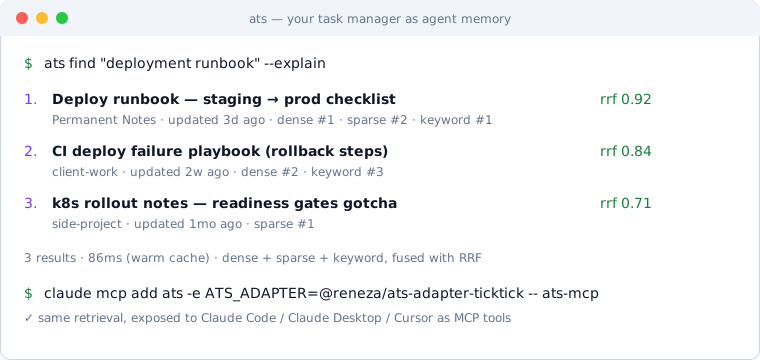
ats find "deployment runbook"
Andrej Karpathy's LLM Wiki idea — keep notes as plain markdown an LLM can reason over — is right about the destination and wrong about the starting line. Almost nobody's knowledge lives in clean markdown; it lives in the task app they've used for years. ATS closes that gap with pluggable storage adapters, so you get an agent-queryable knowledge layer without re-homing a single note.
| Approach | Where memory lives | Upkeep | Retrieval |
|---|---|---|---|
CLAUDE.md / memory files | markdown you re-edit by hand | manual, drifts | none — whole file injected every session |
| Vector-DB agent memory (mem0-style) | a new store only the agent sees | rots unless you keep feeding it | dense-only |
| Plain TickTick / Obsidian MCP servers | your task app | none | keyword or the app's native search |
| ATS | your task app | none — you already curate it daily | hybrid retrieval plus typed context, validity, provenance, and audit |
Six shifts, in the order they surprised me in real use:
1. The task app becomes a two-way bus between you and your agent. It's not just somewhere the agent reads — it's where you and the agent hand work back and forth. Drop a task and the agent can read its title, body, tags, dates, checklist data, and any attachment metadata exposed by the adapter; the agent writes results back where you'll actually see them. ATS does not claim to download attachment file contents automatically.
2. Semantic retrieval makes the first fetch the right one. Parallel hybrid retrieval (dense + sparse + keyword, fused with RRF, with provenance) instead of keyword grep. In practice this collapsed the usual "search → refine → search again" loop into a single fetch that comes back both faster and richer. Better context on turn one means better answers on turn one.
3. Independent agents can follow durable, typed task relationships.
Semantic search answers "what looks relevant to this query?" Typed links answer a different question: "what was explicitly connected, why, and what context must the next agent follow?" One agent can attach a decision, evidence, depends-on, output, or supersedes relationship. A later agent, in a separate context window, uses ats context to receive those deliberate links before retrieval discoveries. The handoff survives because it lives in the shared task app, not in either agent's chat history.
sequenceDiagram
    participant A as Agent A (one context window)
    participant ATS
    participant T as Shared task app
    participant B as Agent B (later context window)
    A->>ATS: ats find "deployment"
    ATS->>T: hybrid semantic retrieval
    T-->>ATS: likely relevant research note
    ATS-->>A: ranked result with provenance
    A->>ATS: ats link add ... --type decision
    ATS->>T: store typed relationship in task metadata
    Note over T: Durable relationship survives both agent sessions
    B->>ATS: ats context project task
    ATS->>T: load links, lifecycle, and retrieval candidates
    T-->>ATS: current linked tasks and task corpus
    ATS-->>B: deliberate context first, discoveries second, with provenance
This adds structure after semantic search: retrieval proposes candidates; links preserve deliberate relationships, dependencies, and handoffs so another agent can reproduce the context later. ATS provides the shared read/write/link layer; agents remain independent and do not need direct agent-to-agent coordination.
4. Agents receive execution intent, current validity, and an audit trail.
ats intent captures the desired outcome, why it matters, completion conditions, authority, constraints, and approval boundary. ats lifecycle prevents archived, expired, future, or superseded context from silently steering current work. ats security marks content trust, scopes actions and resources, checks approvals, requires a reason, and audits allow/deny decisions. ats ledger records what an agent did, which sources and approvals it used, its output, and whether the task advanced.
ats promote turns exploratory material into a committed goal, project, or task without copying the source body. ats hierarchy evaluate follows explicit parent relationships and reports whether local work still supports its parent objective, including invalid role ordering, missing outcomes, cycles, stale ancestors, and active conflicts-with commitments.
ATS security is a decision point for cooperating clients, not an operating-system sandbox: it cannot intercept unrelated shell, filesystem, or network tools.
The metadata lives in one managed JSON block inside the normal task body, so the same model works through every six-method adapter. npm run prove:intent runs a deterministic synthetic proof of the complete path.
5. Agents can react to state changes without becoming open-ended autonomous runners.
ats events snapshot establishes a local baseline; ats events watch --json emits deterministic task.created, task.updated, task.completed, task.removed, task.unblocked, task.validity.changed, and task.due.soon envelopes as newline-delimited JSON. Before advancing the checkpoint, ATS atomically stages those content-free envelopes in a mode-0600 local spool. ats events pending recovers unacknowledged observations after a consumer or output failure; ats events ack removes them only after explicit consumer acknowledgement. Stable event IDs deduplicate retries.
ATS only emits observations. A separate agent may consume them, but it must still evaluate task intent, validity, authority, and scoped security before acting.
6. Context gets curated at write time, not just read time.
The half everyone skips. Every item is hung on a "trunk" — a theme you already care about (writing, client-work, side-project) — the moment it's captured, so retrieval has structure to grab instead of a flat pile.
Plus the plumbing that makes it usable every turn: a disk-backed corpus cache that avoids repeated store fetches, a retrieval benchmark, and a workflow-progress benchmark. ATS can now measure whether context was relevant and whether work advanced instead of treating a polished response as success. End-to-end latency depends on corpus size and enabled retrievers.
agentic-task-system/
├── packages/
│   ├── core/                       # adapter-agnostic
│   │   ├── retrieval.js            # find, hybrid, RRF
│   │   ├── task-context.js          # intent, lifecycle, typed graph/context
│   │   ├── action-ledger.js         # append-only agent action audit
│   │   ├── task-events.js           # deterministic corpus-diff events
│   │   ├── progress-benchmark.js     # workflow outcome scoring
│   │   ├── corpus-cache.js
│   │   ├── usage-log.js
│   │   ├── bench/                  # harness
│   │   └── adapter-interface.md
│   ├── adapter-ticktick/           # reference adapter (today)
│   ├── adapter-obsidian/           # local markdown vault (shipped v0.4)
│   ├── adapter-taskmaster/          # local tagged tasks.json + native dependencies
│   ├── adapter-beads/               # official bd JSON CLI + native dependency graph
│   ├── adapter-notion/             # planned
│   ├── cli/                        # `ats` command
│   └── mcp/                        # `@reneza/ats-mcp` — MCP server
├── docs/
│   ├── adapter-interface.md
│   ├── agent-layer.md
│   ├── wiki-conventions.md
│   └── retrieval.md
└── examples/
    ├── beads/                      # synthetic Beads adapter proof
    └── ticktick/                   # sanitized cron examples
Six methods. Implement them, you have an adapter:
interface KnowledgeAdapter {
  listProjects(): Promise<Project[]>
  listTasksInProject(projectId: string): Promise<Task[]>
  getTask(projectId: string, taskId: string): Promise<Task>
  createTask(input: TaskInput): Promise<Task>
  updateTask(projectId: string, taskId: string, patch: TaskPatch): Promise<Task>
  urlFor(ref: { projectId: string, taskId: string }): string
}
Optional methods (Core uses if present, falls back to its own logic if not):
interface KnowledgeAdapter {
  searchByQuery?(query: string): Promise<Task[]>     // adapter's native search
  bulkFetch?(): Promise<Task[]>                       // single-call corpus refresh
  embeddings?(texts: string[]): Promise<number[][]>  // adapter-supplied embeddings
}
Without embeddings(), Core still provides ranked keyword retrieval and an optional native-search branch. With it, Core also provides dense+sparse hybrid retrieval and generic similarity search.
Full spec: docs/adapter-interface.md.
| Adapter | Status | Storage |
|---|---|---|
ticktick | reference | TickTick OpenAPI v1 + qdrant + ollama (nomic-embed) |
obsidian | shipped v0.4 | local markdown vault (files on disk) |
taskmaster | shipped v0.6 | local .taskmaster/tasks/tasks.json |
beads | shipped v0.6 | repository-local Beads through bd --json |
notion | planned | Notion API |
things | wishlist | Things URL scheme + AppleScript |
apple-notes | wishlist | AppleScript |
google-tasks | wishlist | Google Tasks API |
PRs welcome. Scaffold one in seconds and verify it against the contract:
ats adapter new notion              # writes ats-adapter-notion/ (six stubs + package.json)
# …implement the six methods…
ats adapter test ./ats-adapter-notion   # pass/fail/skip per contract check
The Taskmaster adapter treats tags as projects, flattens subtasks into stable <tag>:<id> references, searches every native text field without model tokens, and exposes native dependencies as read-only depends-on context:
git clone https://github.com/renezander030/agentic-task-system.git
cd agentic-task-system && npm install
cd /path/to/taskmaster-project
ats config use /path/to/agentic-task-system/packages/adapter-taskmaster
ats tasks search "upload limit" --json
ats context master master:4
cd /path/to/agentic-task-system && npm run prove:taskmaster
The Beads adapter calls the official bd --json CLI, maps native dependencies and parent-child edges into ATS context, and leaves Beads' Dolt database authoritative:
npm install -g @reneza/ats-cli @reneza/ats-adapter-beads
cd /path/to/beads-repository
ats config use beads
ats find "release blocker"
ats context my-repo bd-a1b2
Already shipped: the Obsidian adapter is
a worked example of the contract over plain markdown — point ATS at a vault with
ATS_OBSIDIAN_VAULT and ats find / ats open / ats links just work.
The scaffold + conformance kit + interface doc make it a couple-hundred-line job for most well-behaved APIs.
# Lifecycle
ats init <adapter>                 # select adapter + run a health check
ats config use <adapter>           # switch active adapter
ats auth login                     # delegates to adapter
ats doctor                         # adapter, auth, capabilities, cache, retrieval

# Adapters
ats adapter new <name>             # scaffold a starter adapter package
ats adapter test [target]          # run the conformance kit (pass/fail/skip)

# Retrieval
ats find <query>                   # parallel + RRF + provenance — DEFAULT
ats find <query> --explain         # ...and show each result's per-branch rank + RRF math
ats open <id-or-title>             # jump straight to it in your task app (deep link)
ats get <id-or-title> [--extract raw|json|yaml]
ats url <id-or-title>              # paste-ready cross-reference link
ats links <project> <task>         # resolve all deep-links inside a task body
ats hybrid <query>                 # dense+sparse RRF when embeddings are available
ats similar <id>                   # similarity when embeddings are available

# Any read command takes --json (alias for --format json) for piping to jq / agents:
ats find "deploy" --json | jq '.tasks[].title'

# Authoring
ats create "<title>" [--content "..."] [--project <id>] [--relevance]
ats update <project> <task> [--content "..."] [--title "..."]

# Agent execution context (portable across adapters)
ats intent set <project> <task> --outcome "..." --done-when "a,b"
ats promote <source-project> <source-task> <target-project> --outcome "..." --done-when "a,b"
ats hierarchy set <project> <task> --kind task --parent-project <project> --parent-task <task>
ats hierarchy evaluate <project> <task>
ats lifecycle set <project> <task> --status active --valid-until 2026-12-31
ats link add <src-project> <src-task> <dst-project> <dst-task> --type decision
ats link remove <src-project> <src-task> <dst-project> <dst-task> --type decision
ats graph <project> <task> --depth 2
ats context <project> <task> --limit 8
ats ledger record <project> <task> --action release.verified --advanced true
ats security set <project> <task> --trust untrusted --allow-actions read,write --allow-resources "repo://sample/*"
ats security check <project> <task> --action write --resource repo://sample/CHANGELOG.md --reason "Record approved result" --approvals owner
ats events snapshot                 # establish a local content-free checkpoint
ats events watch --json             # emit NDJSON observations; never launch agents
ats events pending --json           # recover every unacknowledged event
ats events ack <event-id>            # remove only after successful consumption

# Ops
ats bench run                      # run all retrievers against bench/data/questions.jsonl
ats bench score                    # markdown report of hit@1 / recall@5 / MRR
ats bench progress                 # advancement, context waste, blockers, criteria, reopen/corrections
ats bench analyze-usage            # per-tool stats from ~/.config/ats/search-log.jsonl
npm run prove:intent               # deterministic synthetic execution-context proof
npm run prove:taskmaster           # repo-local Taskmaster adapter proof
npm run prove:beads                # repo-local Beads adapter proof
npm run prove:progress             # deterministic synthetic workflow-outcome proof
@reneza/ats-mcp exposes the active adapter to any MCP client
as a tool set spanning retrieval, CRUD, and execution context: find,
get_task, list_projects, create_task, update_task, similar, url_for,
set_task_intent, promote_exploration, get_task_hierarchy,
set_task_hierarchy, evaluate_task_hierarchy, set_task_lifecycle, get_task_security, set_task_security,
check_task_access, add_task_link, remove_task_link, task_graph,
context_for_task, record_action, list_actions, snapshot_task_events,
poll_task_events, list_pending_task_events, and acknowledge_task_events.
For Claude Code this works as persistent memory between sessions without introducing a new database: the agent recalls runbooks, decisions, and project state from the task app you already keep current, instead of starting from zero after every session or compaction.
# Claude Code
claude mcp add ats -e ATS_ADAPTER=@reneza/ats-adapter-ticktick -- ats-mcp
// Claude Desktop / Cursor config
{
  "mcpServers": {
    "ats": { "command": "ats-mcp", "env": { "ATS_ADAPTER": "@reneza/ats-adapter-ticktick" } }
  }
}
Already installed from the snippet at the top? Pick up at the OAuth step:
# Interactive — sets up TickTick OAuth + creates ~/.config/ats/config.json
ats config use ticktick
ats auth login          # prints the OAuth URL and next command

# (optional) For semantic / hybrid retrieval, run a local qdrant + ollama:
docker run -d --name qdrant -p 6333:6333 qdrant/qdrant
docker run -d --name ollama -p 11434:11434 ollama/ollama
docker exec ollama ollama pull nomic-embed-text
ats sync vector

# Try it
ats find "ffmpeg commands"
The local-first TickTick cache adapter refreshes its centralized JSON directly
through TickTick OpenAPI. ats cache sync preserves Inbox addressing and the
last good file on any project failure; it does not invoke a legacy TickTick CLI
or MCP server.
Permanent Notes) holds your durable knowledge. Other projects hold ephemeral tasks.json or yaml block. Cron scripts and agents extract it via ats get <title> --extract json.ats url <title> (don't hand-write).docs/wiki-conventions.md for the full pattern.Agent systems fail when the harness silently re-renders state between turns. ATS is a memory layer, so it holds the line: writes round-trip without lossy re-encoding, the store → Task mapping is contract-tested (not a black box), and every retrieval result carries its provenance (sources, find --explain). The same rule guards the outbound boundary — a publish-safety gate (scripts/check-no-pii.mjs) fails the build if personal data could leak into a package. Full note: docs/state-integrity.md.
This is v0.6 — portable execution intent, exploration promotion, goal hierarchy and conflict evaluation, durable bounded task events, workflow-progress evaluation, and shipped Taskmaster and Beads adapters. See CHANGELOG.md.
If ATS is useful to you, consider giving it a star — it helps others find it.
MIT
Run Claude Code as an MCP server so any agent can delegate coding tasks to it
 @microsoft✓ Official
Browser automation using accessibility snapshots instead of screenshots
 @googleapis✓ Official
Google's universal MCP server supporting PostgreSQL, MySQL, MongoDB, Redis, and 10+ databases
 @github✓ Official
Official GitHub integration for repos, issues, PRs, and CI/CD workflows