

DNS for AI agents: a self-hosted registry to register, discover, and health-check MCP agents. One Go binary.
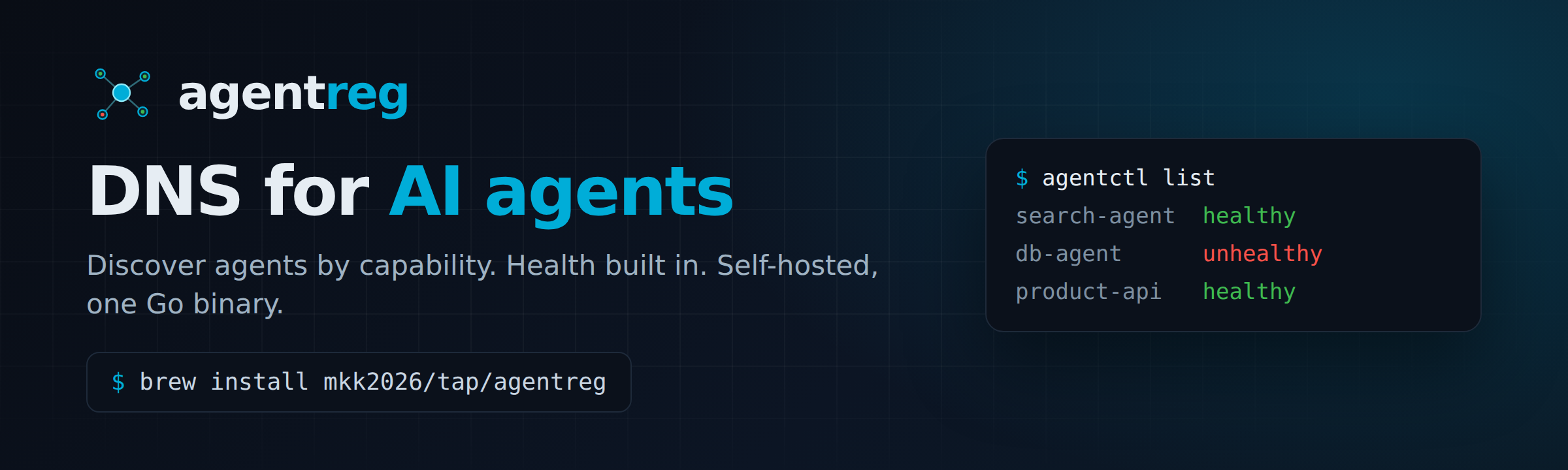
DNS for AI agents.
A self-hosted registry that lets your agents find each other by capability — with health and trust built in.





Everyone is building AI agents. Nobody is building the layer that lets agents exist alongside each other — discovery, health, trust. The moment you run more than a couple of MCP servers, you're hardcoding endpoints in config files, finding out an agent is down only when something breaks, and trusting every endpoint blindly.
MCP gave agents a common language. agentreg gives them a place to find each
other.
Consul tells you where a service is.
agentregtells you what an agent can do, whether it's healthy, and (soon) how much to trust it.
One Go binary. Self-hosted. No cloud, no account, no cluster. Runs on your laptop at 3 agents and scales with you.
# Homebrew (macOS / Linux)
brew install mkk2026/tap/agentreg

# or download a binary from the latest release
#   https://github.com/mkk2026/agentreg/releases

# or from source (Go 1.26+)
go install github.com/mkk2026/agentreg@latest
# 1. run the registry
agentctl serve &

# 2. register your agents
agentctl register search-agent -c search     -e http://localhost:3000
agentctl register db-agent     -c db-read     -e http://localhost:3001
agentctl register product-api  -c api,email   -e http://localhost:3002

# 3. see everything, with live health
agentctl list

# 4. discover by capability — use this in your agent's startup instead of a hardcoded URL
agentctl find search
agentctl find search --format json
agentctl list:
NAME          CAPABILITIES  STATUS     SOURCE  LAST HEARTBEAT  ENDPOINT
db-agent      db-read       unhealthy  local   just now        http://localhost:3001
product-api   api,email     healthy    local   just now        http://localhost:3002
search-agent  search        healthy    local   just now        http://localhost:3000
The daemon health-checks every registered agent on an interval, so a down agent
shows up as unhealthy before it breaks something downstream. That's the
difference between reading a status table and debugging a production incident
backwards.
find search), not
where it lives. Endpoints move; capabilities don't. agentctl (CLI) ──HTTP──▶ agentreg daemon
│
├── Store in-memory + atomic JSON persistence
└── Verifier health probe, on a heartbeat loop
Two design seams make the roadmap additive instead of a rewrite:
Source field on every record (local today; peer:<id>, from:ans,
from:mcp_registry later) so federation and cross-registry ingestion don't
require a migration.
Verifier interface — v1 ships a health probe; ANS-identity,
prompt-injection, and tools/list verifiers plug into the same seam.
labels — optional operator metadata (env, team, version, …) that
rides along on every record and shows up in list. Set it via the API today:
curl -X POST http://localhost:8080/agents -H 'Content-Type: application/json' \
  -d '{"name":"corebrim-search","capabilities":["search"],
       "endpoint":"http://10.0.0.12:3000",
       "labels":{"env":"prod","team":"platform","version":"1.4.2"}}'
| agentreg | MCP Registry | Consul | ANS (IETF) | |
|---|---|---|---|---|
| Self-hosted, no cloud dependency | ✅ | ❌ (cloud) | ✅ | ~ (ref impl) |
| Capability-based discovery | ✅ | ✅ | ~ (tags) | ✅ |
| Health checks built in | ✅ | ❌ | ✅ | ❌ |
| Single binary, 30-second setup | ✅ | n/a | ❌ (cluster) | ❌ |
| Cross-org trust / verification | 🔜 (pluggable) | ❌ | ❌ | ✅ (spec) |
| Purpose-built for agents/MCP | ✅ | ✅ | ❌ | ✅ |
agentreg isn't trying to out-spec the standards bodies — it's the tool
developers actually run, built to interoperate with them.
| Method | Path | Purpose |
|---|---|---|
POST | /agents | register an agent (JSON body) |
GET | /agents | list all agents |
GET | /agents/find?capability=X | find by capability |
POST | /agents/{name}/heartbeat | agent self-reports healthy |
GET | /healthz | daemon liveness |
agentctl serve
  --port 8080                        # listen port
  --store ~/.agentreg/registry.json  # persistence file
  --heartbeat-interval 15s           # how often to health-check agents
  --probe-timeout 3s                 # per-agent probe timeout
agentreg ships as the smallest lovable loop first, then grows toward being the
trust fabric agents rely on.
tools/list validation,
prompt-injection checks. Verification-as-a-service.agentctl federate across registries; the Source
field lights up.Delightful extras on the list: a live list TUI, agentctl doctor,
agentctl graph, and zero-config auto-register from an MCP manifest.
Early days, and help is welcome. Open an issue to discuss a change, or send a PR.
git clone https://github.com/mkk2026/agentreg
cd agentreg
go test ./...
go build -o agentctl .
MIT © Core Brim Tech
Built by Core Brim Tech · agents deserve a substrate.
Run analytics queries on ClickHouse — explore schemas, execute SQL, fetch results
Run Claude Code as an MCP server so any agent can delegate coding tasks to it
 @microsoft✓ Official
Browser automation using accessibility snapshots instead of screenshots
 @googleapis✓ Official
Google's universal MCP server supporting PostgreSQL, MySQL, MongoDB, Redis, and 10+ databases
 @mkk2026