

Are you the author? Sign in to claim
Provider-neutral Agent Skill for Codex, Claude Code, and agentic harness design.

"The model proposes actions; the harness validates, authorizes, executes, records, and returns observations."



A provider-neutral Agent Skill for designing, generating MVP blueprints for, auditing, refactoring, and explaining agentic harnesses.
It applies beyond coding agents: research, support, operations, sales, finance, data analysis, procurement, legal workflows, healthcare workflows, education, and workflow automation agents all need the same core runtime discipline.
Install - pick one:
A. With skills (any compatible agent):
npx skills add DenisSergeevitch/agents-best-practices -g
The -g flag installs globally at user level so every project can discover it.
B. Or paste this prompt to your AI agent:
Install the agents-best-practices skill for me:

1. Clone https://github.com/DenisSergeevitch/agents-best-practices into my
   user-level skills directory as `agents-best-practices/`.
   Use the skill directory my agent reads on this machine, for example:
   - Codex: ~/.codex/skills/
   - Claude Code: ~/.claude/skills/
2. Verify that SKILL.md, icon.jpeg, and the references/ directory are present.
3. Confirm the install path when done.
C. Manual install paths:
# Codex
mkdir -p "${CODEX_HOME:-$HOME/.codex}/skills"
git clone https://github.com/DenisSergeevitch/agents-best-practices.git \
  "${CODEX_HOME:-$HOME/.codex}/skills/agents-best-practices"

# Claude Code, user-level
mkdir -p "$HOME/.claude/skills"
git clone https://github.com/DenisSergeevitch/agents-best-practices.git \
  "$HOME/.claude/skills/agents-best-practices"

# Claude Code, project-level
mkdir -p .claude/skills
git clone https://github.com/DenisSergeevitch/agents-best-practices.git \
  .claude/skills/agents-best-practices
Use cases · What this is · Philosophy · Layout · Sources
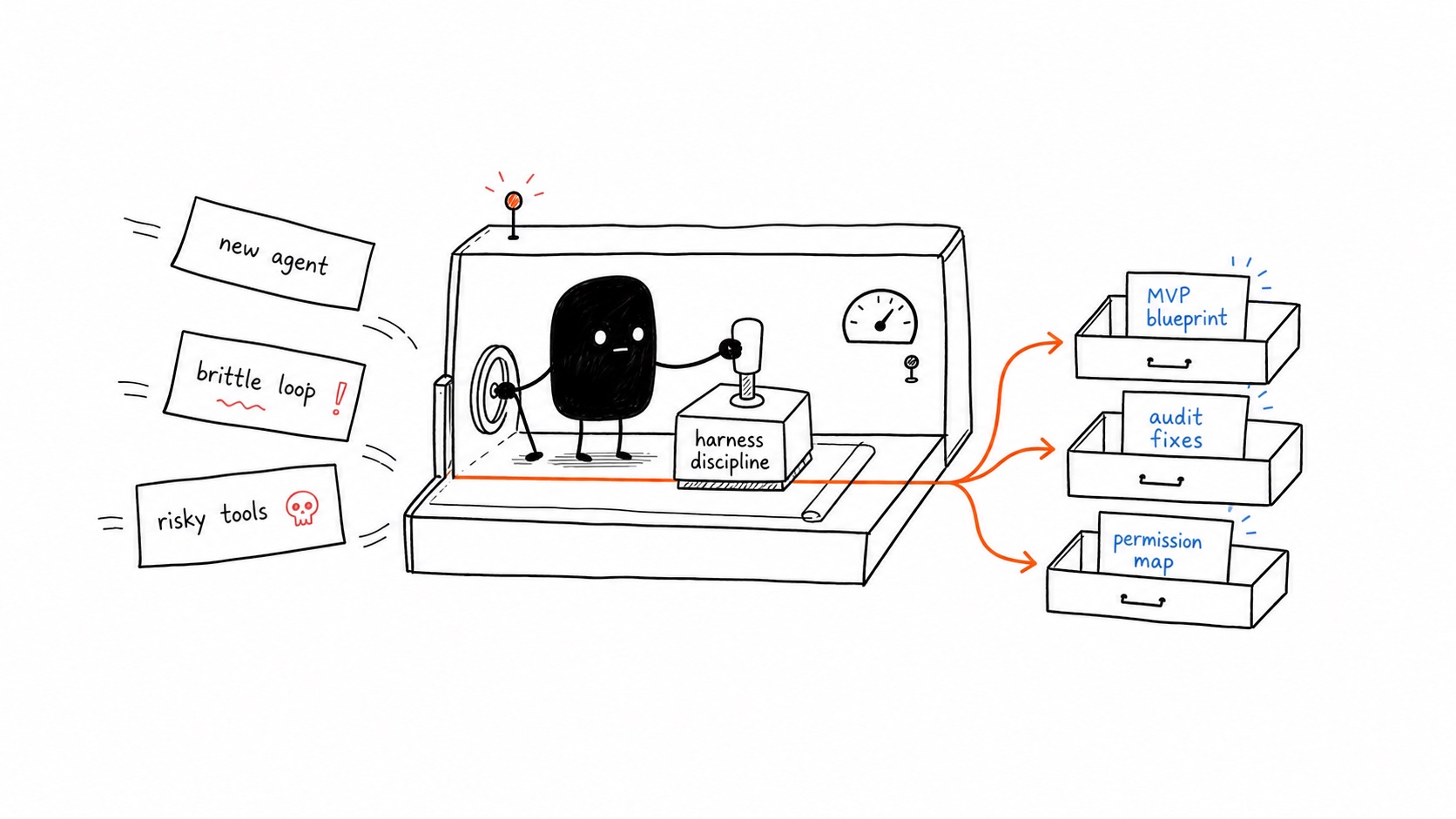
Once installed, the skill activates when a conversation touches agent architecture, harness design, tool permissions, planning mode, workflow orchestration, context and memory, skills, connectors, observability, evals, prompt caching, or production readiness. Three common ways to use it:
You have a domain and need the smallest useful production-safe agent harness, not a vague list of best practices.
You    > Build an agent for account renewal risk. It should read CRM,
         support tickets, and usage data, then draft renewal actions.

Agent  > Start with an approval-gated Level 2 harness.
         The MVP has one job: produce a renewal-risk brief plus draft
         next actions for a human account owner.

         Core loop:
           user/task -> context builder -> model call -> typed tool call
           -> schema validation -> permission check -> execution or pause
           -> structured observation -> next step or final brief

         Minimal tools:
           - read_account_profile      read_private_data
           - list_support_tickets      read_private_data
           - fetch_usage_summary       read_private_data
           - draft_customer_email      draft_external_message
           - request_approval          approval_gate

         Launch gate:
           20 historical accounts, trace review, no unapproved external
           sends, and human acceptance on at least 80% of draft actions.
The primary reference is references/mvp-agent-blueprint.md.
You already have a working agent, but it is brittle, expensive, too broad, or hard to debug.
You    > Our research agent sometimes runs tools forever and forgets why
         it made a decision after context compaction. Audit the harness.

Agent  > The failure points are runtime-level, not prompt-level:
           - no hard step/tool/time/cost budget
           - compaction preserves prose but loses active approvals
           - tool results are unbounded and mix trusted/untrusted data
           - no event trace for model output -> tool call -> observation

         Fix order:
           1. Add loop budgets and termination reasons.
           2. Store plan, approvals, todos, and artifacts outside the prompt.
           3. Make compaction rehydrate active state, not chat history.
           4. Add evals for injection, missing tool result, timeout, and
              budget exhaustion.
Start with references/agentic-loop.md, references/context-memory-compaction.md, and references/security-evals-observability.md.
You need an agent to work with real systems without turning every API into an unsafe broad tool.
You    > The ops agent needs Slack, Linear, Google Drive, and our internal
         deploy API. How should tools and permissions work?

Agent  > Split by risk class. Reads can be autonomous when scoped.
         Drafts can be autonomous when labeled. External writes, deploys,
         destructive actions, privileged access, and financial operations
         require an approval record outside the model.

         Do not expose generic send_message, write_database, or run_command.
         Wrap each action as a narrow typed tool with structured results and
         deterministic permission checks.
Use references/tools-and-permissions.md and references/skills-and-connectors.md.
references/planning-and-goals.md.references/workflow-orchestration.md.references/context-memory-compaction.md.references/coding-agents.md.references/prompt-caching-and-cost.md.references/provider-api-patterns.md.references/checklists.md."Keep the loop simple and make the runtime rigorous."
A reference for people building agentic systems where the model is only one part of the runtime. It helps design a harness that includes:
This is the control plane around an agent: instructions -> context builder -> model call -> tool proposal -> validation -> permission decision -> execution or approval pause -> observation -> next step or final answer.
execute_anything, send_message, or write_database.Use the single-agent MVP first. Add goal loops, connectors, and broader autonomy only after measured failures justify them.
agents-best-practices/
├── README.md                                 # public-facing overview and install notes
├── SKILL.md                                  # skill entry point and trigger rules
├── icon.jpeg                                 # skill image used by the README
└── references/
    ├── mvp-agent-blueprint.md                # domain-specific MVP harness blueprint
    ├── coding-agents.md                      # repository-facing coding-agent harness overlay
    ├── architecture.md                       # component model and harness boundaries
    ├── agentic-loop.md                       # loop invariants, retries, budgets, stopping
    ├── tools-and-permissions.md              # typed tools, risk classes, approvals
    ├── planning-and-goals.md                 # planning mode and long-running goals
    ├── workflow-orchestration.md             # decomposed workflows, packets, verification
    ├── context-memory-compaction.md          # context, memory, retrieval, compaction
    ├── prompt-caching-and-cost.md            # stable prefixes and cost-aware context
    ├── skills-and-connectors.md              # Agent Skills, MCP, connectors, tool search
    ├── system-prompts-instructions.md        # instruction hierarchy and templates
    ├── provider-api-patterns.md              # OpenAI, Anthropic, compatible APIs
    ├── security-evals-observability.md       # guardrails, tracing, evals, launch gates
    ├── agent-legibility-feedback-loops.md    # source-of-truth artifacts and cleanup
    ├── checklists.md                         # implementation and audit checklists
    ├── coverage-audit.md                     # topic coverage verification
    └── source-links.md                       # official references and further reading
The central tension this skill resolves: how can an agent do useful work in real systems without turning the model into an unaudited operator? The answer is a small set of runtime rules:
Read SKILL.md first. Use references/mvp-agent-blueprint.md when the user asks to make or build an agent.
Agent Skills package reusable domain knowledge so compatible agents can discover, load, and apply a workflow only when it is relevant. This repository uses the portable SKILL.md entrypoint and works as a Codex skill, a Claude Code skill, or a skill for other Agent-Skill-aware runtimes.
references/source-links.md.references/source-links.md.references/source-links.md.MIT - see LICENSE.
Authored as an Agent Skill for provider-neutral agent harness design. The recommendations synthesize common production harness patterns across OpenAI, Anthropic, OpenAI-compatible APIs, Agent Skills, MCP, and external connector workflows.
⚠️ Experimentelle Skill-Sammlung für deutsches Recht (Arbeits-, Gesellschafts-, Insolvenz-, Datenschutz-, Prozessrecht u
191 agents, 155 skills, and 82 plugins cross-compatible with Claude Code, Cursor, and Codex
Manage multiple Claude Code agents from TUI or Web with tmux and git worktrees
Project management using GitHub Issues + Git worktrees for parallel agent execution
