

Are you the author? Sign in to claim
Methodology + prompts + Claude Code Skill behind Zombie Scavenger by Mx-Shell — the AI short PJ Ace called "one of the b



The complete methodology + prompt library + Claude Code Skill behind Zombie Scavenger by Mx-Shell — the AI short that Hollywood director PJ Ace called "one of the best short films I've seen in years."
⚡ Quick start: one-page cheat sheet · failure→fix gallery
"This is one of the best short films I've seen in years. Very soon, we'll stop calling it 'AI film' and just call it film."
Film name: Zombie Scavenger by MX-Shell.
— PJ Ace (@PJaccetturo), May 10, 2026
| 13.4M views | 82K likes | 7.4K reposts | 39K bookmarks | 2.3K replies |
|---|
Stats are from PJ Ace's original tweet (@PJaccetturo, May 10, 2026), as of mid-May 2026.
This repository is the complete workflow behind that film, made available because Mx-Shell himself published his prompt collection documents and walked through his entire method on a public Douyin livestream.
Copy this into Sora / Seedance / Kling / Veo. Replace {{...}}:
Anamorphic widescreen cinematic. Simulated IMAX film camera +
Panavision C-series lens (35mm focal, f/4 aperture). Handheld
shot — extremely subtle, breath-like camera float throughout.
{{your scene description}}.
No score. Production audio only.
Why this works: real camera bodies + "breath-like float" anchor the AI to actual film aesthetics — not the vague "cinematic feel" keyword everyone else uses. Full breakdown in methodology.md.
Same idea: a female mech warrior raises an energy shield in a thunderstorm.
❌ The naive prompt (what most people write):
Epic cinematic shot of a beautiful female mech warrior activating a
stunning energy shield in the rain. Highly detailed, 4K, photorealistic,
movie-quality, dramatic lighting.
Vague praise — epic / stunning / 4K / movie-quality — gives the model nothing concrete to anchor to. You get generic game-CG output.
✅ With the 5-stage method (excerpt):
Core theme: gritty hard sci-fi mech | rainy dock | battle-damage aesthetic | energy shield | post-apocalyptic live-action
Atmosphere: simulated IMAX film camera + Panavision C-series (35mm, f/4). Low-saturation teal base, film grain.
Camera: handheld — extremely subtle, breath-like float throughout.
9–12s: hexagonal energy cells light up unevenly, some flicker as if faulty; rain bends around a 2m dome.
Ending: no dialogue, no light burst — just rain vaporizing on the shield, a lightning flash across the dock.
Real camera/lens names + physical reactions + battle damage + an empty ending = visceral realism. Full sample with the 10-item self-check: examples/02-skill-output-sample.md.
May 2026. A 29-year-old vocational-school graduate from rural Yunnan, China — handle Mx-Shell — used 10 days and ~20,000 RMB of cloud credits to make a 3-minute AI short called Zombie Scavenger: an atomic-punk robot wanders into a beachfront villa after a zombie apocalypse, meets a confused ostrich, and starts dancing 1980s-style breakdance moves while kicking a zombie's head across the floor.
On the cost: the widely-quoted "3,000 RMB" figure came from Mx-Shell himself, but on livestream he later revised it to "tens of thousands / 20k+." The real spend was likely well above 3,000 — still far below a comparable live-action shoot.
Hollywood director PJ Ace (@PJaccetturo) retweeted the film, calling it "one of the best short films I've seen in years" and started a search for the author.
A few weeks later Mx-Shell went on a Douyin livestream and gave away his entire workflow — the prompts, the camera language, the failure modes, the reroll counts.
This repo is the result of digesting 130,000 characters of his materials into a structured, reusable system.
ai-shortfilm-prompts/
├── README.md              You're here. English entry point.
├── README.zh.md           Chinese version.
├── cheatsheet.md          One-page cheat sheet (the whole method at a glance).
├── cheatsheet.zh.md       Chinese version.
├── cases.md               Failure→fix gallery: common bad output and the fix.
├── cases.zh.md            Chinese version.
├── methodology.md         The 5-stage prompt structure, explained.
├── methodology.zh.md      Chinese version.
├── faq.md                 Q&A: tools, failures, costs, edge cases.
├── faq.zh.md              Chinese version.
├── credits.md             Sources & attribution.
├── credits.zh.md          Chinese version.
├── showcase.md            Things people made with the method.
├── CONTRIBUTING.md        Submission template & rules for new prompts.
├── LICENSE                MIT (this work)
├── NOTICE                 Attribution + Mx-Shell ARR details (dual-licensing)
│
├── prompts/                Mx-Shell's complete original prompts.
│                           Body kept in Chinese (his authorial
│                           voice), with English header on each file.
│   ├── README.md           Index of all prompt archives
│   ├── index.json          Machine-readable index of every prompt
│   ├── zombie-scavenger.md             *Zombie Scavenger*
│   ├── kamen-rider-transformations.md   Kamen Rider transformation × 6 (5 riders + flight)
│   ├── kaisa-transformation.md       LoL Kai'Sa transformation × 3 versions
│   ├── pacific-rim-gundam.md         Pacific Rim + Gundam mech-drop
│   ├── cyber-wuxia.md                Shaw Brothers + steampunk wuxia template
│   └── metal-gear-charge-combat.md   Weapon-charge + combat composite
│
├── templates/              IP-stripped generalized templates (EN + .zh.md siblings).
│                           Authored by jnMetaCode based on Mx-Shell's structure.
│   ├── 15s-transformation.md         15-second transformation
│   ├── multi-shot-narrative.md       Multi-shot edited narrative
│   ├── atmosphere-prefabs.md         8 reusable atmosphere/look prefabs
│   └── negative-prompts.md           Reusable negative-prompt prefab (per-model)
│
├── assets/                 Diagrams + the README hero-demo prompt.
│   ├── demo-prompt.md       Copy-paste 15s prompt the Skill wrote (hero slot)
│   └── 5-stage-structure.svg  The structure diagram
│
├── skills/shortfilm-prompt/   Claude Code Skill
│   ├── SKILL.md            How Claude should generate prompts (7 hard rules + 10-item checklist)
│   ├── TESTING.md          How to run rigorous skill tests in another Claude window
│   └── examples/           4 test cases (5 files) with expected outputs
│
└── .claude-plugin/         Plugin metadata (plugin.json + marketplace.json)
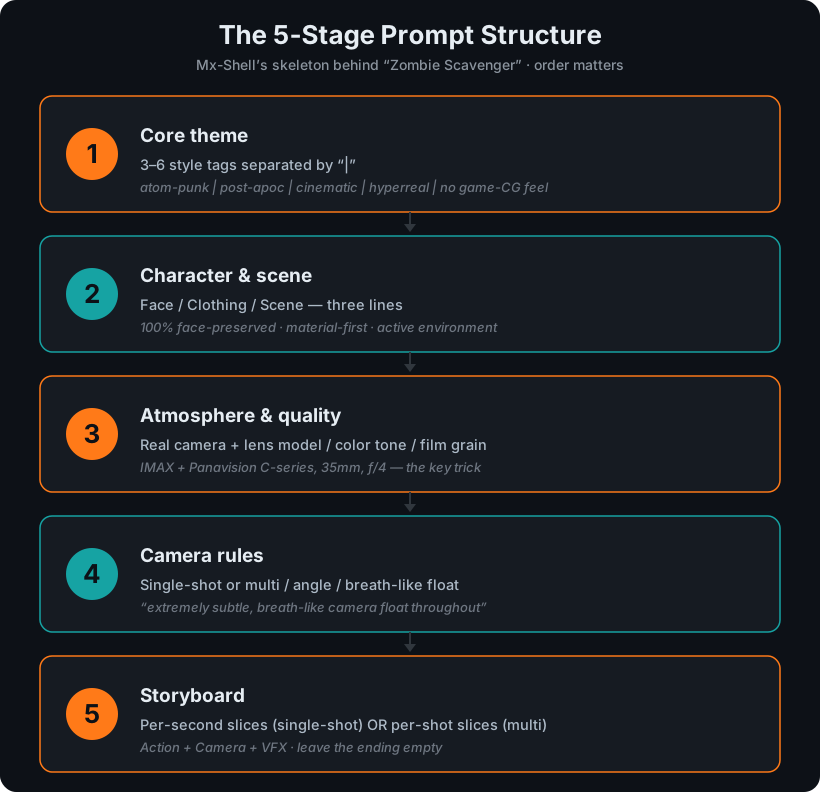
Every Mx-Shell video prompt follows the same skeleton. The order matters:
1. Core theme            ← 3-6 style tags separated by |
2. Character & scene     ← Face / clothing / environment
3. Atmosphere & quality  ← Visual base / color tone / style core
4. Camera rules          ← Single-shot or multi-shot / angle / breathing
5. Storyboard            ← Per-second OR per-shot breakdown
Specify real camera + lens models. Don't write "cinematic feel". Write "simulated IMAX film camera, Panavision C-series lens, 35mm focal, f/4 aperture." AI training data binds those exact strings to real movie aesthetics.
Describe imperfections. "Battle-damaged armor, paint worn off, oil in the joints, minor facial blemishes preserved." Perfection looks fake. The visceral realism comes from the flaws.
Leave the ending empty. "No dialogue. No explosion. No blinding light. Just a figure standing in the smoke, a meteor crossing the sky."
Full methodology in methodology.md.
/plugin marketplace add jnMetaCode/ai-shortfilm-prompts
/plugin install ai-shortfilm-prompts@ai-shortfilm-prompts
Then in Claude Code:
/ai-shortfilm-prompts:shortfilm-prompt  Help me write a 15-second prompt for a
                                        robot transformation, green color palette,
                                        energy core in the belt buckle,
                                        post-apocalyptic jungle background
git clone https://github.com/jnMetaCode/ai-shortfilm-prompts.git
cd ai-shortfilm-prompts
claude --plugin-dir .   # then: /ai-shortfilm-prompts:shortfilm-prompt
mkdir -p ~/.claude/skills
cp -r ai-shortfilm-prompts/skills/shortfilm-prompt \
      ~/.claude/skills/
git submodule add https://github.com/jnMetaCode/ai-shortfilm-prompts.git \
                  vendor/ai-shortfilm-prompts
claude --plugin-dir vendor/ai-shortfilm-prompts   # loads the plugin + skill
The Skill walks through the 5-stage structure, runs a 10-item self-check, and warns you about IP names that may be blocked by Seedance 2.0.
The 5-stage structure is model-agnostic. Here's how the major 2026 engines compare — single-shot ceiling, negative-prompt support, IP filter, preferred prompt language, and the one gotcha that trips people up:
| Model | Max single shot | Negative prompt | IP filter | Lang | Notes / gotcha |
|---|---|---|---|---|---|
| Seedance 2.0 (Doubao / Jimeng / Xiaoyunque, ByteDance) — Mx-Shell's primary engine | ~10–15s — but the Doubao app is locked to 5s/10s preset buttons; the full 4–15s range only on Jimeng/Dreamina web + VolcEngine console | Partial — no reliable dedicated field in the consumer app; negate by describing what you do want | Strict — domestic platforms aggressively reject named celebrities + branded IP | Either (ZH native, EN works) | Duration depends entirely on the front-end. Don't promise 15s if the user is on the Doubao app. Native synced audio-video is its standout strength. |
| Veo 3 / 3.1 (Google) | 8s per clip (4/6/8s); Extend adds 7s hops up to ~148s, but quality degrades after 4–5 extensions | Yes — dedicated field. List unwanted elements as plain nouns (extra limbs, glitch morphs); no no/don't command phrasing | Strict — rejects public figures, brands, voice/likeness; scans prompt and frames | EN | The negative field wants descriptive phrases, not commands — no rain style instructions can backfire. Best-in-class native audio + realism. |
| Kling 2.x / 3.0 (Kuaishou) | 2.5: 5–10s (Pro ~12s); 3.0: up to ~15s single-prompt multi-shot | Yes — dedicated field. Use for stability artifacts (sliding feet, extra fingers, morphing), not generic "quality" words | Strict — a pre-gen banned-word filter rejects the whole prompt on one match; hypersensitive | Either (ZH native, EN strong; 3.0 multilingual dialogue) | The banned-word filter is notoriously over-sensitive — a benign body/contact word can block a clean prompt. Sanitize wording first. Excellent action/motion realism. |
| Hailuo / MiniMax (02 / 2.3) | ~6–10s — 1080p caps ~6s, 768p extends ~10s | Yes — but vendor guidance says use sparingly, for specific artifacts not as a primary lever | Moderate — more permissive than Sora/Veo, still blocks named celebs + overt IP | Either (ZH native, EN solid) | Resolution and duration trade off — you can't get max of both. Pick the axis that matters per shot. Strong motion at low cost. |
| Wan 2.x (Alibaba, open-source) | 2.2: ~3–8s @ 24–30fps; 2.5/2.6 extend ~10–15s by mode | Yes — robust field; defaults like morphing, warping, face deformation, flickering | Lenient — open-weights/self-hostable, so no enforced filter when run locally (hosted APIs may add their own) | Native ZH (both, but ZH-trained) | Leans Chinese — first/last-frame mode especially; EN-only prompts can underperform, add ZH for tricky shots. Self-hostable, full ComfyUI control, renders legible ZH/EN on-screen text. |
| Runway Gen-4 / 4.5 | 5s or 10s per generation | No — does NOT support negatives. avoid X / no X can produce the opposite. Describe only what should appear | Strict — blocks celebs, real people, copyrighted characters/brands | EN | Negative prompts are actively harmful here — no distorted hands can summon distorted hands. The single biggest mistake when porting prompts. Director-grade camera control + mature pro pipeline. |
| Pika (2.2 / 2.5) | Standard + Pikascenes: 5s or 10s; Pikaframes (keyframe) up to ~25s | Partial — 2.5 supports negatives (no morphing, no extra limbs); 2.2 unclear, verify in-app | Moderate — blocks overt celebs/IP, generally more relaxed than Sora/Veo | EN | Only the Pikaframes keyframe path reaches ~25s — ordinary text/image-to-video is still 5s/10s. Fast, effects/transition-driven, great for stylized short-form. |
| Sora 2 / 2 Pro (OpenAI) | Up to ~25s continuous single-pass on Sora 2 Pro (standard tier shorter) | No dedicated field — negate in-prompt with guardrails like original characters only, no logos or text | Strict — triple-layer moderation; blocks named IP and visual lookalikes even without the name | EN | The filter catches descriptions, not just names — a spiky-haired ninja in an orange jumpsuit still trips it (matches Naruto). Avoid recognizable trait-bundles, not only proper nouns. Leading prompt comprehension + world coherence. |
Durations and negative-prompt mechanics for Veo 3.1, Runway Gen-4, Kling,
Wan, and Sora are consistent across multiple 2026 vendor/help-doc sources;
Seedance 2.0 and Hailuo figures lean on third-party guides (treat ~ as
approximate). "Veo ~148s", "Sora/Pika ~25s" come from extension/keyframe
features, not plain single-shot generation. IP-filter "strictness" labels
are qualitative.
Tool names link to their sign-up pages; Xiaoyunque / Jimeng / Kling are invite links (both sides get free credits).
This is the video-prompt sibling of the AI-coding ecosystem maintained by @jnMetaCode:
obra/superpowers (TDD / debug / git workflow skills)All projects share the same SKILL.md format. The video skill stacks
freely with any of them.
The roadmap is to collect more AI-shortfilm creators' methods, structured the same way. New prompts, templates, fixes, and translations are welcome — see CONTRIBUTING.md for the submission template and rules (public source required, credit the original creator).
Made something with the method? It goes on the showcase.
MIT License for everything authored by jnMetaCode (methodology, FAQ, templates, Skill, metadata). Free for any use including commercial — just keep the copyright notice.
Mx-Shell's original prompts and document excerpts — sourced from his fan-group documents and public Douyin livestream that he himself distributed — remain © Mx-Shell, all rights reserved. Archived here for educational reference; commercial use requires contacting Mx-Shell directly. Full dual-licensing details: NOTICE · attribution: credits.md.
"For creation, the equipment is not what matters. The idea is what matters." — Mx-Shell, May 12, 2026 livestream
1000+ skills curated from Anthropic, Vercel, Stripe, and other engineering teams
Design enforcement with memory — keeps your UI consistent across a project
Detects 37 AI writing patterns and rewrites text with human rhythm across 5 voice profiles
WCAG accessibility audit — automated scanning, manual review, remediation
