

Are you the author? Sign in to claim
Self-hosted, local-first AI assistant server: swappable LLM providers, review-gated memory, an encrypted vault, and wake
A self-hosted assistant that runs on your machine with the model you choose. Memory is approved by you; keys stay encrypted.
A self-hosted AI assistant server: one web UI, six swappable LLM providers, review-gated persistent memory, an encrypted credential vault, custom wake-word voice, reminders and scheduled prompts, plus capability packs for browser and perception-grounded desktop automation. One command backs up and restores your whole data directory. Packs are a plain-directory format, so writing your own is the intended path. Your vault, memory and files stay on your machine; no accounts, no telemetry, no cloud tenancy.



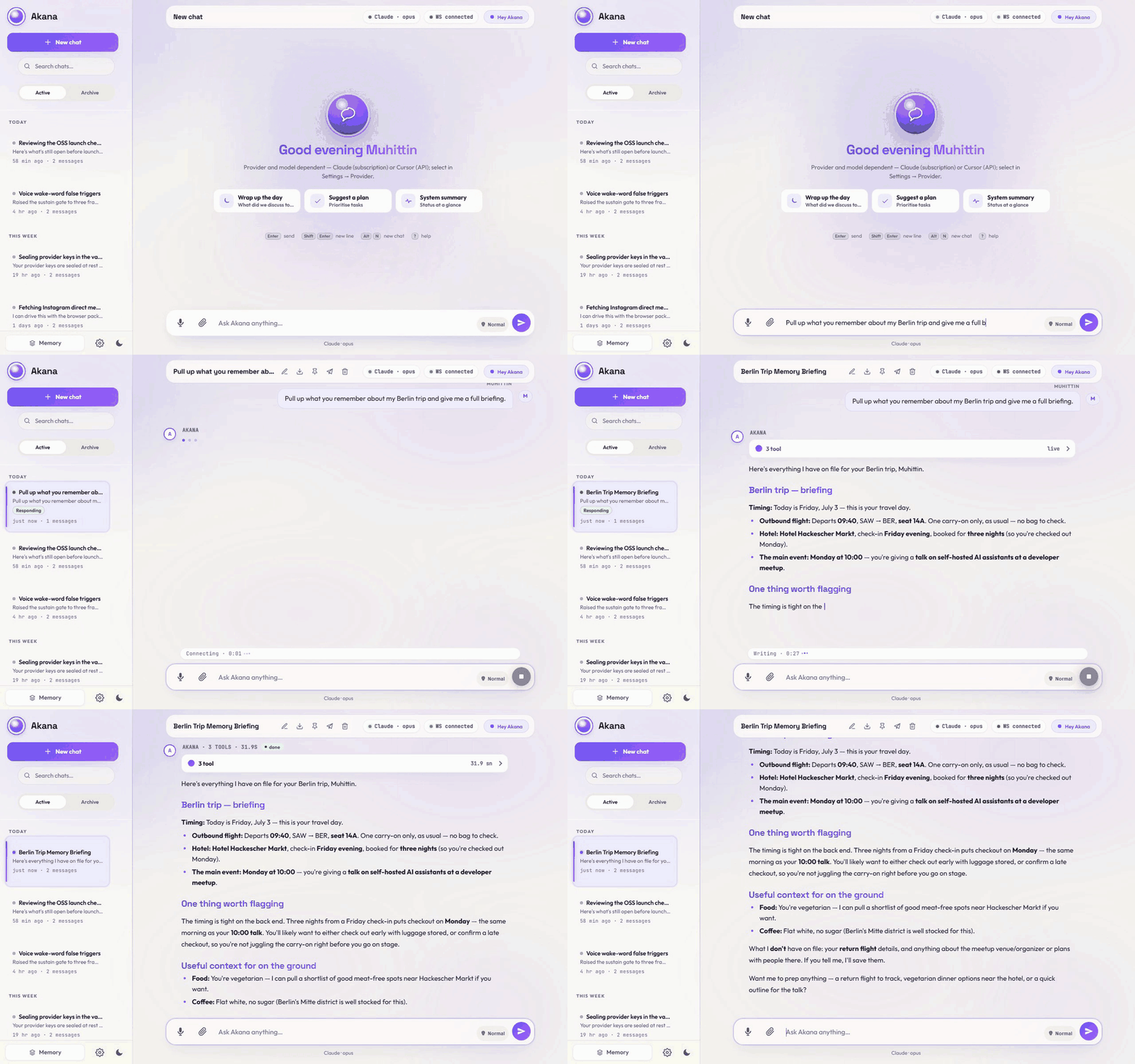
Recorded from the live app — memory recalled across three tool calls, a real briefing written back.
Where your data lives. Your vault, memory database and pack storage stay on your machine. Model traffic does not: unless you run Ollama, prompts go to the cloud provider you pick. The default voice path is cloud too.
edge-ttssends synthesized text to Microsoft; browser speech-to-text sends audio to Google. A fully local pipeline is possible (Ollama for inference plus local voice), but it is the least-tested path: small local models call tools unreliably. Akana's memory/vault tool-calling is unit-tested but not validated end-to-end against a real local model. Treat local inference as experimental. See Security and privacy.
Requires Python 3.11+. Node 18+ is needed for the Cursor and Claude providers and for browser-pack (which runs @playwright/mcp via npx).
Linux / macOS:
git clone https://github.com/MuhittinYilmazer/akana.git
cd akana
bash install.sh
Windows:
git clone https://github.com/MuhittinYilmazer/akana.git
cd akana
.\install.cmd
install.cmd is a batch wrapper that invokes install.ps1 with -ExecutionPolicy Bypass for this one process, so a fresh Windows box does not need any policy change. (powershell -ExecutionPolicy Bypass -File install.ps1 does the same thing.)
The bootstrapper finds a Python 3.11+ interpreter and hands off to python akana.py setup. The setup wizard creates the virtual environment and installs requirements, then configures providers and voice. It asks you to choose a language (English or Turkish), then walks through providers and voice extras. The bundled "Hey Akana" wake model is on by default; wake on/off is a runtime setting in the UI. Both scripts accept the same flags as setup and forward them.
Once setup finishes:
python akana.py start
The server prints its URL (default http://127.0.0.1:8766) and the bearer token if one was generated. Open the URL in a browser to reach the chat and Memory Studio panes.
There is no default provider. You pick one during setup. The two low-friction paths:
claude, or generate a token with claude setup-token and paste it in Settings → Credentials. There is no per-request API key. This is the most heavily used and tested path.python akana.py backup snapshots your whole data directory — memory, personas, uploads, settings, encrypted secrets — into a single .tar.gz (SQLite via the online backup API; secrets stay ciphertext, the master key is not bundled), and restore brings it back.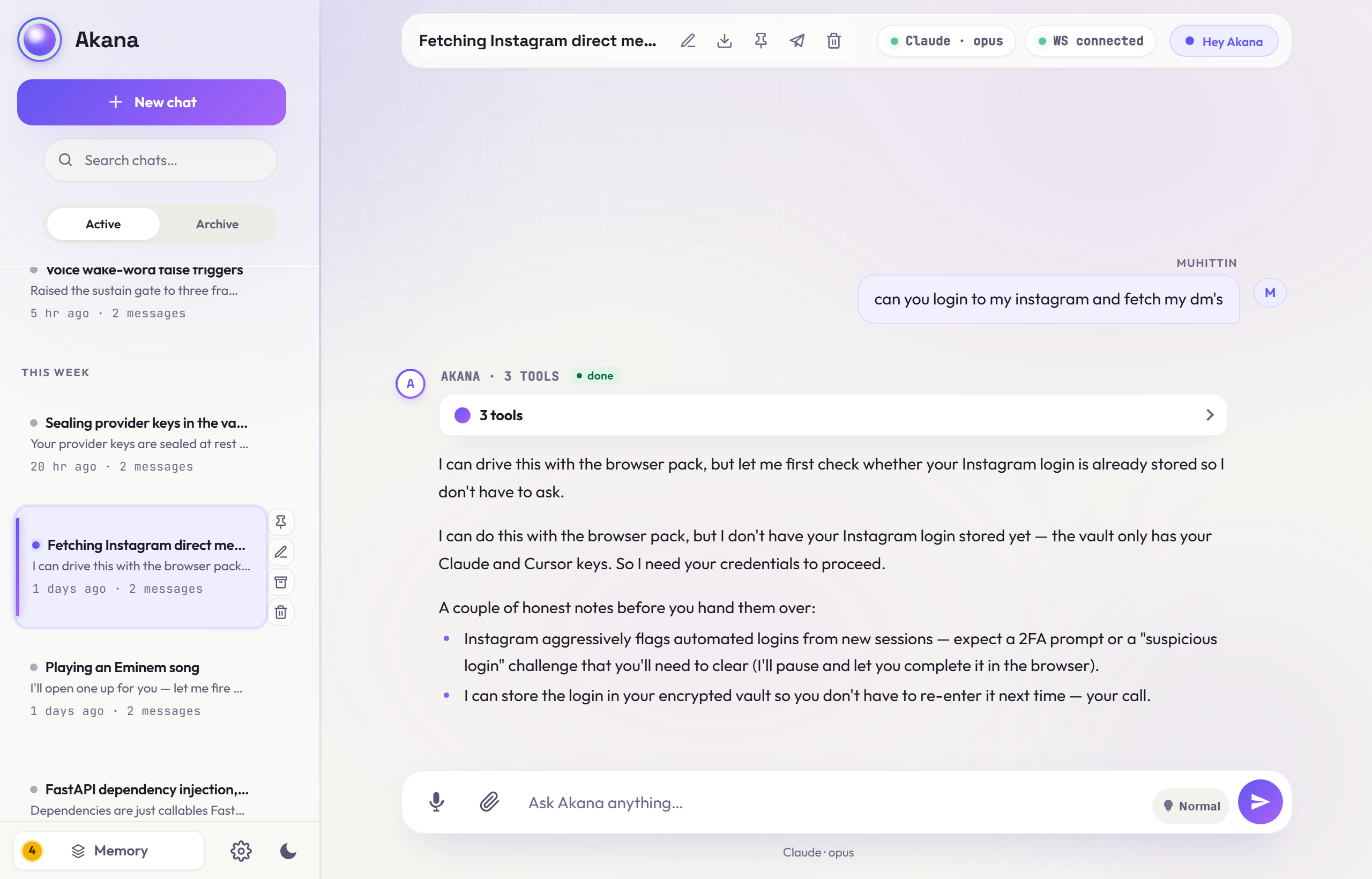 Chat — persona-aware, tool-calling, memory-injected turns | 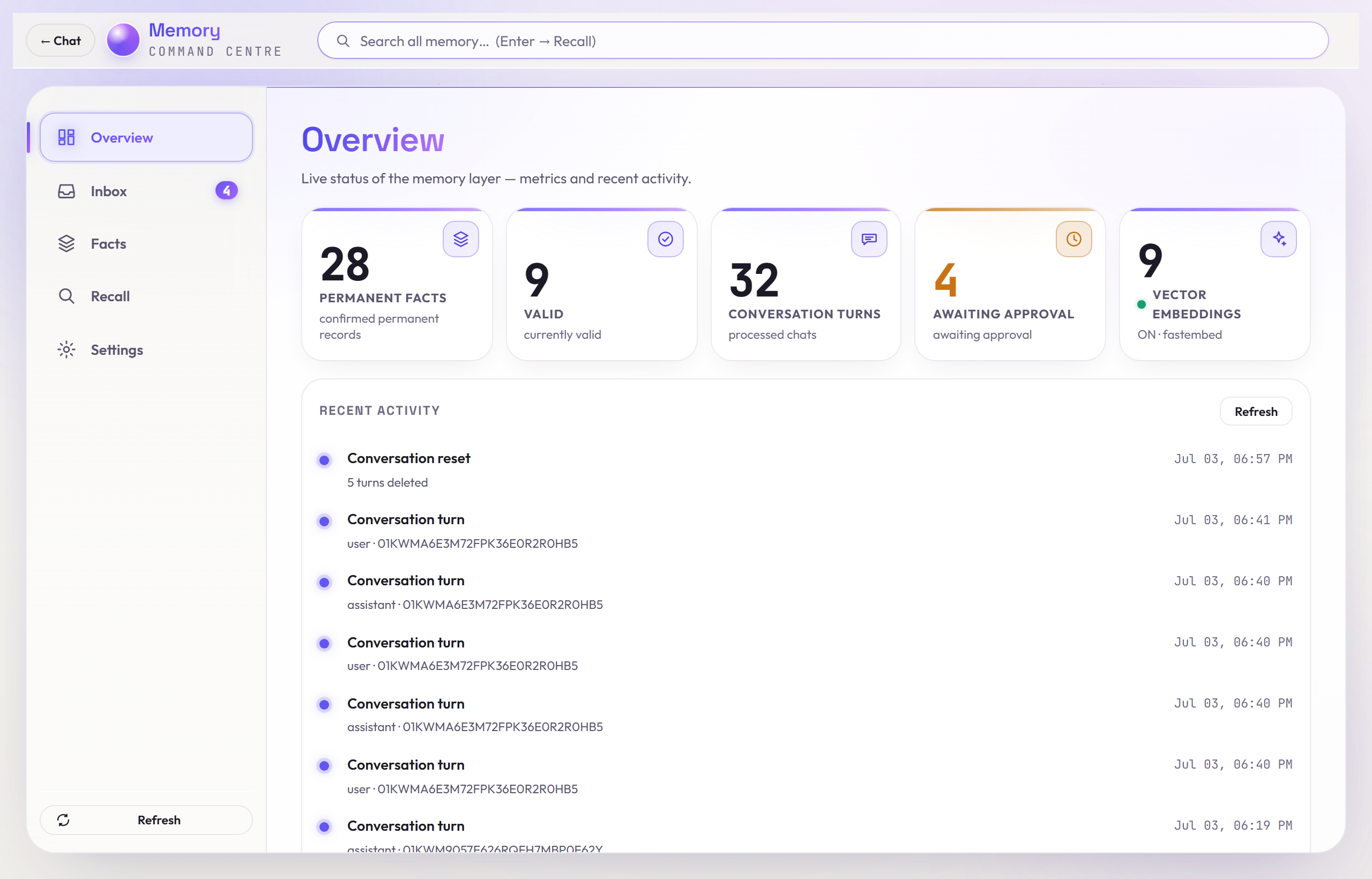 Memory Studio — review the inbox, browse facts, walk the timeline | 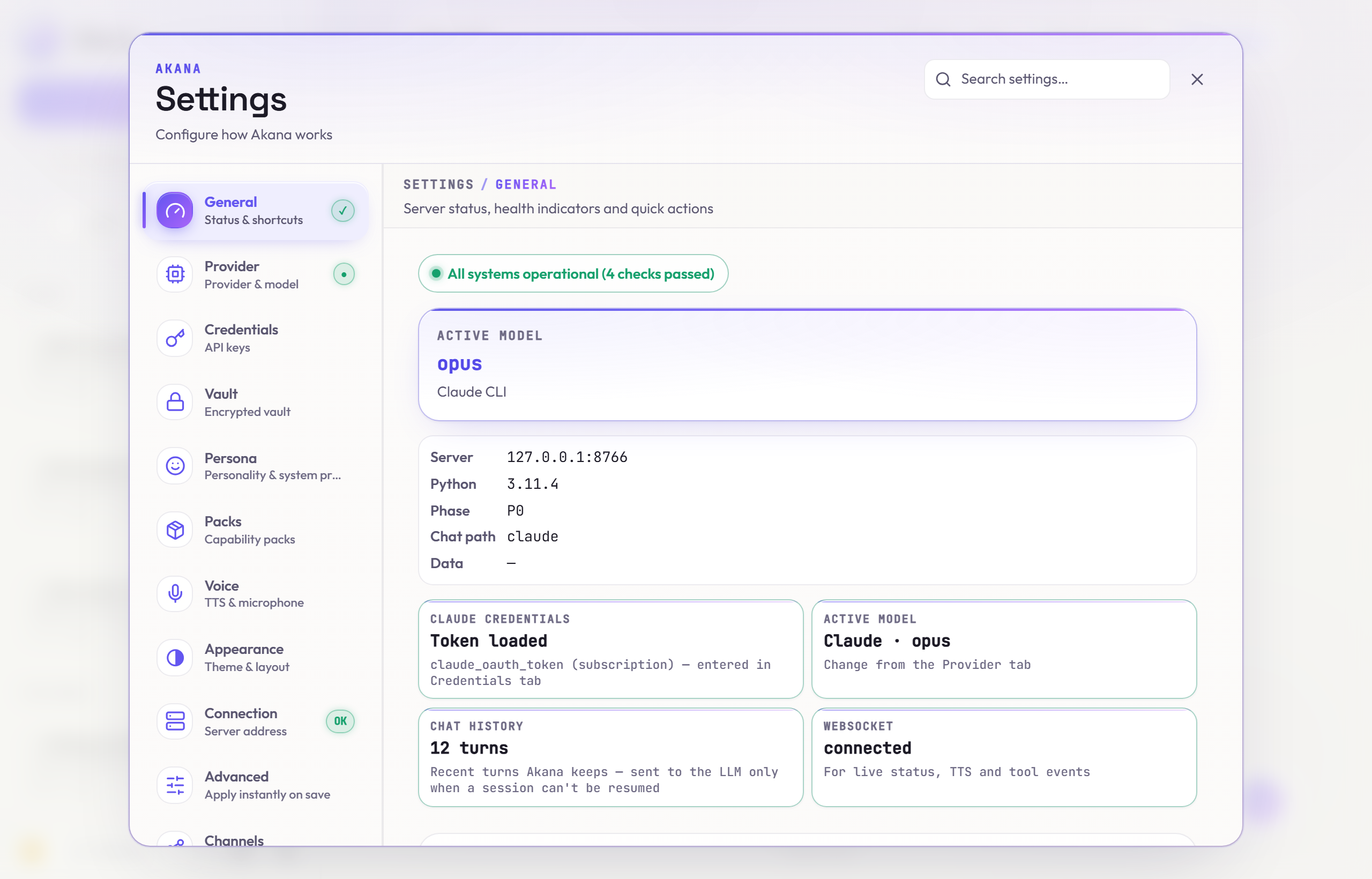 Settings — providers, models, vault, voice, packs |
Akana is a FastAPI application (akana_server/) that serves both HTTP and WebSocket surfaces from one port, alongside the static web UI (web_ui/, no build step). Between the HTTP surface and the providers sits an orchestrator whose single dispatch hub (llm_dispatch.py) resolves the configured provider and forwards each turn. Memory and vault are exposed to the model as first-party MCP servers spawned as subprocesses, so the same servers can also be attached to external MCP clients. Packs are discovered from ~/.akana/packs then the repo's packs/.
flowchart TD
    User([User]) --> UI[Web UI<br/>chat · Memory Studio · Settings]
    UI <-->|HTTP + WS| Server[FastAPI server<br/>akana_server]
    Server --> Orch[Orchestrator<br/>llm_dispatch]
    Orch --> Cursor[Cursor]
    Orch --> Claude[Claude]
    Orch --> Codex[Codex]
    Orch --> Gemini[Gemini]
    Orch --> OpenAI[OpenAI]
    Orch --> Ollama[Ollama]
    Server -->|spawns| MemMCP[akana_memory MCP]
    Server -->|spawns| VaultMCP[akana_vault MCP]
    Server --> Packs[Pack host<br/>~/.akana/packs → repo packs/]
    MemMCP --> DB[(SQLite<br/>memory.db)]
    VaultMCP --> KeyStore[(vault/keys.json)]
Full detail (server, orchestrator, vault internals and the data-directory layout) is in docs/architecture.md.
Akana registers six chat providers under a shared dispatch layer. There is no default: with nothing configured, chat calls fail with a No LLM provider configured error rather than picking one for you. Every provider uses your own key or session; foreign-provider keys are stripped from the environment before the Cursor and Claude bridges spawn.
| Provider | Install | Model traffic goes to | Memory / vault reach | Agent reuse | Notes |
|---|---|---|---|---|---|
| Claude | Global @anthropic-ai/claude-code CLI | Anthropic | Native MCP | Yes (--resume) | MCP-native; only provider with auto-continue (off by default). |
| Cursor | Node bridge (add cursor → npm install) | Cursor cloud | Native MCP | Yes (stored agent_id, SDK Agent.resume) | MCP-native; agent reuse. |
| Codex (beta) | Global @openai/codex CLI (add codex) | OpenAI (ChatGPT plan) | Native MCP | Yes (exec resume) | Subscription-billed via codex login — no API key; agentic CLI like Claude/Cursor. Untested against a live login yet. |
| Gemini (beta) | add gemini (google-genai) | Full parity (function-calling) + MCP bridge | No | Image + PDF input (inline); thinking on Gemini 3+. | |
| OpenAI (beta) | None (uses core httpx) | OpenAI | Full parity (function-calling) + MCP bridge | No | Image + PDF input (inline); reasoning_effort on o-series and GPT-5+. |
| Ollama (beta) | External Ollama app | Local Ollama server | Full parity (function-calling) + MCP bridge | No | Fully local, but the least-tested path. The tool surface is at parity, but firing depends on the local model's own function-calling ability; small models call unreliably. |
Claude and Cursor are the tested path; the other four are beta. Claude and Cursor each run as their own agent (the
claudeCLI, the Cursor SDK), speak MCP natively, and are what the project is built and used against day to day. Codex is beta for a different reason: it is a full agentic CLI bridge like Claude/Cursor (subscription auth viacodex login, session resume, MCP-native), but it has not yet been exercised against a live login — only against protocol fakes. Gemini, OpenAI and Ollama are beta: they are plain chat providers wired for memory/vault and MCP tool-calling, but exercised only by unit tests against fake providers. They have not been verified against the live Google / OpenAI / Ollama APIs, and they are not agentic coders (aclaude/Cursor-style agent that reads, writes and runs in your workspace). Treat them as incomplete and expect rough edges; please open an issue if you hit one.
Cursor and Claude speak MCP natively and see the built-in akana_memory and akana_vault servers plus anything in mcp_servers.yaml. Gemini, OpenAI and Ollama get the same tools re-declared as native function-calling schemas. The memory operations (search / remember / forget, exposed natively as memory_search / save_memory / memory_forget) and the full seven-tool vault surface are at functional parity with what Claude and Cursor reach over MCP, derived single-source from the same schemas so the two surfaces stay in step. These providers also reach external MCP servers through an in-process bridge, with their tool loop capped at five rounds per turn. This path is exercised by unit tests against fake providers. Tool parity and model capability are separate concerns: on local Ollama models, whether the tools actually fire depends on the model's own function-calling ability and has not been verified end-to-end on real hardware. Smaller models call tools unreliably, so treat native tool use there as experimental.
Per-provider install, credentials, thinking mode and multimodal input, plus the two file-upload mechanisms, are in docs/providers.md.
Akana's memory is review-gated. Facts are proposed two ways: an LLM auto-capture pass after each turn, or the model calling the remember tool. Both land in a staging inbox by default. Staged items are visible to the assistant, flagged as pending/unapproved in recall, but nothing becomes durable, trusted memory until you approve it in the Memory Studio (web_ui/memory.html). It has tabs for an overview (including a bilingual timeline), the inbox, the fact list, a recall search, plus memory settings.
Memory lives in one SQLite file (<data_dir>/db/memory.db) with an episodic layer (raw turns) and a semantic layer (durable key/value facts tagged with trust level, validity window and provenance). Recall is keyword-based out of the box; semantic (vector) recall is opt-in via python akana.py add embeddings (a ~220 MB CPU-only ONNX model, no torch/GPU) and falls back to keyword search if the embedder is missing.
Storage model, the capture pipeline, vector recall, the event ledger and background summary jobs are covered in docs/memory.md.
A custom-trained "Hey Akana" openWakeWord ONNX model ships in-repo (akana_server/voice/wake_models/hey_akana.onnx) and is the default wake model. Install python akana.py add voice-full for local acoustic wake scoring and local (faster-whisper) speech-to-text; without it, the browser's SpeechRecognition API handles wake and STT (Chromium-only; audio goes to Google).
Text-to-speech ships three engines:
| Engine | Locality | License | Notes |
|---|---|---|---|
| edge-tts | Online (default), text goes to Microsoft | GPL-3.0 (installed from PyPI; not vendored) | Microsoft neural voices; zero setup. |
| piper | Offline | MIT | add voice-piper. Recommended for local-only / commercial use. |
| XTTS-v2 | Offline, heavy | Model weights CPML — non-commercial | add xtts. ~2 GB model, GPU-friendly, voice cloning. Not for commercial use. |
Why edge-tts is the default: it needs no download and no local model. It is online (synthesized text goes to Microsoft) and GPL-3.0. It is installed from PyPI as a runtime dependency and is not vendored, so Akana's own source stays MIT. For an offline or permissive path, install Piper (MIT) and select it. See THIRD_PARTY_LICENSES.md and Security and privacy.
Wake tuning, STT options, voice selection, conversation mode, barge-in and the Gemini Live / OpenAI Realtime bridges are in docs/voice.md.
Capability Packs bundle skills, personas and MCP tool declarations. Each pack is a directory with a pack.yaml manifest and, per skill, a SKILL.md. Three ship in-repo:
@playwright/mcp) as a headful, persistent-profile browser: navigate, snapshot, click, fill, type, screenshot, download.read_screen returns a structured accessibility tree in which every interactable element ends in a [ref], and click_ref / type_into_ref act on that reference (Windows UI Automation / Linux AT-SPI), with a screenshot + pixel-coordinate fallback for apps that expose no accessibility layer. Plus mouse click/drag/scroll, type, hotkeys, clipboard, launch app, and window list/focus/move/resize/close. An opt-in per-action approval gate (computer_control_approval, off by default) can require your confirmation before it acts — destructive (app launch, window close, drag) or all (every action).Packs are the primary extension point. The three bundled packs are examples; the format is meant for writing your own. A pack is a plain directory you place into packs/; Akana hot-loads it on the next rescan (no restart). At its simplest it is a pack.yaml plus one skills/<name>/SKILL.md. To expose tools, it declares an MCP server that mounts only after you approve it (see the consent model below).
v0.1 enforcement table of what is and isn't wired yet) is in packs/PACK_INTERFACE.md (source of truth: packs/contract/).Installing computer-control's dependencies. The computer-control pack needs extra Python packages that are not in core requirements. Before enabling it, install them into the same venv:
pip install -r requirements-computer.txt
(That pulls pyautogui, mss, pygetwindow, pyperclip, plus uiautomation on Windows for the perception layer. On Linux, perception uses the system AT-SPI bindings — install the distro packages, e.g. python3-pyatspi gir1.2-atspi-2.0, and enable accessibility in the desktop; without a perception backend the pixel tools still work.) browser-pack instead needs Node: it runs @playwright/mcp via npx.
Consent model. Enabling a pack only registers its skills and persona and probes its declared tools. Mounting an MCP server (writing it into mcp_servers.yaml so providers see it) is a separate, bearer-authenticated step (POST /packs/consent). It never happens automatically. Revoking (POST /packs/consent/revoke) only touches entries stamped with Akana's own managed_by marker, so user-authored entries are never overwritten.
Permissions are advisory in v0.1. The
permissionsblock inpack.yaml(network, sandbox tier,secure_vault_read,file_system) is metadata; the host does not enforce it. Packs run as ordinary child processes with the account's own permissions. There is no sandbox around browser-pack or computer-control.
Remote access. Akana is a personal server, not a cloud service. The supported way to reach it from your phone or tablet is Tailscale Serve on a private tailnet: set AKANA_TOKEN, expose the loopback port with tailscale serve, then pair the phone by scanning a QR from the desktop cockpit (the QR carries the bearer token in a URL fragment that the phone strips immediately). Voice mode and PWA install require HTTPS, which Tailscale Serve provides. Safety rails: a non-loopback bind with an empty token refuses to start, proxied requests always require the bearer, Funnel (public exposure) is refused without a token.
Telegram. An optional bridge lets you reach your local assistant like any other bot. Create a bot with @BotFather, paste the token into Settings (or AKANA_TELEGRAM_BOT_TOKEN), then set a mandatory chat_id allowlist (AKANA_TELEGRAM_ALLOWED_CHAT_IDS). With no ids set, the poll loop refuses to start. Text only; every outbound message passes through the egress filter (secret/PII redaction).
Full setup, safety rails, auth headers and Telegram slash commands are in docs/remote-access.md.
Akana's threat model covers accidental exposure: a checked-in secret, a data-dir backup on unencrypted storage, an assistant that reads or writes memory it should not. It does not cover a local attacker running as your user account. It does not cover the trust you extend to whichever LLM vendor you point Akana at.
edge-tts) sends text to Microsoft; the default browser STT sends audio to Google. A local voice pipeline requires installing voice-full and choosing Piper for TTS.edge-tts is GPL-3.0. It is a runtime dependency the user installs via pip; Akana does not vendor it, so Akana's own source stays MIT. See THIRD_PARTY_LICENSES.md for the full disclosure and the permissive Piper alternative.AKANA_VAULT_TOOLS=0 if that trade-off does not suit you.permissions blocks are advisory in v0.1. Nothing sandboxes browser-pack or computer-control; they run with the account's own permissions.Reporting a vulnerability: please do not open a public issue. See SECURITY.md for the private GitHub Security Advisories flow.
Runtime configuration is read from three places, in order of precedence:
<data_dir>/runtime_settings.json, edited live from the Settings tab. Every non-hidden setting applies without a restart; Telegram is the only restart_required setting.akana_server/settings_defaults.py.The most-used environment variables:
| Variable | What it does |
|---|---|
AKANA_HOST | Bind host. Default 127.0.0.1. |
AKANA_PORT | Bind port. Default 8766. |
AKANA_TOKEN | Bearer token required for non-loopback / proxied requests. |
AKANA_DATA_DIR | Data directory. Default ~/.akana. |
AKANA_LANGUAGE | UI/persona language. en (default) or tr. |
AKANA_VAULT_KEY / AKANA_VAULT_KEYFILE | Master key material, or a path to it. |
AKANA_TTS_ENGINE | Force a TTS engine (auto, edge, piper, xtts). |
AKANA_OLLAMA_URL | Base URL for Ollama. Default http://localhost:11434. |
The full set (memory toggles, voice paths, Telegram, wake model override and more) is documented in .env.example.
akana.py is the entry point. All subcommands accept --help.
| Command | What it does |
|---|---|
setup | Interactive install: language, providers, voice extras. Flags: --yes (unattended), --voice {none,piper,full,xtts}, --repair (rebuild venv), --lang {en,tr}. |
add <component> | Install an optional component (see below). |
start | Launch the server. Binds AKANA_HOST:AKANA_PORT (default 127.0.0.1:8766). |
stop | Stop a running server (by port). |
doctor | Pre-flight check (Python, venv, key, port), providers plus voice stack. --mcp also spawns MCP children and health-checks them. |
smoke | Core smoke (doctor + pytest). |
test | Unit tests (pytest). |
ship | Pack a portable tarball. |
reset-memory | Wipe the memory database. Destructive. |
backup | Snapshot the data directory (~/.akana) to a .tar.gz. Flags: --out <file-or-dir>, --include-voices, --include-vault-key (bundles the master key for cross-machine restore — sensitive). |
restore <file> | Restore the data directory from a backup (stop the server first). --force moves an existing data dir aside before restoring. |
add <component> installs an optional component:
| Component | What it installs |
|---|---|
cursor | The Cursor Node bridge (npm install). |
claude | The global @anthropic-ai/claude-code CLI. |
gemini | google-genai (from requirements-gemini.txt). |
openai | Nothing to install — the provider uses core httpx; the component is a readiness check. |
ollama | Nothing to install — connects to an external Ollama app; the component is a readiness check. |
voice-full | openwakeword + faster-whisper + piper-tts: the full local voice stack (wake, STT, offline TTS) in one component. |
voice-piper | piper-tts for offline TTS, plus the interactive Piper voice picker. |
embeddings | fastembed for vector recall; the ~220 MB multilingual ONNX model downloads automatically on first recall. |
xtts | coqui-tts for XTTS-v2 (heavy, non-commercial model license). |
The
computer-controlpack's dependencies are not anaddcomponent; install them withpip install -r requirements-computer.txt(see Capability Packs).
permissions fields (network, sandbox, secure_vault_read, file_system) are advisory metadata in v0.1; the host does not enforce them, so nothing sandboxes the packs.search/remember/forget) and full seven-tool vault surface as Claude and Cursor, capping the tool loop at five rounds per turn. On Ollama, if the local model lacks native tool calls, memory/vault/bridged MCP tools are unavailable that turn..docx/.xlsx/text via path reference; Gemini and OpenAI inline images and PDFs only; Ollama has no file input.read_screen / click_ref) is live-verified on Windows (UI Automation); the Linux AT-SPI path is implemented and unit-tested but not yet verified against a real Linux desktop. The per-action approval prompt needs a desktop dialog backend; if none is available it denies (fail-safe), so enable all/destructive mode only where a confirmation dialog can appear.edge-tts (Microsoft) for TTS and browser STT (Google). Browser wake fallback and browser STT need a Chromium-based browser.+03:00, no DST), which will surprise non-Turkey users.Requirements: Python 3.11+; Node 18+ for the Cursor/Claude bridges and browser-pack.
python -m venv .venv
. .venv/bin/activate           # Windows: .venv\Scripts\Activate.ps1
pip install -r requirements.txt
pip install -r requirements-dev.txt
python akana.py test
The web UI is served statically from web_ui/ with no build step. The Python package layout uses src/akana with an _akana_src_bootstrap shim so akana_server and akana_cli can import shared code without a full editable install.
Test layout:
tests/unit/ — pure-Python unit tests. Fast.tests/integration/ — cross-module tests that touch real subprocesses.tests/architecture/ — invariants over the codebase (import graph, seams).tests/web/ — Playwright-driven contract harnesses that run against a live server on an alternate port.To run a single test:
python -m pytest tests/unit/test_runtime_settings.py -k "your_test_name" -x
The chat titler makes real LLM calls per new conversation; when running chat-related tests, set
AKANA_LLM_CHAT_TITLES=0to avoid tripping its circuit breaker.
Issues and pull requests are welcome. Please run python akana.py test and python akana.py doctor before opening a PR. Note which paths you exercised if your change affects a provider, the memory subsystem, the vault or a pack. See CONTRIBUTING.md and CODE_OF_CONDUCT.md for the process and expectations.
License: Akana is released under the MIT License; see LICENSE.
Third-party components: Akana relies on notable third-party code and runtime dependencies. These include vendored pdf.js (Apache-2.0) and qrcodejs (MIT), plus runtime dependencies installed from PyPI such as edge-tts (GPL-3.0, the default TTS engine) and XTTS-v2 model weights (CPML, non-commercial). Full attribution and the licensing rationale are in THIRD_PARTY_LICENSES.md.
Run Claude Code as an MCP server so any agent can delegate coding tasks to it
 @microsoft✓ Official
Browser automation using accessibility snapshots instead of screenshots
 @googleapis✓ Official
Google's universal MCP server supporting PostgreSQL, MySQL, MongoDB, Redis, and 10+ databases
 @github✓ Official
Official GitHub integration for repos, issues, PRs, and CI/CD workflows