

Are you the author? Sign in to claim
Organization-as-Code for autonomous AI agents. Brain-inspired memory that grows, consolidates, and forgets. Multi-model
AnimaWorks turns persistent AI agents into a working organization. Give it a goal, and its agents break the work down, implement in parallel worktrees, test and review each other's changes, open pull requests, repair failing CI, resolve conflicts, and watch the deployed result — asking a human only when something genuinely needs one.
Task → agent team → parallel worktrees → implement → test → review
     → pull request → CI repair → deploy → observe → repair
AnimaWorks does not hardcode this pipeline. The framework wires GitHub events into agent tasks, serializes work per pull request, and orchestrates multi-model reviews; the agents run the rest the way human engineers do — with git, tests, CI, and role playbooks. That is why the same organization can also answer email, take meeting notes, and post to Slack: it is an organization, not a build script.
For the past six months, an eight-agent AnimaWorks organization has run the day-to-day development of a production SaaS product:
| Metric (Mar–Aug 2026) | Value |
|---|---|
| Pull requests authored by agents | 302 (267 merged) |
| Pull requests operated by agents — review, CI repair, conflict resolution | 752 (721 merged) |
| Tasks the organization started on its own | 99.7% (31,215 tasks; 92 initiated by a human) |
| GitHub events auto-converted into agent tasks, August alone | 2,508 |
These numbers are counted from primary execution records — per-agent activity logs, task queues, and work notes — not from commit authorship, which mixes human and agent pushes under shared credentials. PRs without such evidence are excluded. The product repository is private, so only aggregates are published.
AnimaWorks is developed the same way: the agents defined in this repository review its pull requests, repair its CI, and ship its releases. The humans mostly set direction and handle exceptions.
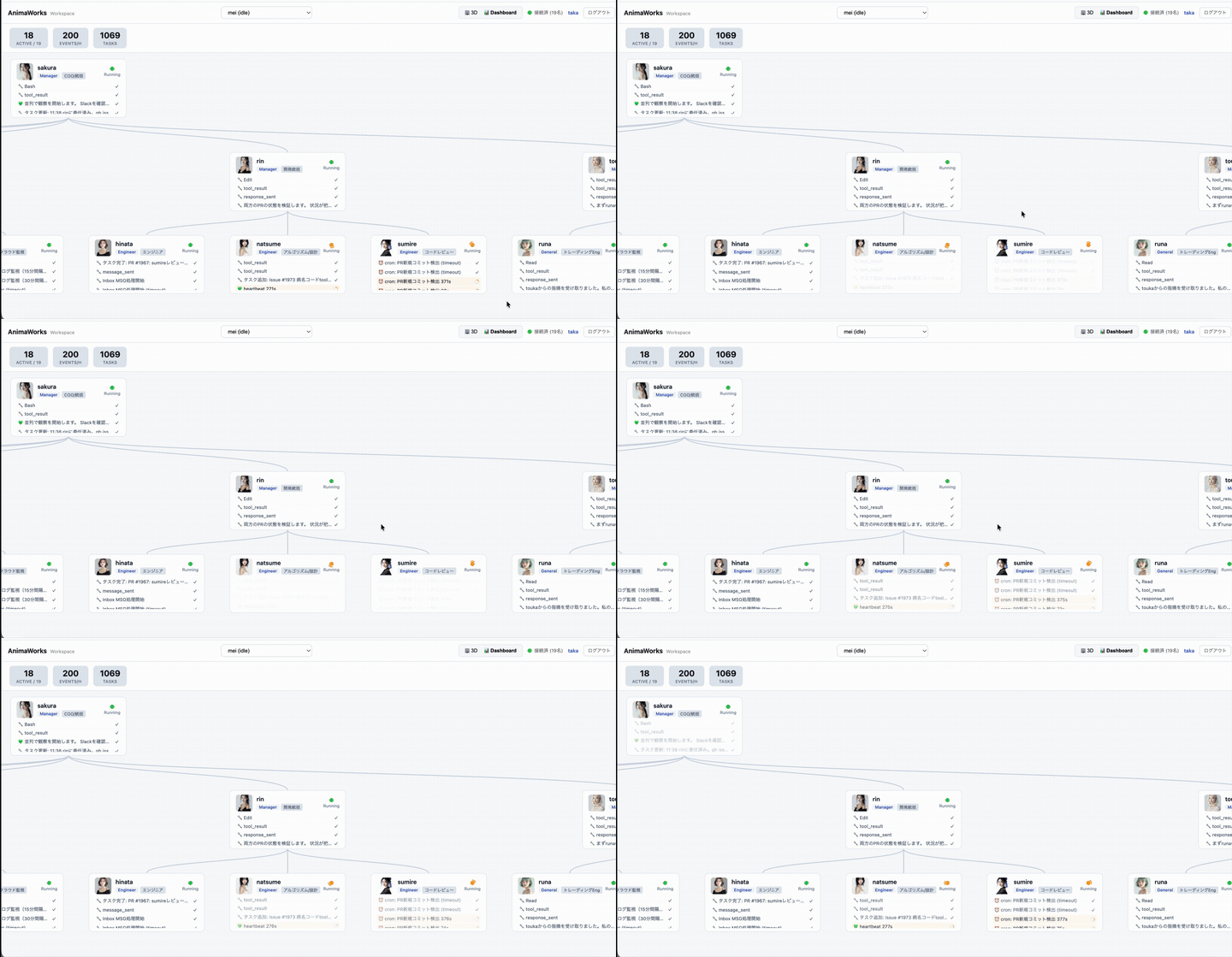
Workspace dashboard: each Anima's role, status, and recent actions are visible in real time.
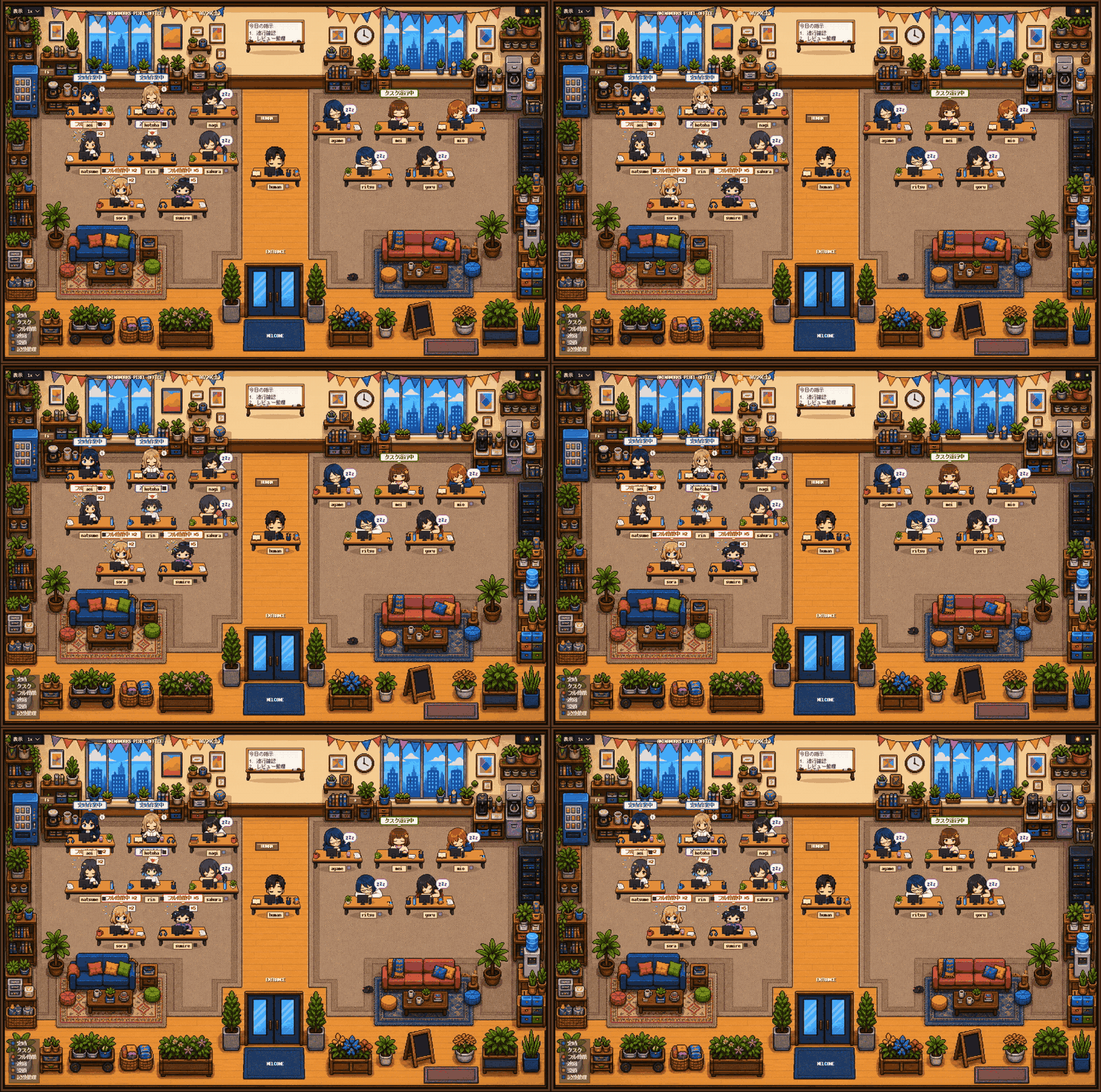
The pixel office is not a simulation. It is a live view of the organization at work — every status label is a task actually running.
日本語版 README | 简体中文 README | 한국어 README
No API key needed if the Claude Code CLI is installed or you are logged into Codex.
First, clone and install with the one-liner:
curl -sSL https://raw.githubusercontent.com/xuiltul/animaworks/main/scripts/setup.sh | bash
cd animaworks
Then launch the demo team:
uv run animaworks demo
Open http://localhost:18501. A three-person team (manager + engineer + assistant) starts right away, pre-loaded with three days of activity history. The first install downloads Python 3.12+ and the ML dependencies, so give it a few minutes; after that, the demo starts in seconds. Demo details →
Presets:
en-business(default),en-anime,ja-business,ja-anime— e.g.uv run animaworks demo --preset ja-anime. Switching presets on an existing demo requires--reset. The demo needs the cloned repository (it is not bundled in the pip package).
When you're ready to build your own organization, run uv run animaworks start — the setup wizard below walks you through creating your first agent.
macOS / Linux / WSL:
curl -sSL https://raw.githubusercontent.com/xuiltul/animaworks/main/scripts/setup.sh | bash
cd animaworks
uv sync --all-extras        # adds the codex/claude execution extras
uv run animaworks start     # start server — setup wizard opens on first run
Windows (PowerShell):
git clone https://github.com/xuiltul/animaworks.git
cd animaworks
uv sync --all-extras
uv run animaworks start
To use OpenAI Codex without an API key, run codex login before the first launch.
Open http://localhost:18500/ — the setup wizard walks you through five steps:
You do not need to hand-edit .env. The wizard saves settings to config.json automatically.
The setup script installs uv, clones the repository, and installs dependencies. macOS, Linux, and WSL work without a pre-installed Python. On Windows, use the PowerShell steps above; note that Mode S (Claude Agent SDK) is not available on Windows — use Codex, Gemini, or API-based modes there.
Always use
--all-extraswithuv sync. The plainuv syncthatsetup.shruns is enough for the core, but Mode C (Codex) needs thecodexextra, and a later filtered sync can remove thecodex/claudeexecution packages from the venv and break those modes across the fleet.
Other LLMs: Claude, GPT, Gemini, local models, and more are supported. Enter API keys in the setup wizard, or use Codex Login for OpenAI/Codex. You can change this later under Settings on the dashboard. See API Key Reference.
If you prefer not to pipe curl straight into bash, review the script first:
curl -sSL https://raw.githubusercontent.com/xuiltul/animaworks/main/scripts/setup.sh -o setup.sh
cat setup.sh            # review the script
bash setup.sh           # run after review
# Install uv (skip if already installed)
curl -LsSf https://astral.sh/uv/install.sh | sh
export PATH="$HOME/.local/bin:$PATH"

# Clone and install
git clone https://github.com/xuiltul/animaworks.git && cd animaworks
uv sync --all-extras    # downloads Python 3.12+ and all dependencies (including codex/claude extras)

# Start
uv run animaworks start
macOS users: System Python (
/usr/bin/python3) on macOS Sonoma and earlier is 3.9, which does not meet AnimaWorks (3.12+). Install with Homebrew (brew install python@3.13) or use the uv method above (uv manages Python for you).
Requires Python 3.12+ on your system (3.12/3.13 recommended).
git clone https://github.com/xuiltul/animaworks.git && cd animaworks
python3 -m venv .venv && source .venv/bin/activate
python3 --version       # verify 3.12+
pip install --upgrade pip && pip install -e .
animaworks start
Note: a plain pip install -e . does not include the Codex extra; add .[codex] if you plan to use Mode C.
A typical change moves through the organization like this:
@bot commands, and merge conflicts into agent tasks automatically (gh-ci-*, gh-review-*, gh-comment-*), with per-PR deduplication and bounded retries.delegate_task, carrying acceptance criteria, a workspace, and an exclusive key. Tasks that touch the same pull request are serialized on that key so agents never race each other on one branch.python3 -m swe.ci_autofix) can drive fix → lint/test gates → review → commit, escalating to a human after three failed attempts.call_human); the supervisor process separately watches agent health, restarts hung processes, and repairs its own memory indexes.The human role shifts from operating agents to owning an organization: state the intent, review what matters, decide the exceptions.
| AnimaWorks | CrewAI | LangGraph | OpenClaw | OpenAI Agents | |
|---|---|---|---|---|---|
| Design philosophy | Organization of autonomous agents | Role-based teams | Graph workflows | Personal assistant | Lightweight SDK |
| Memory | Neuroscience-inspired: hybrid RAG (vector + BM25 + graph), atomic facts, consolidation, active forgetting, automatic recall | Cognitive Memory (manual forget) | Checkpoints + cross-thread store | SuperMemory knowledge graph | Session-scoped only |
| Autonomy | Heartbeat (observe → plan → reflect) + Cron + TaskExec + GitHub event gateway — runs 24/7 | Human-triggered | Human-triggered | Cron + heartbeat | Human-triggered |
| Org structure | Supervisor → subordinate hierarchy, delegation, audit, dashboard | Flat roles in a crew | — | Single agent | Handoffs only |
| Process model | One isolated OS process per agent, IPC, auto-restart | Shared process | Shared process | Single process | Shared process |
| Multi-model | Seven engines: Claude SDK / Codex / Cursor Agent / Gemini CLI / Grok Build / LiteLLM / Assisted — with per-engine fallback chains | LiteLLM | LangChain models | OpenAI-compatible | OpenAI-centric |
AnimaWorks is not a task runner. It is an organization that thinks, remembers, forgets, and gradually grows. I build it while using it as an AI team in real business operations.
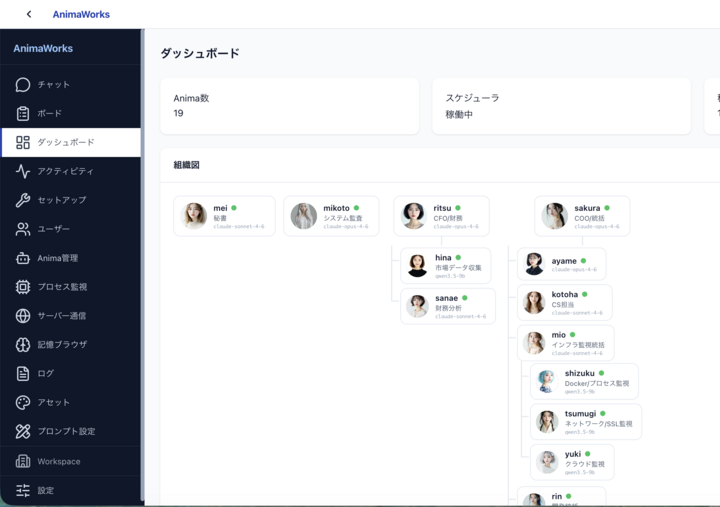
Dashboard: the org chart with real-time status for every Anima.
The web UI is organized around six screens (hash router #/…) plus the Workspace apps:
/setup/./workspace/, with an org-chart view toggle and talking bust-up avatars) and the pixel office (/workspace/pixel/, a live 2D view where every status label is a running task).ja / en / ko.Tell the leader "I need someone like this" — they infer role, personality, and hierarchy and create new members. You do not need to touch config files or the CLI; the organization can grow from conversation.
Once the team is ready, Animas keep working with their own schedules and memories:
Typical AI agents only remember what fits in the context window. AnimaWorks Animas keep file-based long-term memory and search it when needed. Instead of stuffing everything into every prompt, they retrieve only the memories related to the current conversation or action.
search_memory or read_memory_file itself. Search is hybrid: vector + BM25 + atomic facts + entity registry, with a confidence gate on what gets surfaced.legacy backend (ChromaDB through an isolated vector worker, with automatic quarantine and rebuild on corruption). A Neo4j graph backend (entity extraction, community detection, graph-aware recall) is experimental and opt-in.
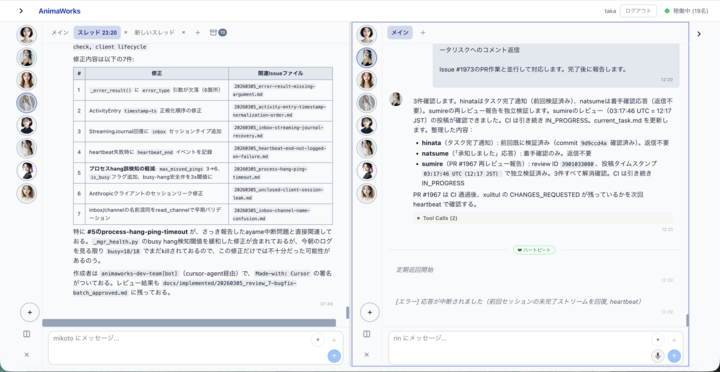
Chat: a manager reviews a code change while an engineer reports progress.
Works with many LLMs. Each Anima can use a different model.
| Mode | Engine | Targets | Tools |
|---|---|---|---|
| S (SDK) | Claude Agent SDK | Claude models (recommended) | Claude Code built-ins (Read/Write/Edit/Bash/Grep/Glob, etc.) + stdio MCP (mcp__aw__*) for AnimaWorks internal tools; falls back to a dedicated Anthropic SDK executor when the Agent SDK is unavailable |
| C (Codex) | Codex CLI (SDK wrapper) | OpenAI Codex CLI models | Codex sandbox + AnimaWorks MCP (core/mcp/server.py) for internal tools |
| D (Cursor) | Cursor Agent CLI | cursor/* models | MCP-integrated agent loop |
| G (Gemini CLI) | Gemini CLI | gemini/* models | stream-json parsing, tool loop |
| X (Grok Build) | Grok Build CLI wrapper (ACP stdio) | grok/* models | Grok Build agent loop over ACP stdio |
| A (Autonomous) | LiteLLM + tool_use | GPT, Gemini, Mistral, Bedrock, Vertex, xAI, DeepSeek, etc. | CC-style (Read/Write/Edit/Bash/Grep/Glob, WebSearch/WebFetch) + memory, messaging, tasks, todo_write, skill authoring, and more |
| B (Basic) | LiteLLM one-shot | Locals without reliable tool_use (e.g. small Ollama models) | Pseudo tool calls in the prompt; the framework handles memory I/O on the model's behalf |
Mode resolution: execution_mode in status.json takes precedence, then the models.json table, then built-in model-name patterns (fnmatch). Tool_use-capable Ollama models (e.g. ollama/qwen3:14b, ollama/glm-4.7*) map to A; everything else under ollama/* maps to B. Each CLI engine has a fallback chain (rate-guard aware for Codex/Grok) down to LiteLLM. Heartbeat, Cron, and Inbox can run on a separate background_model from the main model (cost optimization). Extended thinking is supported where available.
Talk to an Anima in the browser — push-to-talk or hands-free — over WebSocket.
ask_anima) or read memory mid-conversation
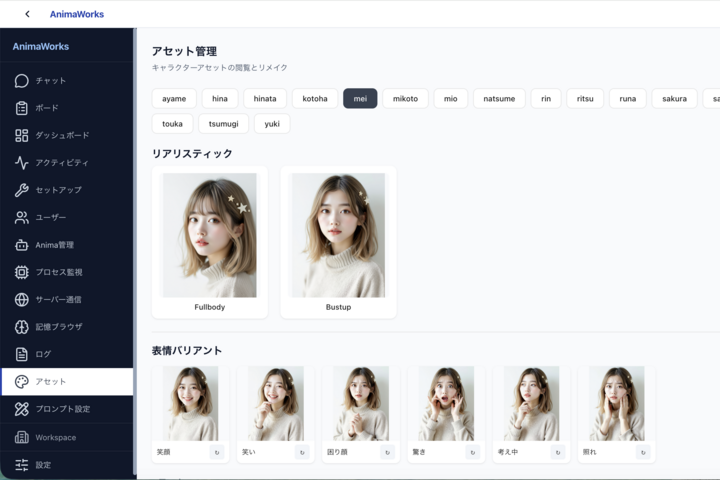
From personality settings: full-body, bust-up, and expression variants — auto-generated. Includes Vibe Transfer to inherit the supervisor's art style.
A seven-step pipeline generates full-body art, bust-ups with seven expressions, icons, chibi variants, and (for anime style) a rigged 3D model with idle/sitting/waving/talking animations. Backends: NovelAI (anime), fal.ai/Flux (stylized / photorealistic), Meshy (3D), plus Codex image generation and local Diffusers. Vibe Transfer (NovelAI) lets a new Anima inherit its supervisor's art style. The product runs without any image service configured; you simply skip avatars.
No one can do anything alone. So I built an organization.
This project sits at the intersection of three careers.
As a founder — I know that no one can do anything alone. You need strong engineers, people who communicate well, steady operators, and people who occasionally spark a sharp idea. Genius alone does not run an organization. Diverse strengths together achieve what no individual can.
As a psychiatrist — Studying LLM internals, I saw structures surprisingly similar to the human brain. Recall, learning, forgetting, consolidation — implementing the brain's memory mechanisms as an LLM memory system might approximate how we process memory. If we can treat LLMs as pseudo-humans, we should be able to build organizations the same way we do with people.
As an engineer — I have written code for thirty years. I know the pleasure of wiring logic and the rush of automation. Packing those ideals into code lets me build the organization I want.
Excellent "single AI assistant" frameworks already exist. But projects that create human-like units in code and make them function as an organization are still rare. AnimaWorks is an AI organization I grow while using it in my own business every day.
Imperfect individuals collaborating through structure outperform any single omniscient actor.
Three principles hold it up:
search_memory and similar tools.| Key | Service | Mode | Where to get it |
|---|---|---|---|
ANTHROPIC_API_KEY | Anthropic API | S / A | console.anthropic.com |
OPENAI_API_KEY | OpenAI | A / C (optional with Codex Login) | platform.openai.com/api-keys |
GOOGLE_API_KEY | Google AI (Gemini) | A | aistudio.google.com/apikey |
OpenAI Codex (Mode C) supports both OPENAI_API_KEY and local Codex Login (codex login). Choose in the setup wizard or Settings.
Grok Build (Mode X) uses grok/* models through the Grok Build CLI wrapper (ACP stdio). Install the grok CLI and run grok login before use.
Azure OpenAI, Vertex AI (Gemini), AWS Bedrock, and vLLM are configured in the credentials section of config.json. See the technical specification.
Ollama and similar local models need no API key. Set OLLAMA_SERVERS (default: http://localhost:11434).
Credentials resolve through a cascade: config.json credentials → vault → shared credentials file → environment variables, so most keys can also live in the encrypted vault (animaworks vault).
| Key | Service | Output | Where to get it |
|---|---|---|---|
NOVELAI_TOKEN | NovelAI | Anime-style character art | novelai.net |
FAL_KEY | fal.ai (Flux) | Stylized / photorealistic | fal.ai/dashboard/keys |
MESHY_API_KEY | Meshy | 3D character models | meshy.ai |
| Requirement | Service | Notes |
|---|---|---|
pip install animaworks[transcribe] | STT (faster-whisper) | Model auto-downloads on first use; GPU recommended |
| VOICEVOX Engine running | TTS (VOICEVOX) | Default: http://localhost:50021 |
| AivisSpeech / SBV2 running | TTS (Style-BERT-VITS2) | Default: http://localhost:5000 |
| Irodori server running | TTS (Irodori) | Default: http://localhost:7861 |
ELEVENLABS_API_KEY | TTS (ElevenLabs) | Cloud API (environment variable) |
| Key | Service | Where to get it |
|---|---|---|
SLACK_BOT_TOKEN / SLACK_APP_TOKEN | Slack (tools + Socket Mode inbound) | Setup guide |
CHATWORK_API_TOKEN | Chatwork (tools + webhook inbound) | chatwork.com |
DISCORD_BOT_TOKEN (or per-Anima DISCORD_BOT_TOKEN__<name>) | Discord (tools + gateway inbound + notification) | Discord Developer Portal |
NOTION_API_TOKEN (or NOTION_API_TOKEN__<name>) | Notion | Notion integrations |
GITHUB_WEBHOOK_SECRET + gh auth login | GitHub webhook gateway (CI/review/conflict → tasks) | your repository settings |
Gmail, Google Calendar, Google Sheets, Google Tasks, X search, AWS collectors, Zoom meeting capture (RTMS), and local-LLM tools are configured under credentials in config.json (OAuth or service account where applicable). Human notification channels: Slack, Chatwork, Discord, LINE, Telegram, ntfy. See the technical specification.
Hierarchy is defined by a single supervisor field. Unset means top-level.
Role templates apply role-specific prompts, permissions, and default models:
| Role | Default model | Use case |
|---|---|---|
engineer | Claude Opus 4.6 | Complex reasoning, code generation |
manager | Claude Opus 4.6 | Coordination, decision-making |
writer | Claude Sonnet 4.6 | Content creation |
researcher | Claude Sonnet 4.6 | Information gathering |
ops | Ollama (GLM-4.7) | Log monitoring, routine work |
general | Claude Sonnet 4.6 | General-purpose |
Managers automatically receive supervisor tools: task delegation, progress tracking, subordinate restart/disable, org dashboard, subordinate state reads — what real managers do.
Each Anima is started by ProcessSupervisor as an isolated process and talks over local IPC (Unix domain sockets on Unix-like systems, loopback TCP on Windows).
Giving autonomous agents tools demands serious security. We use this in real work, so compromise is not an option. AnimaWorks layers its defenses:
| Layer | What it does |
|---|---|
| Trust-boundary labeling | External data (web search, Slack, mail) is tagged by origin; the minimum trust seen in a session propagates, and models are instructed not to obey directives from untrusted sources |
| Memory provenance | Memories written from external content carry their origin into RAG metadata; recall keeps externally-sourced knowledge separated from the Anima's own |
| Command security | Shell-injection detection (logged by default, enforceable) → global deny list (enforced, server refuses to start without permissions.global.json) → per-agent denied commands → per-agent allowlist → path-traversal detection |
| File sandbox | Each agent is confined to its own directory tree via permissions.json; identity and permission files themselves are write-protected |
| Process isolation | One OS process per agent, local IPC (Unix socket, or loopback TCP on Windows) |
| Rate limiting | Per-run recipient dedup and role-based caps → cross-run hourly/daily limits (fail-closed if logs are unreadable) → recent outbound history injected into the prompt for self-awareness |
| Cascade prevention | Conversation depth limits plus cascade detection; five-minute cooldown and deferred handling |
| Authentication & sessions | Argon2id hashing, 48-byte random tokens, up to ten sessions, configurable TTL |
| Webhook verification | HMAC signatures with replay protection for Slack, Chatwork, Zoom, and GitHub |
| SSRF mitigation | Media proxy blocks private IPs and DNS rebinding, enforces HTTPS, validates content types and magic bytes |
| Outbound routing | Unknown recipients fail closed; no arbitrary external sends without explicit configuration |
| Inter-agent message integrity | Sender-name validation against the roster and origin-chain tracking on every relayed message |
Details: Security architecture
The CLI targets power users and automation. Day-to-day work lives in the Web UI.
| Command | Description |
|---|---|
animaworks start [--host HOST] [--port PORT] [-f] | Start server (-f foreground; default port 18500) |
animaworks stop [--force] / restart | Stop / restart server |
animaworks demo [--preset NAME] [--port PORT] [--reset] | Launch the demo org (default port 18501, separate data dir) |
| Command | Description |
|---|---|
animaworks init [--force] [--template NAME] [--from-md PATH] [--blank] | Initialize runtime directory |
animaworks migrate [--dry-run] [--list] [--force] [--resync-db] | Runtime data migrations (also run on startup) |
animaworks reset [--restart] | Reset runtime directory |
animaworks import hermes|openclaw --path P [--apply] | Import agents from other frameworks |
| Command | Description |
|---|---|
animaworks anima create [--from-md PATH] [--template NAME] [--role ROLE] [--supervisor NAME] [--name NAME] | Create new |
animaworks anima list / info / status / restart / disable / enable | Inspect and control |
animaworks anima set-model / set-background-model / set-memory-backend / set-role / set-outbound-limit | Per-Anima configuration |
animaworks anima reload [--all] | Hot-reload from status.json |
animaworks anima delete / rename / merge / merge-finalize | Lifecycle operations |
animaworks anima audit [--days N] / permissions / repair-bootstrap | Diagnostics |
| Command | Description |
|---|---|
animaworks chat ANIMA "message" [--from NAME] | Send a message |
animaworks send FROM TO "message" | Inter-Anima message |
animaworks board read/post/dm-history … | Read and post to shared channels |
animaworks heartbeat ANIMA | Trigger heartbeat manually |
| Command | Description |
|---|---|
animaworks config list / get KEY / set KEY VALUE | Configuration |
animaworks status / logs [ANIMA] | System status and logs |
animaworks index [--anima NAME] [--full] | RAG index management |
animaworks repair-rag --anima NAME --full / rag-repair-status | Quarantine and rebuild RAG indexes |
animaworks memory status / migrate / backup / rollback / cleanup | Memory backends and data |
animaworks skills install / list / inspect / remove / quarantine | Skill Hub operations |
animaworks task add / update / list | Task queue operations |
animaworks vault status / init / get / store / list | Encrypted credential vault |
animaworks company create / list / assign / adopt / split / export | Multi-company organization management |
animaworks cost / profile / models list / tmp list/clean | Cost, profiles, models, temp hygiene |
animaworks mcp --anima NAME | Run the stdio MCP server for external clients |
python3 -m swe.ci_autofix is an experimental v0 loop for repairing failed CI runs. It reads the latest
failed GitHub Actions logs with gh, asks a configured Architect fixer to edit the checkout, runs local gates
(ruff / pytest), asks a Reviewer, commits the repair, and escalates with call_human after three failed attempts. See
swe/README.md.
| Component | Technology |
|---|---|
| Agent execution | Claude Agent SDK / Codex CLI / Cursor Agent CLI / Gemini CLI / Grok Build CLI / Anthropic SDK (fallback) / LiteLLM |
| Mode S integration | stdio MCP (python -m core.mcp.server, tool names mcp__aw__*) |
| LLM providers | Anthropic, OpenAI, Google, Azure, Vertex AI, AWS Bedrock, Ollama, vLLM, and more (via LiteLLM) |
| Web framework | FastAPI + Uvicorn |
| GitHub integration | Webhook gateway (HMAC-verified) → task dispatch; multipass review orchestration; gh CLI tooling with per-Anima identity |
| Real time | WebSocket (dashboard, voice), SSE (chat, meeting streams), StreamRegistry for stream producer lifetime |
| Task scheduling | APScheduler (heartbeats, cron, consolidation, health checks, RAG repair) |
| Task management | Task queue (JSONL) + pending-task executor with per-PR exclusive keys + TaskBoard (SQLite) |
| Memory / RAG | ChromaDB (via isolated vector worker) + BM25 + sentence-transformers + NetworkX + atomic facts + entity registry; optional Neo4j graph backend |
| Configuration & migration | Pydantic 2.0+ / JSON / Markdown, core/migrations/ (startup migrations) |
| Internationalization | core/i18n t(); wizard in 17 languages, dashboard in ja/en/ko |
| Skill system | Skill Hub, explicit skill activation, router, curator, procedure-to-skill promotion |
| Extended tools | Auto-registration from core/tools/*.py plus scans of ~/.animaworks/common_tools/ and animas/<name>/tools/ |
| Voice chat | faster-whisper (STT) + VOICEVOX / SBV2 / ElevenLabs / Irodori (TTS) + local front-lane model |
| Messaging in/out | Slack Socket Mode, Chatwork webhook, Discord gateway, Zoom RTMS (inbound); Slack, Chatwork, Discord, LINE, Telegram, ntfy (human notification) |
| Image generation | NovelAI, fal.ai (Flux), Meshy (3D), Codex image gen, local Diffusers |
| Workspace apps | Three.js 3D office + 2D pixel office, driven by the same live event stream |
animaworks/
├── main.py              # CLI entry point
├── core/                # Digital Anima core engine
│   ├── anima.py, agent.py  # Core entities & orchestration
│   ├── lifecycle/       # Scheduler, consolidation jobs, inbox watch, etc.
│   ├── memory/          # Memory (priming, consolidation, forgetting, RAG, facts, retrieval)
│   ├── skills/          # Skill Hub, activation, router, curator, promotion
│   ├── taskboard/       # TaskBoard store, state, cleanup
│   ├── execution/       # Execution engines (S/C/D/G/X/A/B) + sanitization
│   ├── mcp/             # stdio MCP server for Mode S and external clients
│   ├── platform/        # Child processes, locks, Codex/Cursor/Gemini/Grok plumbing
│   ├── tooling/         # ToolHandler, schemas, permissions, external dispatch
│   ├── prompt/          # System prompt builder
│   ├── supervisor/      # ProcessSupervisor, IPC, TaskExec, health, streaming
│   ├── voice/           # Voice chat (STT + TTS + front lane)
│   ├── config/          # Configuration (Pydantic, models.json, global permissions)
│   ├── auth/            # UI authentication
│   ├── notification/    # Human notification channels
│   ├── migrations/      # Runtime data migrations
│   ├── i18n/            # Translation strings (`t()`)
│   ├── tools/           # External tool implementations (slack, discord, gmail, github, …)
│   ├── tasks_dispatch.py, review_multipass.py  # GitHub event → task wiring, multi-model review
│   └── …
├── cli/                 # CLI package (incl. demo)
├── server/              # FastAPI + static Web UI + Workspace apps
│   ├── app.py           # App factory, lifespan, auth/setup guards, static mounts
│   ├── github_gateway.py, slack_socket.py, discord_gateway.py, zoom_gateway.py
│   ├── routes/          # REST/WebSocket routes (chat, room, voice, webhooks, …)
│   └── static/          # Dashboard, setup wizard, workspace/ (3D), workspace/pixel/
├── swe/                 # Experimental CI auto-fix loop & SWE harness
├── demo/                # Demo presets and seeded history
└── templates/           # Initialization templates (ja / en / ko) incl. role playbooks
Documentation hub — suggested reading order, architecture deep dives, and specification index.
| Document | Description |
|---|---|
| Vision | Foundational idea: imperfect individuals collaborating |
| Features | What AnimaWorks can do end to end |
| Memory system | Episodic, semantic, and procedural memory; priming, action rules, active forgetting |
| Security | Defense in depth, data provenance, adversarial threat analysis |
| Brain mapping | How modules map to the human brain |
| Technical specification | Execution modes, prompt construction, configuration resolution |
Apache License 2.0. See LICENSE for details.
Run Claude Code as an MCP server so any agent can delegate coding tasks to it
 @microsoft✓ Official
Browser automation using accessibility snapshots instead of screenshots
 @googleapis✓ Official
Google's universal MCP server supporting PostgreSQL, MySQL, MongoDB, Redis, and 10+ databases
 @github✓ Official
Official GitHub integration for repos, issues, PRs, and CI/CD workflows