

Are you the author? Sign in to claim
🔨 Throwaway Docker sandbox for agents: run code/commands in isolated, resource-limited containers with structured resul

A throwaway Docker sandbox for agents.
Run code or shell commands in a resource-limited, network-isolated, single-use container and get back a structured result — stdout, stderr, exit_code, timed_out, duration_ms. So an agent can verify its work, reproduce a bug, or check output without ever touching the host.
Part of tools-for-agents. Zero npm dependencies — drives the docker CLI directly.
Every run is launched with:
--network none — no network unless you opt in (network: "on")--memory 512m --cpus 1 --pids-limit 512 — bounded resources--cap-drop ALL --security-opt no-new-privileges — minimal privileges--rm ephemeral container, work dir is a fresh temp mount, removed afterdocker kills the containersecure: true → read-only rootfs + tmpfs /tmpnode src/cli.js check # docker version + presets
node src/cli.js run python 'print(2**10)' # → 1024
node src/cli.js run node 'console.log(6*7)' # → 42
echo 'print("hi")' | node src/cli.js run python -
node src/cli.js sh 'apk info 2>/dev/null | head'
anvil serve)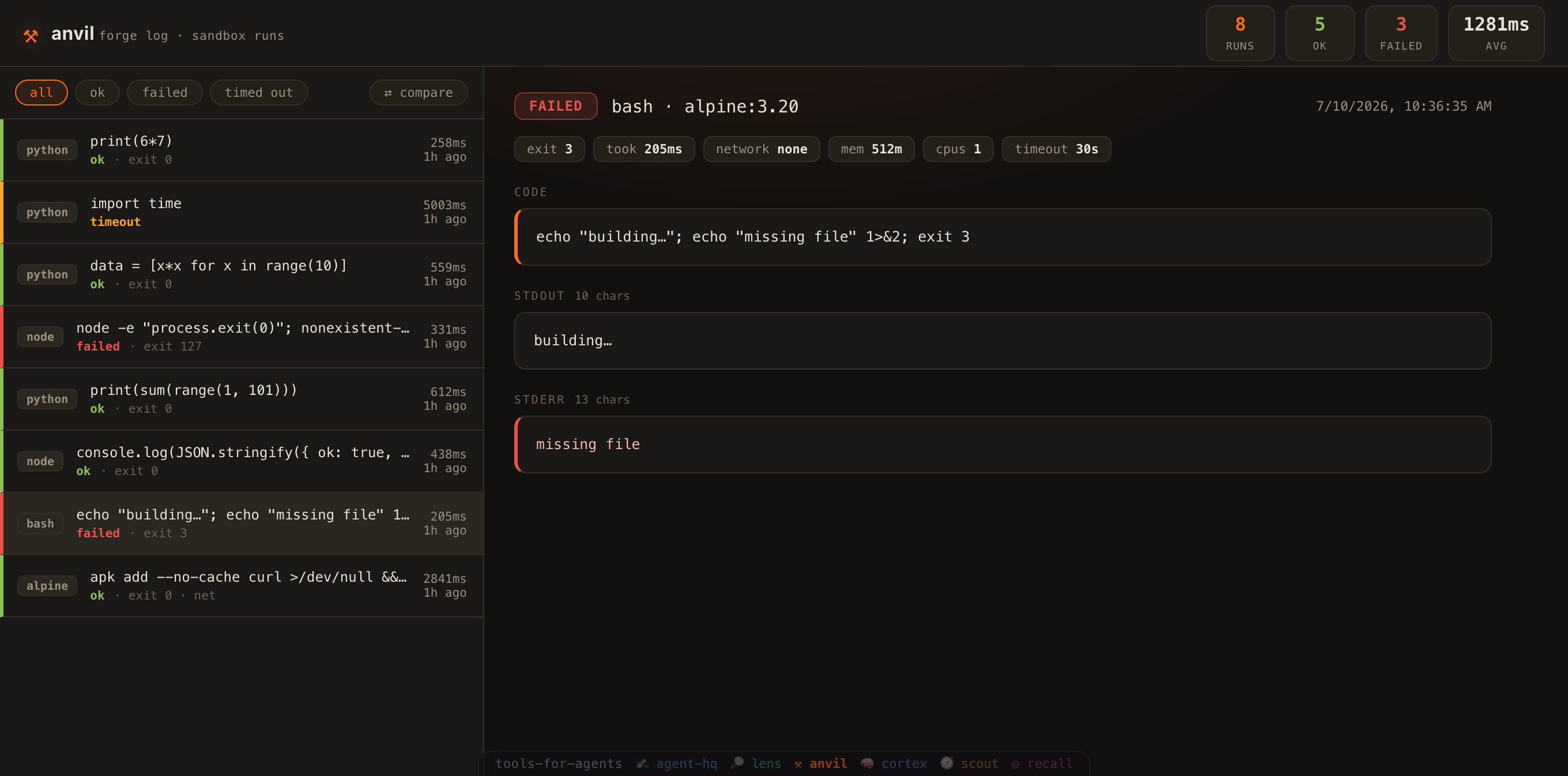
anvil is stateless by default. Set ANVIL_DB to record every run, then browse them in a dashboard:
export ANVIL_DB=./.anvil/runs.db          # opt in to the run log
node src/cli.js run python 'print(2**10)'  # …runs are now recorded
node src/cli.js serve                       # → http://localhost:7930  (--port to change)
A zero-dependency forge log of what the sandbox executed:
took 258ms → 559ms, mem 512m → 256m).run() has always taken { path: content } files and written them into /work beside your snippet (agents use it), and the form never offered it. Now + file adds fixture files — a module and its test, a parser and a sample payload — and + stdin pipes input to the process. A snippet on its own can only prove syntax; a snippet with a fixture can prove behaviour. Paths that try to climb out of the sandbox are refused before a container starts./repo — cd /repo && npm test — without the repo ever leaving your disk or being writable by the container (touch /repo/x → Read-only file system). There's a read-only rootfs switch too. A mount that doesn't exist is refused in the form, before docker gets a chance to fail at you.POST /api/exec?stream=1 → an event stream ending with the logged run), and run({ onData }) gives the same live chunks to any caller — the CLI, an agent, anything.#run=<id> link straight back to the run in the forge log. anvil never writes: your browser POSTs to cortex's own /api/capture (point it elsewhere with ANVIL_CORTEX_URL).…/#run=<id>), so any run in the log can be linked, bookmarked or handed to someone else.DELETE on the API — a stray GET can never prune anything.3 / 7 count); Esc clears it. Composes with the status filters, so you can find "that curl run that failed" in a long history.python 3 · node 1 · bash 1).j/k (or ↑/↓) to move a cursor through the run list and open each run as you go — browse the whole forge log from the keyboard without touching the mouse (it stands down while you're typing in the search box or in compare mode).Logging is opt-in, fire-and-forget and fully guarded — it never slows or breaks a run. Try the demo without Docker: ANVIL_DB=./.anvil/runs.db node scripts/seed.js then anvil serve.
{
  "mcpServers": {
    "anvil": { "command": "node", "args": ["/abs/path/to/anvil/mcp/mcp-server.js"] }
  }
}
| Tool | Use it to… |
|---|---|
anvil_run_code | Run a bash / node / python snippet, get structured output. |
anvil_run_command | Run a shell command with supplied files and/or a host dir mounted read-only at /repo (e.g. run a test suite). |
anvil_check | Docker availability + language presets. |
{ "name": "anvil_run_command",
  "arguments": { "image": "node:22-alpine", "mount": "/path/to/repo/src",
                 "cmd": "node --check /repo/core.js && echo OK" } }
{ "ok": true, "exit_code": 0, "timed_out": false, "duration_ms": 178,
  "image": "python:3.12-alpine", "stdout": "...", "stderr": "" }
anvil is the run safely leg of tools-for-agents — an operating system for agents.
Seven zero-dependency, MCP-native tools that form one loop:
| 🛰️ | agent-hq | coordinate — shared memory, a kanban agents claim work from, a registry, a cost ledger |
| 🔎 | lens | read code — token-budgeted retrieval — search, outlines, surgical reads |
| ⚒ | anvil | run safely — a throwaway Docker sandbox: network off, capped, timed |
| 🧠 | cortex | remember — an Obsidian-compatible second brain, wikilinked |
| 🧭 | scout | read the web — a URL becomes clean, cached, searchable markdown |
| 🎯 | recall | recall it all — one query across brain, team, reading and code |
| 👁 | iris | see — look at what you built, before you claim it works |
Reading this as an agent? /llms.txt is the map, and
/tools.json hands you all 70 MCP tools — every name, every
description, every install command — in one fetch, without cloning anything.
MIT licensed.
40+ tools for querying dashboards, alerts, datasources, and logs in Grafana
Run Claude Code as an MCP server so any agent can delegate coding tasks to it
 @microsoft✓ Official
Browser automation using accessibility snapshots instead of screenshots
 @googleapis✓ Official
Google's universal MCP server supporting PostgreSQL, MySQL, MongoDB, Redis, and 10+ databases