

Are you the author? Sign in to claim
Policy-as-code for MCP agents: deny risky tool calls before they run, prove what ran with verifiable evidence, and enfor
Policy-as-code for MCP agents: enforce what a tool call can do, prove what it did, and stay honest about what you can't.
A deterministic, fail-closed policy gate for MCP tool calls, with real kernel-level (eBPF/LSM) enforcement on Linux and offline-verifiable evidence. CI-native, no backend, bounded by design.



Quickstart · How it works · See it work · MCP example · CI guide · OWASP MCP Top 10 · Discussions
In 2026 agents got real tool access through MCP, and the attacks came with it: tool poisoning, rug pulls, confused-deputy OAuth, dozens of CVEs in the first months alone. Most tools scan a server or filter a prompt. Assay sits at the tool-call boundary and does three things, in order.
tools/call before it runs, with the precise reason for each allow or deny. On Linux it adds real kernel-level enforcement: a proven IPv4/TCP connect-egress block (eBPF/LSM) and a Landlock TCP-connect port allowlist, both opt-in and fail-closed. A policy it cannot express exactly is refused, never half-applied.verified, self_reported, inferred, or absent), and a gate refuses to let a claim exceed what was actually observed. A tool returning "success" is the provider's assertion, never proof, until evidence confirms it. Assay ships no single safety score and never claims more than it can prove.cargo install assay-cli
mkdir -p /tmp/assay-demo && echo "safe content" > /tmp/assay-demo/safe.txt
assay mcp wrap --policy examples/mcp-quickstart/policy.yaml \
-- npx @modelcontextprotocol/server-filesystem /tmp/assay-demo
✅ ALLOW read_file path=/tmp/assay-demo/safe.txt reason=policy_allow
❌ DENY read_file path=/tmp/outside-demo.txt reason=path_constraint_violation
❌ DENY exec cmd=ls reason=tool_denied
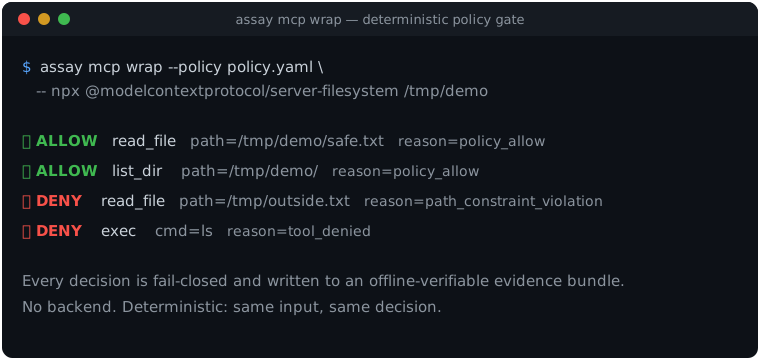
Wire it into Cursor, Claude Code, or Codex in one line with assay mcp config-path <editor>. New to the threat model? Start with the OWASP MCP Top 10 mapping, which lays out, per risk, what Assay covers and what it deliberately does not.
Use Assay if you already have machine-readable AI outcomes or agent tool-call tests and want a small reviewable artifact boundary in CI.
Start with the path that matches what you already have:
| You have | Use this when | What you get | Next click |
|---|---|---|---|
| Promptfoo JSONL from CI evals | You want smaller PR evidence than a full eval export | Eval outcome receipts, verified bundle, Trust Basis diff | Promptfoo JSONL |
OpenFeature boolean EvaluationDetails | You want CI evidence for a runtime flag decision boundary | Decision receipt, verified bundle, Trust Basis diff | OpenFeature EvaluationDetails |
| CycloneDX ML-BOM model component | You want CI evidence for the model inventory/provenance boundary that existed | Inventory receipt, verified bundle, Trust Basis diff | CycloneDX ML-BOM |
| MCP tool calls | You are ready to put a policy file around tool execution | Allow/deny audit trail and evidence for observed tool behavior | MCP Quick Start |
| A GitHub PR gate | You want CI to block regressions from checked artifacts | Trust Basis diff, gate status, SARIF/JUnit-ready output | CI Guide |
| A Runner archive or coverage annotation from an observed run | You want to know what the observed evidence can and cannot support before trusting a side-effect claim | Coverage descriptors, claim-class cells (strength x basis), and a claimed-vs-observed check | Coverage-honesty walkthrough |
The core workflow is intentionally small: import or record a bounded outcome, bundle and verify it, compile trust-basis.json, then gate the Trust Basis diff. Assay does not make the upstream tool the source of truth; it makes the evidence boundary inspectable.
For observed runtime evidence specifically, the same boundary discipline runs end to end: a coverage descriptor declares what the capture can and cannot support, claim-class cells record each claim as claim_strength x claim_basis, and a gate refuses to let a claim exceed what was observed. See the coverage-honesty walkthrough and the claim-class semantics.
For privileged tool actions specifically, the MCP proxy records each observed tools/call as a structured tool-decision (assay.tool_decision_surface.v0): the privileged in-application actions kernel and network enforcement cannot see, such as a deploy key added or a workspace member invited. Rule-based classifiers tag the action and project a target with sensitive ids hashed and raw arguments never stored, and the shape keeps the asserted-versus-verified line honest: a tool returning success is the provider's assertion, never proof, until independently checked audit evidence confirms it. See tool-decision surface and credential-scope.
Trust Basis Gate
Status: OK
Bundles verified: 1
Regressed claims: 0
Assay is not a trust-score engine, a generic eval dashboard, or a hosted observability product. See What Assay is and is not for the boundary.
Yes, if you:
Not yet, if you:
cargo install assay-cli
CI: GitHub Action. Python SDK: pip install assay-it.
No hosted backend. No API keys for core flows. Deterministic: same input, same decision.
v3.21.0 runtime enforcement (Linux):
assay sandbox --enforce-netenforces a TCP-connect port allowlist with Landlock, a second kernel route beside the connect4/eBPF egress path, denying any TCP connect to a non-allowlisted port. It records the outcome in a separateassay.enforcement_health.v1artifact, and--probe-enforcementadds a per-run real-block check (a denied connect blocked withEACCES, the harness listener never reached). Enforcement is opt-in and fail-closed: a network policy it cannot express as an explicit port allowlist is refused rather than partially applied, and a requested health artifact that cannot be written is an error, never a silent absence. It is bounded by design and makes no IP/CIDR, hostname, UDP, or QUIC claim. See CHANGELOG.md for the full release notes.
Trust claims use explicit epistemology, not a single “safety score”:
| Level | Meaning |
|---|---|
verified | Backed by direct evidence or offline verification in the bundle/path |
self_reported | Emitted by the system without stronger independent corroboration |
inferred | Derived from bounded, documented rules |
absent | No trustworthy evidence supports the claim |
Assay does not ship a primary aggregate trust score or a safe/unsafe badge as the main output. See ADR-033.
| Output | Role |
|---|---|
| Policy gate | MCP wrap — deterministic allow/deny before tools run (see CLI note below the diagram). |
| Evidence bundle | Offline-verifiable, tamper-evident archive for audit and replay. |
| External receipts | Selected eval outcomes, runtime decision details, and inventory/provenance surfaces as bounded evidence receipts with JSON Schema contracts. |
| Trust Basis | Canonical trust-basis.json — bounded claim classification from verified bundles. |
| Trust Card | trustcard.json / trustcard.md / trustcard.html — same claims, review-friendly artifacts. |
| SARIF / CI | GitHub Action, Security tab integration, policy gates on PRs. |
| Coding-agent governance | Run a coding agent under assay sandbox; emit its observed effects as an evidence bundle (--bundle) or OTel execute_tool spans (--otel-jsonl). |
| Attestation | Export a bundle as an in-toto / DSSE statement (v0), anchor-pluggable. |
Repository truth: release notes and CHANGELOG.md remain the authority for what is actually public.
mainmay carry release-prep commits before a tag is cut; crates.io publication is separate from repository merge state.
Agent ──► Assay ──► MCP Server
│
├─ ✅ ALLOW / ❌ DENY (policy)
├─► 📋 Evidence bundle (verifiable)
└─► 📊 Trust Basis → Trust Card → SARIF / CI
CLI: MCP runtime commands live under
assay mcp. Useassay mcp --help,assay mcp wrap …,assay mcp discover,assay mcp kill, or follow the MCP Quickstart.
A boundary, not a category. “MCP firewall” describes the control plane; trust compilation describes the outcome: reviewable claims backed by evidence. See ADR-033 and RFC-005.
An agent tries a privileged action — github.add_deploy_key — through the enforcing proxy. Assay
decides per call before it forwards and writes a replayable evidence record. One command,
offline, against a local mock (no real credentials, no real GitHub call):
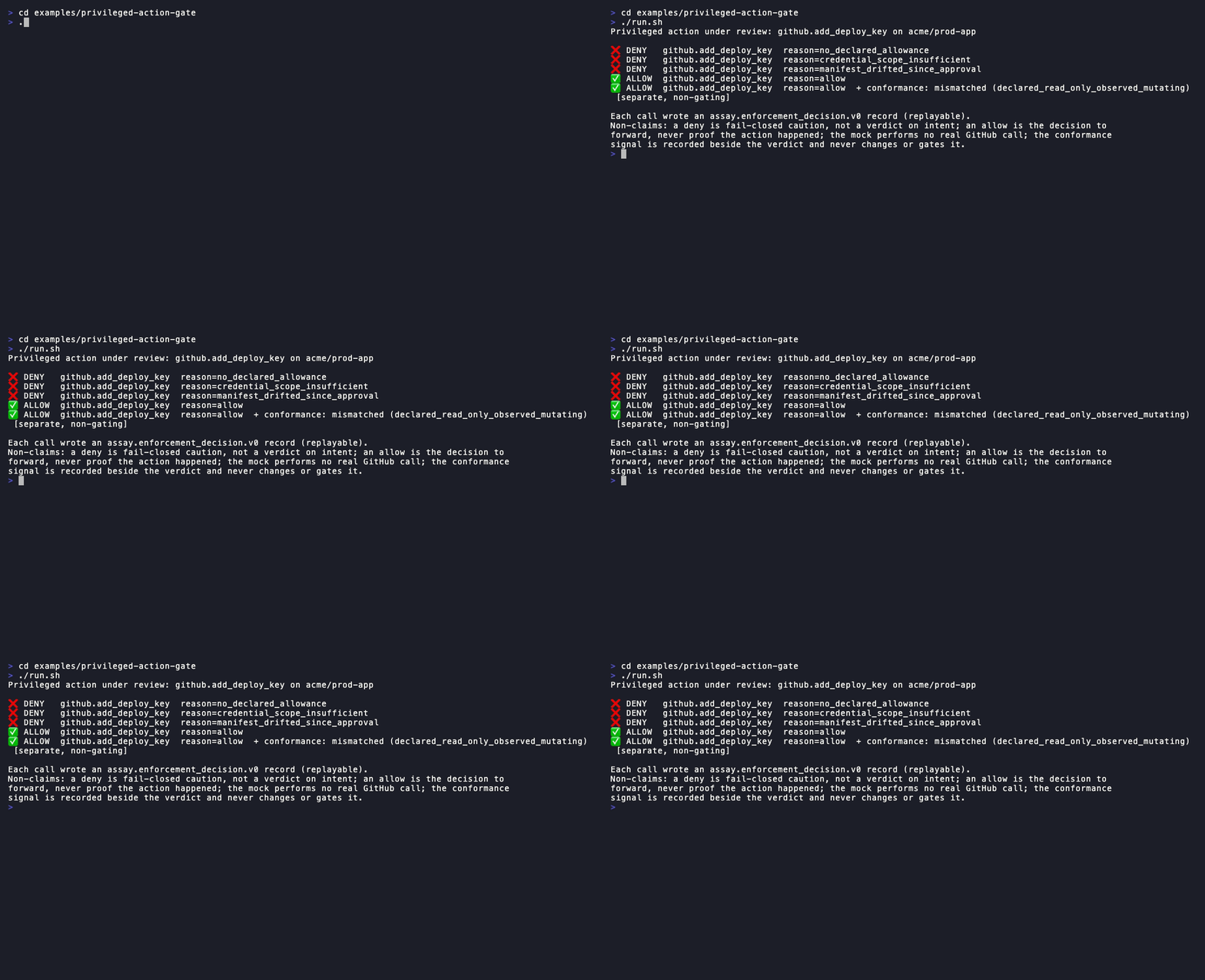
cd examples/privileged-action-gate && ./run.sh
❌ DENY github.add_deploy_key reason=no_declared_allowance
❌ DENY github.add_deploy_key reason=credential_scope_insufficient
❌ DENY github.add_deploy_key reason=manifest_drifted_since_approval
✅ ALLOW github.add_deploy_key reason=allow
✅ ALLOW github.add_deploy_key reason=allow + conformance: mismatched (declared_read_only_observed_mutating) [separate, non-gating]
A deny is fail-closed caution, not a verdict on intent; an allow is the decision to forward, never proof the action happened. The last line is separate evidence — the tool declared itself read-only while the observed call was mutating — recorded beside the verdict, never a gate. Full walkthrough: examples/privileged-action-gate/.
cargo install assay-cli

mkdir -p /tmp/assay-demo && echo "safe content" > /tmp/assay-demo/safe.txt

assay mcp wrap --policy examples/mcp-quickstart/policy.yaml \
  -- npx @modelcontextprotocol/server-filesystem /tmp/assay-demo
✅ ALLOW  read_file  path=/tmp/assay-demo/safe.txt  reason=policy_allow
✅ ALLOW  list_dir   path=/tmp/assay-demo/           reason=policy_allow
❌ DENY   read_file  path=/tmp/outside-demo.txt      reason=path_constraint_violation
❌ DENY   exec       cmd=ls                          reason=tool_denied
Inspect the audit artifact:
assay evidence show demo/fixtures/bundle.tar.gz
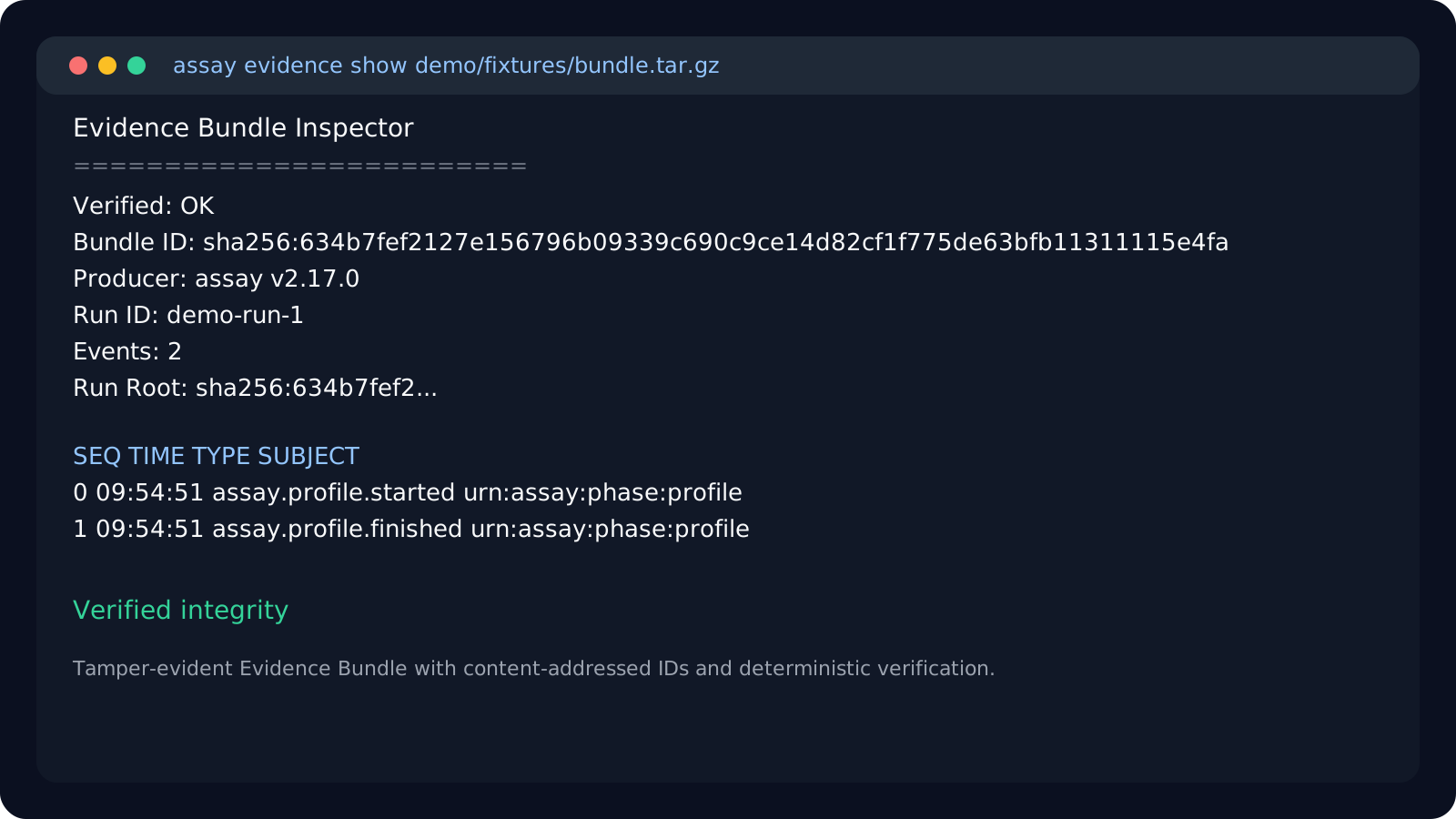
The bundle is tamper-evident and cryptographically verifiable. Signed mandate events can include an Ed25519-backed authorization trail for high-risk actions.
After a bundle verifies, compile the claim artifact:
# Machine-readable claim basis (deterministic, claim-first)
assay trust-basis generate demo/fixtures/bundle.tar.gz > trust-basis.json
trust-basis.json is the canonical output for CI and review. Claim id values are stable across runs; consumers should key by id, not row count or order. It is not a scalar trust score.
The current claim-visible receipt families are Promptfoo assertion-component results, OpenFeature boolean EvaluationDetails, and CycloneDX ML-BOM model components. See the receipt-family matrix, the three-family note, and Evidence Receipts in Action.
assay trust-card generate demo/fixtures/bundle.tar.gz --out-dir ./trust-out
# -> trust-out/trustcard.json , trust-out/trustcard.md , trust-out/trustcard.html
The Trust Card is a deterministic render of the same claim rows plus frozen non-goals; trustcard.json is canonical, while Markdown and static HTML are reviewer projections. Contract versions, pack floors, and release checklist: MIGRATION — Trust Compiler 3.2, receipt-family matrix. Release history belongs in CHANGELOG.md.
Assay ships a helper that finds your local Cursor MCP config path and prints a ready-to-paste entry:
assay mcp config-path cursor
It generates JSON like:
{
  "filesystem-secure": {
    "command": "assay",
    "args": [
      "mcp",
      "wrap",
      "--policy",
      "/path/to/policy.yaml",
      "--",
      "npx",
      "-y",
      "@modelcontextprotocol/server-filesystem",
      "/Users/you"
    ]
  }
}
The same wrapped command works in other MCP clients (Claude Code, Codex) — see the editor MCP recipe and MCP Quick Start.
version: "2.0"
name: "my-policy"

tools:
  allow: ["read_file", "list_dir"]
  deny: ["exec", "shell", "write_file"]

schemas:
  read_file:
    type: object
    additionalProperties: false
    properties:
      path:
        type: string
        pattern: "^/app/.*"
        minLength: 1
    required: ["path"]
Legacy constraints: policies still work. Use assay policy migrate for the v2 JSON Schema form, or assay init --from-trace trace.jsonl to generate from observed behavior.
See Policy Files.
Assay ingests OpenTelemetry JSONL, builds replayable traces, and exports canonical evidence — OTel is a bridge, not the sole semantic authority.
assay trace ingest-otel \
  --input otel-export.jsonl \
  --db .eval/eval.db \
  --out-trace traces/otel.v2.jsonl
Assay can also emit observed tool effects as OTel GenAI execute_tool spans carrying the claim-class outcome (assay sandbox --otel-jsonl), so declared and observed sit in one trace. See OpenTelemetry & Langfuse.
Assay ships adapters that map protocol events into canonical evidence:
| Protocol | Adapter | What it maps |
|---|---|---|
| ACP (OpenAI/Stripe) | assay-adapter-acp | Checkout events, payment intents, tool calls |
| A2A (Google) | assay-adapter-a2a | Agent capabilities, task delegation, artifacts |
| UCP (Google/Shopify) | assay-adapter-ucp | Discover/buy/post-purchase state transitions |
Adapter crates are workspace / binary-driven, not published as separate crates.io packages.
# .github/workflows/assay.yml
name: Assay Gate
on: [push, pull_request]
permissions:
  contents: read
  security-events: write
jobs:
  assay:
    runs-on: ubuntu-latest
    steps:
      - uses: actions/checkout@v4
      - uses: Rul1an/assay-action@v2
PRs that violate policy get blocked; SARIF can surface in the Security tab.
| Canonical evidence | Assay’s evidence model is the stable contract; OTel and adapters map into it. |
| Deterministic | Same input, same decision — not probabilistic. |
| Portable artifacts | Bundles, Trust Basis, Trust Card, SARIF — for CI, review, audit. |
| Bounded claims | Explicit about what is verified vs visible vs absent — no score-first UX. |
| MCP-native | assay mcp wrap is the fast path; assay mcp discover, assay mcp kill, and assay mcp tool keep the runtime surface grouped. Adapters extend the same engine. |
| Offline-first | No backend required for core enforcement and bundle verification. |
On the M1 Pro/macOS fragmented-IPI harness, protected tool-decision path:
0.771ms p50 / 1.913ms p950.345ms p50 / 1.145ms p95These are tool-decision timings, not end-to-end model latency. (See Research & experiments for methodology context.)
assay mcp wrapAssay-Runner is an internal measured-run subsystem used by Assay's delegated Linux/eBPF acceptance path. It is not a standalone product. As of Phase 2D, the runner candidate is split into extraction-ready Rust crates (assay-runner-schema, assay-runner-core, assay-runner-linux) — all publish = false — plus the runner-fixtures/ package tree (Node fixture marked "private": true; Python fixture has no distribution surface). Everything stays inside this repository.
No release commitment. No timeline. No external demand has been measured.
Bounded context: numbers below support mapping and experiments, not a product “security score.”
cargo test --workspace
cargo clippy --workspace --all-targets -- -D warnings
See CONTRIBUTING.md. Discussions: GitHub Discussions — seed topics for pinned threads live in docs/community/DISCUSSIONS.md.
Run Claude Code as an MCP server so any agent can delegate coding tasks to it
 @microsoft✓ Official
Browser automation using accessibility snapshots instead of screenshots
 @googleapis✓ Official
Google's universal MCP server supporting PostgreSQL, MySQL, MongoDB, Redis, and 10+ databases
 @github✓ Official
Official GitHub integration for repos, issues, PRs, and CI/CD workflows
