

Are you the author? Sign in to claim
Convert AI coding sessions between Claude Code, Codex, OpenCode, Zed, Aider, Gemini CLI, Cursor, Cline & more — lossless

Pass the baton between coding agents.
Convert any coding-agent session to any other. One command. Keep going where you left off.



A passed transcript kept 14/17 concrete facts. A hand-written handoff summary kept 3/17. Benchmark ↓
It's 4 p.m. Claude Code says "usage limit reached — resets at 10 p.m." You're three hours into a session: architecture decided, edge cases mapped, half the diff written.
❌ Without baton — open another agent and start from zero. Re-explain the plan. Re-read the files. Re-litigate every decision you already made.
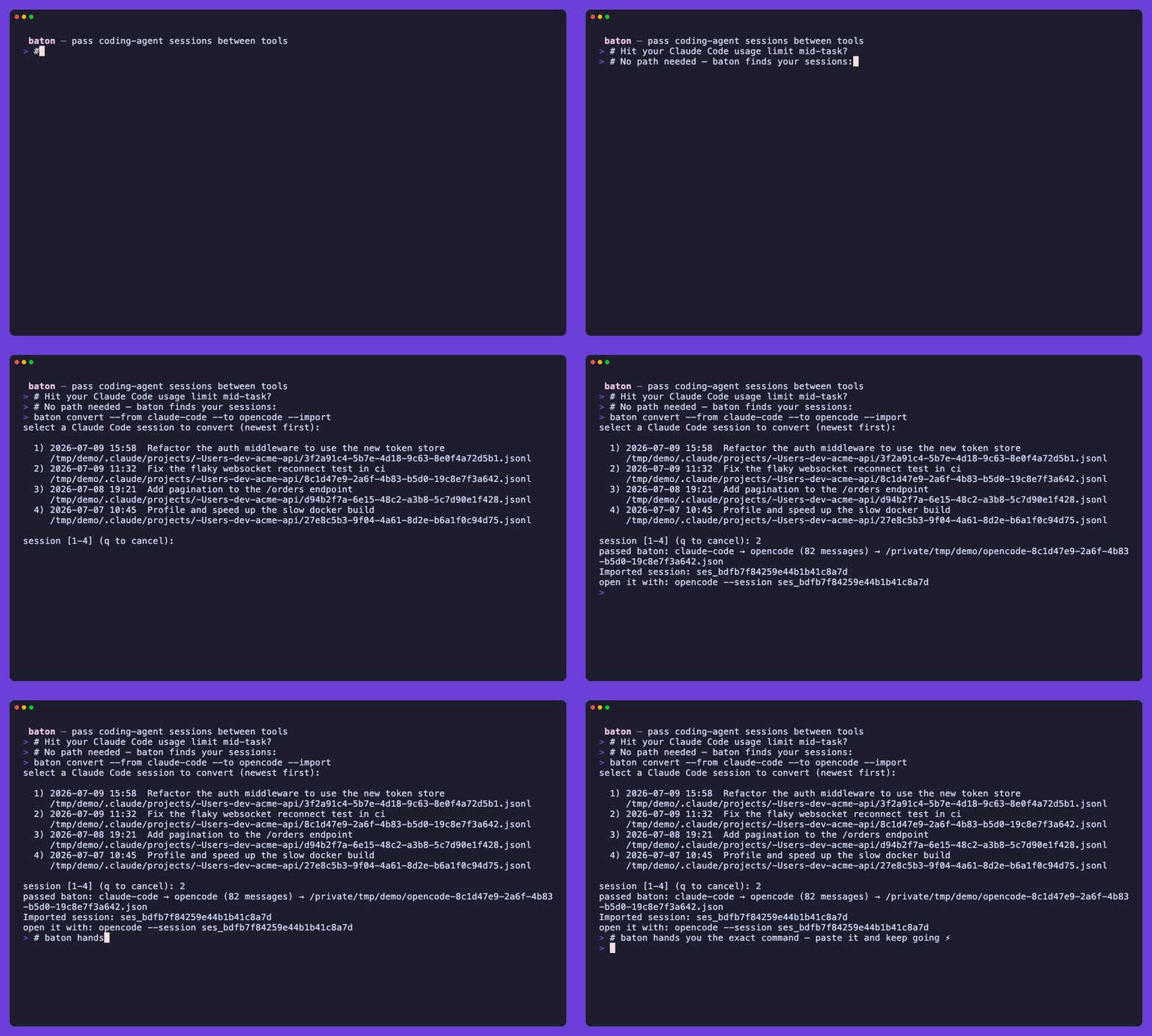
✅ With baton — pass the session and keep going:
baton convert --from claude-code --to opencode --latest --import
# using latest claude-code session: 2026-07-09 15:58  Refactor the auth middleware to…
# passed baton: claude-code → opencode (1388 messages) → handoff.json
# Imported session: ses_8c4c973a521549e2

opencode -s ses_8c4c973a521549e2   # same conversation, different runner
Works in every direction: switch agents mid-task, try a second opinion on a hard bug, move a session from your editor agent to a terminal agent, or archive everything in one format.
# zero-install run (downloads prebuilt binary)
npx @kasabeh/baton-mcp --help

# convert your most recent session + auto-import into the target agent
baton convert --from claude-code --to opencode --latest --import

# or omit the path to pick interactively — newest first,
# each session previewed by its first user message
baton convert --from claude-code --to opencode --import

# or pass an explicit session file
baton convert --from claude-code --to opencode <session.jsonl> --import

# see every session on your machine, across all agents
baton list
You never have to hunt these down (--latest and the interactive picker find them for you), but for reference — each agent stores its transcripts on disk:
| Agent | Location |
|---|---|
| Claude Code | ~/.claude/projects/<encoded-cwd>/<session-uuid>.jsonl |
| Codex CLI | ~/.codex/sessions/<YYYY>/<MM>/<DD>/rollout-*.jsonl |
baton list prints the path of every session it can find, across all agents.
| Agent | Read | Write | Auto-import |
|---|---|---|---|
| Claude Code | ✅ | ✅ | — |
| OpenCode | ✅ | ✅ | ✅ opencode import |
| Codex CLI | ✅ | ✅ | — |
| Gemini CLI | ✅ | ✅ | — |
| Zed | ✅ | ✅ | — |
| Aider | ✅ | ✅ | — |
| Cursor | ✅¹ | —² | — |
| Continue | ✅ | — | — |
| Cline / Roo | ✅ | —² | — |
¹ Cursor reads from exported JSON (sqlite3 state.vscdb "SELECT value FROM ItemTable WHERE key='aiService:chats'")
² Not planned: Cursor and Cline keep session state inside editor databases (SQLite / VS Code globalState) with no file-level import path.
Does carrying the full transcript beat writing a handoff summary for the next agent? We measured both on a real 3.4 MB Claude Code session (same model both arms, only the context differs):
| session size | baton transcript | handoff summary |
|---|---|---|
| sm (93 KB) | 3/3 details recalled | 1/3 |
| md (198 KB) | 6/6 | 1/6 |
| lg (599 KB) | 5/8 | 1/8 |
| total | 14/17 | 3/17 |
The summary lost concrete facts (versions, line counts, MSRV) even on the smallest slice — the receiving agent had to re-read files and re-run commands to rediscover them. Mechanical fidelity: all 896 messages are written to every target; round-trip loss reflects each target format's expressiveness (claude-code 896/896, codex 736, gemini-cli 723, aider 111 — it stores chat text only).
We also measured task continuation: cut the session at three mid-task points, ask a fresh agent to state the task, state, and next steps. Result: parity (baton 10/12, handoff 10/12) — a good summary is enough for what to do next; the transcript is what answers the specific factual questions the summary's author didn't anticipate. And the summary only exists if an agent spends a full transcript read writing it — baton makes the transfer free.
Full methodology, caveats, and reproduction steps: benchmark/RESULTS.md.
baton is also an MCP server — your agent can pass the baton itself, mid-conversation:
| Tool | Description |
|---|---|
list_sessions | Scan all agents, return a unified list |
convert_session | Convert a session from one format to another |
import_to_target | Convert + run the target agent's import command |
detect_format | Sniff a file/dir and report which agent produced it |
baton install     # registers baton in every detected agent's MCP config
baton doctor      # verify
baton uninstall   # remove from all agents
Claude Code session (.jsonl)
      │
      ▼
  baton read ──► canonical Session { messages: [Text, Reasoning, ToolCall, ToolResult] }
      │
      ▼
  baton write ──► OpenCode import JSON (SessionV1 schema)
Every agent format is read into a canonical intermediate representation, then written out in the target format. Adding a new format is O(1), not O(N×M) per-pair converters.
# npm (prebuilt binary, no Rust needed)
npm install -g @kasabeh/baton-mcp

# Homebrew
brew install kaseban/tap/baton-mcp

# Cargo binstall (prebuilt binary)
cargo binstall baton-mcp

# Cargo (from source)
cargo install baton-mcp

# Shell installer (prebuilt binary)
curl --proto '=https' --tlsv1.2 -LsSf https://github.com/Kaseban/baton/releases/latest/download/baton-mcp-installer.sh | sh
Or grab a binary from GitHub Releases.
git clone https://github.com/Kaseban/baton.git
cd baton
cargo build --release
./target/release/baton --help
Each format lives in src/formats/<name>.rs and implements the Format trait (read + write). See src/formats/claude_code.rs for a complete reference implementation.
All nine formats have readers; Claude Code, OpenCode, Codex, Zed, Aider, and Gemini CLI also have writers. The most impactful contribution now is a writer for Continue.
The README GIF is scripted with VHS: vhs assets/demo.tape. It records against a sandboxed $HOME (/tmp/demo) populated with fabricated sessions, so no real session data ends up in the GIF.
Don't drop the baton.
Dual-licensed under MIT OR Apache-2.0.
Run Claude Code as an MCP server so any agent can delegate coding tasks to it
 @microsoft✓ Official
Browser automation using accessibility snapshots instead of screenshots
 @googleapis✓ Official
Google's universal MCP server supporting PostgreSQL, MySQL, MongoDB, Redis, and 10+ databases
 @github✓ Official
Official GitHub integration for repos, issues, PRs, and CI/CD workflows
