

Are you the author? Sign in to claim
Brave API is totally free. No login. No API key. No bullshit.
An async Python client for Brave Search, providing streaming AI answers and structured web search in a single, typed interface — with a built-in Model Context Protocol (MCP) server.
Ask (AI)
client.ask() — blocking call, returns a complete StreamResult with text, infobox, images, videos, web results, and followupsclient.ask_stream() — async generator that yields StreamEvent objects in real timeconversation_id and symmetric_keyrun_tool execution for web search, image fetch, and other tool callsSearch (Web)
client.search() — scrape structured web and news results with paginationclient.suggest() — autocomplete suggestions with entity detectionMCP Server
ask, search, and suggest as MCP tools, ready to drop into Claude Desktop, Claude Code, Cursor, or any MCP-compatible clientGeneral
curl_cffi with browser fingerprinting (no API key required)graph TD
A[Your Application] -->|imports| B[BraveClient]
C[MCP Client<br/>Claude Desktop / Claude Code / other] -->|stdio| D[Brave API MCP Server]
G[OpenAI-compatible Client<br/>or remote agent] -->|HTTP / SSE| D
D -->|ask / search / suggest| B
B --> E[HTTPClient<br/>curl_cffi]
E --> F[Brave Search / Brave AI]
style B fill:#2b2b2b,stroke:#888,color:#fff
style D fill:#2b2b2b,stroke:#888,color:#fff
style F fill:#1a1a1a,stroke:#888,color:#fff
The library can be used directly in Python code, or indirectly through the MCP server, which wraps the same BraveClient and exposes it as tools for LLM-based agents.
curl-cffi, pydantic, pillowfastmcpuv pip install brave-api-python
From source:
git clone https://github.com/iqbalmh18/brave-api
cd brave-api
uv pip install -e ".[dev]"
With MCP server support:
uv pip install "brave-api-python[mcp]"
import asyncio
from brave_api import BraveClient

async def main():
    async with BraveClient() as client:
        # AI answer
        result = await client.ask("what is quantum computing?")
        print(result.text)

        # Web search
        search = await client.search("python asyncio tutorial")
        for item in search.web:
            print(item.title, item.url)

asyncio.run(main())
async with BraveClient() as client:
    result = await client.ask("mount bromo indonesia")

print(result.text)           # AI answer text (markdown)

if result.infobox:
    print(result.infobox.title)      # "Mount Bromo"
    print(result.infobox.subtitle)   # "Active volcano in East Java"
    print(result.infobox.url)        # Wikipedia URL
    print(result.infobox.image_url)  # entity image

for img in result.images:
    print(img.url, img.thumbnail)

for vid in result.videos:
    print(vid.title, vid.url)

for web in result.web_results:
    print(web.title, web.url)

for q in result.followups:
    print(q)
With an image (vision/multimodal):
from pathlib import Path

result = await client.ask("what is in this image?", image=Path("photo.jpg"))
async for event in client.ask_stream("what is Space X?"):
    if event.type is StreamEventType.TEXT_DELTA:
        print(event.delta, end="", flush=True)
    elif event.type is StreamEventType.TEXT_STOP:
        print()
    elif event.type is StreamEventType.FOLLOWUPS:
        for q in event.payload.get("followups", []):
            print(f"-> {q}")
| Method | Mode | Returns | Best for |
|---|---|---|---|
client.ask() | Blocking | StreamResult | Full result at once (infobox, images, etc.) |
client.ask_stream() | Streaming | AsyncGenerator[StreamEvent] | Typewriter output |
conversation() + collect() | Blocking | StreamResult | Multi-turn, image input, full control |
conversation() + stream_events() | Streaming | AsyncGenerator[StreamEvent] | Streaming + multi-turn |
async with BraveClient() as client:
    result = await client.search("python asyncio tutorial")

print(result.query)          # original query
print(len(result.web))       # number of web results
print(len(result.news))      # number of news results

for item in result.web:
    print(item.title)
    print(item.url)
    print(item.description)
    print(item.age)          # "2 days ago", etc.

for item in result.news:
    print(item.title, item.source, item.age)

# All unique URLs in a flat list
for url in result.urls:
    print(url)
Pagination:
# Page 1 (default)
page1 = await client.search("rust programming", offset=0)

# Page 2
page2 = await client.search("rust programming", offset=1)
Disable spellcheck for exact keyword matching:
result = await client.search("pyton tutorial", spellcheck=False)
suggestions = await client.suggest("elon")
for s in suggestions:
    print(s.text, s.entity_type, s.is_entity)
    if s.thumbnail:
        print(s.thumbnail)
ClientConfig is a frozen Pydantic model. All fields have safe defaults.
from brave_api import BraveClient, ClientConfig

config = ClientConfig(
    # Language and region
    language="id",                   # Response language: "id", "en", etc.
    ui_lang="id-id",                 # UI language: "id-id", "en-us", etc.
    country="id",                    # ISO 3166-1 country code
    geoloc="-6.200x106.816",         # lat x lng (Jakarta)

    # Search
    safesearch="moderate",           # "off", "moderate", or "strict"
    units_of_measurement="metric",   # "metric" or "imperial"

    # Mode
    enable_research=False,           # True = deep research mode

    # HTTP
    request_timeout_seconds=60.0,
    max_retries=3,
    retry_backoff_seconds=1.5,

    # Optional proxy pool
    proxy_list=[
        "http://user:password@proxy-1.example:8080",
        "socks5://proxy-2.example:1080",
    ],

    # Browser fingerprinting
    impersonate="chrome136",
    extra_headers={"X-Custom": "value"},
)

async with BraveClient(config) as client:
    ...
Pass proxy URLs through ClientConfig(proxy_list=...) to rotate proxy usage across requests. The pool is shared by Ask, Search, Suggest, and streaming requests.
from brave_api import BraveClient, ClientConfig

config = ClientConfig(
    proxy_list=[
        "http://user:password@proxy-1.example:8080",
        "http://proxy-2.example:8080",
        "socks5://proxy-3.example:1080",
    ],
)

async with BraveClient(config) as client:
    result = await client.search("python asyncio tutorial")
Supported proxy schemes are http, https, socks4, socks4a, socks5, and socks5h. Proxy URLs are normalized and duplicate entries are removed when the configuration is created.
The client selects an active proxy using round-robin order for each request. A proxy that fails before a response or stream data is received is disabled for the lifetime of that client. The next active proxy is tried automatically; if none remain, the request continues with curl_cffi configured for a direct connection (proxies=None). HTTP responses from Brave, including 429 and 5xx, do not disable a proxy.
Enable transport logs to see the selected proxy and fallback behavior. Proxy credentials are never included in these log messages.
import logging

logging.basicConfig(
    level=logging.DEBUG,
    format="%(asctime)s %(levelname)s %(name)s: %(message)s",
)
See examples/proxy-usage.py for a runnable example that reads comma-separated proxy URLs from BRAVE_PROXY_LIST.
async with BraveClient() as client:
    # New conversation
    conv = await client.conversation("explain how DNS works")
    result = await conv.collect()

    # Continue the same conversation
    conv2 = await client.conversation(
        "what is DNSSEC?",
        conversation_id=conv.id,
        symmetric_key=conv.symmetric_key,
    )
    result2 = await conv2.collect()
Key conversation() parameters:
| Parameter | Type | Description |
|---|---|---|
query | str | Question or prompt (required) |
conversation_id | str | None | Continue an existing conversation |
symmetric_key | str | None | Required when conversation_id is set |
image | bytes | str | Path | None | Image for multimodal input |
language | str | None | Override response language |
query_type | str | See QueryType enum |
auto_tools | bool | Auto-execute tool calls (default: True) |
context | str | None | Article/passage context |
quote | str | None | Highlighted text span |
async for event in conv.stream_events():
    if event.type is StreamEventType.TEXT_DELTA:
        print(event.delta, end="", flush=True)
    elif event.type is StreamEventType.TEXT_STOP:
        print()
    elif event.type is StreamEventType.ERROR:
        print(f"Error: {event.error_message}")
Key event types:
TEXT_DELTA / TEXT_STOP                    response text tokens
THINKING_DELTA / THINKING_STOP            chain-of-thought reasoning
TOOL_USE                                  server requests a tool call
AUGMENT_WITH_TOOL_USE                     run_tool result (web results, images, etc.)
AUGMENT_WITH_WEB / NEWS / IMAGES / VIDEOS enrichment data
AUGMENT_WITH_INFOBOX                      entity knowledge card
FOLLOWUPS                                 suggested follow-up questions
ERROR                                     server error event
CHALLENGE                                 CAPTCHA required
The sequence below shows how these events flow during a single ask() call:
sequenceDiagram
    participant App
    participant Client as BraveClient
    participant Brave as Brave AI

    App->>Client: ask(query)
    Client->>Brave: POST /api/tap/v1/new
    Brave-->>Client: SSE stream

    loop until stream ends
        Brave-->>Client: TEXT_DELTA / THINKING_DELTA
        Brave-->>Client: AUGMENT_WITH_WEB / IMAGES / INFOBOX
    end

    Brave-->>Client: FOLLOWUPS
    Client-->>App: StreamResult
result = await conv.collect()

result.text            # str - full AI answer (markdown)
result.thinking         # str - chain-of-thought reasoning (if any)
result.urls             # list[str] - unique URLs found
result.images           # list[ImageResult]
result.videos           # list[VideoResult]
result.web_results      # list[WebResult]
result.infobox          # Infobox | None
result.followups        # list[str]
result.citations        # list[dict] - raw tool result payloads
result.inline_entities  # list[dict]
result.raw_events       # list[StreamEvent] - every event for debugging
result.state            # StreamState enum
result.is_complete      # bool
result.has_images       # bool
result.has_videos       # bool
result.has_infobox      # bool
result.has_tool_calls   # bool
All exceptions inherit from BraveAPIError.
BraveAPIError
├── TransportError          network error, timeout, connection reset
├── HTTPStatusError         non-2xx HTTP response (.status_code, .response_text)
├── TokenExtractionError    could not parse auth token from server HTML
├── ConversationError       /api/tap/v1/new did not return a conversation id
├── StreamAbortedError      server sent an error event mid-stream
├── ChallengeRequiredError  server sent a CAPTCHA challenge
└── InvalidResponseError    response was not valid JSON or unexpected shape
from brave_api.exceptions import (
    BraveAPIError, ChallengeRequiredError, HTTPStatusError,
    StreamAbortedError, TransportError,
)

try:
    async with BraveClient() as client:
        result = await client.ask("what is rust?")
except ChallengeRequiredError:
    print("CAPTCHA required")
except HTTPStatusError as e:
    print(f"HTTP {e.status_code}: {e.response_text[:200]}")
except TransportError as e:
    print(f"Network error: {e}")
except StreamAbortedError as e:
    print(f"Stream aborted: {e}")
except BraveAPIError as e:
    print(f"Error: {e}")
Retry strategy: HTTP 429 and 5xx responses are retried with exponential backoff (backoff_seconds * 2^attempt).
The MCP server reuses this same hierarchy: any BraveAPIError raised by the client is caught and surfaced to the calling MCP client as a ToolError, so agents receive a clean, descriptive message instead of a raw stack trace.
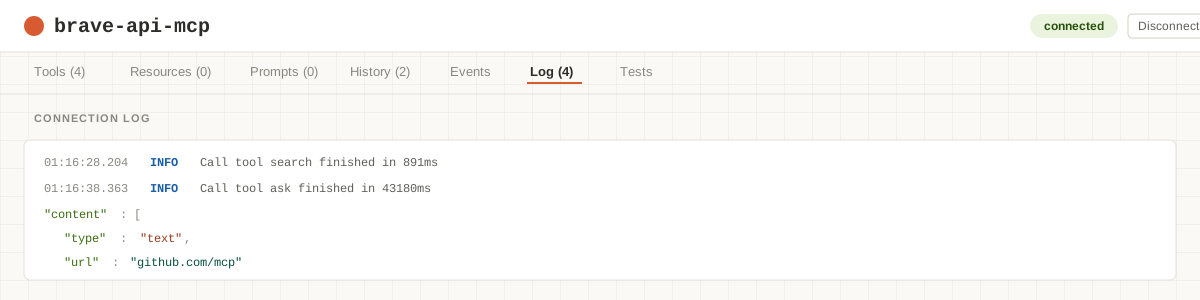
Brave API ships with a Model Context Protocol server built on FastMCP, exposing the client's core capabilities as tools for any MCP-compatible agent (Claude Desktop, Claude Code, Cursor, etc.).
| Tool | Description | Read-only |
|---|---|---|
ask | Ask Brave AI a question and receive a complete AI-generated answer with citations, source URLs, images, videos, and follow-up suggestions | Yes |
search | Search Brave and return structured web and news results (raw SERP, no AI answer) | Yes |
suggest | Fetch autocomplete suggestions for a partial query, including rich entity suggestions with thumbnails | Yes |
stdio (default — for local clients like Claude Desktop, Claude Code, Cursor):
python -m brave_api.mcp.server
# or via the CLI entry-point
brave-api-mcp
The server communicates over stdio and is meant to be launched by an MCP client, not run standalone in a terminal for interactive use.
HTTP (for remote or multi-client deployments, OpenAI-compatible clients):
brave-api-mcp --http
# bind to a specific host/port
brave-api-mcp --http --host 0.0.0.0 --port 8000
Full CLI reference:
usage: brave-api-mcp [-h] [--http] [--host HOST] [--port PORT]
                     [--log-level {debug,info,warning,error,critical}]

options:
  --http              Run with HTTP/SSE transport instead of stdio.
  --host HOST         Host address to bind to (HTTP transport only). [default: 127.0.0.1]
  --port PORT         Port to bind to (HTTP transport only). [default: 8000]
  --log-level LEVEL   Logging level. [default: warning]
Claude Desktop / Claude Code (claude_desktop_config.json or ~/.claude/claude_code_config.json):
{
  "mcpServers": {
    "brave-api": {
      "command": "python",
      "args": ["-m", "brave_api.mcp.server"],
      "env": {
        "BRAVE_COUNTRY": "id",
        "BRAVE_LANGUAGE": "id",
        "BRAVE_SAFESEARCH": "moderate"
      }
    }
  }
}
Or via the Claude Code CLI:
claude mcp add brave-api python -- -m brave_api.mcp.server
OpenAI-compatible clients / remote deployments — start the server in HTTP mode and point the client at the endpoint:
brave-api-mcp --http --host 0.0.0.0 --port 8000
The server exposes a standard MCP-over-HTTP (Streamable HTTP / SSE) endpoint at http://<host>:<port>/mcp. Any client that supports the MCP HTTP transport can connect to it directly.
All server behavior is controlled through environment variables — no code changes required.
| Variable | Default | Description |
|---|---|---|
BRAVE_BASE_URL | https://search.brave.com | Base URL for the Brave endpoints |
BRAVE_GEOLOC | library default | Geolocation as lat x lng |
BRAVE_COUNTRY | library default | ISO 3166-1 country code |
BRAVE_LANGUAGE | library default | Response language (BCP-47) |
BRAVE_UI_LANG | library default | UI language, e.g. en-us |
BRAVE_SAFESEARCH | library default | off, moderate, or strict |
BRAVE_ENABLE_RESEARCH | false | true/false/1/0/yes/no — enables deep research mode |
BRAVE_REQUEST_TIMEOUT | library default | Request timeout in seconds |
BRAVE_MAX_RETRIES | library default | Maximum retry attempts on transient failures |
BRAVE_MAX_CONCURRENT | library default | Maximum concurrent requests |
Invalid numeric or boolean values fall back to their defaults, with a warning logged rather than raising an error at startup.
Every tool call is wrapped so that any BraveAPIError raised by the underlying client is converted into an MCP ToolError with the original message, keeping error handling consistent between direct library use and MCP-based use.
| File | Description |
|---|---|
examples/quick_start.py | Simplest usage - ask and print |
examples/stream_events.py | Real-time token streaming |
examples/web_results_and_urls.py | Web results, thumbnails, URLs |
examples/images_and_videos.py | Image and video results |
examples/multi_turn_conversation.py | Multi-turn + answer regeneration |
examples/client_config.py | All ClientConfig options |
examples/language_override.py | Auto-detect vs explicit language |
examples/multimodal_image_input.py | Vision - attach image to query |
examples/context_and_quote.py | Context and quote parameters |
examples/auto_tools_control.py | auto_tools=True vs False |
examples/exception_handling.py | All exception types + stream state |
examples/inline_entities_and_citations.py | Inline entities and tool citations |
examples/context_manager_vs_manual.py | Client lifecycle patterns |
examples/raw_events_inspection.py | Inspect every raw event |
examples/thinking_mode.py | Chain-of-thought reasoning |
examples/interactive_chat.py | Terminal REPL chat |
examples/ask_method.py | ask() and ask_stream() demos |
examples/search_method.py | search() and suggest() |
examples/proxy-usage.py | Proxy pool rotation, fallback, and transport logging |
This project is licensed under the terms of the license found in the LICENSE file.
Run Claude Code as an MCP server so any agent can delegate coding tasks to it
 @microsoft✓ Official
Browser automation using accessibility snapshots instead of screenshots
 @googleapis✓ Official
Google's universal MCP server supporting PostgreSQL, MySQL, MongoDB, Redis, and 10+ databases
 @github✓ Official
Official GitHub integration for repos, issues, PRs, and CI/CD workflows