

Are you the author? Sign in to claim
The identity provider for AI agents — registry, scoped delegation, in-path MCP enforcement, instant revocation, tamper-e


The identity provider for AI agents. Every agent gets its own identity, authority that can only narrow when delegated, revocation that lands on its next action, and an audit trail it cannot write to.
Self-hosted. Single Go binary. Apache-2.0. chanceryai.vercel.app
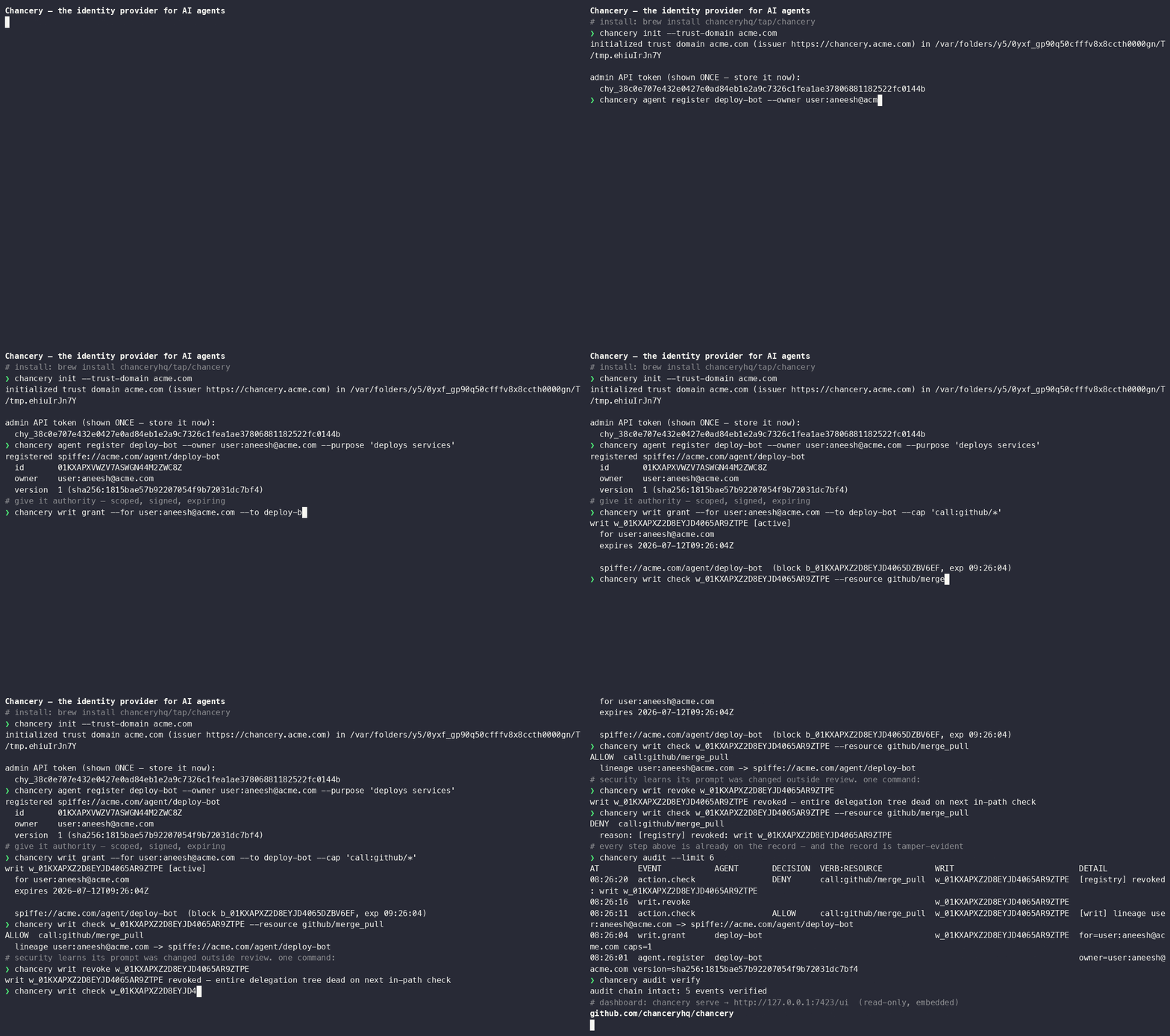
Agents usually run on a shared API key, so you can't revoke one without breaking the rest and can't attribute an action to a specific agent. A prompt injection then isn't bad output — it drives every tool that key can reach. And the logs come from the agent itself, the one component you stopped trusting the moment it was compromised.
Chancery moves all three outside the agent: identity it doesn't mint, authority it can't widen, and a record it can't write.
brew install chanceryhq/tap/chancery          # macOS / Linux
# or: docker run --rm -v chancery:/data ghcr.io/chanceryhq/chancery --help
# or: go build -o chancery ./cmd/chancery
Binaries are cosign-signed (keyless, GitHub OIDC) and ship an SBOM.
chancery init --trust-domain acme.com
chancery agent register deploy-bot --owner user:you@acme.com --purpose "deploys services"
chancery writ grant --for user:you@acme.com --to deploy-bot --cap "call:github/get_*" --ttl 8h

# run a real MCP server behind the gate, with a sealed token
chancery secret put github-token --from-file ./token
chancery mcp wrap --agent deploy-bot --writ <writ-id> \
    --secret GITHUB_TOKEN=github-token -- npx @acme/github-mcp
#   get_pull_request → ALLOW      forwarded, attributed, recorded
#   delete_repo      → DENY       never reaches the server

chancery writ revoke <writ-id>    # the agent's NEXT call fails, mid-session
chancery audit                    # the timeline; `audit verify` checks the chain
Full walkthrough: QUICKSTART · try every feature in order: testing playbook.
mcp wrap decides every tool call against
fresh state, filters tools/list, and answers denials in-protocol. A
prompt-injected agent can't talk its way around an out-of-process proxy.--confine adds an egress allow-list and read-only
filesystem as an OS boundary, and --run-as gives the server its own
UID so injected secrets aren't readable by anything sharing yours./ui.MCP-first, not MCP-only. Identity, writs, policy, credentials, and audit govern any agent in any language today via the decision API — see governing any agent. What's MCP-specific is the unbypassable enforcement; HTTP, shell, and browser PEPs follow, with the same writs.
| Quickstart | govern a real MCP server in 5 minutes |
| Concepts | agent, version, instance, writ |
| Governing any agent | the non-MCP path |
| Verify every claim | hands-on checks that each promise holds |
| Testing playbook | one guided run through every feature |
| Design RFCs | 19 locked decisions, each argued before it was written |
| Security | threat model and the honest gap table |
| Changelog | what shipped, when |
Examples: Claude Code / MCP clients · browser agents · LangGraph · Perseus Vault · Go SDK
Beta. All 19 design RFCs are locked and implemented; 109 tests across 11 packages gate every commit. The security model is settled and every known gap is published in SECURITY.md with an owner and a phase. The CLI and REST surfaces may still take breaking changes before 1.0, always noted in the changelog.
Two promises (RFC-011): what ships open source stays Apache-2.0 — no license flip, ever — and security is never paywalled; every gap in that table closes in the open core.
make build && make test    # Go 1.26+, no CGO; go vet + 109 tests in seconds
make demo                  # the 60-second enforcement + audit arc
CONTRIBUTING.md has the repo layout, how tests map to each RFC, and how to propose changes. Found a hole? Please open an issue — that's worth more to me than a star.
 @microsoft✓ Official
Browser automation using accessibility snapshots instead of screenshots
Run Claude Code as an MCP server so any agent can delegate coding tasks to it
 @googleapis✓ Official
Google's universal MCP server supporting PostgreSQL, MySQL, MongoDB, Redis, and 10+ databases
 @github✓ Official
Official GitHub integration for repos, issues, PRs, and CI/CD workflows