

Are you the author? Sign in to claim
A Claude Code skill bundle for bug hunting and external red-team work — 71 skills, 15 slash commands, 681 disclosed-repo
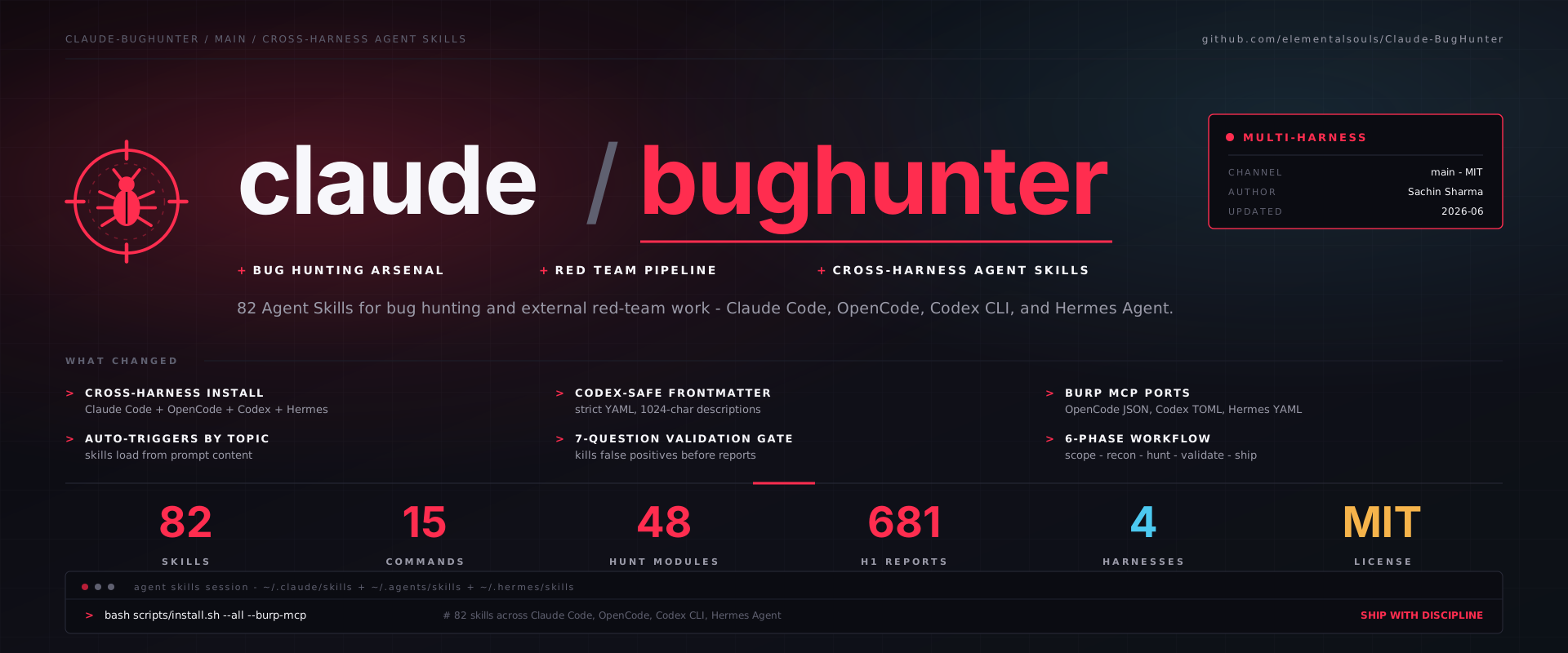
A self-contained Claude skill bundle for bug hunting and external red-team work · 71 skills · 15 slash commands · 681 disclosed-report patterns across 24 core vulnerability classes · enterprise identity + infrastructure attack matrices · engagement-folder scaffolding · Burp MCP integration · battle-tested across authorized red-team and bug-hunting engagements, plus public training platforms (DVWA, OWASP Juice Shop, Hacker101, testphp.vulnweb.com).
Built by Sachin Sharma — Bug Hunting & GenAI Security Research.
SPONSORED BY

claude-bughunter is a drop-in skill bundle for the Claude Code skills system. Install once and Claude Code stops being a chatbot and starts behaving like a senior bug-hunting researcher or red-team operator: it knows the techniques, the chain templates, the VRT mappings, the platform CVE chains, and the hygiene — and it stays in scope.
Four layers stack:
bb-methodology + redteam-mindset: the 5-phase non-linear workflow, critical-thinking framework, and red-team operator discipline.hunt-* skills curated from 681 disclosed HackerOne reports: per-class detection patterns, payloads, bypass tables, and chain templates.triage-validation + reporting + evidence-hygiene: the 7-Question Gate, VRT-aware severity, OOS rebuttals, PII redaction, and red-team deliverables.All triggered automatically by topic — describe what you're testing in plain English and the relevant skill loads. No invocation by name.
Option A — install as a Claude Code plugin (recommended). From inside Claude Code:
/plugin marketplace add elementalsouls/Claude-BugHunter
/plugin install claude-bughunter@elementalsouls
All 71 skills + 15 commands load namespaced under claude-bughunter: and update when you bump the plugin version — no files copied into ~/.claude/.
Option B — copy install (no plugin system / pin to a clone):
git clone https://github.com/elementalsouls/Claude-BugHunter.git
cd Claude-BugHunter
bash scripts/install.sh        # copies skills + commands into ~/.claude/
That's it. Open Claude Code and describe what you're testing in plain English — the right skill loads automatically, no invocation by name:
> Testing acme.com — an in-scope HackerOne target. Run recon and rank the surface.

  ⟳ loading skills: web2-recon, offensive-osint, bb-methodology …
    → subdomain enum (subfinder + crt.sh) … 47 hosts
    → live hosts (httpx) … 12 · tech fingerprint … 6 distinct stacks
    → ranked surface: api.acme.com (GraphQL, introspection ON)  ← start here
                      auth.acme.com (OAuth, SSO)               ← hunt-oauth

  Next: want me to probe the GraphQL introspection + OAuth redirect_uri?
→ Full Installation guide · Usage guide · searchable skill catalog.
The block above is an illustrative transcript. To record a real demo of your own session:
asciinema rec demo.cast→ upload to asciinema.org and drop the badge here.
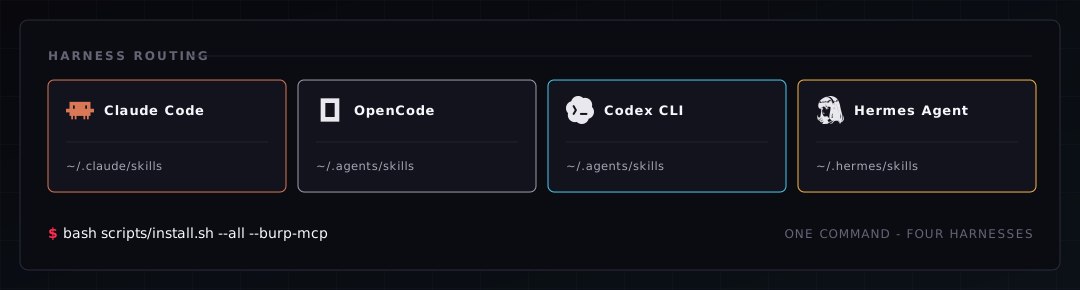
The skills are plain Agent Skills — the same SKILL.md format that Claude Code · OpenCode · OpenAI Codex CLI · Hermes Agent all load. One command installs them everywhere:
bash scripts/install.sh --all --burp-mcp
--all copies the skills to every harness's path (~/.claude/skills, ~/.agents/skills, ~/.hermes/skills); --burp-mcp wires the Burp MCP server into each. The full knowledge layer ports to all four — the slash commands and /hunt engine stay Claude-Code-only by design.
This bundle covers the external attack surface — anything reachable from the internet without first compromising an internal endpoint.
If you're running an internal red team that includes domain-takeover chains via Kerberos or lateral movement, this bundle won't help you in those phases — and we'd rather say that up front than have you find out mid-engagement. The external surface handoff to internal-RT tooling (Impacket, NetExec, CrackMapExec, Rubeus, Certify, BloodHound) is intentionally outside our scope. Coverage for internal AD and post-exploit may come in a future update.
71 skills, auto-loaded by topic — no invocation by name. Coverage across the external attack surface:
| Category | # | Examples |
|---|---|---|
| Web application hunting | 13 | XSS, SQLi, SSRF, IDOR, LFI, SSTI, XXE, CSRF, CORS, open-redirect |
| Authentication & identity | 7 | auth-bypass, session, OAuth, SAML, MFA-bypass, ATO |
| API & infrastructure | 15 | GraphQL, gRPC, WebSocket, API-misconfig, host-header, RCE |
| Advanced & concurrency | 6 | race-condition, HTTP smuggling, deserialization, cache-poison |
| Framework-specific | 4 | Next.js, Node.js, Laravel, Spring Boot |
| Enterprise identity & cloud ★ | 3 | M365/Entra, Okta, cloud-IAM-deep |
| Infrastructure & appliance ★ | 4 | VMware vCenter, enterprise VPN, SharePoint, ASP.NET/NTLM |
| Red-team tradecraft ★ | 4 | redteam-mindset, APK pipeline, supply-chain recon, mid-engagement IR |
| Recon & OSINT | 4 | web2-recon, offensive-osint, subdomain |
| Workflow, reporting & specialized | 11 | methodology, triage-validation, evidence-hygiene, VRT-aware reporting |
Full searchable catalog → docs/skills.md. Also ships 15 slash commands (/hunt, /recon, /report, …) and a deterministic engagement engine (engine/) that maps a target's attack surface and routes each finding to the skill that handles it.
A 6-phase, non-linear workflow — recon → map & rank → hunt → validate → report — with scope enforced in code and a 7-Question Gate before anything is submitted. Two ways to drive it:
/hunt scaffold + cbh CLI — engagement-folder structure, state, and orchestration.→ Usage guide & worked example · 6-phase architecture & skill-to-phase map · cbh CLI
These skills are intended for assets you own or have written authorization to assess (bug-bounty in-scope assets, pentest engagement letters, CTF challenges, your own infrastructure).
The skills include validation gates that auto-trigger when you point Claude at unverified third-party targets — triage-validation's 7-Question Gate explicitly asks whether the asset is in scope (Q3) and on the program's accepted-impact list (Q2). The bugcrowd-reporting skill includes researcher-side hygiene (Bugcrowdninja alias, account-state restoration, friendly-tester posture) that signals legitimate authorized testing to the target's fraud team.
The bundle explicitly excludes: weaponizing 0-days against unauthorized targets, post-exploitation tooling, malware development, mass-targeting infrastructure. See SECURITY.md for the full posture.
Heads-up — Anthropic runtime cyber safeguards. Anthropic's models apply real-time safeguards that block "vulnerability exploitation or offensive security tooling development" by default — so even authorized, in-scope work can hit a refusal that isn't this bundle's doing. If you do authorized offensive security (pentest / bug bounty / red team), enroll in Anthropic's free, application-based Cyber Verification Program (CVP) to get safeguards adjusted for legitimate dual-use work. (Mass data exfiltration and ransomware development stay prohibited and are not adjustable.) Details: Anthropic — real-time cyber safeguards.
| Doc | Contents |
|---|---|
README.md | This file — overview, quickstart, scope, skill summary |
INSTALL.md | Full setup with Burp MCP integration and optional skill regenerator |
USAGE.md | Workflow walkthrough · decision tree · worked engagement example |
docs/architecture.md | 6-phase architecture · skill-to-phase mapping · engagement composition |
docs/cbh-cli.md | cbh CLI — native runner orchestrating recon + classify + triage + report |
docs/cve-coverage.md | CISA KEV coverage snapshot — refreshed weekly via the workflow template at docs/automation/cve-refresh.yml.template |
docs/credits.md | Full attribution: 43 original skills + 8 vendored from upstream |
CONTRIBUTING.md | PR guidelines · skill quality standards · scope |
SECURITY.md | Authorized-use posture · responsible disclosure · what's excluded |
LICENSE | MIT |
Most bug-hunting Claude setups are either too generic (one big "security" prompt) or too fragmented (you bookmark 30 disclosed reports and re-read them every engagement). Neither scales past the second target.
This bundle was built and validated through authorized engagements that exposed different capability gaps:
Bug-bounty engagement — surfaced four gaps a starter 3-skill stack could not close:
External red-team engagement — exposed five additional gaps that bug-bounty defaults made worse:
redteam-mindsetmid-engagement-ir-detectionm365-entra-attack, okta-attack, hunt-sharepoint, hunt-aspnet, hunt-ntlm-info, vmware-vcenter-attack, enterprise-vpn-attack, apk-redteam-pipelineredteam-report-templatecloud-iam-deepThe per-class hunt-* skills address gap-zero ("what should I look for in webapps") — the original 24 codifying patterns from 681 disclosed HackerOne reports, with 20+ framework/surface skills added by the community v3 expansion — Claude knows the actual chain templates real triagers paid for, not abstract OWASP Top 10. The enterprise-platform and red-team-tradecraft layers address what bug-bounty alone cannot: external red-team engagements against monitored enterprise targets.
hunt-fintech-graphql, hunt-healthcare-fhir, hunt-gov-compliancescope.md from program texthunt-* skills with newer disclosed reports (re-run public-skills-builder)citrix-netscaler-deep, f5-bigip-attack, ad-cs-attack (AD Certificate Services)
Atlas Cloud is a full-modal AI inference platform that gives developers a single AI API to access video generation, image generation, and LLM APIs. Instead of managing multiple vendor integrations, you connect once and get unified access to 300+ curated models across all modalities.
Check out Atlas Cloud's new coding plan promotion for more budget-friendly API access: https://www.atlascloud.ai/console/coding-plan
Operational tradecraft accumulated across bug-bounty engagements and authorized pentests, codified into Claude skills. Platform-agnostic — slot into any engagement workflow you already use, or none.
Author: ElementalSoul · GenAI Security Research
Sister project: Claude-OSINT — paired skills for the recon phase that this bundle picks up after.
Vendored foundation: shuvonsec/claude-bug-bounty — methodology, validation, reporting, payload library (8 of 71 skills + 15 slash commands)
Generator tool used (not vendored): shuvonsec/public-skills-builder — used to scaffold per-class skills from H1 disclosed reports
Inspirations:
trailofbits/skills — skill-authoring disciplinetrilwu/secskills — subagent patternTool inventory:
License: MIT — use freely, attribution appreciated.
"Give Claude the right skill and it stops being a chatbot. It becomes an operator."
⚠️ Experimentelle Skill-Sammlung für deutsches Recht (Arbeits-, Gesellschafts-, Insolvenz-, Datenschutz-, Prozessrecht u
Manage multiple Claude Code agents from TUI or Web with tmux and git worktrees
Project management using GitHub Issues + Git worktrees for parallel agent execution
Core skills library for Claude Code with 20+ battle-tested skills including TDD, debugging, and brainstorming