Are you the author? Sign in to claim
Browse every recent Claude Code session across all your projects and jump back into any of them. Shows project path, sum
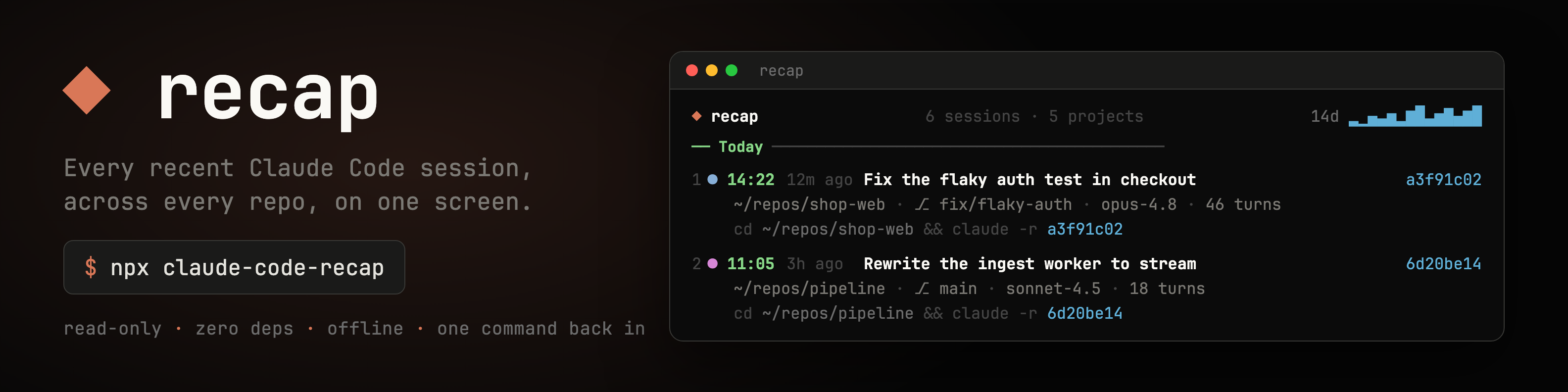
See every recent Claude Code session across every project on your machine, and get the exact command to jump back into any of them.


npx claude-code-recap then /recap





The GIF above is a downsampled loop. Full-quality recording: assets/demo.mp4.
Claude Code's built-in /resume only lists sessions for the directory you are standing in. After a reboot, a crash, or a week of jumping between five repos, there is no way to answer "what was I working on, and where did I leave off". recap answers that in one command, and can re-open a whole working set in terminal tabs.
The full story behind
recap, why it reads exactly two files and writes nothing, theshlex.quotesafety in--open, and the zero-dependency stance: Resume Claude Code Sessions Across Every Project on adatepe.dev.
 What it does
recap reads the session logs Claude Code already writes to disk and prints a day-grouped timeline of your recent sessions. Per session: last activity, the absolute project path, a short summary, an approximate turn count, the git branch, the model, the session id, and a ready-to-paste cd <path> && claude -r <id> resume command.
--pick jumps straight into one session.--open re-opens all of them, each in its own terminal tab, already resumed.--smart flag. Install
Three ways in, all live. The plugin marketplace is the native path; npx and curl | sh install the same skill into ~/.claude/skills/recap.
The repo is its own Claude Code marketplace. Two lines inside any Claude Code session:
/plugin marketplace add noluyorAbi/claude-code-recap
/plugin install claude-code-recap@noluyorabi-plugins
Then /reload-plugins, and invoke it as:
/claude-code-recap:recap
Plugin skills are namespaced plugin-name:skill-name, so this cannot collide with anything else you have installed. Add the marketplace by repo (owner/repo), not by a direct URL to marketplace.json: a URL-added marketplace downloads only that one file, and the entry's relative source (./) would not resolve.
Installs the skill into your Claude Code skills directory (~/.claude/skills/recap, or $CLAUDE_CONFIG_DIR/skills/recap):
npx claude-code-recap
Then invoke it as /recap. The package has no postinstall hook; it writes only when you run the command. It records a sha256 manifest of the files it wrote and refuses to clobber a directory it did not install or files you have edited, unless you pass --force.
npx claude-code-recap --force      # overwrite local edits
npx claude-code-recap --uninstall  # remove what it installed
Same install, no Node:
curl -fsSL https://raw.githubusercontent.com/noluyorAbi/claude-code-recap/main/install.sh | sh
Same guarantees as the npx path: sha256 manifest, no silent overwrite, --force and --uninstall supported.
curl -fsSL https://raw.githubusercontent.com/noluyorAbi/claude-code-recap/main/install.sh | sh -s -- --uninstall
If you use the skills directory CLI, recap resolves straight from this repo and installs across every agent it manages:
npx skills add noluyorAbi/claude-code-recap
Claude Code picks up ~/.claude/skills without a restart. Restart only if that directory did not exist when the session started.
Pick one path. Installing the skill and the plugin gives you /recap and /claude-code-recap:recap side by side; they will not conflict, but you carry two copies of the description in the skill listing.
 What you see
◆ recap 6 sessions · 5 projects 14d ▂▁▄▃▅▂▆█▃▅▇▄▆█
── Today ─────────────────────────────────────────────────────────────────────────────────
1 ● 14:22 12m ago Fix the flaky auth test in the checkout flow a3f91c02
~/repos/shop-web · ⎇ fix/flaky-auth · opus-4.8 · 46 turns
cd ~/repos/shop-web && claude -r a3f91c02-7b4e-4d19-9c2a-5f83e6d1b704
2 ● 11:05 3h ago Rewrite the ingest worker to stream instead of buffer 6d20be14
~/repos/pipeline · ⎇ main · sonnet-4.5 · 18 turns
cd ~/repos/pipeline && claude -r 6d20be14-0a8f-49c7-8b31-1e4d90c7aa52
3 ● 09:41 5h ago Draft the migration plan for the billing schema c17ff5a9
~/repos/billing-svc · ⎇ chore/migrate · opus-4.8 · 7 turns
cd ~/repos/billing-svc && claude -r c17ff5a9-2e6b-4f10-9d55-b0c3e7182f44
── Yesterday ─────────────────────────────────────────────────────────────────────────────
4 ● 22:58 1d ago Debug the flexbox overflow in the sidebar 9b3c0d67
~/repos/shop-web · ⎇ fix/flaky-auth · sonnet-4.5 · 31 turns
cd ~/repos/shop-web && claude -r 9b3c0d67-58a1-4c02-91ff-6ea27d3b8c19
5 ● 17:12 1d ago Set up the release workflow and the version check 40ea8b25
~/.claude · opus-4.8 · 12 turns
cd ~/.claude && claude -r 40ea8b25-c934-4d7e-a06b-72f1958e3dd0
── Fri 10.07 ─────────────────────────────────────────────────────────────────────────────
6 ● 16:30 3d ago Port the CLI to the new argparse layout e58a1c93
~/work/internal-tools/cli · ⎇ main · haiku-4.5 · 4 turns
cd ~/work/internal-tools/cli && claude -r e58a1c93-6f22-4bb8-83e0-9c17d4a52b61
turns ≈ user + assistant messages · --pick jump in · --open all in tabs · --smart 1-line summaries
In a real terminal this is colored: a day-grouped timeline (Today green, Yesterday amber), a 14-day activity sparkline in the header, and a stable per-project colored dot so the same repo keeps the same color across runs. Color is disabled automatically when the output is piped, and by NO_COLOR. The resume line is indented with spaces only, so a triple-click copies a command that actually runs.
| Flag | Default | What it does |
|---|---|---|
--since SPEC | off | only sessions active within the window: 30m, 24h, 7d, 2w |
--project SUBSTR | off | only sessions whose absolute project path contains SUBSTR (separators are interchangeable, so my_app, my-app and work/my_app all match /work/my_app) |
--limit N | 15 | maximum number of sessions listed |
--json | off | machine-readable output with full session ids and resume commands |
--smart | off | replace summaries with real one-sentence descriptions, via ONE claude -p call (network) |
--pick | off | pick a row interactively, then cd and claude -r straight into it |
--open | off | open every listed session in its own new terminal tab and resume it there (macOS) |
--claude-flags "FLAGS" | "" | extra flags for each resumed claude, passed through verbatim |
--terminal auto|iTerm2|Terminal | auto | which app --open drives; auto picks iTerm2 when it is installed |
--yes, -y | off | skip the --open confirmation prompt; required when stdin is not a TTY |
--dry-run | off | with --open: print the tabs and commands, open nothing |
--color | auto | force ANSI colors even when the output is piped |
--plain | off | disable all ANSI colors |
Environment: CLAUDE_CONFIG_DIR overrides ~/.claude. NO_COLOR, FORCE_COLOR and CLICOLOR_FORCE are honored. CLAUDE_CODE_SESSION_ID is read by --open so it never re-opens the session it is running in.
Run it directly, without the skill layer:
python3 ~/.claude/skills/recap/recap.py --since 7d --project shop-web
python3 ~/.claude/skills/recap/recap.py --json --limit 50 | jq '.[].projectPath'
An alias, if you want it outside Claude Code:
alias recap='python3 ~/.claude/skills/recap/recap.py'
 Restoring a whole working set with
 --open--open takes the sessions currently listed and opens one new terminal tab per session, typing the resume command into each. It is the fastest way back to a five-repo working set after a reboot.
# preview first: prints the tabs, opens nothing
python3 ~/.claude/skills/recap/recap.py --since 24h --limit 8 --open --dry-run

# then actually do it
python3 ~/.claude/skills/recap/recap.py --since 24h --limit 8 --open
Rules it follows:
--limit, --since and --project decide exactly which tabs appear. Preview with --dry-run before you commit.recap itself runs in is skipped automatically, matched on CLAUDE_CODE_SESSION_ID. It never re-opens itself.--yes it asks for confirmation. When stdin is not a TTY (which is the case for Claude Code's Bash tool) it refuses to open anything unless --yes is passed explicitly.osascript, so it is macOS-only. On other platforms --open exits with a clear message, and --open --dry-run still prints the commands so you can paste them anywhere.--claude-flags--claude-flags is passed through verbatim to every resumed claude. That includes --dangerously-skip-permissions:
python3 ~/.claude/skills/recap/recap.py --since 24h --limit 8 \
  --open --yes --claude-flags "--chrome --dangerously-skip-permissions"
Read that command for what it is. It launches N Claude Code sessions, in N different repos, each with every permission check disabled, each resuming a conversation you may not remember the contents of. A resumed session carries its old context with it, so whatever it was in the middle of, it can now finish without asking you. That is a real blast radius, multiplied by the number of tabs.
recap does not stop you. It prints an explicit warning before opening the tabs:
Opening 3 tab(s):
  Fix the flaky auth test in the checkout flow    cd /Users/you/repos/shop-web && claude --dangerously-skip-permissions -r a3f91c02-7b4e-4d19-9c2a-5f83e6d1b704
  Rewrite the ingest worker to stream instead o…  cd /Users/you/repos/pipeline && claude --dangerously-skip-permissions -r 6d20be14-0a8f-49c7-8b31-1e4d90c7aa52
  Draft the migration plan for the billing sche…  cd /Users/you/repos/billing-svc && claude --dangerously-skip-permissions -r c17ff5a9-2e6b-4f10-9d55-b0c3e7182f44
  skipped (path gone): /Users/you/repos/old-spike

  WARNING: --dangerously-skip-permissions disables all permission checks in every tab opened.
Use it only on repos you fully control, and only when you have looked at the --dry-run list first. If you are not sure what a session was doing, resume it without the flag and let it ask.
 How it works
Claude Code already logs your sessions to disk. recap is a reader for those logs, nothing more.
Data sources. Exactly two, both local:
| Path | What is read from it |
|---|---|
~/.claude/history.jsonl | fast global index: prompt text, timestamp, project path, session id |
~/.claude/projects/<encoded>/<session>.jsonl | the transcript, parsed only for the sessions about to be displayed: title, git branch, model, turn count, cwd |
CLAUDE_CONFIG_DIR is honored, so a non-standard config directory works.
Ordering. Candidate transcripts are ranked by file mtime, then re-sorted by the true last timestamp inside the file. Claude Code touches transcripts on compaction and title writes, so mtime alone is only an approximation.
Summaries. Preference order: Claude Code's own ai-title line, then the first real user prompt of the session, then (no prompt). Slash commands, system reminders and tool results are not treated as prompts. --smart replaces this with a real one-sentence summary.
Project paths always come from the cwd and project fields in the logs, never decoded back from the directory-name encoding, which is lossy. A session is resumable only from the directory it started in, so when a conversation cds somewhere else mid-session, recap keeps the starting directory: it picks the first recorded cwd whose encoding matches the transcript's own folder, and falls back to a sibling transcript when a session records no cwd at all.
Turn count is user prompts plus distinct assistant messages, grouped by message id so streaming chunks are not counted twice. It is labeled approximate because it is.
Robustness. Broken or partial JSONL lines are skipped, never fatal. recap sees only sessions still on disk; Claude Code prunes old ones on its own schedule.
 Privacy
This tool reads your conversation transcripts, so here is the precise claim.
$CLAUDE_CONFIG_DIR/history.jsonl and $CLAUDE_CONFIG_DIR/projects/*/*.jsonl (default ~/.claude). Nothing else on your filesystem is opened.recap run creates, modifies and deletes zero files. It never touches your session data. (The installers are the exception, and they only write into ~/.claude/skills/recap, tracked by a sha256 manifest.)--smart, which is opt-in and off by default. It shells out to your local claude CLI once and sends, for the listed sessions only: the 8-character session id prefix, the session title (first 150 characters), and the first user prompt (first 300 characters). No file contents, no transcript bodies, no other session. If the claude CLI is not on your PATH, --smart is skipped with a warning and the offline summaries are used.--open and --pick are the only paths that do anything outside stdout. --open drives iTerm2 or Terminal via osascript; --pick execs claude -r in the chosen directory. Neither writes to session data.The whole tool is one auditable file: skills/recap/recap.py, Python standard library only.
recap exits with a clear message if ~/.claude/projects does not exist.npx. Not needed at runtime.--open tab opening (iTerm2 or Terminal, driven by osascript). Everything else, including --open --dry-run, works on Linux and Windows.# npx install
npx claude-code-recap --uninstall
# curl install
curl -fsSL https://raw.githubusercontent.com/noluyorAbi/claude-code-recap/main/install.sh | sh -s -- --uninstall
Both refuse to delete files you have edited since installing, unless you pass --force.
If you installed it as a plugin instead, open the plugin manager with /plugin inside Claude Code and disable or remove claude-code-recap@noluyorabi-plugins there.
Issues and pull requests are welcome. The local loop:
git clone https://github.com/noluyorAbi/claude-code-recap
cd claude-code-recap

sh tests/smoke.sh              # end-to-end test against a synthetic config dir, no network
node scripts/check-version.mjs # package.json, plugin.json and SKILL.md must agree
claude plugin validate . --strict
claude --plugin-dir .          # load this checkout as a plugin for one session
tests/smoke.sh builds a fake CLAUDE_CONFIG_DIR and asserts the --json output, so it never reads your real sessions. CI runs it on every push, together with a Python syntax check, shellcheck, node --check, and a full install-update-uninstall cycle for both installers in a scratch directory.
Version numbers live in three places (package.json, .claude-plugin/plugin.json, skills/recap/SKILL.md under metadata.version) and CI fails if they disagree. Bump them together.
Two house rules for anything you submit: no emoji, and no em dashes or en dashes as punctuation.
MIT. See LICENSE.
1000+ skills curated from Anthropic, Vercel, Stripe, and other engineering teams
Design enforcement with memory — keeps your UI consistent across a project
Detects 37 AI writing patterns and rewrites text with human rhythm across 5 voice profiles
WCAG accessibility audit — automated scanning, manual review, remediation