

Are you the author? Sign in to claim
Make Codex reasoning budgets visible — MCP plugin, cosmic control UI, local estimator, and reversible Windows adapter.
Codex Reasoning Reactor turns an opaque model-and-effort picker into a compact, observable control surface. Across three project-defined profiles and six work modes, it presents local estimates for elapsed time, relative quota pressure, speed, task fit, and estimate confidence before work begins.
The same budget semantics power two surfaces:
Independent community project. Estimates are local heuristics, not OpenAI billing, quota, latency, reliability, or model-performance guarantees. Luna, Terra, and Sol are Reactor profile names, not official product names or SKUs.
A one-word effort setting hides several decisions: how long a task may take, how much relative budget it may consume, whether the task benefits from deeper serial work or parallel decomposition, and how confident the estimate is. Reactor makes those trade-offs visible at the moment of selection without pretending to know exact future cost.
The cosmic language is functional state encoding:
Motion stays inside the control. The rest of Codex remains readable and familiar.
Every profile exposes the same six-mode rail, for 18 selectable combinations.
| Profile | Intended use |
|---|---|
| Luna | Clear, repeatable, high-volume work |
| Terra | Everyday engineering and balanced tool use |
| Sol | Ambiguous, complex, high-value work requiring judgment |
| Mode | Meaning |
|---|---|
| Light | Fast handling for narrow, well-defined work |
| Medium | Everyday balance between speed and depth |
| High | Stable default for multi-step engineering work |
| XHigh | Deeper planning and verification for difficult tasks |
| Max | More reasoning budget for one task |
| Ultra | Parallel subagent work for tasks that can be divided |
Max and Ultra are not two points on the same scalar. Max allocates more depth to one task. Ultra changes the shape of execution: it adds parallelism and coordination overhead, may reduce wall-clock time for divisible work, and usually increases relative quota pressure.
Requirements: Git, Node.js 22+, a Codex build with plugin support, and the codex command on PATH.
git clone https://github.com/wangsiyi7/codex-reasoning-reactor.git
cd codex-reasoning-reactor
codex plugin marketplace add .
codex plugin add reasoning-budget@codex-reasoning-reactor
Or use the repository installer:
.\scripts\Install-Reactor.ps1
Start a new Codex task after installation so the skill and MCP tools are loaded. Try:
Show a reasoning budget for this task and compare Max with Ultra.
Run the standalone visual preview without installing anything:
npm run preview
# http://127.0.0.1:43191
The plugin is the primary product. The native adapter is a local, version-sensitive bridge for users who want the same control inside the installed Codex picker.
cd native-adapter\windows
.\Start-Codex-Energy.ps1 -ForceRestart
It launches the installed Codex app with a loopback Chrome DevTools Protocol port, injects a renderer-only enhancement, and routes choices through callbacks already owned by Codex. It does not patch app.asar, replace signed files, or ship a custom Codex build. Stop the watcher or restart Codex normally to remove the injected interface.
On the currently verified host build, Ultra also selects Codex's existing priority service tier. That is a real host-side choice, not merely an animation; confirm the native trigger and account implications before using it.
Read the native-adapter safety and rollback guide before enabling it.
flowchart LR
    E["Local budget engine"] --> M["stdio MCP server"]
    M --> W["Conversation widget"]
    E --> A["Optional Windows adapter"]
    A --> C["Existing Codex picker callbacks"]
    H["Opt-in local calibration"] --> E
The widget and adapter import the same model, mode, and estimation definitions. A second renderer never creates a second meaning.
| Plugin · Medium | Plugin · Ultra |
|---|---|
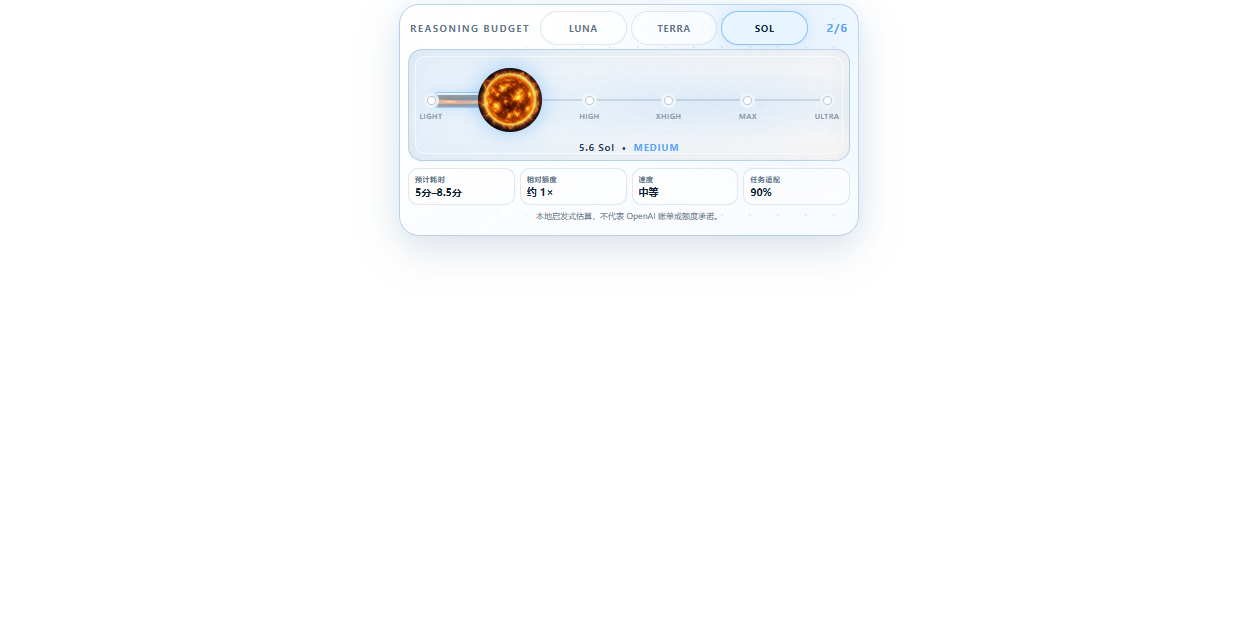 | 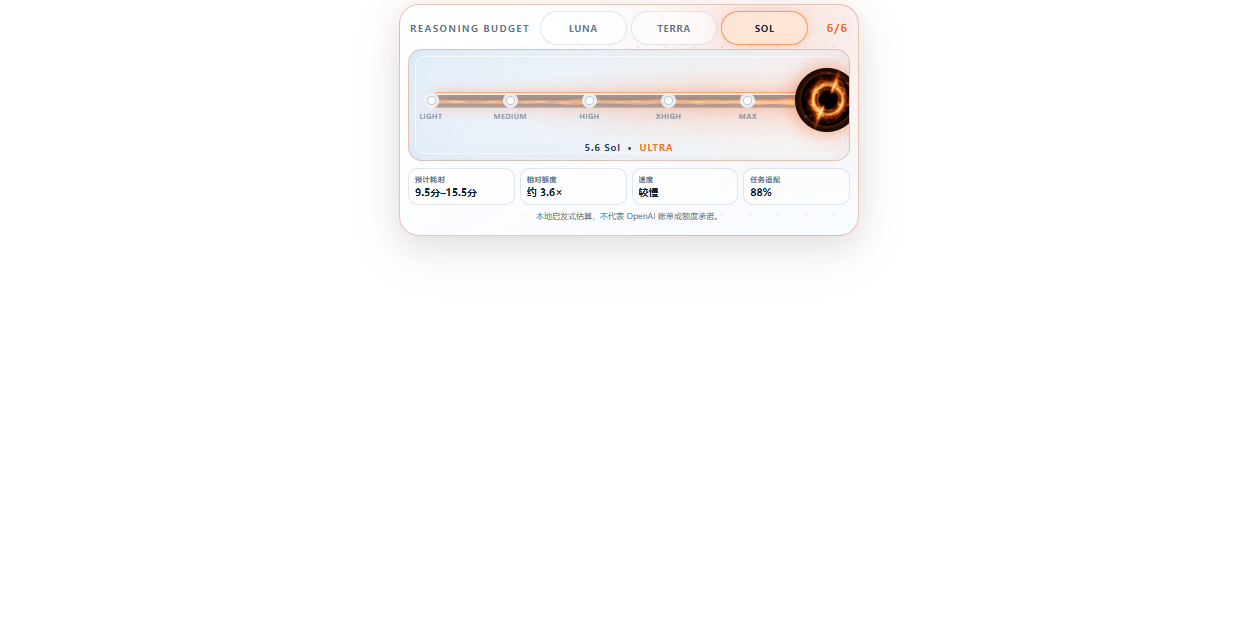 |
| Native control · Medium | Native control · Ultra |
|---|---|
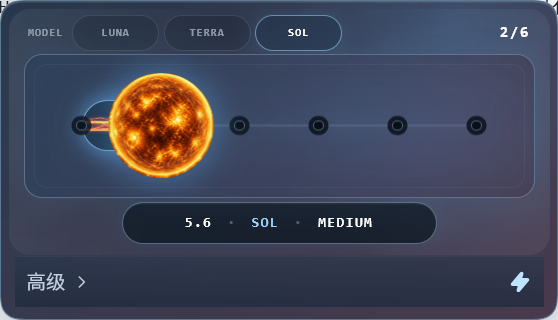 | 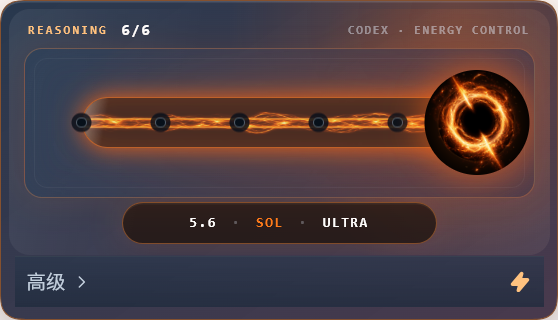 |

View the original concept by @xiaohu on X
That public post sparked the project's visual direction. We studied its orbital movement, progressive energy trails, material density, and cool-to-warm transitions, then independently designed and implemented a compact reasoning-budget system around those ideas. Discussion around the concept reinforced a more substantive goal: a reasoning control should communicate time, relative budget, speed, and confidence—not merely look impressive.
The original post and video are not mirrored, embedded as repository assets, or included in this project's licenses. See Inspiration and attribution.
The estimator combines task scope, prompt complexity signals, file count, context size, profile factors, mode factors, parallelizability, and optional local timing calibration. It returns a range and a relative multiplier against a project baseline—not a price or account-credit prediction.
See Budget model for the formula, confidence rules, and limitations.
| Surface | Mechanism | Data boundary | Rollback |
|---|---|---|---|
| MCP plugin/widget | Local stdio MCP + HTML resource | No hosted backend | Disable/remove plugin |
| Calibration | Opt-in JSONL history | Written only on explicit request | Delete local history |
| Windows adapter | Loopback CDP + renderer injection | No public listener | Stop watcher/restart Codex |
| X inspiration | External link only | No mirrored source media | Remove the link |
Read PRIVACY.md and SECURITY.md.
plugins/reasoning-budget/   Installable Codex plugin, MCP server, widget, tests
native-adapter/windows/     Optional renderer-only Windows bridge
artwork/originals/          Full-resolution generated source PNGs
assets/                     Asset provenance manifest and reproduction brief
media/                      Sanitized project captures used by GitHub docs
docs/                       Product philosophy, architecture, estimates, safety
scripts/                    Repository validation, asset manifest, installer
.agents/plugins/            Repo-local Codex marketplace
npm test
npm run check
npm run assets:manifest
The normal test suite validates the budget engine, MCP protocol/resource, 18 profile combinations, generated PNG assets, adapter injection expression, repository structure, public-text hygiene, and provenance hashes. Live adapter verification is intentionally manual because it requires an installed Codex renderer.
Source code is MIT licensed. Original project illustrations are offered under CC BY 4.0 to the extent contributors hold licensable rights. Third-party software UI and trademarks visible in project screenshots are excluded from the asset license. See ASSET_LICENSE.md and NOTICE.md.
 @microsoft✓ Official
Browser automation using accessibility snapshots instead of screenshots
Run Claude Code as an MCP server so any agent can delegate coding tasks to it
 @googleapis✓ Official
Google's universal MCP server supporting PostgreSQL, MySQL, MongoDB, Redis, and 10+ databases
 @github✓ Official
Official GitHub integration for repos, issues, PRs, and CI/CD workflows



