

Are you the author? Sign in to claim
Local-first memory for AI agents — one SQLite file you own, offline, no API key. Claude Code plugin for automatic recall

Local-first memory for your AI agent.
One SQLite file you own — offline, no API key. Plugs straight into Claude Code.





Your memory as a banked fire — warmth is belief, the cold is forgetting. Pinned facts sit under glass; the weak gutter out.
Your agent forgets everything between sessions. coldframe gives it a memory that lives in one
local file (~/.cold-frame/memory.db) — with full-text + vector search, version history, automatic
forgetting, and the ability to rewind what was true when. No server, no account, no key.
In Claude Code — one install, then it remembers automatically:
claude plugin marketplace add coldzero94/cold-frame
claude plugin install coldframe
Recall is injected at the start of every session; durable facts you state are captured as you work (using the Claude you already pay for — no extra key or cost). Nothing to configure.
On the command line — offline, instant:
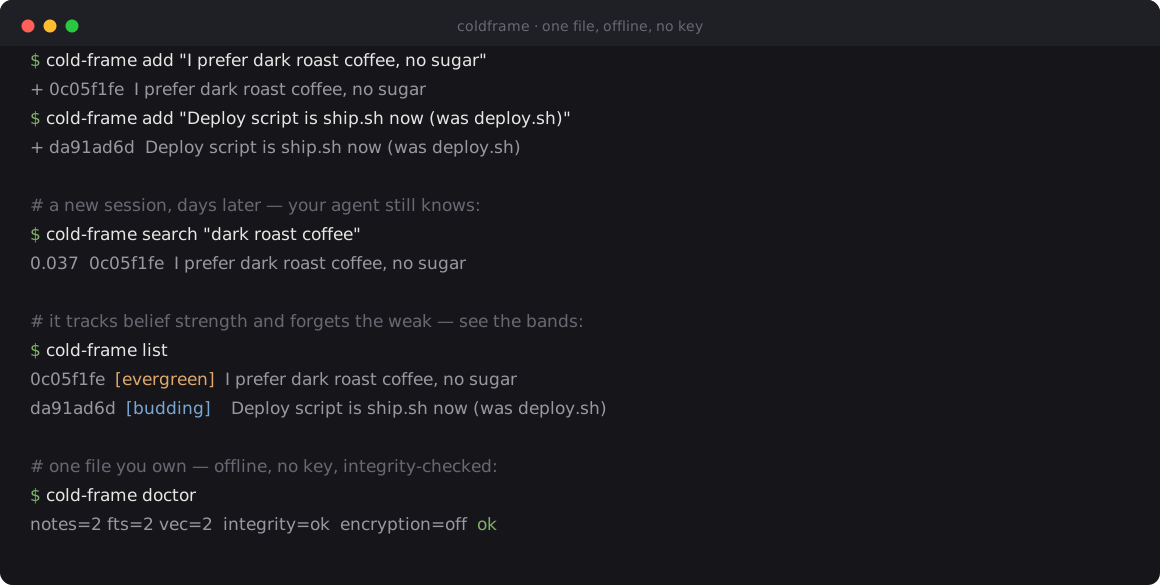
cold-frame add "I prefer dark roast coffee."
cold-frame search "dark roast coffee"
cold-frame list            # each memory with its strength band
cold-frame doctor          # health: counts, integrity, embedder
(Install: brew install coldzero94/coldframe/cold-frame (Apple Silicon macOS + Linux x86_64), or
download the self-contained binary for your platform from the
latest release — CLI + MCP in one file,
no Python needed. The optional [local-llm] (semantic recall) extra isn't in the binary; install
from source for that — see examples/.)
~/.cold-frame/memory.db. Copy it to back up, delete it
to forget. No server, no account.add → search works with zero keys, zero network.valid_at, never
the LLM). Detecting that two facts contradict needs a model: the cold-frame worker (and
COLD_FRAME_LLM=claude, using your Claude session — no API key) turn it on; the zero-key offline
default still does exact/near-duplicate merging and honors explicit correct/supersede.add_memory during your session (a
bundled skill), with a keyless deterministic backstop so nothing is missed; dedup merges them.add --redact-pii, or
Memory(pii_redact=…)) — off by default so a personal store keeps your own contact facts. For
at-rest protection, the DB is a single local file — put it on an OS-encrypted disk (FileVault /
LUKS), which covers the stolen-laptop threat without a second key to manage.HashEmbedder,
no download). For semantic recall, install from source with the [local-llm] extra and set
COLD_FRAME_EMBEDDER=local (a small local bge-small model, downloaded once — nothing leaves the
machine). After switching on an existing DB, run cold-frame reembed to re-index.It's a standard stdio MCP server, so it works with any MCP client — not just Claude Code.
from datetime import UTC, datetime
from cold_frame import Memory, Scope

mem = Memory()                                   # ~/.cold-frame/memory.db, offline
me = Scope(user_id="coby")
mem.add("I switched jobs to Anthropic in 2026.", scope=me)
print(mem.search("where do I work?", scope=me).hits[0].note.content)

past = mem.search("where do I work?", scope=me, as_of=datetime(2026, 3, 1, tzinfo=UTC))  # rewind
See and edit your memory anytime: cold-frame ui — a local dashboard at 127.0.0.1:27182 where
you can browse facts and pin / correct / forget them (writes are CSRF-guarded and localhost-only).
packaging/ (plugin, Homebrew, standalone binary)docs/ (the spec, decisions, and the analysis of mem0 / Letta /
Zep-Graphiti / Cognee / MemOS / A-MEM / LangMem that informed it)cold-frame export backup.db then import it elsewhere.The engine, CLI, MCP server, Claude Code plugin, deterministic pre-disk secret-blocking +
grep-verified hard-purge, opt-in PII redaction, an admission confidence-gate + opt-in consent hold,
idempotent event-log replay import, and a local web UI are built and tested end-to-end on a fully
offline gate (ruff + mypy --strict + ~420 deterministic mock-LLM tests green on a 3.12/3.13 CI
matrix). The automatic
recall + capture loop is verified end-to-end against real Claude Code. Distributed as a self-contained
binary via Homebrew + GitHub Releases (not PyPI).
Apache-2.0.
 @googleapis✓ Official
Google's universal MCP server supporting PostgreSQL, MySQL, MongoDB, Redis, and 10+ databases
Official MongoDB integration — query collections, run aggregations, inspect schemas
 @designcomputer
Secure MCP server for MySQL database interaction, queries, and schema management
Run Claude Code as an MCP server so any agent can delegate coding tasks to it