

Are you the author? Sign in to claim
An operating system for AI agents. Plug in the agent CLIs you already use (Claude Code, Codex, Gemini CLI, Cursor) and t

The system around the agent, already built.
An operating system for AI agents.


Anyone can prompt an agent. Making agents work continuously is still an engineering project: loops, triggers, cron, memory, permissions, approvals, observability, and the glue scripts that hold them together. CompozyOS turns that entire agent stack into one product, a complete environment to create, automate, and supervise agent work with the agent CLIs you already use (Claude Code, OpenClaw, and Hermes). Built first for developers and technical operators.
[!WARNING] The v0.3 line is in beta. The previous v0.2.15 product is deprecated and maintained only for critical fixes on
legacy/v0.2. Start with the migration guide before replacing an existing v0.2 installation.
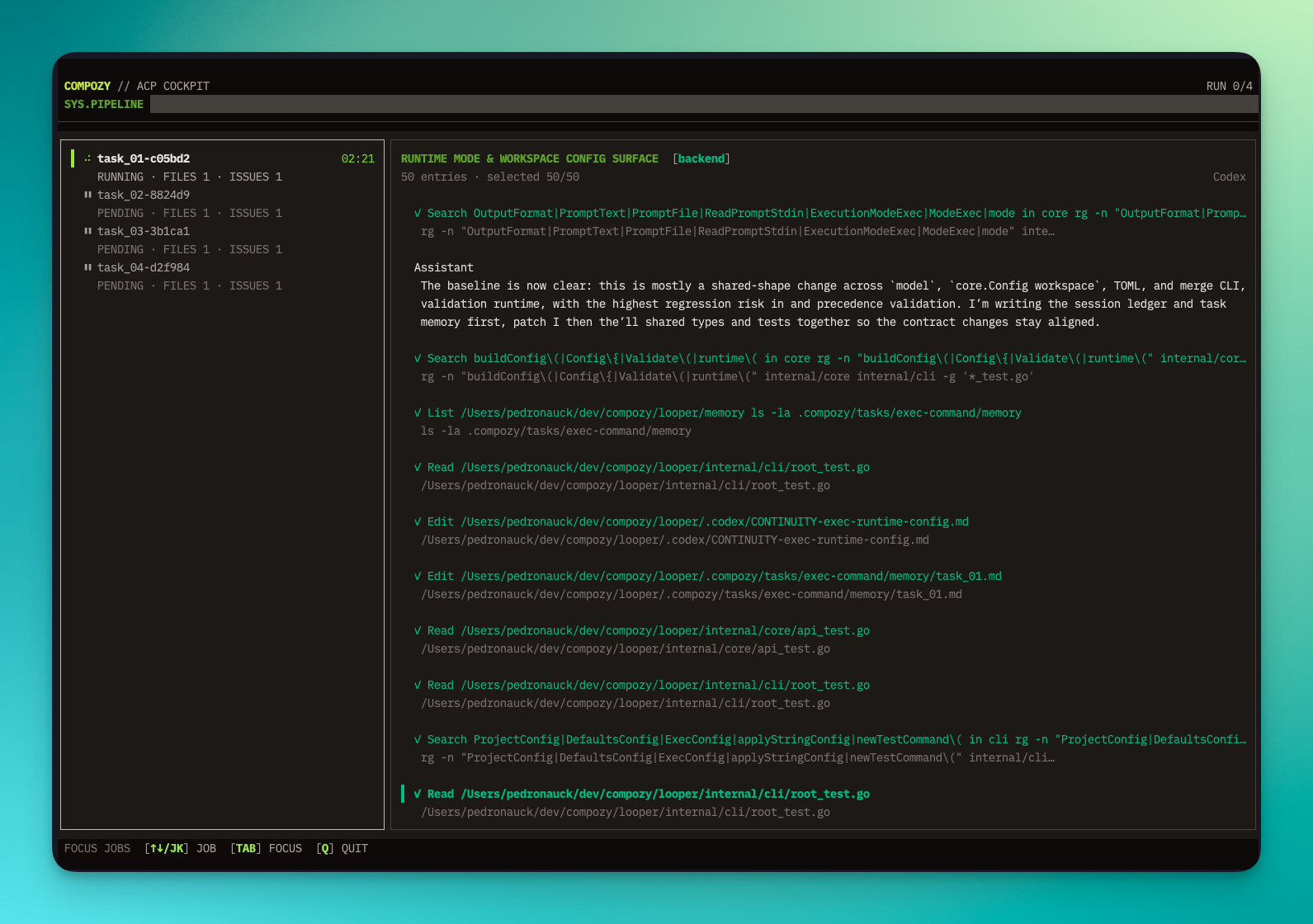
compozy-network/v0.The v0.3 beta ships through the channels below. Homebrew continues to serve the deprecated v0.2 line
during the beta window and is intentionally omitted here. The compozy formula returns with v0.3.0
stable.
The installer pins the latest published beta and verifies Sigstore provenance before installing the binary on macOS or Linux.
curl -fsSL https://compozy.com/install.sh | sh
npm install -g @compozy/cli@beta
Go's @latest still resolves the v0.2 stable line while v0.3 is in beta, so install with the
explicit tag shown on the latest release:
go install github.com/compozy/compozy@<release-tag>
git clone https://github.com/compozy/compozy.git
cd compozy
go build -o ./bin/compozy .
The installation guide covers installer flags, Linux packages, source builds, verification, and managed updates.
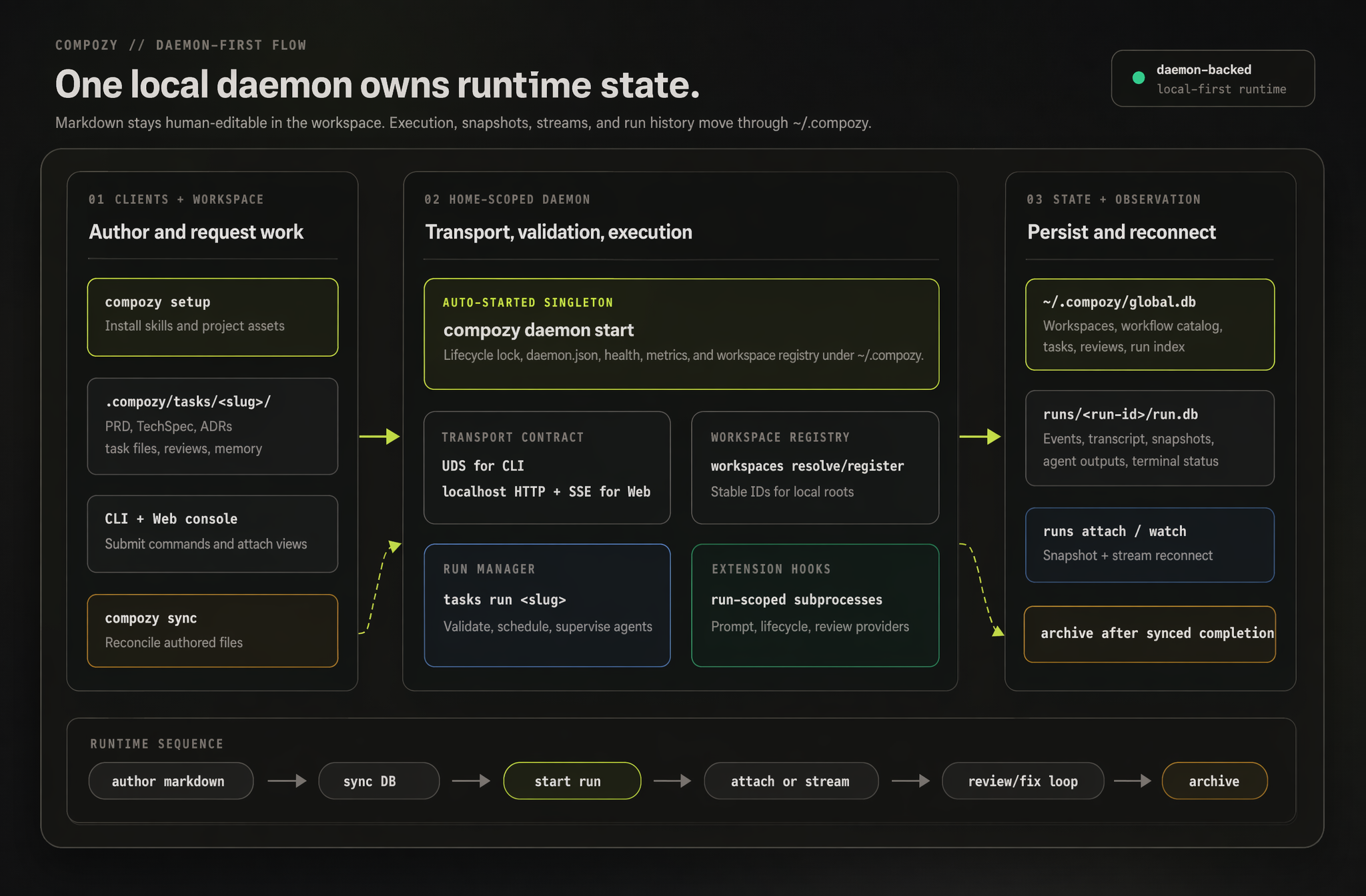
People and agents send commands through public control surfaces. The home-scoped daemon resolves the workspace, applies permissions and runtime policy, coordinates ACP agents, and persists events and resource state. Web and streaming clients read that same daemon-owned truth instead of maintaining a parallel model.
compozy daemon start, compozy status, and compozy daemon stop manage the local daemon.
Sessions, tasks, Loop runs, memory,
automation, tools, and Compozy Network activity keep explicit owners and workspace boundaries. Use
structured CLI output (-o json), HTTP/SSE, UDS, MCP, or native tools when another agent or program
needs to manage the same resources.
Authored task files remain portable Markdown with typed frontmatter. The v0.3 runtime imports them
into durable tasks and executes them through Loops; it does not revive the v0.2 tasks run pipeline.
See Migrate from v0.2.15 for the exact schema and command changes.
Global defaults live in ~/.compozy/config.toml; a workspace can override supported fields through
.compozy/config.toml. Explicit command flags win over workspace configuration, which wins over
global configuration and built-in defaults.
compozy config path
compozy config validate
compozy config show -o json
Configuration, credentials, and provider-home policies have different owners. Follow the configuration guide instead of copying v0.2 state into a v0.3 home.
Agent definitions live under ~/.compozy/agents/<name>/ or .compozy/agents/<name>/. Each definition
has an AGENT.md and may include an agent-local mcp.json. Workspace definitions override global
definitions as a whole.
compozy agent list -o json
compozy agent info general -o json
compozy session new --agent general
Extensions add versioned resources and runtime behavior through declared provide surfaces. The daemon owns discovery, enablement, trust decisions, lifecycle, and hooks; extensions do not bypass public runtime contracts.
compozy extension init hello --template tool-provider-go
compozy extension dev hello
compozy tool invoke ext__hello__search --workspace . --input '{"query":"compozy"}'
Executable extensions are code-first: declare the tool once in code and compozy extension build
generates the manifest. Resource-only extensions can instead hand-write extension.toml and use the
same build, dev, reload, and watch loop without running extension code. Walkthrough:
Build your first extension.
@compozy/extension-sdk (npm, MIT) and github.com/compozy/compozy/sdk/go are published and
version-matched to the daemon.
compozy extension list -o json
compozy extension status <name> -o json
compozy extension provenance <name> -o json
compozy extension logs <name> --follow
Bootstrap the home, start the daemon, enter the repository you want agents to work in, and create one
durable session. CompozyOS infers and registers the workspace from the current directory; use
--workspace <id|name|path> only when you need an override.
compozy install
compozy daemon start
compozy session new --agent general --name first-run
The Quick Start continues through the first prompt, live attachment, inspection, and cleanup.
Skills are daemon-discovered resources with explicit source and scope. Use the structured skill and marketplace surfaces to inspect what is active instead of copying v0.2 setup directories forward.
compozy skill list -o json
compozy skill inspect <name> -o json
compozy marketplace search --kind skill --query <term> -o json
Durable memory is scoped and daemon-owned. Agents can inspect, propose, and consolidate memory through the same public contracts as people. The v0.2 workflow-memory files remain ordinary repository artifacts; they are not imported as hidden runtime state.
CompozyOS runs ACP-compatible agent CLIs and adapters. The active provider catalog and each agent's runtime settings are runtime truth; inspect them before selecting a model or reasoning mode. See the provider guide for authentication and provider-home policies.
The generated CLI reference is authoritative for verbs, flags, structured output, and exit behavior. Start with:
compozy --help
compozy version
compozy doctor -o json
CompozyOS is a Go and Bun monorepo. Start the daemon with automatic Go rebuilds and the web UI with Vite HMR:
make dev
Run the affected local gate before committing or pushing:
make gate
Delivery finishes in the draft PR: wait for every required CI check to pass on its current head.
Read AGENTS.md and the surface-specific instructions before editing.
Contributions are welcome. Open an issue or pull request, keep public behavior agent-manageable, and
run make gate before sending changes, then keep the PR until its current-head CI is green. Security reports belong in the repository's
private security channel, not a public issue.
Thanks to everyone who has contributed to CompozyOS.
CompozyOS is distributed under the MIT License.
Run analytics queries on ClickHouse — explore schemas, execute SQL, fetch results
Run Claude Code as an MCP server so any agent can delegate coding tasks to it
 @microsoft✓ Official
Browser automation using accessibility snapshots instead of screenshots
 @googleapis✓ Official
Google's universal MCP server supporting PostgreSQL, MySQL, MongoDB, Redis, and 10+ databases