

Are you the author? Sign in to claim
An implementation of the ConnectRPC protocol for Rust




A Tower-based Rust implementation of ConnectRPC, serving Connect, gRPC, and gRPC-Web clients over HTTP with binary or JSON protobuf messages.
Status: pre-1.0. The API surface is settling but may shift in 0.x. Production-quality runtime: passes the full ConnectRPC conformance suite — 3,600 server and 6,872 client tests across the three protocols.
MSRV: Rust 1.88 (declared on the workspace, verified in CI).
Documentation:
examples/ - runnable end-to-end examples (streaming, tower middleware, TLS, multi-service, browser/wasm, Bazel).connectrpc provides:
connectrpc — A Tower-based runtime library implementing the Connect protocolprotoc-gen-connect-rust — A protoc plugin that generates service traits, clients, and message typesconnectrpc-build — build.rs integration for generating code at build timeconnectrpc-health — The standard grpc.health.v1.Health service, for grpc_health_probe / kubelet gRPC probes / service-mesh health checksconnectrpc-reflection — The standard gRPC server reflection service (grpc.reflection.v1 + v1alpha), so grpcurl, buf curl, Postman, and grpcui can discover and call your servicesThe runtime is built on tower::Service, making it framework-agnostic. It integrates with any tower-compatible HTTP framework including Axum, Hyper, and others.
// greet.proto
syntax = "proto3";
package greet.v1;

service GreetService {
  rpc Greet(GreetRequest) returns (GreetResponse);
}

message GreetRequest {
  string name = 1;
}

message GreetResponse {
  string greeting = 1;
}
Two workflows are supported. Both produce the same runtime API; pick the one that fits your build pipeline.
buf generate (recommended for checked-in code)Runs two codegen plugins (protoc-gen-buffa for message types,
protoc-gen-connect-rust for service stubs) and protoc-gen-buffa-packaging
twice to assemble the mod.rs module tree for each output directory. The
codegen plugins are invoked per-file; only the packaging plugin needs
strategy: all.
protoc-gen-buffa and protoc-gen-buffa-packaging ship from the
buffa repo - see its release
page for binaries or cargo install.
For protoc-gen-connect-rust, three options:
1. Download a pre-built binary from the GitHub release. Releases
ship Linux (x86_64, aarch64), macOS (x86_64, aarch64), and Windows
(x86_64) binaries, each with a SHA-256 checksum, a Sigstore signature
(.sig + .pem), and a GitHub-native build provenance attestation.
VERSION=v0.7.0
PLATFORM=linux-x86_64        # or darwin-aarch64, etc.
BASE=https://github.com/anthropics/connect-rust/releases/download/${VERSION}
BIN=protoc-gen-connect-rust-${VERSION}-${PLATFORM}

curl -fSL -o "${BIN}"        "${BASE}/${BIN}"
curl -fSL -o "${BIN}.sig"    "${BASE}/${BIN}.sig"
curl -fSL -o "${BIN}.pem"    "${BASE}/${BIN}.pem"
curl -fSL -o checksums-sha256.txt "${BASE}/checksums-sha256.txt"

# Verify the checksum.
grep " ${BIN}\$" checksums-sha256.txt | sha256sum -c -

# Verify the GitHub-native attestation (no .sig/.pem download needed).
gh attestation verify "${BIN}" --repo anthropics/connect-rust

# Or verify the cosign signature directly.
cosign verify-blob \
  --certificate "${BIN}.pem" \
  --signature "${BIN}.sig" \
  --certificate-identity "https://github.com/anthropics/connect-rust/.github/workflows/release.yml@refs/tags/${VERSION}" \
  --certificate-oidc-issuer "https://token.actions.githubusercontent.com" \
  "${BIN}"

install -m 0755 "${BIN}" /usr/local/bin/protoc-gen-connect-rust
2. Build from source via cargo. Pulls the latest published
connectrpc-codegen crate from crates.io and installs the binary into
$CARGO_HOME/bin:
cargo install --locked connectrpc-codegen
3. Buf Schema Registry remote plugin (planned). Once accepted upstream
the plugin will be runnable as remote: buf.build/anthropics/connect-rust
in buf.gen.yaml, with no local install step.
# buf.gen.yaml
version: v2
plugins:
  - local: protoc-gen-buffa
    out: src/generated/buffa
    opt: [views=true, json=true]
  - local: protoc-gen-buffa-packaging
    out: src/generated/buffa
    strategy: all
  - local: protoc-gen-connect-rust
    out: src/generated/connect
    opt: [buffa_module=crate::proto]
  - local: protoc-gen-buffa-packaging
    out: src/generated/connect
    strategy: all
    opt: [filter=services]
// src/lib.rs
#[path = "generated/buffa/mod.rs"]
pub mod proto;
#[path = "generated/connect/mod.rs"]
pub mod connect;
buffa_module=crate::proto tells the service-stub generator where you
mounted the buffa output. For a method input type greet.v1.GreetRequest
it emits crate::proto::greet::v1::GreetRequest - the crate::proto root
you named, then the proto package as nested modules, then the type. The
second packaging invocation uses filter=services so the connect tree's
mod.rs only include!s files that actually have service stubs in them.
Changing the mount point requires regenerating.
The underlying option is
extern_path=.=crate::proto- same format the Buf Schema Registry uses when generating Cargo SDKs.buffa_module=Xis shorthand for the.catch-all case. Any module anextern_pathpoints at must be buffa-generated code from buffa 0.7.0 or newer with views enabled (buffa-types 0.7+ for the well-known types): the service stubs rely on theHasMessageViewimpls and owned-view wrappers that buffa generates alongside each message, just as they rely on the JSON serialization impls.
build.rs (generated at build time)Unified output: message types and service stubs in one file per proto,
assembled via a single include!. No plugin binaries required at build time.
[build-dependencies]
connectrpc-build = "0.7"
// build.rs
fn main() {
    connectrpc_build::Config::new()
        .files(&["proto/greet.proto"])
        .includes(&["proto/"])
        .include_file("_connectrpc.rs")
        .compile()
        .unwrap();
}
// lib.rs
pub mod proto {
    connectrpc::include_generated!();
}
use connectrpc::{RequestContext, Response, ServiceRequest, ServiceResult};

struct MyGreetService;

impl GreetService for MyGreetService {
    async fn greet(
        &self,
        _ctx: RequestContext,
        request: ServiceRequest<'_, GreetRequest>,
    ) -> ServiceResult<GreetResponse> {
        // `request` derefs to the view — string fields are borrowed `&str`
        // directly from the request buffer (zero-copy). The borrow lives for
        // the duration of the call; use `request.to_owned_message()` for
        // anything that must outlive it (e.g. `tokio::spawn`).
        Response::ok(GreetResponse {
            greeting: format!("Hello, {}!", request.name),
            ..Default::default()
        })
    }
}
use axum::{Router, routing::get};
use connectrpc::Router as ConnectRouter;
use std::sync::Arc;

let service = Arc::new(MyGreetService);
let connect = service.register(ConnectRouter::new());

// Plain HTTP liveness probe for `kubectl`'s httpGet style. For the
// standard gRPC Health protocol (grpc_health_probe, kubelet `grpc:`
// probes), mount `connectrpc_health::HealthService` on the Connect
// router instead — see docs/guide.md#health-checking.
let app = Router::new()
    .route("/health", get(|| async { "OK" }))
    .fallback_service(connect.into_axum_service());

let listener = tokio::net::TcpListener::bind("0.0.0.0:8080").await?;
axum::serve(listener, app).await?;
For simple cases, enable the server feature for a built-in hyper server:
use connectrpc::{Router, Server};
use std::sync::Arc;

let service = Arc::new(MyGreetService);
let router = service.register(Router::new());

Server::new(router).serve("127.0.0.1:8080".parse()?).await?;
Enable the client feature for HTTP client support with connection pooling:
use connectrpc::client::{HttpClient, ClientConfig};

let http = HttpClient::plaintext();  // cleartext http:// only; use with_tls() for https://
let config = ClientConfig::new("http://localhost:8080".parse()?);
let client = GreetServiceClient::new(http, config);

let response = client.greet(GreetRequest {
    name: "World".into(),
}).await?;
Generated clients expose both a no-options convenience method and a
_with_options variant for per-call control (timeout, headers, max
message size, compression override):
use connectrpc::client::CallOptions;
use std::time::Duration;

// Per-call timeout
let response = client.greet_with_options(
    GreetRequest { name: "World".into() },
    CallOptions::default().with_timeout(Duration::from_secs(5)),
).await?;
For options you want on every call (e.g. auth headers, a default
timeout), set them on ClientConfig instead — the no-options method
picks them up automatically:
let config = ClientConfig::new("http://localhost:8080".parse()?)
    .with_default_timeout(Duration::from_secs(30))
    .with_default_header("authorization", "Bearer ...");

let client = GreetServiceClient::new(http, config);

// Uses the 30s timeout and auth header without repeating them:
let response = client.greet(request).await?;
Per-call CallOptions override config defaults (options win).
The Quick Start above shows the unary path. For everything else, see the user guide and the focused examples:
examples/streaming-tour/ for all four RPC types side-by-side.Spec, headers, deadline, and a lazily decoded message body, and can rewrite or short-circuit the call - the equivalent of connect-go's WithInterceptors.examples/middleware/ for a custom auth layer that stamps caller identity into request extensions.examples/eliza/README.md for cert generation and Server::with_tls / HttpClient::with_tls patterns.grpc.health.v1.Health, used by grpc_health_probe, kubelet grpc: probes, and service meshes) - see docs/guide.md#health-checking and the connectrpc-health crate.grpc.reflection.v1 + v1alpha, used by grpcurl, buf curl, Postman, and grpcui) - see the connectrpc-reflection crate, and run examples/multiservice/reflection-demo.sh for a buf curl walkthrough against a live server.| Feature | Default | Description |
|---|---|---|
gzip | Yes | Gzip compression via flate2 |
zstd | Yes | Zstandard compression via zstd |
streaming | Yes | Streaming compression via async-compression |
client | No | HTTP client transports (plaintext) |
client-tls | No | TLS for client transports (HttpClient::with_tls, Http2Connection::connect_tls) |
server | No | Standalone hyper-based server |
server-tls | No | TLS for the built-in server (Server::with_tls) |
tls | No | Convenience: enables both server-tls + client-tls |
axum | No | Axum framework integration |
The core crate compiles for wasm32-unknown-unknown. Generated clients are generic over ClientTransport, so they work on wasm with a custom transport (e.g. web-sys::fetch). The client/server/tls features require platform networking and zstd requires native C compilation. See examples/wasm-client for a complete Fetch-based transport.
[dependencies]
connectrpc = { version = "0.7", default-features = false, features = ["gzip"] }
[dependencies]
connectrpc = { version = "0.7", default-features = false }
[dependencies]
connectrpc = { version = "0.7", features = ["axum"] }
Code generated by protoc-gen-connect-rust requires these dependencies:
[dependencies]
connectrpc = { version = "0.7", features = ["client"] }
buffa = { version = "0.7", features = ["json"] }
buffa-types = { version = "0.7", features = ["json"] }
serde = { version = "1", features = ["derive"] }
serde_json = "1"
http-body = "1"
If you want a server-only build of your crate to drop the
connectrpc/client transport stack, opt in to the cfg gate. With
buf generate:
# buf.gen.yaml
plugins:
  - local: protoc-gen-connect-rust
    out: src/gen/connect
    opt: [buffa_module=crate::proto, gate_client_feature]
Or with connectrpc-build in build.rs:
// build.rs
connectrpc_build::Config::new()
    .files(&["proto/greet.proto"])
    .includes(&["proto/"])
    .gate_client_feature(true)
    .compile()?;
The codegen then prefixes every emitted FooClient<T> struct and its
impl block with #[cfg(feature = "client")]. Declare the feature in
your Cargo.toml to forward it through to the runtime dep:
[features]
default = ["client"]
client = ["connectrpc/client"]

[dependencies]
connectrpc = { version = "0.7", features = ["server"] }  # no "client"
cargo build --no-default-features now leaves out the FooClient items
and drops connectrpc/client (the HTTP/2 transport stack) from the
dependency graph. See connectrpc-health for the minimal example. The
option is opt-in; the default emission is unconditional.
| Protocol | Status |
|---|---|
| Connect (unary + streaming) | ✓ |
| gRPC over HTTP/2 | ✓ |
| gRPC-Web | ✓ |
All 3,600 ConnectRPC server conformance tests and 6,872 client conformance
tests pass across all three protocols (2,580 Connect, 1,454 gRPC,
2,838 gRPC-Web). Run the server suite with task conformance:test and the
client suites with task conformance:test-client-*.
| RPC type | Status |
|---|---|
| Unary | ✓ (POST + GET for idempotent methods) |
| Server streaming | ✓ |
| Client streaming | ✓ |
| Bidirectional streaming | ✓ |
The gRPC server reflection service (grpc.reflection.v1 and v1alpha)
is provided by the connectrpc-reflection
crate, fed by connectrpc_build::Config::emit_descriptor_set (which
writes the FileDescriptorSet with its full import closure to OUT_DIR
for include_bytes!) or by an existing buffa_descriptor::DescriptorPool.
Comparison against tonic 0.14 (the standard Rust gRPC implementation, built on the same hyper/h2 stack). Measured on Intel Xeon Platinum 8488C with buffa as the proto library. Higher is better unless noted.
Criterion benchmarks at concurrency=1 (no h2 contention), measuring per-request framework + proto work in isolation. Lower is better.
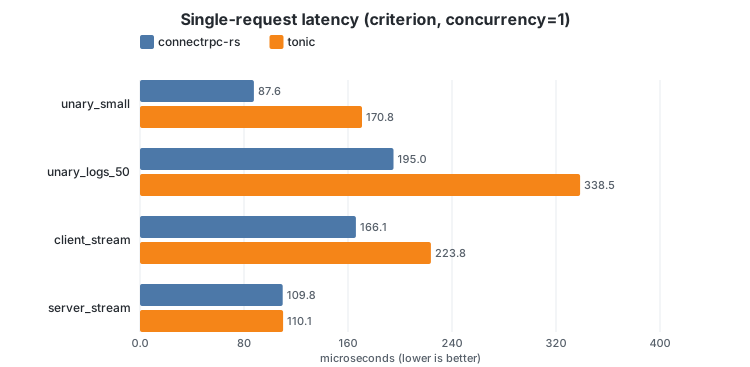
| Benchmark | connectrpc-rs | tonic | ratio |
|---|---|---|---|
| unary_small (1 int32 + nested msg) | 87.6 | 170.8 | 1.95× |
| unary_logs_50 (50 log records, ~15 KB) | 195.0 | 338.5 | 1.74× |
| client_stream (10 messages) | 166.1 | 223.8 | 1.35× |
| server_stream (10 messages) | 109.8 | 110.1 | 1.00× |
Run with task bench:cross:quick.
64-byte string echo, 8 h2 connections (to avoid single-connection mutex contention — see h2 #531). Measures framework dispatch + envelope framing + proto encode/decode with minimal handler work.
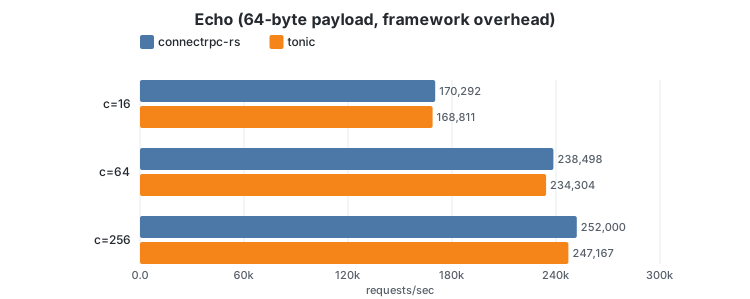
| Concurrency | connectrpc-rs | tonic |
|---|---|---|
| c=16 | 170,292 | 168,811 (−1%) |
| c=64 | 238,498 | 234,304 (−2%) |
| c=256 | 252,000 | 247,167 (−2%) |
Run with task bench:echo -- --multi-conn=8.
50 structured log records per request (~22 KB batch): varints, string fields, nested message, map entries. Handler iterates every field to force full decode. This is where the proto library matters — buffa's zero-copy views avoid the per-string allocations that prost's owned types require.
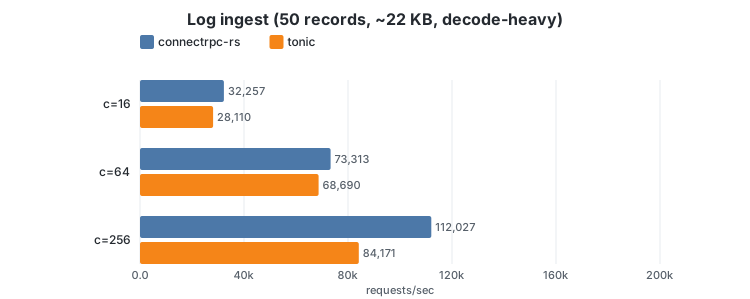
| Concurrency | connectrpc-rs | tonic |
|---|---|---|
| c=16 | 32,257 | 28,110 (−13%) |
| c=64 | 73,313 | 68,690 (−6%) |
| c=256 | 112,027 | 84,171 (−25%) |
At c=256, connectrpc-rs decodes 5.6M records/sec vs tonic's 4.2M.
Raw mode (strict_utf8_mapping): For trusted-source log ingestion where
UTF-8 validation is unnecessary, buffa can emit &[u8] instead of &str for
string fields (editions utf8_validation = NONE + the strict_utf8_mapping
codegen option). CPU profile shows this eliminates 11.8% of server CPU
(str::from_utf8 drops to zero). End-to-end throughput gain in this benchmark
is smaller (~1%) because client encode becomes the bottleneck when both run on
one machine — in production with separate client/server, the server sees ~15%
more capacity.
Run with task bench:log.
Handler performs a network round-trip to a valkey
container (HGETALL of 12 fortune messages, ~800 bytes), adds an ephemeral
record, sorts, and encodes a 13-message response. This is the shape of a
typical read-mostly service: RPC framing + async I/O wait + moderate-size
response. All three servers use an 8-connection valkey pool; client uses
8 h2 connections so protocol framing is the only variable.
Cross-implementation (gRPC protocol):
| Implementation | req/s | vs connectrpc-rs |
|---|---|---|
| connectrpc-rs | 199,574 | — |
| tonic | 192,127 | −4% |
| connect-go | 88,054 | −56% |
Protocol framing (connectrpc-rs server):
| Protocol | c=16 | c=64 | c=256 | Connect ÷ gRPC |
|---|---|---|---|---|
| Connect | 73,511 | 177,700 | 245,173 | 1.23× |
| gRPC | 69,706 | 157,481 | 199,574 | — |
| gRPC-Web | 69,067 | 153,727 | 191,811 | — |
Connect's ~20% unary throughput advantage over gRPC at c=256 comes from simpler framing: no envelope header, no trailing HEADERS frame. At 200k+ req/s, gRPC's trailer frame is ~200k extra h2 HEADERS encodes per second. The gap grows with throughput (5% @ c=16 → 23% @ c=256).
Run with task bench:fortunes:protocols:h2. Requires docker for the
valkey sibling container (image pulled automatically on first run).
CPU profile breakdown (log-ingest, c=64, 30s, task profile:log):
| Cost center | connectrpc-rs | tonic |
|---|---|---|
| Proto decode (views/owned) | 14.7% | 2.1% |
| UTF-8 validation | 11.2% | 4.0% |
| Varint decode | 2.2% | 3.5% |
| String alloc + copy | ~0 | 6.2% |
| HashMap ops (map fields) | ~0 | 8.5% |
| Total proto | 27.1% | ~24% (+allocator) |
| Allocator (malloc/free/realloc) | 3.6% | 9.6% |
connectrpc-rs spends a larger fraction of CPU in proto decode — because it
spends so much less everywhere else. buffa's view types borrow string data
directly from the request buffer (zero allocs per string field); MapView is
a flat Vec<(K,V)> scan with no hashing. tonic/prost must fully materialize
String + HashMap<String,String> for every record before the handler runs.
The framework itself contributes: codegen-emitted FooServiceServer<T> with
compile-time match dispatch (no Arc<dyn Handler> vtable), a two-frame
GrpcUnaryBody for the common unary case, and stream-message batching into
fewer h2 DATA frames.
The compression system is pluggable:
use connectrpc::{CompressionProvider, CompressionRegistry, ConnectError};
use bytes::Bytes;

struct MyCompression;

impl CompressionProvider for MyCompression {
    fn name(&self) -> &'static str { "my-algo" }
    fn compress(&self, data: &[u8]) -> Result<Bytes, ConnectError> { /* ... */ }
    fn decompressor<'a>(&self, data: &'a [u8]) -> Result<Box<dyn std::io::Read + 'a>, ConnectError> {
        // Return a reader that yields decompressed bytes. The framework
        // controls how much is read, so decompress_with_limit is safe by default.
        /* ... */
    }
}

let registry = CompressionRegistry::default().register(MyCompression);
This implementation tracks the following upstream specifications:
Local copies can be fetched with task specs:fetch (see docs/specs/).
By submitting a pull request, you agree to the terms of our Contributor License Agreement.
This project is licensed under the Apache License, Version 2.0.
1000+ skills curated from Anthropic, Vercel, Stripe, and other engineering teams
Design enforcement with memory — keeps your UI consistent across a project
Detects 37 AI writing patterns and rewrites text with human rhythm across 5 voice profiles
WCAG accessibility audit — automated scanning, manual review, remediation
 @codeguilds-knight