

Are you the author? Sign in to claim
Save thousands of lines of code by building universal, domain-agnostic Multi-Agent Systems (MAS) through high-level sema

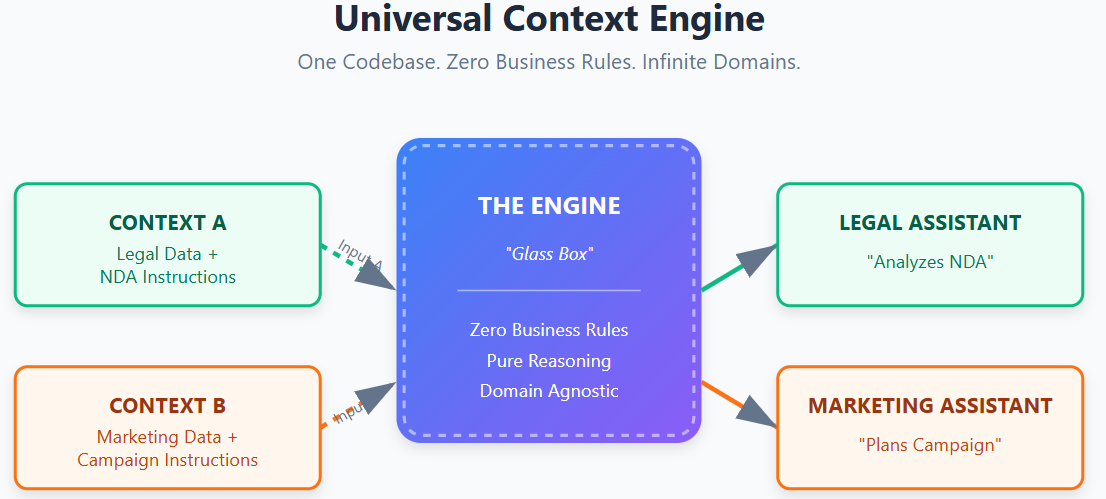
🎞️▶️ In 21st‑century Agentic AI, Natural‑Language‑Programmed LLMs are the execution agents, and the domain‑agnostic dual‑RAG MAS is the environment they operate in. This repository provides a production-ready blueprint for the Agentic Era, allowing you to replace rigid, hard-coded workflows with a dynamic, transparent, observable, and sovereign Context Engine. By building universal, domain-agnostic Multi-Agent Systems through high-level semantic orchestration, you can save thousands of lines of code while maintaining 100% observability.
Copyright 2025-2026, Denis Rothman. Last updated: June 02, 2026
June 3, 2026 — New Gradio Standalone UI: Chapter10/Universal_Context_Engine_Gradio_UI.ipynb now contains a deployable Gradio web app — live public URL in Colab, one-command deploy to Hugging Face Spaces.
See the Changelog for updates, fixes, and upgrades(past, present, coming).
Save thousands of lines of code by building universal, domain-agnostic Multi-Agent Systems (MAS) using the ultimate new programming language: 🛰️ View Software Evolution Timeline
🐬 March 14, 2026 update of the January 24, 2026 Release: OpenAI gpt-5.4 implemented in the Universal Context Engine
Sovereign Universal Context Engine: A new Glass Box Context Engine implementation - Chapter10/Universal_Context_Engine.ipynb and Chapter10/Universal_Context_Engine_UI.ipynb- demonstrating domain-agnostic architecture by running cross-domain use cases on the same core.
Token Analytics: engine.py and the Dashboard provide rigorous transparency into token usage (Input, Output, Difference) for cost and verbosity analysis.
For a detailed list of affected notebooks and all changes, see the ➡️ CHANGELOG.md
LLM API update:
Several notebooks have been upgraded to use GPT‑5.1 along with the latest OpenAI library standards.
These improvements provide better performance, lower reasoning latency, and more reliable handling of structured agent outputs.
This update also includes fixes to the Moderation API, ensuring safer and more robust processing of multi‑agent interactions.
Alternative: Sovereign AI Without External LLM APIs:
If you prefer not to rely on an external LLM API, a full DeepSeek‑R1 Sovereign AI Implementation Guide and the Hardware benchmark notebook (with code) is available:
➡️ DeepSeek‑R1 Sovereign AI Guide
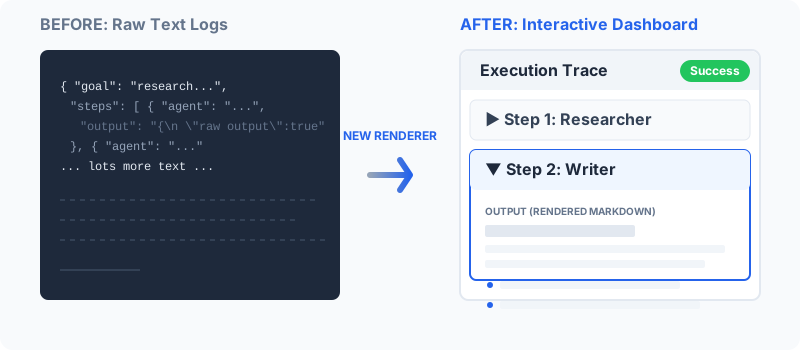
🚀 NEW: Interactive Trace Dashboard
Available in the Context Engine Room of Chapters 8 & 9: Visualize agent reasoning with our new HTML-based trace renderer.
Denis Rothman




Generative AI is powerful, yet often unpredictable. This guide shows you how to turn that unpredictability into reliability by thinking beyond prompts and approaching AI like an architect. At its core is the Context Engine, a glass-box, multi-agent system you’ll learn to design, strengthen, and apply across real-world scenarios. Written by an AI guru and author of various cutting-edge AI books, this book takes you on a hands-on journey from the foundations of context design to building a fully operational Context Engine. Instead of relying on brittle prompts that give only simple instructions, you’ll begin with semantic blueprints that map goals and roles with precision, then orchestrate specialized agents using the Model Context Protocol (MCP). As the engine evolves, you’ll integrate memory and high-fidelity retrieval with citations, implement safeguards against data poisoning and prompt injection, and enforce moderation to keep outputs aligned with policy. You’ll also harden the system into a resilient architecture, then see it pivot seamlessly across domains, from legal compliance to strategic marketing, proving its domain independence. By the end of this book, you’ll be equipped with the skills needed to engineer an adaptable, verifiable architecture you can repurpose across domains and deploy with confidence.
✅ The Levels of Efficient Context · ✅ Dual RAG · ✅ Agent Orchestration · ✅ Compliance & Risk
Stop tinkering with prompts. Start engineering context. Most AI implementations fail at scale because they rely on black-box prompting — sending a request into the void and hoping for a coherent reply. Following the success of our January session, Cohort 2 of this hands-on workshop is now open. We move beyond simple instructions to build a Context Engine: a transparent, glass-box architecture where agents don't just guess — they execute a precise, structured plan.
The workshop frames the new software stack as a delegation gradient across four runtimes — from the human running a context engine in their head, through embedded copilots, configured platforms, and engineered systems. Mastery of the underlying tiers is what makes any of them deployable. We close with the question that sits underneath every enterprise AI decision in 2026: which tier does this problem belong in, and what does compliance actually require?
Save thousands of lines of code by building universal, domain-agnostic Multi-Agent Systems (MAS) using the ultimate new programming language: natural language, engineered as context.
🧭 The Tiers of Context Engines — Tier 3 → Tier 2 → Tier 1.5 → Tier 1
⚖️ Compliance & Risk Management — GDPR · HIPAA · SOC 2 · ISO · FedRAMP
This recorded session walks through the entire stack behind the sentence: “In 21st‑century Agentic AI, Natural‑Language‑Programmed LLMs are the agents, and the domain‑agnostic dual‑RAG MAS is the environment they operate in.” The deep dive unpacks each term step‑by‑step:
| Chapters | Colab | Kaggle | Studio Lab |
|---|---|---|---|
| Chapter 1: From Prompts to Context: Building the Semantic Blueprint | |||
|  |  |  |
| | | |
| Chapter 2: Building a Multi-Agent System with MCP | |||
| | | |
| | | |
| Chapter 3: Building the Context-Aware Multi-Agent System | |||
| | | |
| | | |
| Chapter 4: Assembling the Context Engine | |||
| | | |
| Chapter 5: Hardening the Context Engine | |||
| | | |
| | | |
| Chapter 6: Building the Summarizer Agent for Context Reduction | |||
| | | |
| Chapter 7: High-Fidelity RAG and Defense: The NASA-Inspired Research Assistant | |||
Domain‑agnostic Universal Context Engine architectures are powered by environment‑ingestion agents illustrated in High_Fidelity_Data_Ingestion.ipynbthat dynamically construct the operational context for complex, cross‑domain agentic systems. | |||
| | | |
Domain‑agnostic Universal Context Engine architectures are also driven by MAS‑RAG‑Context Engines, illustrated in NASA_Research_Assistant_and_Retrocompatibility.ipynb, which combine high‑fidelity retrieval, defense, and multi‑agent reasoning into a unified operational environment. | |||
| | | |
| Chapter 8: Architecting for Reality: Moderation, Latency, and Policy-Driven AI | |||
| | | |
| | | |
| Chapter 9: Architecting for Brand and Agility: The Strategic Marketing Engine | |||
| | | |
| | | |
| Chapter 10: The Blueprint for Production-Ready AI | |||
| The Universal Context Engine provides full architectural sovereignty through glass‑box reasoning, verifiable multi‑agent traces, and complete control over memory, dual RAG, moderation, and orchestration. Its domain‑agnostic core can be deployed in restricted, mission‑critical, strategic environments where transparency, auditability, and sovereignty are mandatory. | |||
The Universal_Context_Engine.ipynb version runs a list of explicit scenarios for batch processing. | |||
| | | |
The Universal_Context_Engine_UI.ipynbprovides an IPython interface for interactive sessions that highlights how the industry is converging toward domain‑agnostic, environment‑driven agentic systems built on transparent, context‑rich architectures. | |||
| | | |
The Universal_Context_Engine_Gradio_UI.ipynb can serve as an alternative to the IPython widget interface, providing a full Gradio web application that generates a live public URL directly from Colab. The same Glass Box engine runs unchanged underneath — only the presentation layer is new. The app can also be exported as app.py and deployed permanently to Hugging Face Spaces or any container host, making it the recommended interface for demos, workshops, and stakeholder presentations. |

For organizations requiring 100% data privacy and zero external API dependencies, this repository provides a dedicated Sovereign Path.
By leveraging high‑reasoning open‑source models like DeepSeek‑R1, you can achieve industrial‑grade performance entirely on your own infrastructure.
⚡Performance: Benchmarked at ~9.75 seconds on NVIDIA H100 hardware for complex multi‑step reasoning.
🔍Transparency: Provides 100% Glass‑Box observability using local reasoning traces (</think> blocks).
🛠️Independence: Fully disconnected execution with no vendor lock‑in and no unpredictable API costs.
Read the DeepSeek-R1 Sovereign AI Guide and the Hardware benchmark notebook
Before running the code, ensure your development environment is properly set up. All hands-on chapters use reproducible Python-based environments, tested in Google Colab and VS Code.
A Note on Latency: The Context Engine built in this book and repository performs complex, multi-step reasoning, not simple, single-shot answers. The delay you observe in Colab is the "thinking" time, as the engine dynamically plans and executes a sequence of API calls (e.g., planning, then RAG, then generation). This is the same reason advanced platforms like Gemini or ChatGPT require a moment to "think" for complex requests, even though they benefit from significantly more powerful environments.
openaipinecone-clienttiktokentenacityfastapiGet up and running using cloud-based virtual machines using the Google Colab links provided for each notebook.
No local installation is required.
Before running the notebooks, you will need valid API keys for the underlying services:
Click the badges below to launch the notebooks directly in a pre-configured Google Colab VM. You will be asked to add your API keys to the Colab Secrets Manager upon launch.
| Chapter | Notebook | Launch |
|---|---|---|
| Chapter 4 | Context Engine | |
| Chapter X | Another Notebook | |
Create a GitHub or local workspace containing at least:
helpers.pyagents.pyregistry.pyengine.py| Requirement | Minimum | Recommended |
|---|---|---|
| CPU | Dual-core | Any modern multi-core |
| RAM | 8 GB | 16 GB or Google Colab Pro |
| GPU | Optional, but helpful for embeddings and token-heavy operations |
Note: From Chapter 5 onward, modular components depend on earlier notebooks. Ensure your environment is configured correctly, as setup steps may not be repeated in later chapters.
Denis Rothman is an AI systems architect and author whose work bridges foundational AI research with today’s generative and agentic architectures. A graduate of Sorbonne University and Paris‑Diderot University, he designed one of the earliest patented word2matrix numerical encoding systems which was a precursor to modern embedding techniques. He designed one of the first industrial conversational agents, deployed as an automated language teacher for Moët & Chandon and other global companies.
Throughout his career, Denis has built large‑scale AI systems across industries, from IBM resource optimizers to worldwide Advanced Planning and Scheduling (APS) solutions, always focusing on transparent, explainable, and production‑ready architectures.
Building on decades of applied AI engineering, he has become a leading voice in the agentic era of AI, authoring influential books on transformers, RAG pipelines, business‑ready generative AI, and now Context Engineering for Multi‑Agent Systems. His work emphasizes model‑agnostic engineering, semantic design, and the construction of resilient, domain‑independent AI systems that go far beyond prompting.
Denis continues to publish hands‑on frameworks, open‑source architectures, and practical guides that help engineers, researchers, and organizations build the next generation of verifiable, context‑driven AI systems.

We welcome contributions! High interaction through Issues, PRs, and Comments helps the Context Engine grow and improves the trending visibility for the community.
engine.py or new specialized agents in agents.py.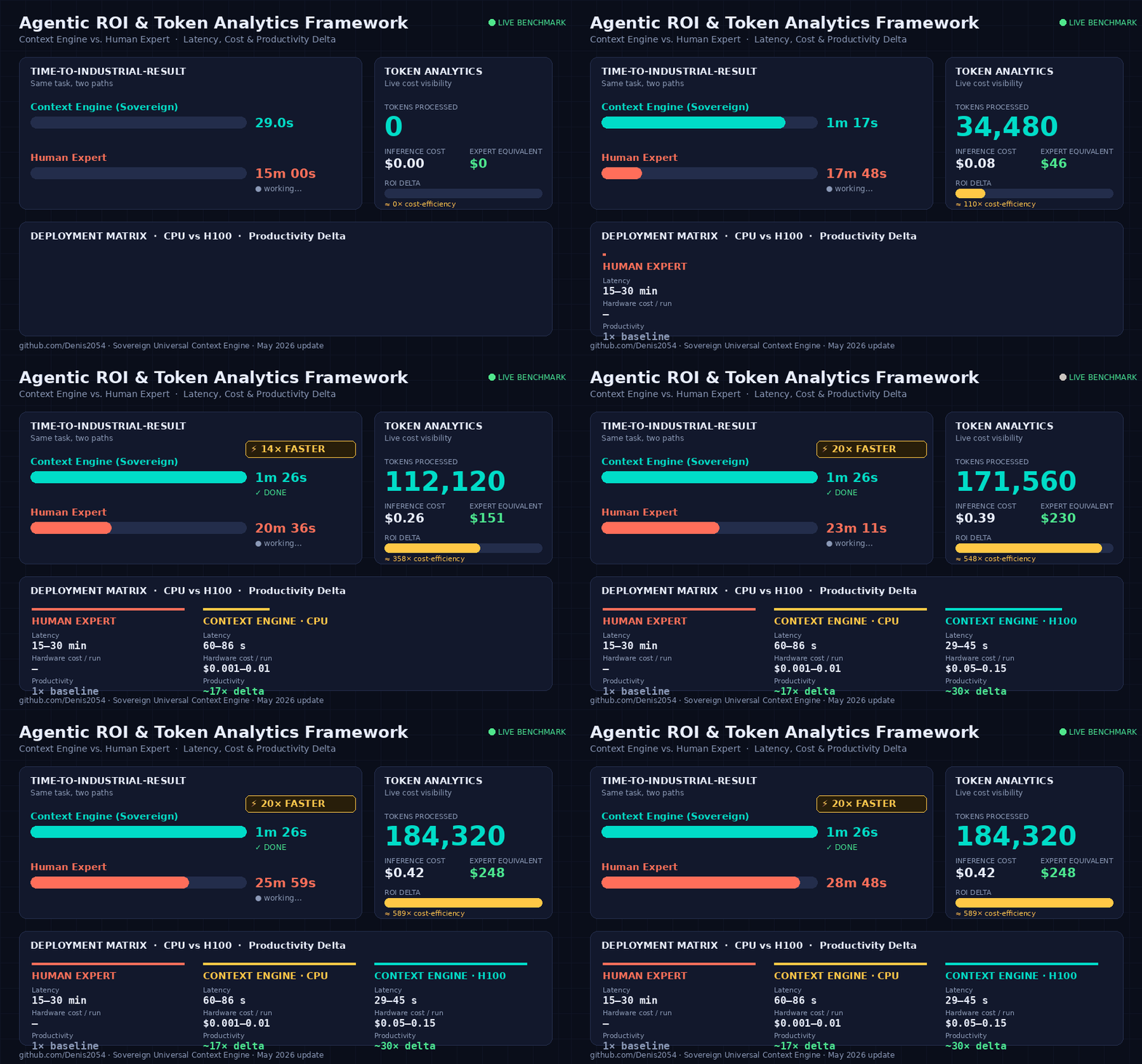
Run Claude Code as an MCP server so any agent can delegate coding tasks to it
 @microsoft✓ Official
Browser automation using accessibility snapshots instead of screenshots
 @googleapis✓ Official
Google's universal MCP server supporting PostgreSQL, MySQL, MongoDB, Redis, and 10+ databases
 @github✓ Official
Official GitHub integration for repos, issues, PRs, and CI/CD workflows