

Are you the author? Sign in to claim
Governed state engine and typed knowledge graph for AI agents, declared in YAML.


cruxible.ai · quickstart · docs · kits · skills
Cruxible is a governed state engine for AI agents. It turns a YAML ontology into a typed knowledge graph with write rules enforced outside the model.
Declare the model and its rules:
entity_types:
  Incident:
    id: incident_id
    properties:
      title: string indexed
  Supplier:
    id: supplier_id
    properties:
      name: string indexed

relationships:
  - incident_impacts_supplier: Incident -> Supplier
    write_policy: proposal_only        # judgment call: enters only through review

named_queries:
  incident_impacted_suppliers:
    mode: traversal
    entry_point: Incident
    returns: Supplier
    traversal:
      - relationship: incident_impacts_supplier
        direction: outgoing
Agents write; the rules run, not the prompt. The refused write, the review that admits the judgment, and the receipted answer:
  $ cruxible relationship add incident_impacts_supplier \
      Incident INC-TW-RAIL-2026-07 Supplier S-CN-DG-HARNESS
- Error: DirectWriteRefusedError: Direct write to relationship
- 'incident_impacts_supplier' is refused (write_policy=proposal_only).
- Use 'group propose' to stage a governed proposal. (receipt: RCP-…)

  $ cruxible propose --workflow propose_incident_impacts_supplier
  $ cruxible group resolve --group <GRP-id> --action approve \
      --rationale "Confirmed against supplier geography"

  $ cruxible query run incident_impacted_suppliers \
      --param incident_id=INC-TW-RAIL-2026-07 --json
+ { "items": [ { "entity_type": "Supplier", "entity_id": "S-CN-DG-HARNESS" } ],
+   "receipt_id": "RCP-2f61a90c84d3" }
This repository gates its own releases with Cruxible: a push to main is refused until state pins an approved review (how).
pip install cruxible— the Quickstart goes install to first query; Get Started below runs the seeded demo world in ~3 minutes, with no model calls or API keys.
No LLM inside the engine: Cruxible is a Python daemon with a CLI and MCP server, with state in a SQLite file you own. We call the result hard state: knowledge the rest of your stack can act on without re-checking it. If your team's knowledge currently lives in markdown or a vector store, the comparison section explains exactly what changes.
Start permissive, then tighten claim types where being wrong is expensive,
one write_policy line at a time. Authoring skills can draft the ontology
from your data; you review and refine it as the domain teaches you what
matters. The model gets stricter where experience proves it should,
without an ontology team or a rewrite.
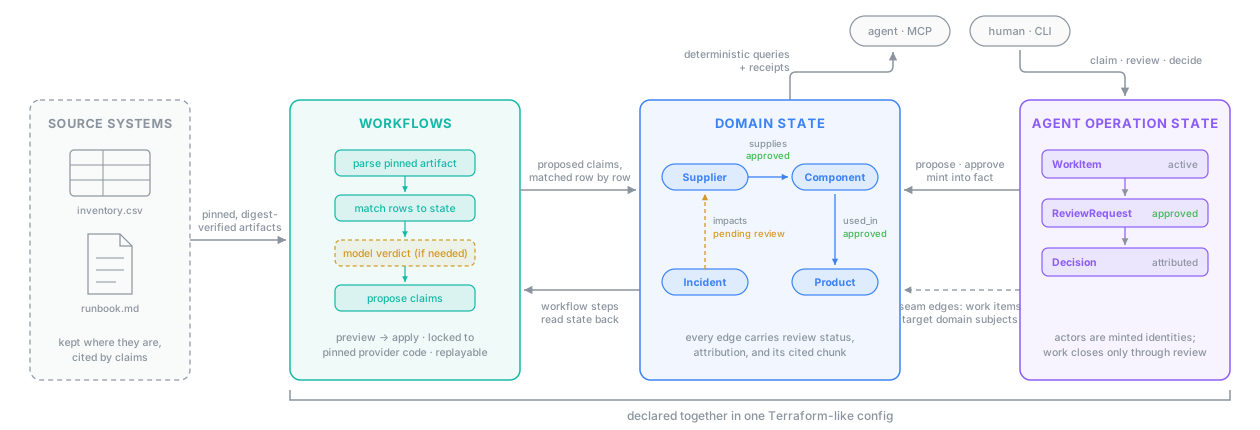
write_policy: direct, proposal-only, or mint-only; guards
enforce evidence, transitions, and co-writes at one chokepoint
(Concepts)apply re-verifies digests
before committing; providers are version- and digest-pinned with
execution traces (Providers And Dataflow)explain; the same state returns the same answer for
every agentgit pre-pushpip install cruxible
Model your own domain with the
authoring skills
and Modeling State,
or run the demo — a seeded supply-chain world, ~3 minutes, with no model
calls or API keys. Sandbox writes attribute to a built-in operator
identity:
# shell 1 — local sandbox daemon
CRUXIBLE_SERVER_STATE_DIR="$HOME/.cruxible/sandbox" cruxible server start

# shell 2 — kit bundles are fetched from the release and digest-verified
# (agent-operation is the optional agent-ops layer; domain-only works too)
cruxible --server-url http://127.0.0.1:8100 init --kit agent-operation --kit supply-chain-blast-radius
cruxible context connect --server-url http://127.0.0.1:8100 --instance-id <instance-id>

# deterministic ingest: preview, then commit
cruxible run --workflow build_seed_state && cruxible apply --workflow build_seed_state --from-last-preview
cruxible run --workflow ingest_incidents && cruxible apply --workflow ingest_incidents --from-last-preview

# the incident feed can only PROPOSE impact edges; the judgment is yours, on the record
cruxible propose --workflow propose_incident_impacts_supplier
cruxible group list --status pending_review
cruxible group resolve --group <GRP-id> --action approve \
  --rationale "Confirmed against supplier geography" --expected-pending-version 1

# receipted answers through the edges you just admitted
cruxible query run open_incident_impacts --json
cruxible query run incident_impacted_suppliers --param incident_id=INC-TW-RAIL-2026-07 --json
When agents join, identity turns on: restart with CRUXIBLE_SERVER_AUTH=true,
claim the bootstrap credential, and mint each agent its own token — every
write is attributed. Details, permission tiers, and hardening:
Quickstart ·
Runtime Auth And Agent Roles.
Cruxible never asks a model to follow the rules, because the rules run as code. A rule declared in config runs at the write chokepoint on every mutation, and there is no code path around the chokepoint.
| Prompted | Enforced |
|---|---|
| "The agent knows an exposure can't be closed while unremediated" | The write chokepoint refuses the transition until the remediation claim, with its evidence, is linked |
| "The model says these sources support the claim" | The write is refused unless every reference dereferences to a content-hash-verified source chunk |
| "The agent was told not to accept claims it proposed itself" | The guard compares the acting actor against the creation receipt's recorded actor and refuses, including create-as-accepted |
| "The agent remembers the ingest procedure" | The workflow is declared, previewed, and locked to pinned providers; every run leaves a receipt |
Guards face inward (the write boundary of accepted state); gates face outward (an external action holds until state agrees).
gates:
  merge-review:
    kind: git-pre-push
    entity_type: ReviewRequest
    match_property: change_head
    condition: {status: approved}
    adapter: {branch_pattern: refs/heads/main}
This repository runs on that gate: it refused our own 0.2.2 release push until the review record was corrected in state. We fixed the state, not the hook.
The deep dive builds one governed truth end to end: a single
reviewed judgment lets a query walk a recursive bill of materials and
name every exposed shipment five typed hops downstream, with a receipt
you can explain.
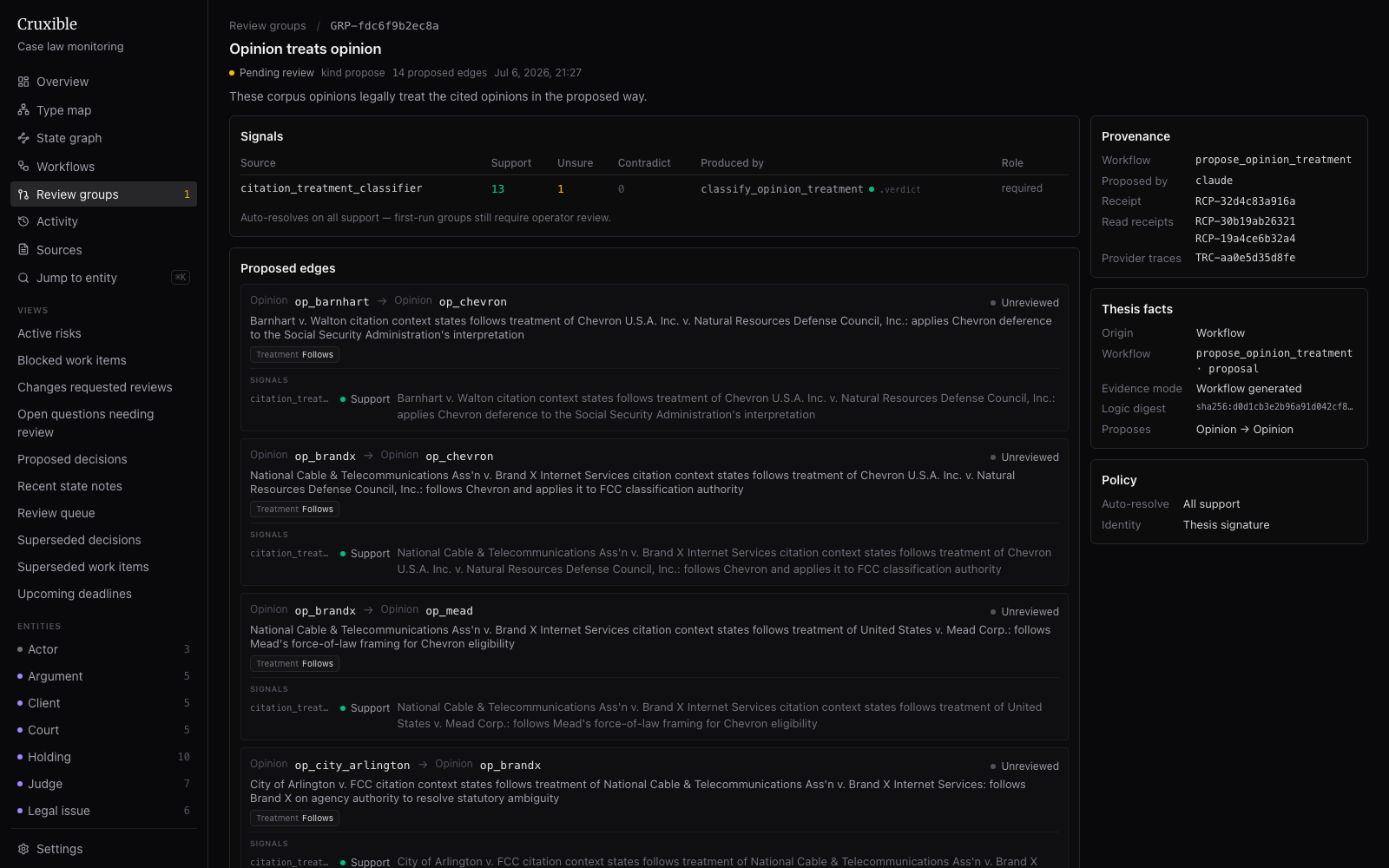
The screenshot is the review seat in the inspection UI: each proposed edge carries the evidence that matched it, with a provenance rail back to workflows, receipts, and traces.
We spent fifty years keeping the facts that matter in systems with schemas, constraints, and transactions — then handed agents piles of markdown, because prose was the only interface they spoke. What changes:
| Markdown · RAG · vector memory | Cruxible |
|---|---|
| A claim is prose; nothing refuses one without a source | Evidence-gated writes refuse references that don't verify against content-hashed sources |
| Edits are reviewed as diffs, not claims | Writes pass typed validation, guards, and review |
| Links live in prose, re-inferred on every read | Typed edges, traversed multi-hop, visibility rules at every hop |
| A rollup is a one-off summary | Counts and joins are deterministic, receipted, re-runnable |
| No record of which answer was settled on | One accepted state; the same query returns the same answer for every agent |
| No record of when a source was captured | Sources are dated and hashed; staleness is queryable |
| A correction is just more text | Feedback attaches to the exact claim; claims mature from proposed to accepted |
| A better model reads the pile better | It can't read what was never written; the record and its derivations don't move when you swap models |
If the wiki already exists (a team wiki, an Obsidian vault), the
wiki-to-state
skill converts it: pages become pinned evidence, an agent proposes the
typed claims, you review what gets minted.
A kit packages an ontology with its governance, queries, workflows, and providers as one versioned, composable unit; per-kit guides run each end to end.
| Kit | Kind | What it models |
|---|---|---|
| agent-operation | Agent operating state | Work items, review requests, decisions, risks, open questions, state notes, actors, lifecycle, and dependency context. |
| project-domain | Domain overlay state | Roadmap items, milestones, release lines, and product areas composed over the agent-operation base — the project state Cruxible itself runs on. |
| agent-release | Domain overlay state | Agent systems, versions, eval suites and runs, with governed certification and promotion gates. |
| kev-reference | Domain reference state | Public known-exploited vulnerability reference data. Consumed as a published state release (state create-overlay); init the kit itself only to build offline or publish your own. |
| kev-triage | Domain overlay state | Local asset exposure, service impact, controls, incidents, findings, remediation, and governed vulnerability triage. |
| supply-chain-blast-radius | Domain state | Suppliers, components, assemblies, products, shipments, and incident blast radius. |
| case-law-monitoring | Domain state | Matter-centered case-law monitoring and authority impact. |
docs/; agent skills for authoring state from your dataCruxible uses Pydantic for validation, NetworkX for in-memory graph operations, Polars for data operations, SQLite for local durable state, FastAPI for the daemon, and FastMCP for MCP tools.
Contributions welcome — see CONTRIBUTING.md. If governed agent state is a problem you're working on, star the repo or open an issue with your use case.
Apache 2.0
Run Claude Code as an MCP server so any agent can delegate coding tasks to it
 @microsoft✓ Official
Browser automation using accessibility snapshots instead of screenshots
 @googleapis✓ Official
Google's universal MCP server supporting PostgreSQL, MySQL, MongoDB, Redis, and 10+ databases
 @github✓ Official
Official GitHub integration for repos, issues, PRs, and CI/CD workflows
