

Are you the author? Sign in to claim
Self-improving context & memory for Claude Code and OpenAI Codex. One canonical knowledge store injected only when relev

Local context control for Claude Code and OpenAI Codex.
One trusted knowledge store. Only the relevant cards reach each prompt. Useful lessons come back for review.


culi (cà phê culi — the single dense peaberry bean) is the memory and context layer between your coding agents and your projects. It stores rules, lessons, styles, patterns, skills, and agent definitions as small Markdown cards, then routes a token-budgeted selection to Claude Code or Codex.
It is local-first, git-backed, and inspectable. Hooks and retrieval make no model calls; optional background learning proposes new knowledge for review. No Node, Python, or resident daemon is required.
claude:<id> and
codex:<id> provenance.~/.culi/knowledge/; SQLite holds rebuildable card-search tables
plus preserved local activity state.| Without culi | With culi |
|---|---|
Guidance is copied across CLAUDE.md, AGENTS.md, agents, and skills | One canonical, git-versioned card store |
| Every session loads large instruction files | Only prompt-relevant cards are packed under a hard budget |
| Claude and Codex learn separately | Both agents contribute to and retrieve from the same knowledge |
| Useful corrections disappear in old transcripts | Lessons are mined, deduplicated, and placed in a review queue |
| Context delivery is invisible | Activity and Knowledge Pulse show what was delivered, where, and to which harness |
go install github.com/hung12ct/culi/cmd/culi@latest
culi init                       # auto-detect Claude Code and Codex
culi serve                      # http://localhost:7378
Open a new coding-agent session after initialization. Codex users should run /hooks once and
trust the four generated Culi hooks. Verify the wiring with:
culi doctor --harness=codex
Ollama is optional. Without it, retrieval uses SQLite FTS/BM25. For semantic retrieval, install
Ollama and run ollama pull nomic-embed-text.
For harness-specific setup, adding your first cards, and importing existing instructions, see the getting started guide.
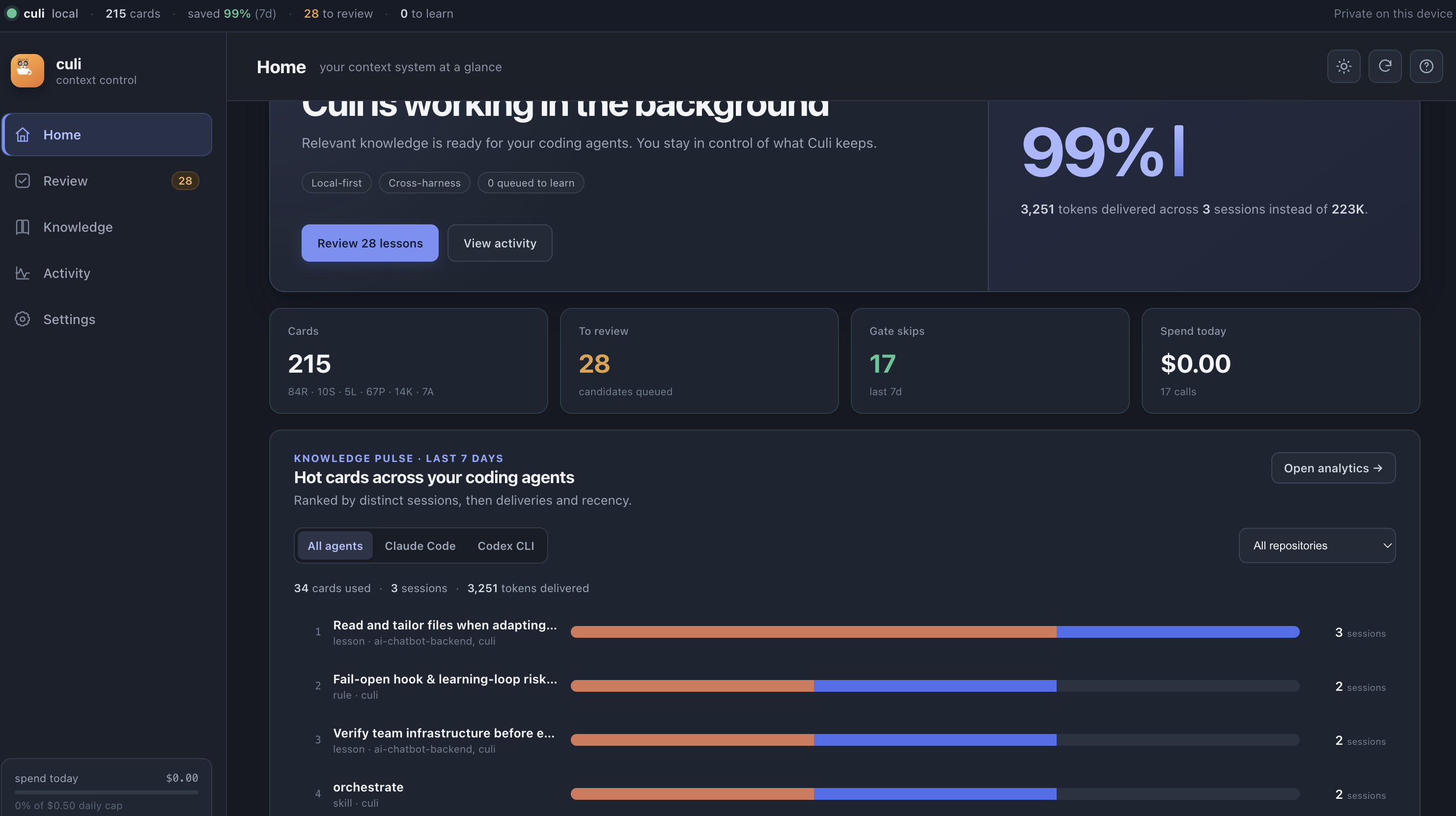
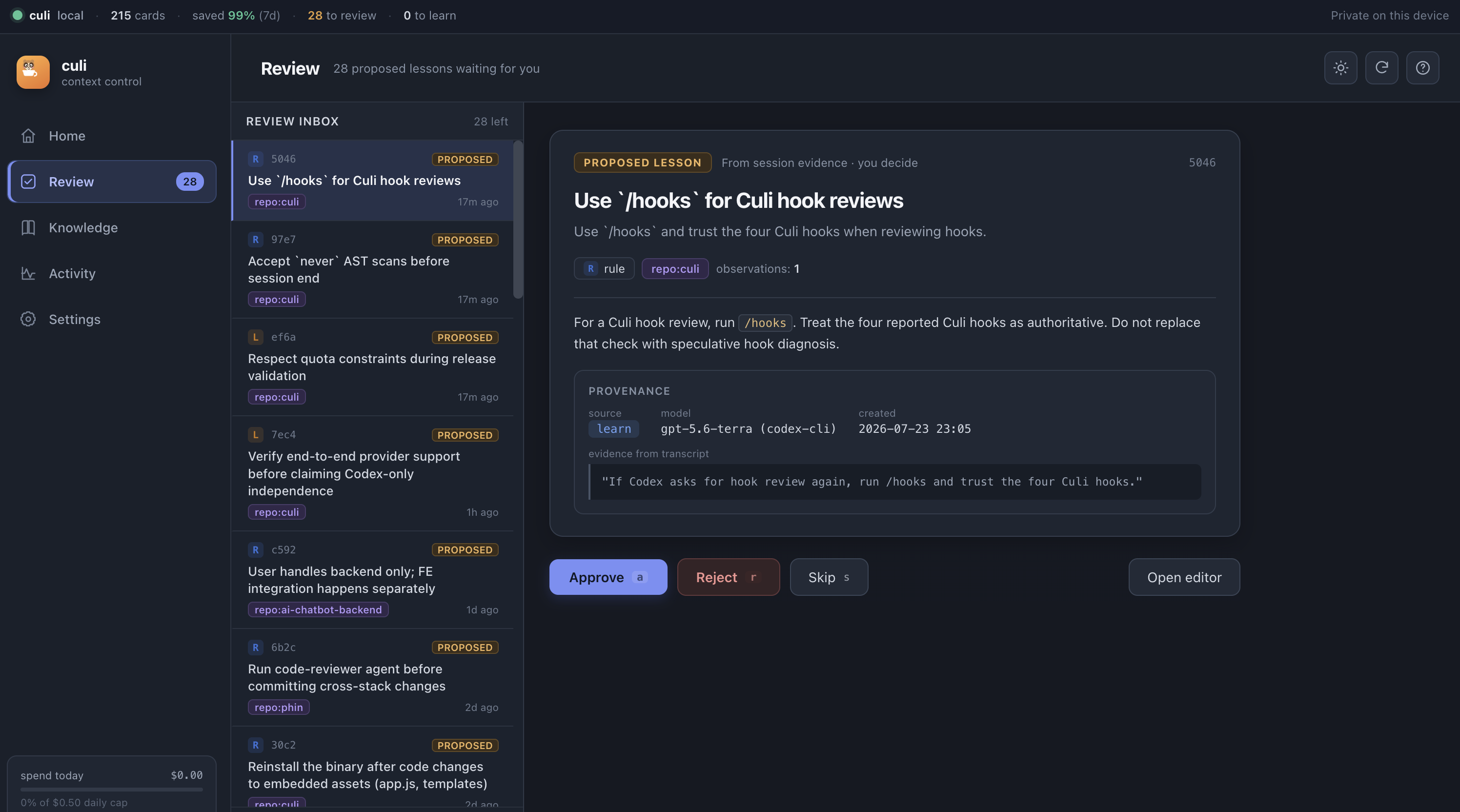
The local console makes Culi's behavior visible and reversible: review proposed lessons, search and edit cards, filter delivery activity by agent/repository/date, compare hot cards across Claude and Codex, and safely tune the learning backend.
| Home — health, next actions, and savings | Review — evidence-first lesson decisions |
|---|---|
 |  |
See the console guide and full screenshot gallery.
prompt ──► cheap gate ──► scope + keyword + optional semantic retrieval
                                      │
                              rank + budgeted pack
                                      │
                         Claude Code or Codex
                                      │
session transcript ──► background mining ──► review ──► knowledge cards
search_context, expand_card, and save_lesson.| Provider | Authentication | Billing path |
|---|---|---|
codex-cli | Existing codex login | ChatGPT/Codex account quota |
openai | OPENAI_API_KEY or key file | Metered OpenAI API |
claude-cli | Existing Claude Code login or token file | Claude subscription quota |
anthropic | ANTHROPIC_API_KEY or key file | Metered Anthropic API |
ollama | Local endpoint | Local compute |
none | None | Learning disabled; retrieval remains active |
The default auto provider tries configured APIs first, then signed-in Claude and Codex terminals.
Ollama is opt-in so Culi never silently chooses an unprepared local generation model. Model calls
never occur in prompt hooks.
See learning and cost for Codex backfill, authentication, caps, model defaults, and manual learning commands.
config.yaml reference and safe console settings.| Command | Purpose |
|---|---|
culi init [--harness=auto|claude|codex|all] | Create the store and register selected hooks + MCP |
culi serve | Start the local control console |
culi doctor --harness=codex | Check Codex hooks, MCP, scanner health, and learning backlog |
culi query <text> | Inspect retrieval from the terminal |
culi stats | Show context savings, gate behavior, and learning spend |
culi learn | Mine queued transcripts once |
culi learn --scan-codex --dry-run | Preview discoverable Codex history without writing |
culi import scan|merge|apply | Reconcile existing agent instructions into cards |
culi gen --repo X --target=claude|codex|both | Generate repo instructions and cards from git history |
culi review | Approve or reject proposed cards in the terminal |
Run culi help for the complete command list.
go install (the Go toolchain can download the pinned version automatically).nomic-embed-text is optional.Actively developed and dogfooded daily. Built on gopheragent. Issues and ideas are welcome.
MIT © 2026 hung12ct
Run Claude Code as an MCP server so any agent can delegate coding tasks to it
 @microsoft✓ Official
Browser automation using accessibility snapshots instead of screenshots
 @googleapis✓ Official
Google's universal MCP server supporting PostgreSQL, MySQL, MongoDB, Redis, and 10+ databases
 @github✓ Official
Official GitHub integration for repos, issues, PRs, and CI/CD workflows
