

Are you the author? Sign in to claim
A Data analysis agent powered by llm for querying database and visualizing results
The chatbot is designed to provide data analysis insights from database based on a predefined schema. It is built using Chainlit and OpenAI's GPT-3.5-turbo-1106 model. The chatbot utilizes OpenAI function calling to decide when to use tools and in case of db error it retries.
cd <repository>
pip install -r requirements.txt
chainlit run src/data-analysis-llm-agent/app.py --port 8002
The chatbot has access to a range of tools, including: Database Query: Execute database queries to retrieve data. Plot Chart: Generate visualizations to help users understand data insights.
app.py: The main application file, which sets up the Chainlit framework and defines the chatbot's logic.
bot.py: The chatbot class which handles conversation history, talking to llm and parallel function calling.
utils.py: Utility functions for db introspection and format conversion.
tools.py: Tool functions for executing database queries and plotting charts.
.env: openai api key
It uses simple sqlite3 database of movie and actors from https://github.com/slackhq/sqlite-python-connect/. The schema is very simple with only two tables but should work with more complex schema.
Here's a high-level overview of how the application works:
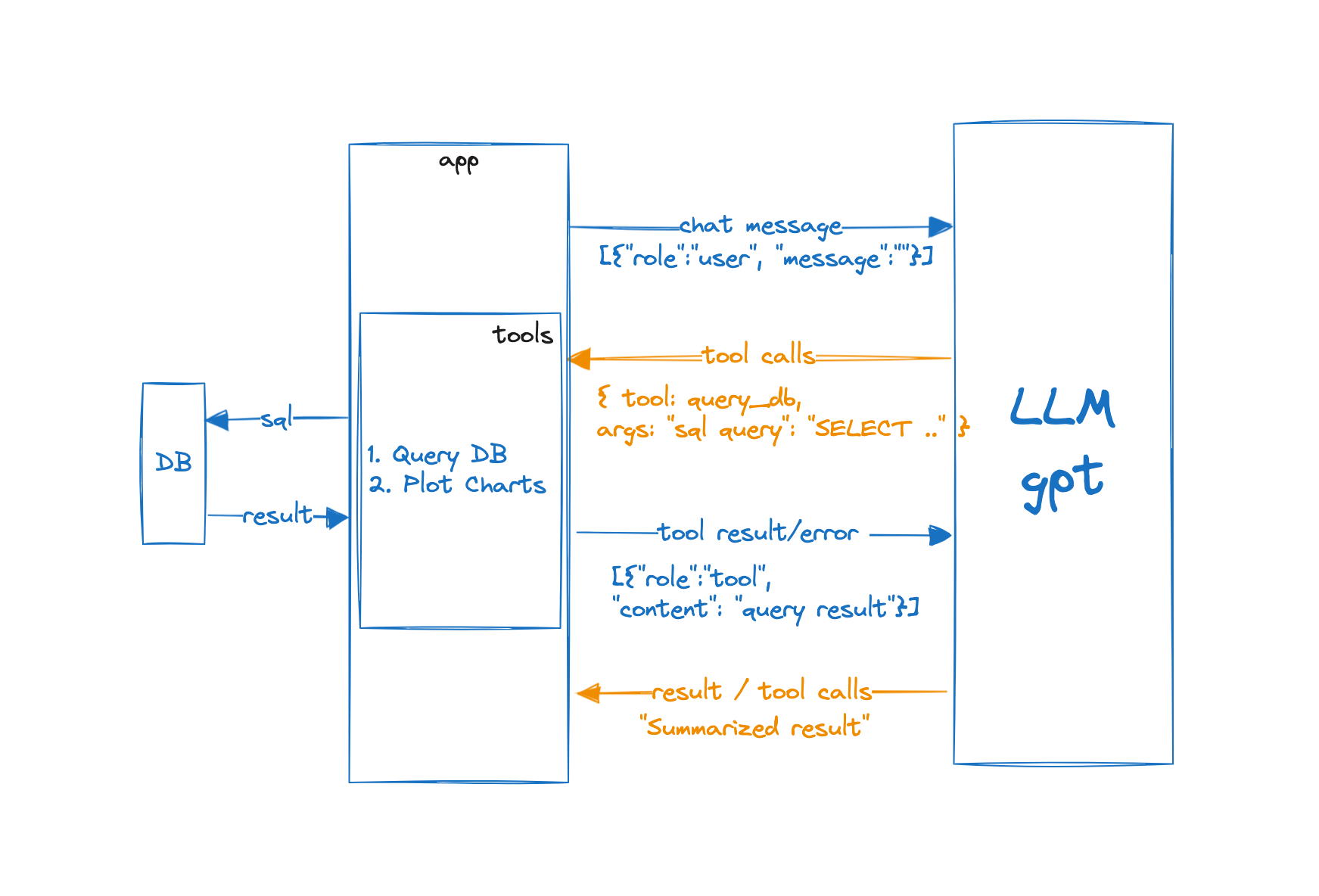
Importance of Foreign Key Constraints Providing foreign key constraints in the database schema is crucial for generating accurate and efficient SQL queries. Without them, the LLM may generate multiple parallel function calls with separate queries or incorrect queries. By including foreign key constraints, the LLM can create SQL queries with proper joins, ensuring more accurate data retrieval.
LLM's Limited Domain Knowledge The LLM has knowledge of the database schema but doesn't know about the underlying data. For instance, it may not be aware of the actual data values in a column, leading to incorrect queries. If severity table a column status, the LLM generated a query with 'where status = 'LOW'' despite the actual values being 'CRITICAL', and 'NORMAL'.
Multi-Step Flow for Error Handling A multi-step execution flow is necessary to handle errors encountered during SQL query execution. By providing the error message along with the previous conversation history, the LLM can reflect and correct its mistakes. This ensures a more robust and accurate conversation flow.
Valid but Incorrect SQL Queries The LLM may generate valid but incorrect SQL queries, which can lead to incorrect results without any error messages. This raises concerns about trusting the LLM's responses. When I asked "provide top 10 movies", it responded with 10 movies but when I asked how are this top movies, it's responded with "The top 10 movies are based on the initial 10 movies in the database."
Handling Different Data Scales The LLM may not always be aware of the different scales used in various data columns. For instance, it may generate a query to find drastic differences in Metacritic and IMDB scores without considering that they are on different scales (0-100 and 0-10, respectively).
⚠️ Experimentelle Skill-Sammlung für deutsches Recht (Arbeits-, Gesellschafts-, Insolvenz-, Datenschutz-, Prozessrecht u
Manage multiple Claude Code agents from TUI or Web with tmux and git worktrees
Project management using GitHub Issues + Git worktrees for parallel agent execution
Core skills library for Claude Code with 20+ battle-tested skills including TDD, debugging, and brainstorming