

Are you the author? Sign in to claim
MCP server that lets AI agents query SQL databases in natural language - read-only, with column masking, row caps, and q
An MCP server that lets an AI agent query a SQL database in plain language — safely and read-only.


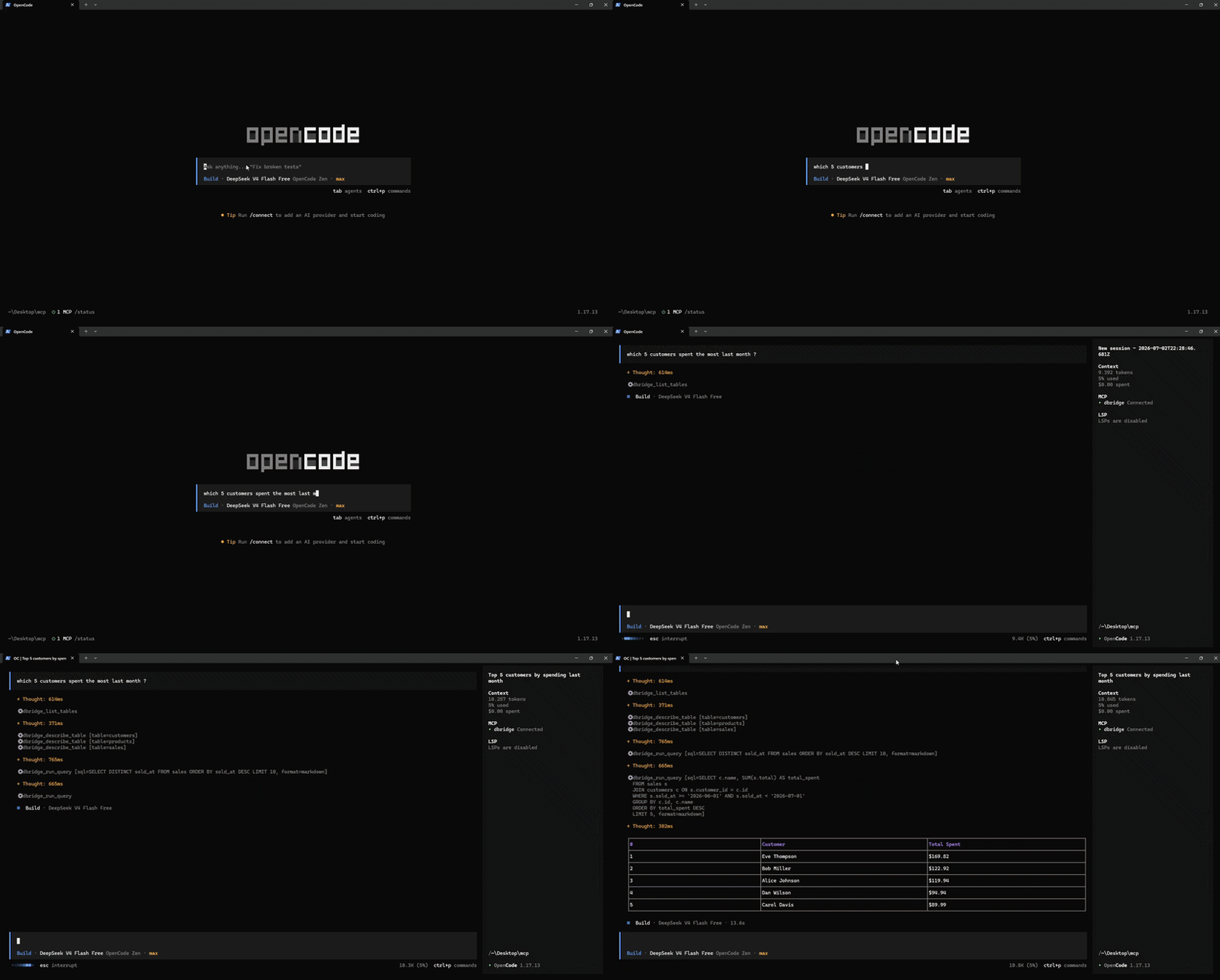
The agent discovers the schema on its own (list_tables, describe_table), then writes and runs a SELECT for whatever the user asks. No hand-written endpoint per question.
Works with SQLite, PostgreSQL, and MySQL / MariaDB.
A raw LLM cannot know what is inside your database, and web search cannot reach private data. dbridge gives the model a guarded door to that data: it can read and answer, but it cannot write, drop, or leak the whole table.
There are many database MCP servers. dbridge is built around one idea — you should be able to point an AI at a real database without holding your breath — and that shows up as a combination the single-engine servers don't offer:
SELECT/WITH and every query runs inside a database-enforced READ ONLY transaction — so even a query that outsmarts the guard cannot write.a***@site.com) while keeping them queryable. Most servers expose whatever the connection can see.LIMITs, per-query timeouts, EXPLAIN-based cost rejection for expensive queries, per-minute rate limits, and a capped connection pool.node:sqlite, so npx -y dbridge-mcp works without a compiler toolchain.column_stats and index_health give the model real cardinality and index-usage data, and test_index simulates an index with hypopg before anyone builds it — so the model's optimization advice is grounded in the actual database instead of guesswork.If all you need is "run SQL from my agent", plenty of servers do that. dbridge is for pointing an agent at data you actually care about.
| Tool | Purpose |
|---|---|
list_tables | List every table in the database. |
describe_table | Return a table's columns, primary key, foreign keys, and row-count estimate. |
sample_table | Preview the first rows of a table (json/csv/markdown). |
count_rows | Return the exact row count of a table. |
run_query | Run a single read-only SELECT / WITH and return rows as json, csv, or markdown. |
explain_query | Return a query's plan and estimated cost without running it. |
column_stats | Per-column distinct-value counts and null fractions — is this column selective enough to index? |
index_health | List indexes with sizes and scan counts, flagging unused, duplicate, and invalid ones. |
test_index | Simulate a CREATE INDEX without building it and report whether the planner would use it (PostgreSQL, via hypopg). |
slow_queries | The most expensive recorded statements with call counts and timings (PostgreSQL pg_stat_statements, MySQL performance_schema). |
get_limits | Report the safety limits in effect (caps, timeouts, hidden/masked columns). |
| Resource | Purpose |
|---|---|
dbridge://schema | The full schema (every table and its columns) as one JSON document. |
| Prompt | Purpose |
|---|---|
optimize | A guided optimization pass: find slow queries, inspect plans and index health, and validate every index recommendation with test_index before suggesting it. |
Node.js 22.5+ (SQLite uses the built-in node:sqlite, no native build step).
The published package ships a dbridge-mcp binary, so no clone or build step is needed to use it. Point it at a database with the connection argument:
npx -y dbridge-mcp demo.db                                  # SQLite (file path)
npx -y dbridge-mcp "postgresql://user:pass@host:5432/mydb"  # PostgreSQL
npx -y dbridge-mcp "mysql://user:pass@host:3306/mydb"       # MySQL / MariaDB
The database engine is chosen from the connection string: a file path is SQLite, postgres:// / postgresql:// is PostgreSQL, and mysql:// is MySQL/MariaDB.
Or install it once, globally:
npm install -g dbridge-mcp
dbridge-mcp "postgresql://user:pass@host:5432/mydb"
MCP clients start the server for you as a subprocess — see the client sections below.
Windows note: MCP clients cannot launch
npxdirectly on Windows because it is a.cmdscript. Wrap it withcmd /c— use"command": "cmd"and put"/c", "npx", "-y", "dbridge-mcp", "<connection>"in the args. The examples below use the direct form (macOS/Linux); on Windows add thecmd /cprefix.
Claude Desktop only supports a single global config. Add to claude_desktop_config.json:
{
  "mcpServers": {
    "dbridge": {
      "command": "npx",
      "args": ["-y", "dbridge-mcp", "postgresql://user:pass@host:5432/mydb"],
      "env": { "DBRIDGE_CONFIG": "/absolute/path/to/dbridge.config.json" }
    }
  }
}
For a local SQLite file, replace the connection string with an absolute path to the .db file. Restart Claude Desktop, then ask: "what were the 5 best-selling products last month?"
Add it to the current project with the CLI:
claude mcp add dbridge --scope project \
  -e DBRIDGE_CONFIG=/absolute/path/to/dbridge.config.json \
  -- npx -y dbridge-mcp "postgresql://user:pass@host:5432/mydb"
--scope project writes a shareable .mcp.json in the project root; use --scope user for a global server or omit it for a private per-project one. The .mcp.json looks like:
{
  "mcpServers": {
    "dbridge": {
      "command": "npx",
      "args": ["-y", "dbridge-mcp", "postgresql://user:pass@host:5432/mydb"],
      "env": { "DBRIDGE_CONFIG": "/absolute/path/to/dbridge.config.json" }
    }
  }
}
Run claude from that directory; approve the project server once, then check it with /mcp.
Add the same mcpServers block to .cursor/mcp.json in the project root (or ~/.cursor/mcp.json for all projects), enable the server under Settings → MCP, then ask the Agent a question about your data.
Add the same mcpServers block to ~/.codeium/windsurf/mcp_config.json, then refresh the server list under Settings → Cascade → MCP.
Add to opencode.json (project root or ~/.config/opencode/opencode.json):
{
  "$schema": "https://opencode.ai/config.json",
  "mcp": {
    "dbridge": {
      "type": "local",
      "command": ["npx", "-y", "dbridge-mcp", "postgresql://user:pass@host:5432/mydb"],
      "enabled": true
    }
  }
}
To tune the safety guard, point the server at a config file with the environment block:
"environment": { "DBRIDGE_CONFIG": "/absolute/path/to/dbridge.config.json" }
Build the image and run the server over stdio:
docker build -t dbridge-mcp .
docker run --rm -i dbridge-mcp "postgresql://user:pass@host:5432/mydb"
Mount a config file and point DBRIDGE_CONFIG at it:
docker run --rm -i \
  -v "$PWD/dbridge.config.json:/config.json:ro" \
  -e DBRIDGE_CONFIG=/config.json \
  dbridge-mcp "postgresql://user:pass@host:5432/mydb"
READ ONLY transaction, so writes are rejected by the database itself even if a query slips past the guard.SELECT and WITH statements pass; writes, DDL, and data-modifying CTEs are rejected.LIMIT (default 1000 rows).statement_timeout / max_execution_time), so a runaway or expensive query cannot pin the database.information_schema, pg_authid, sqlite_master, …) are not queryable; schema discovery goes through the tools.a***@site.com).EXPLAIN cost estimate, and callers can be rate-limited per minute.Every setting has three sources, in increasing precedence: a JSON file (DBRIDGE_CONFIG), environment variables, then CLI flags. So you can drop the JSON file entirely and set only what you need:
npx -y dbridge-mcp "postgresql://user:pass@host/db" --max-rows 200 --statement-timeout-ms 3000 --masked-columns email,iban
DBRIDGE_MAX_ROWS=200 DBRIDGE_REQUIRE_SSL=true npx -y dbridge-mcp "postgresql://user:pass@host/db"
Or keep everything in one place: point DBRIDGE_CONFIG at a JSON file (see dbridge.config.example.json for a full template). Every field is optional:
{
  "maxRows": 500,
  "hiddenColumns": ["ssn", "password_hash"],
  "maskedColumns": ["iban", { "column": "email", "strategy": "email" }],
  "allowedTables": ["products", "sales", "customers"],
  "blockedTables": ["employees", "audit_log"],
  "statementTimeoutMs": 5000,
  "maxCost": 100000,
  "rateLimitPerMin": 60,
  "maxPoolSize": 5,
  "connectionTimeoutMs": 10000,
  "requireSsl": true,
  "schemas": ["public", "reporting"],
  "auditLog": true
}
| Field | CLI flag / env var | Default | Purpose |
|---|---|---|---|
maxRows | --max-rows / DBRIDGE_MAX_ROWS | 1000 | Hard cap on rows returned per query, enforced even over a larger LIMIT. |
hiddenColumns | --hidden-columns / DBRIDGE_HIDDEN_COLUMNS | [] | Columns hidden from the schema, queries, and results. |
maskedColumns | --masked-columns / DBRIDGE_MASKED_COLUMNS | [] | Columns whose values are redacted in results (see below). |
maxCellChars | --max-cell-chars / DBRIDGE_MAX_CELL_CHARS | 0 | Truncate any string cell longer than this; 0 disables. |
maxResultBytes | --max-result-bytes / DBRIDGE_MAX_RESULT_BYTES | 0 | Cap the total serialized result size, dropping trailing rows; 0 disables. |
allowedTables | --allowed-tables / DBRIDGE_ALLOWED_TABLES | [] | If non-empty, only these tables are exposed. |
blockedTables | --blocked-tables / DBRIDGE_BLOCKED_TABLES | [] | Tables that are always hidden and unqueryable. |
statementTimeoutMs | --statement-timeout-ms / DBRIDGE_STATEMENT_TIMEOUT_MS | 10000 | Per-query timeout (PostgreSQL statement_timeout, MySQL max_execution_time); 0 disables. |
maxCost | --max-cost / DBRIDGE_MAX_COST | 0 | Reject queries whose EXPLAIN cost estimate exceeds this (PostgreSQL/MySQL); 0 disables. |
rateLimitPerMin | --rate-limit-per-min / DBRIDGE_RATE_LIMIT_PER_MIN | 0 | Max query-executing tool calls per minute; 0 disables. |
maxPoolSize | --max-pool-size / DBRIDGE_MAX_POOL_SIZE | 5 | Maximum pooled connections (PostgreSQL/MySQL). |
connectionTimeoutMs | --connection-timeout-ms / DBRIDGE_CONNECTION_TIMEOUT_MS | 10000 | How long to wait for a connection (PostgreSQL/MySQL). |
requireSsl | --require-ssl / DBRIDGE_REQUIRE_SSL | false | Require a verified TLS connection (PostgreSQL/MySQL). |
schemas | --schemas / DBRIDGE_SCHEMAS | ["public"] | PostgreSQL-only: schemas to expose; multiple schemas yield schema.table names. |
auditLog | --audit-log / DBRIDGE_AUDIT_LOG | false | Log every tool call (query, rows, duration, errors) as JSON to stderr. |
List values on the command line or in env vars are comma-separated (--allowed-tables products,sales).
Engine note: statementTimeoutMs, maxCost, maxPoolSize, connectionTimeoutMs, requireSsl, and schemas apply to the networked engines (PostgreSQL/MySQL). SQLite is a local file, so it ignores them; the row cap, column/table access control, and masking apply to every engine.
maskedColumns keeps a column visible but redacts its values. Each entry is either a column name (defaults to the partial strategy) or an object { "column": ..., "strategy": ..., "keep": ... }:
| Strategy | Example input | Output |
|---|---|---|
partial (default) | TR120000123456 | **********3456 (keeps the last keep, default 4) |
email | ayse@site.com | a***@site.com |
full | anything | *** |
Unlike hiddenColumns, a masked column can still be used in WHERE/GROUP BY, so use hiddenColumns for true secrets and maskedColumns for values that should be recognizable but not exposed.
run_query and sample_table take an optional format argument: json (default, full result object), csv, or markdown. CSV and Markdown return a compact table prefixed with a short rows: N · Nms header — handy for fewer tokens and readable output. Combine with maxCellChars and maxResultBytes to keep large results in check.
DBRIDGE_DB_PATH environment variable instead of the command line, so the password does not appear in the process list.statementTimeoutMs, maxRows, and maxCost, and use allowedTables to expose only reporting tables.To hack on dbridge itself, clone the repo and build from source:
npm install
npm run build
npm run seed        # creates demo.db (a small store: products, customers, sales)
node dist/index.js demo.db
npm run inspect
Then call the tools from the Inspector UI. No LLM or API key needed.
npm test
See CHANGELOG.md.
MIT
 @designcomputer
Secure MCP server for MySQL database interaction, queries, and schema management
 @googleapis✓ Official
Google's universal MCP server supporting PostgreSQL, MySQL, MongoDB, Redis, and 10+ databases
Official MongoDB integration — query collections, run aggregations, inspect schemas
Run analytics queries on ClickHouse — explore schemas, execute SQL, fetch results