

Are you the author? Sign in to claim
Compression with a quality contract — cache-aware, causally-pruned LLM context compression for agentic runtimes, certifi






Every other compressor asks you to trust it won't break your agent. Distil is the only one that proves it won't.
On 500 real coding tasks, compressed context matched full context within statistical noise: 42.0% vs 39.2%. (SWE-bench Verified)
uvx --from distil-llm distil bench — runs the certificate gate in ~10s, no API key · distil wrap -- claude routes your agent, zero config.
◉ LIVE · measured from the opt-in census on a public git branch, never estimated



▶ Watch the counter tick live & audit every number →
| ⚡ Get the savings 2 min, no config pipx install distil-llmdistil onboard | 🔬 See the proof real harness benchmark ↓ · paper vs the others |
Honest scope: +2.8pp is a point estimate (CI −0.6..+6.2pp — non-inferiority certified, superiority not yet). Details, incl. what doesn't transfer →
Use it · Integrations · Install · vs the others · Full Docs →
| On a real 500-instance long-horizon agent (SWE-bench Verified, official harness) | task success | tied with full context? | reversible + certified? |
|---|---|---|---|
| Distil (gated + surprise digest, v1.7) | 42.0% | ✅ tied (+2.8pp point est., CI −0.6..+6.2 — n.s.) | ✅ |
| Distil (relevance-gated, E8) | 36.8% | ✅ | ✅ |
| Headroom (lossy) | 32.6% | ❌ −6.6pp | ❌ |
| LLMLingua-2 (lossy — only 16/500 runs completed) | 2.4% | ❌ −36.8pp | ❌ |
| no compression (full) | 39.2% | — | — |
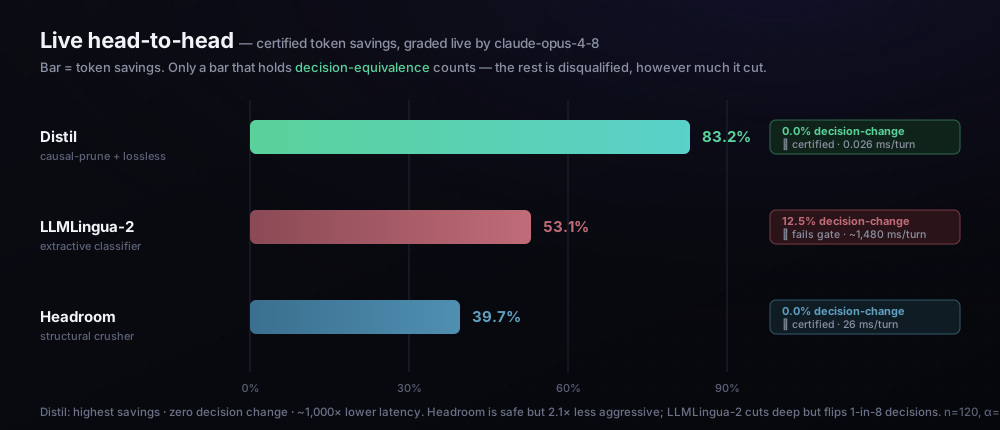
Distil is the only compressor statistically tied with full context — its v1.7 surprise-preserving digest reaches 42.0% vs 39.2% (paired non-inferiority certified; superiority not significant) while every lossy tool craters. And on the live head-to-head above (graded by claude-opus-4-8), it certifies 83.2% savings at a 0% decision-change rate, ~1,000× faster than the nearest tool (distil is pure-Python heuristics — no local ML model; competitors run transformer inference). Full breakdown ↓
One command sets you up and tells you what to do next:
pipx install distil-llm
distil onboard      # detects your agent + billing, wires the status line, prints a guided tour
It detects your environment (Claude Code · Codex · Gemini CLI; metered vs subscription) and hands you the exact commands. Or wrap your agent directly — no config, no code change:
# Claude Code on a metered API key — saves real $$:
distil wrap --expand -- claude

# Claude Code on a Pro/Max subscription — flat-rate, ToS-safe (trims context, not $):
distil wrap --lossless-only -- claude

# Codex, Gemini CLI, aider — same pattern; env var auto-selected per agent:
distil wrap --expand -- codex     # → OPENAI_BASE_URL
distil wrap --expand -- gemini    # → GOOGLE_GEMINI_BASE_URL
distil wrap --expand -- aider     # → OPENAI_BASE_URL

# Headless too — print mode, CI, and Agent SDK scripts route the same way:
distil wrap -- claude -p "summarise this diff"
distil wrap -- python my_agent_sdk_script.py
Each recognized agent (claude / codex / gemini / aider) auto-selects the right env var and upstream — no --env-var or --upstream flag needed. Prints preset: <agent> detected → <VAR> on start. Explicit flags always win.
distil wrap againTired of typing distil wrap every time? Make it the default — once:
distil default            # adds a managed shell alias so `claude` always routes through distil
distil default --undo     # remove it anytime (backed up before any change)
It detects your shell (zsh / bash / fish / PowerShell) and billing mode, writes the
right line to the rc file your shell actually reads, and tells you what it detected.
Want every SDK covered (not just the agent you type)? distil default --always-on
runs a persistent proxy service — powerful, but it's a daemon you keep alive.
Then watch genuine savings from your traffic — measured, not estimated:
distil leaderboard          # cumulative tokens + $ saved, from the local ledger
distil dashboard            # live terminal TUI — token-trim + decision-equiv bars, Ctrl-C to exit
distil dissect             # per-session deep-dive: savings, digest inventory, anomalies (--html/--serve)
Validate it on your traffic. --shadow runs a fraction of requests twice (compressed and full) and compares the agent's chosen next action:
distil wrap --shadow 0.1 -- claude   # wrap + shadow 10% of requests
distil shadow-stats                  # live decision-equivalence rate
Honest scope: that's next-action equivalence — a proxy, not task success (E7 shows it doesn't fully transfer under aggressive lossy compression). Distil fails safe to full context.
Will it save money? Only on metered billing (API key) — fewer tokens, fewer dollars. On a flat-rate subscription it trims context + latency, not the bill. Coding agents: short sessions ~7%, big wins on long, many-turn sessions the model never re-reads.
You don't need byte-equivalence — you need decision-equivalence: your agent taking the same actions with compressed context. That's measurable and certifiable.
distil certify-trajectories bounds how many solvable tasks compression can cost (no other compressor certifies either level).distil_expand tool. Compress fearlessly.max_attempts = 5; ask "the connection timeout?" and it keeps deadline_ms. Two more layers grow from your own traffic, never from a shipped blob: associations distil learns from its content-free expand flywheel (hashed pairs, --expand sessions), and a learned relevance model that is promoted only after its held-out recall beats the lexical baseline on your labels — until promotion, the lexical + bridge layers are exactly what runs. An optional distributional-vector table can be supplied too (pure-Python cosine; none ships). Every layer is additive — it can only widen keeps, so reversibility and the certificate are untouched — and it needs no embeddings or model to work.distil dissect turns a wrap session into a report: savings by model/mechanism, the digest inventory, billed-usage calibration, latency by path, and a worth-your-attention anomaly list that catches silent failures automatically.distil_expand call mid-stream, splicing the recovery in without buffering the turn (no TTFT tax on the reversible tier).Fidelity tiers: lossless (
--verbatim) · reversible (byte-recoverable on demand — default) · lossy (every other tool). Only Distil certifies the reversible tier (Headroom ships an uncertified retrieve; Distil's recovery is agent-facing — the model expands mid-task — and gated by the decision-equivalence certificate).
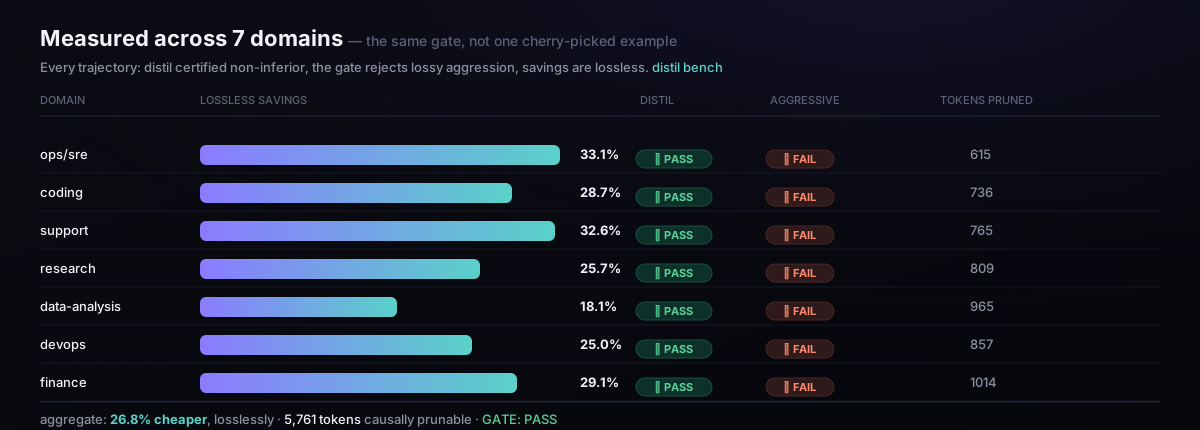
Don't take the table above on faith. distil bench re-certifies savings and decision-equivalence on a bundled 7-domain corpus, offline, in seconds — the same gate that runs in CI. How we evaluate — and why a compression ratio without a task-success delta is meaningless — is written up in docs/EVALUATION.md, including our own negative result:
uvx --from distil-llm distil bench      # certify savings + quality across 7 domains, in seconds
distil verify                           # byte-fidelity: every compression is exactly reversible
distil validate                         # adversarial real-path gate: invariants on hostile inputs
Three gates, all in CI: bench (non-inferiority on the corpus), verify (byte-fidelity), and validate — which drives the compressor against adversarial inputs (huge/unicode/nested/malformed/marker-injection/secret-looking) and asserts reversibility, reject-if-bigger, recency-exactness, fail-open, and content-free telemetry hold on every one. That last gate exists because a green unit suite kept coexisting with real-traffic bugs; validate is the adversarial layer that catches them.
To be precise about what each layer proves: the per-commit gates grade decision-equivalence with an offline deterministic oracle over the committed corpus (fast, free, runs on every push — but synthetic). A nightly live-cert job re-certifies the same trajectories against a real model (distil certify --runner anthropic), budget-capped with a hard --max-live-calls ceiling so an unattended run can never spend silently. The empirical results above (SWE-bench n=500, live head-to-head n=200) were graded by real models; the per-commit badge alone doesn't claim that.
domain            trajectory                $ saved   distil   aggr  pruned
---------------------------------------------------------------------------
ops/sre           sre-disk-incident           33.1%     PASS   FAIL     615
coding            coding-bugfix               28.7%     PASS   FAIL     736
support           support-refund              32.6%     PASS   FAIL     765
research          research-synthesis          25.7%     PASS   FAIL     809
data-analysis     data-analysis-sql           18.1%     PASS   FAIL     965
devops            devops-rollback             25.0%     PASS   FAIL     857
finance           finance-reconcile           29.1%     PASS   FAIL    1014
---------------------------------------------------------------------------
aggregate: distil cuts $0.14212 -> $0.10402 (26.8% cheaper) reversibly; 5761 tokens causally prunable.
GATE: PASS — every trajectory certified non-inferior; aggressive rejected on all.
Why trust the number? Token-savings numbers are easy to fake — measure quality at low compression, advertise savings at high compression. Distil refuses that: accuracy and compression are measured on the same trajectories, and a strategy that can't pass non-inferiority doesn't ship.
hljs language-bashdistil certify --strategy distil # VERDICT: PASS (100% decision-equivalence) distil certify --strategy aggressive # VERDICT: FAIL (mean diff −1.0, blocked)
distil eval plots the certified compression frontier — a savings-vs-quality curve where every point carries its certification verdict, locating the cliff past which lossy compression drops decisions. The artifact no competitor publishes: benchmark.html.
Three results, all reproducible, all published with caveats:
llmlingua / headroom-ai (graded by claude-opus-4-8): 83.2% savings at 0% decision-change, ~1,000× faster (no ML model loaded vs. competitors' local transformer inference). The live proxy behavior is pinned to the certified strategy by tests/test_live_certified_equivalence.py; the one reviewed delta is a recency carve-out that keeps the last few tool-result turns verbatim (an agent needs its freshest output byte-exact). → benchmarkFull methodology, McNemar tests, per-instance data: docs/PAPER.md · PDF.
Measured on your traffic, never estimated, nothing leaves your machine:
x-distil-* response headers (tokens-saved, mode, compressible-tokens, expanded).distil leaderboard (--html for a page).distil proxy --shadow 0.05 reports the live decision-change rate — streaming-aware.distil proxy sidecar + set ANTHROPIC_BASE_URL once; every client routes through it.distil census on) shares your numbers-only totals — preview the exact payload with distil census show before consenting; TELEMETRY.md has the frozen schema. Default remains: nothing is sent.Dashboard, status-line plugin, federated leaderboard: Deploy & observability.
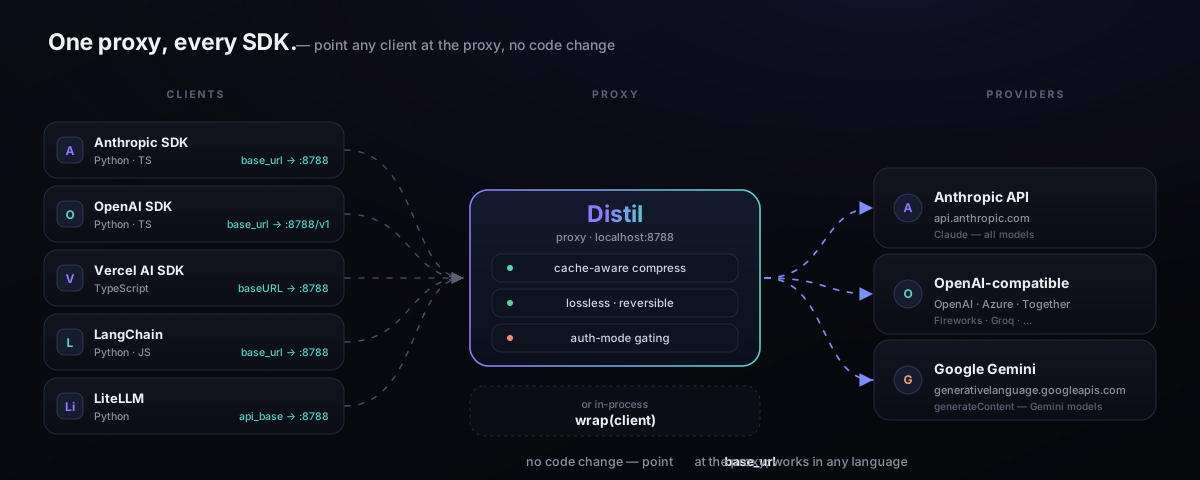
One proxy. Point any base_url-honoring client at it — Python, TypeScript, any language — and get cache-aware reversible compression with no code change.
distil proxy --upstream https://api.anthropic.com # localhost:8788
// JS/TS: npm i distil-llm  → helper so you don't hardcode the URL
import Anthropic from "@anthropic-ai/sdk";
import { distilBaseURL } from "distil-llm";
const client = new Anthropic({ baseURL: distilBaseURL() });
| SDK / framework | Change | Example |
|---|---|---|
| Anthropic SDK (Py/TS) | base_url="http://127.0.0.1:8788" | examples/python_anthropic.py · examples/js_anthropic.ts |
Claude Agent SDK / claude -p (headless) | distil wrap -- <cmd> or ANTHROPIC_BASE_URL | examples/python_claude_agent_sdk.py |
| OpenAI SDK (Chat + Responses) | base_url="http://127.0.0.1:8788/v1" | examples/python_openai.py |
| Vercel AI SDK | createAnthropic({ baseURL: '…:8788' }) | examples/js_vercel_ai_sdk.ts |
| LangChain (py/js) · LangGraph | anthropicApiUrl / base URL · pre_model_hook | examples/js_langchain.ts |
| LiteLLM | api_base="http://127.0.0.1:8788" | examples/python_litellm.py |
| Google Gemini | --upstream https://generativelanguage.googleapis.com | examples/python_gemini.py |
Codex · aider · Cursor-agent · any base_url client | distil wrap -- <agent> or OPENAI_BASE_URL | — |
Anything that speaks the Anthropic / OpenAI / Gemini wire format works — the proxy is framework-agnostic, so CrewAI, AutoGen, Agno, Strands, Bedrock, etc. route through it unchanged by pointing their client's base URL at distil.
Prefer in-process? Wrap the client directly — still no call-site change:
from distil.adapters.anthropic import wrap
client = wrap(anthropic.Anthropic())   # compresses the request, keeps the cache warm
(OpenAI — Chat Completions and Responses API — and Gemini route through the proxy: distil wrap -- codex, or point OPENAI_BASE_URL at it. An in-process client wrap exists for the Anthropic SDK only.)
Framework hooks (no proxy, no network hop) — for agent frameworks that own the message list, compress it where it lives:
| Framework | Hook | Example |
|---|---|---|
| LiteLLM | distil.integrations.litellm.compress(kwargs) | examples/python_litellm.py |
| LangChain | distil.integrations.langchain.compress_messages(msgs) | — |
| LangGraph | pre_model_hook=pre_model_hook() (compresses graph state before the model node) | examples/python_langgraph.py |
Distil ships a Model Context Protocol server so an agent can compress its own tool output and get the exact bytes back later. Zero dependencies (stdlib JSON-RPC over stdio, no SDK), fully local — content never leaves the machine.
Add it in one line:
claude mcp add distil -- distil mcp
{
  "mcpServers": {
    "distil": { "command": "distil", "args": ["mcp"] }
  }
}
Haven't installed distil? Run it straight from PyPI — no install step:
{
  "mcpServers": {
    "distil": { "command": "uvx", "args": ["--from", "distil-llm", "distil", "mcp"] }
  }
}
Config lives in ~/Library/Application Support/Claude/claude_desktop_config.json (Claude Desktop,
macOS), .cursor/mcp.json (Cursor), or .vscode/mcp.json (VS Code). Restart the client after editing.
Verify it's up — no client needed:
echo '{"jsonrpc":"2.0","id":1,"method":"tools/list"}' | distil mcp
| Tool | Does | Your agent reaches for it when |
|---|---|---|
distil_compress(text) | Returns a compact digest + an 8-hex handle; stores the original locally (encrypted, 0600) | A tool returned something huge and carrying it verbatim is wasteful |
distil_expand(handle) | Returns the exact original bytes — not a summary | The digest lost a detail it now needs: a line, a value, a stack frame |
distil_savings() | Cumulative tokens/dollars from the local ledger | You ask "how much has distil saved me?" |
Every tool is annotated (readOnlyHint, idempotentHint, openWorldHint: false), so a well-behaved
client knows distil_expand is a safe, repeatable, offline read without having to guess from prose.
This is the recall path, not the savings path. The MCP server doesn't compress your agent's traffic —
distil wrap -- <agent>does that, transparently, with no tool calls. What the MCP server adds is the other half: any agent, including one you didn't wrap, can calldistil_expandon a handle it sees in context and get the original back. Handles persist across sessions and processes, and age out afterDISTIL_RESTORE_TTL_DAYS(default 14).
New here? pipx install distil-llm, then distil onboard — it sets you up and guides you (see Use it now). Want to see it prove itself first instead? distil bench runs the certified gate in ~10s, no API key. The matrix below is for picking an install format — everything in it is an alternative, not a requirement.
⚠️ The one gotcha — the name. The PyPI package is
distil-llmbut the command isdistil(the bare name was taken). Sopipx install distil-llm→ rundistil ….pip install distilinstalls something else.
🔧 Seeing
Could not find a version that satisfies the requirement distil-llm (from versions: none)? The package is on PyPI — that error means yourpip/pipxis on a Python older than the package's floor, so pip filters every release out. Distil now supports Python 3.9+ (the version macOS ships), so a current install just works; if you still hit this on a very old Python, let uv provision one for you:uvx --python 3.12 --from distil-llm distil bench(oruv tool install --python 3.12 distil-llm). Check yours withpython3 --version.
🔧 Got an old version (e.g.
0.25.1) instead of the latest? Public PyPI always serves the newest (pip index versions distil-llmlists them). If you got an older one, yourpip/pipxis not resolving against public PyPI — almost always a stale internal mirror (Artifactory / CodeArtifact / Nexus that hasn't synced the latest yet — common right after a release) or a<1.0version pin in a constraints file /pip.conf. Diagnose and fix:hljs language-bashpip index versions distil-llm # stops at an old version? → your index/mirror is stale pip config list ; env | grep -i pip # look for an index-url or PIP_CONSTRAINT pin # unblock now — force public PyPI: pipx install --pip-args="--index-url https://pypi.org/simple/" distil-llm # (or, if you must use the mirror, ask your platform team to sync distil-llm; it exists upstream)
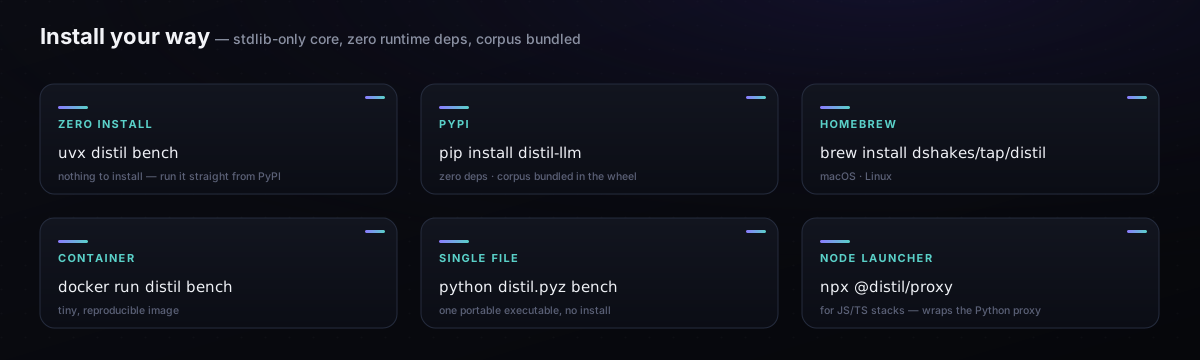
| Format | Command | Prereq |
|---|---|---|
| Zero install | uvx --from distil-llm distil bench | uv — auto-provisions Python 3.9+ |
| Isolated CLI | pipx install distil-llm → distil bench | Python 3.9+ (else pipx install --python python3.12 distil-llm) |
| Homebrew | brew install dshakes/tap/distil | Homebrew |
| Docker | docker run ghcr.io/dshakes/distil:latest bench (or docker build -t distil .) | Docker |
| Single file | make pyz → python dist/distil.pyz bench | Python 3.9+ |
| In a venv | pip install distil-llm (inside an active virtualenv) | Python 3.9+ |
| Node / JS / TS | npx distil-llm wrap -- <agent> · npm i distil-llm for baseURL helpers | Node 18+ (bridges to Python via uv/pipx) |
The import package and CLI are
distil; the PyPI distribution isdistil-llm(the bare name was taken — souvx/pipmust referencedistil-llm, notdistil). Distil is a CLI: install it isolated (pipx/uv/brew/Docker), because modern macOS/Linux block system-widepip install(PEP 668). Node / JS / TS:npx distil-llm wrap -- <agent>(the npm package bridges to the CLI), ornpm i distil-llmfordistilBaseURL()helpers to point any SDK at the proxy — or just setbase_urlyourself.
Basics are in Use it now and Works with every SDK. Beyond that:
| Goal | Command |
|---|---|
| Set up + a guided tour (start here) | distil onboard |
Make distil the default (no per-session wrap) | distil default · undo: distil default --undo |
| Remove distil's footprint (before uninstalling) | distil offboard · also clear data: distil offboard --purge |
| Diagnose your setup (ledger, shadow, proxy self-test, wiring) | distil doctor |
| Wire the savings status line into Claude Code | distil setup (compact segment: DISTIL_STATUSLINE=minimal) |
| Watch genuine savings accumulate | distil leaderboard · live TUI: distil dashboard |
| Session summary on exit (tokens, cost, shadow, restorability) | printed automatically by distil wrap — opt out with DISTIL_NO_LEDGER=1 |
| Deep-dive one session (savings, anomalies) | distil dissect (--html / --serve) |
| Live decision-equivalence on real traffic | distil wrap --shadow 0.1 -- claude → distil shadow-stats |
| Certify on your domain | distil ingest --input prod.jsonl --out ./mycorpus → distil conformal --corpus ./mycorpus |
| Recover digested detail from any agent (MCP) | distil mcp |
| Self-improving keep policy | distil learn / distil online |
Status line — one pattern in every state:
distil · <live> · total ▼<lifetime>.
state you see means saving distil · ⬢ digest · ▼12.0K · 40% smaller · $0.31 · total ▼27.0M · de 99%compressing (mode chip: ⬢ digest·◇ lossless·▪ verbatim;de= decision-equivalence)watching distil · ✓ on · waiting for a large read · total ▼27.0Mon, but no large content yet — savings come from big file/command output idle distil · ✓ on · total ▼27.0Mset up and on, no recent traffic not routed distil · off — session not routed · total ▼27.0Mthis session's requests go straight to the provider — start it with distil wrap(or the always-on env) to compressbypassing distil · ⚠ wrapped, agent bypassing proxy · total ▼27.0Mthe wrap is up but zero requests reached its proxy in 3+ minutes — the agent pinned its own endpoint. Fix: restart the wrap. Seen mostly with claude.ai-subscription (OAuth) sessions; routing those through a custom base URL is undocumented upstream, and a session occasionally ignores it. scripts/soak-report.shcaptures evidence if it persistsThe
desegment is live decision-equivalence evidence: a ✓/⚠/✗ rate once 50 A/B samples + 30 A/A samples accrue (A/B = compressed-vs-original; A/A = same request replayed against itself — the sampling-noise baseline),de n/50while collecting. Shadow sampling is on by default at 2% (--shadow 0disables;--shadow 1.0samples every request — proves equivalence in minutes at ~3× token cost, then drop back to the default 2%).Measured: In live validation (signature v3 / 1.13.0), distil preserved the agent's next decision on 100% of 116 sampled production requests (0 changes); temperature-0 A/A self-agreement of 31/31 confirms this is compression fidelity, not sampling noise. Validated result — not a guarantee for all workloads.
▼= tokens saved ·total= lifetime ·de= decision-equivalence (verdict once 50 A/B + 30 A/A shadow samples accrue). Sharing the line with git/cwd/model?DISTIL_STATUSLINE=minimal→distil ▼7.8K · 27M total. On a flat-rate subscription, dollars are notional and auto-hidden (DISTIL_SUBSCRIPTION=0/1).
Compression modes — in plain English
You usually don't need to pick. distil onboard detects your billing and sets the right mode for you — it writes it into your setup so every session just works. Pass a flag to override for a specific session.
--safe) — The cautious setting: Distil only trims things it can rebuild perfectly (like extra blank space), and never summarizes. You save less, but there's zero chance of losing any detail. Picked automatically on a flat monthly subscription.For the technical breakdown:
| Mode | What it does | Savings | Safety | Auto-selected when |
|---|---|---|---|---|
--expand | Digest + injected expand tool so the model recovers content on demand | Most | Lossy-but-recoverable | Metered / API-key (PAYG) |
(default) digest | Tier-1 digest only — no tool injection | High | Reversible via RestoreStore | No flag passed |
--lossless-only / --safe | Lossless transforms only — no digests, no tool injection | Fewer | Zero unrecoverable content | Subscription / flat-rate |
--verbatim | Whitespace + JSON normalization only | Minimal | Most conservative | Debugging / auditing |
Subscription users should not force --expand; it crosses the lossless safety boundary. Coding re-reads? Add --session-delta either way.
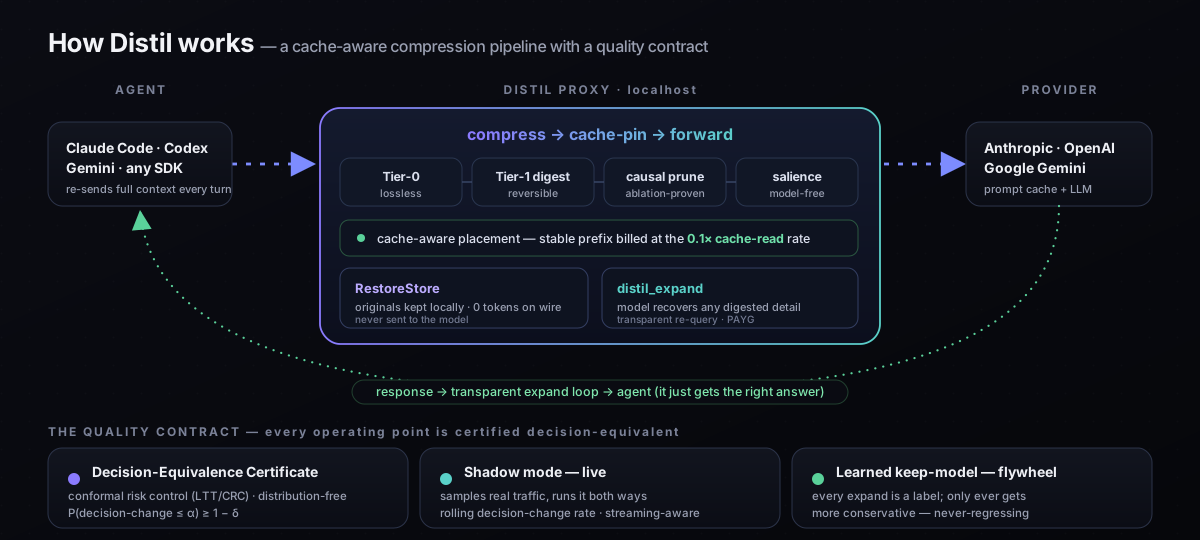
Two techniques carry most of the win — they target where the money actually is in an agent loop, not where it looks like it is.
You re-send the growing context every step. With prompt caching a cache read is ~10× cheaper than fresh input, so the real cost is cache misses, not context size. Distil keeps the prefix byte-stable (schema canonicalization + lifting volatile fields like timestamps/UUIDs out of the prefix) and compresses only the volatile tail.
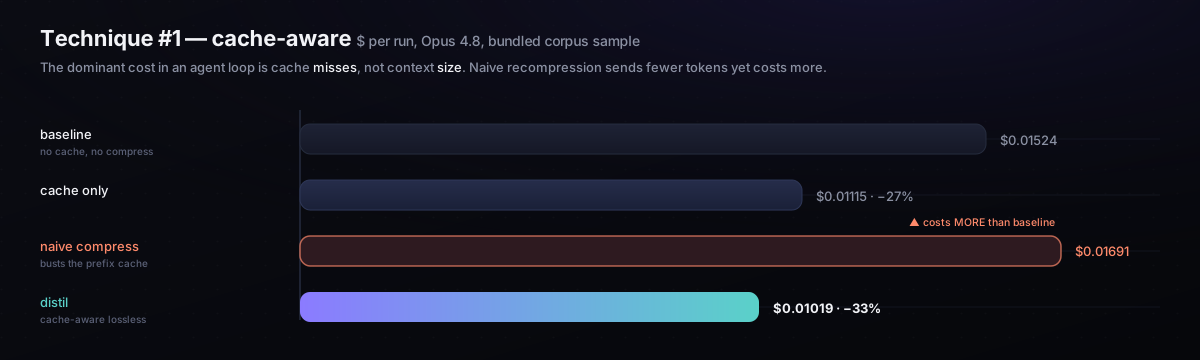
Naive recompression sends fewer tokens yet costs more than not compressing at all, because it rewrites the cached prefix every turn. Distil doesn't — that's the whole game most tools miss.
The eval isn't a ruler bolted on the side; it's a discovery engine. Remove a context block, replay, did any decision change? Blocks that never change a decision are provably free to drop.
distil prune
# doc-0   PRUNE (causally inert)     # speculative retrieval, never cited
# obs-0   keep (changed a decision)  # carries the decision-driving signal
The gate answers "is this strategy non-inferior on my corpus?". The Decision-Equivalence Risk Certificate answers the operational one: "for a risk budget I choose (say ≤5% decision-change), how hard can I compress with a guarantee that holds on my real traffic?"
distil conformal --corpus ./mycorpus --alpha 0.05 --delta 0.05
# ✔ CERTIFIED 'lossless' → 57.4% savings; decision-change ≤ 5.0% at 95% confidence (Learn-Then-Test)
It's conformal risk control (Learn-Then-Test / CRC — distribution-free, finite-sample), not a heuristic threshold. The one load-bearing caveat: the guarantee requires exchangeability (calibration traffic ≈ live traffic) and is marginal over that distribution — recalibrate on drift. Full theory + citations: Concepts · docs/PAPER.md.
DERC certifies the step; this certifies the task. Our E7 experiment — and the 2024–26 agent-compression literature — shows per-step fidelity can pass while end-to-end success collapses, so distil also certifies the level users actually feel: run your eval suite twice (full context vs compressed), feed the matched outcomes in, and get a distribution-free bound on how many solvable tasks compression may cost you:
distil certify-trajectories outcomes.jsonl --alpha 0.05 --delta 0.05
# each line: {"task_id": "...", "full_success": true, "compressed_success": true}
# → With confidence 95%, compression degrades at most 5.0% of tasks the full
#   context would have solved (observed 0.5% over 200 matched trajectories).
It refuses to certify on small samples, states its exchangeability assumptions in the certificate itself, and ships an anytime-valid drift monitor (trajectory_risk.drift_monitor) that tells you when live traffic has shifted enough that the certificate is stale. Matched failures also feed the outcome-guided policy (distil.compress.guideline): content classes that break tasks when digested get protected byte-exact, automatically.
40+ shipped capabilities, all real (no stubs): the cache-aware cost engine, causal pruning, the TOST gate + conformal certificate, the proxy + Anthropic/OpenAI/Gemini first-class adapters (Chat Completions, Responses API, and Gemini generateContent), an MCP server, LiteLLM/LangChain/LangGraph hooks, per-agent wrap presets, the Proof Ledger end-of-session printout, the multi-tenant gateway with issued keys and rate limits, encrypt-at-rest for the restore store, learned keep-models, output compression, and an optional Rust hot-path core (build-from-source via maturin; published wheels run the pure-Python engine, same API) — with zero runtime dependencies in the core.
Full module-by-module map: Architecture · Techniques · CLI reference.
127.0.0.1 and forwards only to the single configured upstream (no SSRF).--lossless-only (Tier-0 verbatim: no Tier-1 digest stubs, no tool injection — provider-ToS-safe); distil wrap -- claude is safe by default, no flag needed. An explicit --expand opts into the recoverable digest even there (you authorized the recovery tool, so nothing is irreversibly lost — issue #28). Without an injected expand tool the agent cannot recover a stub, so --lossless-only folds directly into verbatim.~/.distil/restore/ are encrypted with HMAC-SHA256-CTR (encrypt-then-MAC, DSTL1 header, key at chmod 0600), protecting against backup/sync leakage and cross-user reads on shared filesystems. A same-UID attacker who can read both the data files and the key file is explicitly out of scope (see THREAT_MODEL.md). Legacy plaintext files load transparently. DISTIL_NO_ENCRYPT_AT_REST=1 opts out; handles age out after DISTIL_RESTORE_TTL_DAYS (default 14). No data is forwarded upstream.GET /distil/health liveness probe on every entry point (never touches the billed upstream); gateway accounting checkpoints to disk every 30 s (crash-safe, not just on graceful shutdown); DISTIL_DEBUG=1 surfaces everything the fail-open compression path swallows.distil wrap supervises its proxy as a subprocess on a wrap-owned socket; when a new version lands on disk (pipx/pip upgrade) the wrap hot-swaps in a fresh worker — same port, in-flight streams finish on the old one, the agent never restarts. Health-checked with automatic rollback: a broken upgrade keeps the old worker serving. POSIX; kill -USR1 <wrap pid> forces it, DISTIL_HOT_SWAP=0 opts out. On Windows the wrap keeps the historical in-thread proxy (no seamless swap) and warns on version skew instead — upgrades there apply on the next session.pip install 'distil-llm[otel]' and every proxied call emits a GenAI semantic-convention span (gen_ai.request.model, gen_ai.usage.input_tokens) plus distil's own story: distil.tokens.original vs distil.tokens.compressed, distil.compression.ratio, distil.shadow.sampled, and distil.session.id for per-session trace correlation — your existing OTel backend sees exactly what compression did to each request. Without the extra installed it's a single boolean check, zero overhead, and an OTel failure can never break the request path. No metrics endpoint exists — the LiteLLM unauthenticated-/metrics leak class of bug is structurally absent.main. Don't take our word for it — verify a release yourself: uvx pypi-attestations verify pypi --repository https://github.com/dshakes/distil pypi:distil_llm-1.19.0-py3-none-any.whl (or inspect the raw bundle at https://pypi.org/integrity/distil-llm/<version>/<filename>/provenance).See Deploy & security for topologies (local sidecar, container sidecar, shared gateway) and the threat model.
usage.* on every response — it learns the systematic correction from that (content-free, no network) and calibrates the absolute counts to your model + content mix automatically. The leaderboard shows "calibrated to your billed usage (N requests, ±X%)" once enough traffic has flowed; until then it's the raw heuristic (identity, so no skew). For per-string exactness there's still --tokenizer anthropic.distil_expand recovery loop.metrics.json regenerates byte-identically from python -m distil.codec.learned, seed-pinned). The optional transformer codec ships no checkpoint in the package — a demo checkpoint is attached to the v0.1.0 release, and production means retraining on your own traces (distil train-transformer).Distil is a compression engine with a correctness gate, not a context suite. We declined what can't go under the certificate:
| Adjacent feature | Our stance |
|---|---|
| Persistent memory / knowledge graph | Out of scope — a lossy store is the opposite of byte-reversible. |
| Hosted semantic cache | Out of scope — we make the provider's prompt cache pay off, not a second lossy one. |
| Editor/Copilot auth | Out of scope — Distil sits on the wire or in-process; never brokers credentials. |
What we did adopt (it survives the gate): a pluggable salience scorer to protect entities, cache-prefix observability, and framework hooks.
Distil compresses input/context (comprehensive) and output — generation-side verbosity shaping (PAYG, measured with distil output-savings) plus a reversible output-on-re-entry digest, so verbose past answers stop costing full price as history. Details: Output & I/O.
Every number reproduces from the bundled corpus (distil bench, no key). The non-circular proof harness grades real agent traces with a real model (τ-bench / SWE-bench): benchmarks/PROVE.md. Compiled paper, LaTeX source, and all committed results: docs/PAPER.md · docs/paper/ · paper PDF. Step-by-step: Reproduce the Numbers →
pipx install distil-llm && distil bench
certified savings across 7 domains in ~10 seconds — zero API key, zero runtime deps
Get started → · Wire it into your SDK · Read the proof · PyPI
A star is how the next engineer finds provable savings instead of a lossy guess — and
distil stats --badge gives you a shareable badge of your own measured number to
show alongside it. That badge + this repo are the whole marketing department.
PRs welcome — see CONTRIBUTING.md. The one rule that matters: a new compression strategy must pass make gate (non-inferior on every domain, byte-reversible). No green gate, no merge. That's the whole philosophy in one sentence.
Beta program — want early access to v1.20.0 and to help close the GA gate? See docs/BETA.md.
pip install -U distil-llm (or uv tool upgrade distil-llm) tracks them.Apache-2.0 · “Same potency, less volume.”
Run Claude Code as an MCP server so any agent can delegate coding tasks to it
 @microsoft✓ Official
Browser automation using accessibility snapshots instead of screenshots
 @googleapis✓ Official
Google's universal MCP server supporting PostgreSQL, MySQL, MongoDB, Redis, and 10+ databases
 @github✓ Official
Official GitHub integration for repos, issues, PRs, and CI/CD workflows