

Are you the author? Sign in to claim
Diagnose and Fix CUDA / GPU environments compatibility issues locally, in Docker, and CI/CD. CLI + MCP server available.

The missing link between your GPU and Python AI libraries


"Why does my PyTorch crash with CUDA errors when I just installed it?"
Because your driver supports CUDA 11.8, but
pip install torchgave you CUDA 12.4 wheels.
Env-Doctor diagnoses and fixes the #1 frustration in GPU computing: mismatched CUDA versions between your NVIDIA driver, system toolkit, cuDNN, and Python libraries.
It takes 5 seconds to find out if your environment is broken - and exactly how to fix it.
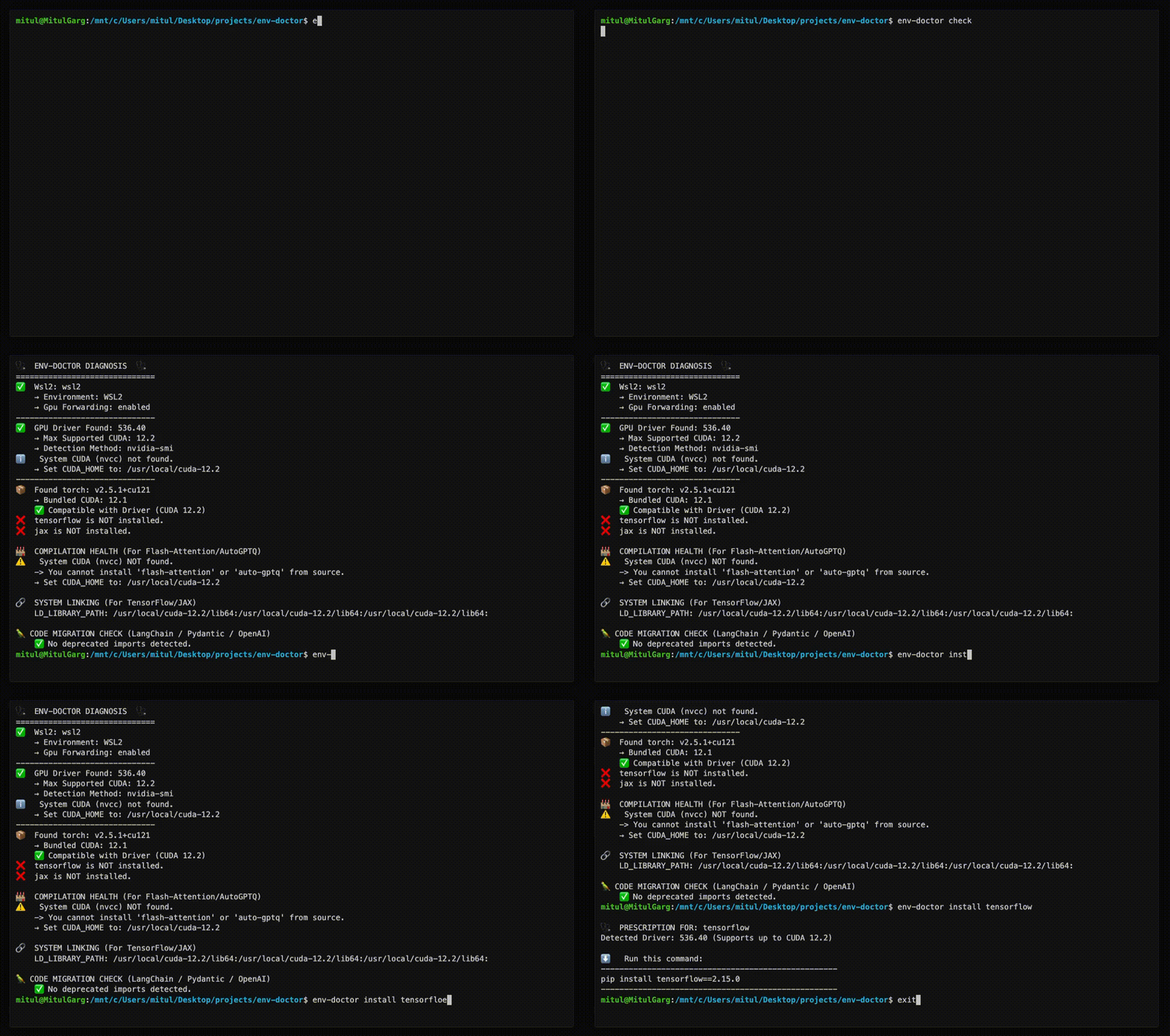
| Feature | What It Does |
|---|---|
| One-Command Diagnosis | Check compatibility: GPU Driver → CUDA Toolkit → cuDNN → PyTorch/TensorFlow/JAX |
| Compute Capability Check | Detect GPU architecture mismatches — catches why torch.cuda.is_available() returns False on new GPUs (e.g. Blackwell) even when driver and CUDA are healthy |
| Python Version Compatibility | Detect Python version conflicts with AI libraries and dependency cascade impacts |
| Jupyter / Notebook Output | from env_doctor import check; check() renders a rich HTML diagnosis inline in Jupyter, Colab, or VS Code notebooks — falls back to text in the terminal |
| CUDA Auto-Installer | Execute CUDA Toolkit installation directly with --run; CI-friendly with --yes; preview with --dry-run |
| Safe Install Commands | Get the exact pip install command that works with YOUR driver |
| Extension Library Support | Install compilation packages (flash-attn, SageAttention, auto-gptq, apex, xformers) with CUDA version matching |
| AI Model Compatibility | Check if LLMs, Diffusion, or Audio models fit on your GPU before downloading |
| WSL2 GPU Support | Validate GPU forwarding, detect driver conflicts within WSL2 env for Windows users |
| Deep CUDA Analysis | Find multiple installations, PATH issues, environment misconfigurations |
| Container Validation | Catch GPU config errors in Dockerfiles before you build |
| MCP Server | Expose diagnostics to AI assistants (Claude Desktop, Zed) via Model Context Protocol |
| CI/CD Ready | JSON output, proper exit codes, and CI-aware env-var persistence (GitHub Actions, GitLab CI, CircleCI, Azure Pipelines, Jenkins) |
| Fleet Dashboard (optional) | Web UI for monitoring multiple GPU machines — aggregate status, drill-down diagnostics, history timeline. Install with pip install "env-doctor[dashboard]" |
The core CLI has no heavy dependencies — installs in seconds.
pip install env-doctor
# Or with uv (faster, isolated)
uv tool install env-doctor
uvx env-doctor check
If you want to manage a distributed system of multiple GPU nodes, this dashboard can help you from a observability POV. It adds a web UI for monitoring multiple GPU machines and has no effect on the core CLI. You will be able to soon take action directly from the dashboard via distributed env-doctor cli instances on each VM!
pip install "env-doctor[dashboard]"
This adds: fastapi, uvicorn, sqlalchemy, aiosqlite
pip install env-doctor | pip install "env-doctor[dashboard]" | |
|---|---|---|
env-doctor check | ✅ | ✅ |
| All CLI commands | ✅ | ✅ |
| MCP server | ✅ | ✅ |
env-doctor check --report-to | ✅ | ✅ |
env-doctor report install/status | ✅ | ✅ |
env-doctor dashboard (web UI) | ✗ | ✅ |
Env-Doctor includes a built-in Model Context Protocol (MCP) server that exposes 11 diagnostic tools to AI assistants like Claude Code and Claude Desktop.
// Claude Desktop config (~/.config/Claude/claude_desktop_config.json)
{
  "mcpServers": {
    "env-doctor": {
      "command": "env-doctor-mcp"
    }
  }
}
Ask your AI assistant things like "Check my GPU environment", "Can I run Llama 3 70B on my GPU?", or "Validate this Dockerfile for GPU issues".
Learn more: MCP Integration Guide
The core CLI works standalone. The dashboard is an observability layer for teams running multiple GPU machines.
pip install "env-doctor[dashboard]" unlocks a web UI that aggregates diagnostic results from every machine in your fleet into a single view — no SSH required.
1. Start the dashboard (any machine — no GPU needed):
pip install "env-doctor[dashboard]"
env-doctor dashboard
# → Serving at http://localhost:8765
# → Generated API token at ~/.env-doctor/api-token
2. Report from each GPU machine:
pip install env-doctor

# One-time report
env-doctor check --report-to http://<dashboard-host>:8765 --token <token>

# Automatic reporting every 2 minutes (cron on Linux, Task Scheduler on Windows)
env-doctor report install --url http://<dashboard-host>:8765 --token <token> --interval 2m
env-doctor commands from the UI, executed on next check-in (no SSH needed)Smart change detection means stable machines only POST ~1 heartbeat every 30 minutes, not on every poll.
Learn more: Fleet Monitoring Guide
env-doctor check
Example output:
🩺 ENV-DOCTOR DIAGNOSIS
============================================================

🖥️  Environment: Native Linux

🎮 GPU Driver
   ✅ NVIDIA Driver: 535.146.02
   └─ Max CUDA: 12.2

🔧 CUDA Toolkit
   ✅ System CUDA: 12.1.1

📦 Python Libraries
   ✅ torch 2.1.0+cu121

✅ All checks passed!
On new-generation GPUs (e.g. RTX 5070 / Blackwell), env-doctor catches compute capability mismatches — the reason torch.cuda.is_available() returns False even when your driver and CUDA are healthy:
🎯  COMPUTE CAPABILITY CHECK
    GPU: NVIDIA GeForce RTX 5070 (Compute 12.0, Blackwell, sm_120)
    PyTorch compiled for: sm_50, sm_60, sm_70, sm_80, sm_90, compute_90
    ❌ ARCHITECTURE MISMATCH: Your GPU needs sm_120 but PyTorch 2.5.1 doesn't include it.

    FIX: Install PyTorch nightly with sm_120 support:
       pip install --pre torch torchvision torchaudio --index-url https://download.pytorch.org/whl/nightly/cu126
Inside a Jupyter, Colab, or VS Code notebook, the Python API renders a rich, self-contained HTML report inline:
from env_doctor import check
check()   # auto-renders HTML in notebooks, prints text in terminals
Install the optional extra for notebook support: pip install "env-doctor[notebook]".
You can also force HTML from the CLI with env-doctor check --format html > report.html.
env-doctor python-compat
🐍  PYTHON VERSION COMPATIBILITY CHECK
============================================================
Python Version: 3.13 (3.13.0)

❌  2 compatibility issue(s) found:

    tensorflow: supports Python <=3.12, but you have Python 3.13
    torch: supports Python <=3.12, but you have Python 3.13

⚠️   Dependency Cascades:
    tensorflow [high]: propagates to keras, tensorboard
    torch [high]: propagates to torchvision, torchaudio, triton

💡  Consider using Python 3.12 or lower for full compatibility
============================================================
env-doctor install torch
⬇️ Run this command to install the SAFE version:
---------------------------------------------------
pip install torch torchvision --index-url https://download.pytorch.org/whl/cu118
---------------------------------------------------
Display instructions or execute the installation directly:
# Show platform-specific steps (default)
env-doctor cuda-install

# Preview what would run — no changes made
env-doctor cuda-install --dry-run

# Execute interactively (asks [y/N] before running)
env-doctor cuda-install --run

# Execute headlessly — great for CI/scripts
env-doctor cuda-install --run --yes

# Install a specific version, headless
env-doctor cuda-install 12.6 --run --yes
Example dry-run output (Windows):
[DRY RUN] [1/1] winget install Nvidia.CUDA --version 12.2

[DRY RUN] [1/1] nvcc --version

CUDA 12.2 installation completed successfully.
Verification: PASSED

Full log: C:\Users\you\.env-doctor\install.log
Every run writes a timestamped log to ~/.env-doctor/install.log for debugging.
Supported Platforms:
winget)Exit codes for CI pipelines:
| Code | Meaning |
|---|---|
0 | Installation succeeded and verified |
1 | An installation step failed |
2 | Installed but nvcc --version failed |
For packages like flash-attn, SageAttention, auto-gptq, apex, and xformers that compile from source, env-doctor detects CUDA mismatches and provides two fix paths:
env-doctor install flash-attn
🩺  PRESCRIPTION FOR: flash-attn

⚠️   CUDA VERSION MISMATCH DETECTED
     System nvcc: 12.1.1 | PyTorch CUDA: 12.4.1

🔧  Two options:
    📦 OPTION 1: Downgrade PyTorch to match nvcc (12.1) — no system changes
    ⚙️  OPTION 2: Upgrade nvcc to match PyTorch (12.4) — better long-term

    (Full step-by-step commands shown for both options)
env-doctor model llama-3-8b
🤖  Checking: LLAMA-3-8B (8.0B params)

🖥️   Your Hardware: RTX 3090 (24GB)

💾  VRAM Requirements:
  ✅  FP16: 19.2GB - fits with 4.8GB free
  ✅  INT4:  4.8GB - fits with 19.2GB free

✅  This model WILL FIT on your GPU!
List all models: env-doctor model --list
Cloud GPU Recommendations:
# Get cloud GPU recommendations for a model that doesn't fit
env-doctor model llama-3-70b --recommend

# Direct VRAM lookup (no model name needed)
env-doctor model --vram 80000 --recommend
☁️   Cloud GPU Recommendations

  FP16 (~140.0 GB):
    $27.20 /hr  azure  ND96asr_v4              8x A100 (40GB each)          180.0GB free
    $29.39 /hr  gcp    a2-highgpu-8g            8x A100 (40GB each)          180.0GB free
    ...
Automatic HuggingFace Support (New ✨) If a model isn't found locally, env-doctor automatically checks the HuggingFace Hub, fetches its parameter metadata, and caches it locally for future runs — no manual setup required.
# Fetches from HuggingFace on first run, cached afterward
env-doctor model bert-base-uncased
env-doctor model sentence-transformers/all-MiniLM-L6-v2
Output:
🤖  Checking: BERT-BASE-UNCASED
    (Fetched from HuggingFace API - cached for future use)
    Parameters: 0.11B
    HuggingFace: bert-base-uncased

🖥️   Your Hardware:
    RTX 3090 (24GB VRAM)

💾  VRAM Requirements & Compatibility
  ✅  FP16:  264 MB - Fits easily!

💡  Recommendations:
1. Use fp16 for best quality on your GPU
env-doctor dockerfile
🐳  DOCKERFILE VALIDATION

❌  Line 1: CPU-only base image: python:3.10
    Fix: FROM nvidia/cuda:12.1.0-runtime-ubuntu22.04

❌  Line 8: PyTorch missing --index-url
    Fix: pip install torch --index-url https://download.pytorch.org/whl/cu121
| Command | Purpose |
|---|---|
env-doctor check | Full environment diagnosis |
env-doctor python-compat | Check Python version compatibility with AI libraries |
env-doctor cuda-install | Step-by-step CUDA Toolkit installation guide |
env-doctor install <lib> | Safe install command for PyTorch/TensorFlow/JAX, extension libraries (flash-attn, auto-gptq, apex, xformers, SageAttention, etc.) |
env-doctor model <name> | Check model VRAM requirements |
env-doctor cuda-info | Detailed CUDA toolkit analysis |
env-doctor cudnn-info | cuDNN library analysis |
env-doctor dockerfile | Validate Dockerfile |
env-doctor docker-compose | Validate docker-compose.yml |
env-doctor init --github-actions | Generate GitHub Actions workflow |
env-doctor scan | Scan for deprecated imports |
env-doctor debug | Verbose detector output |
env-doctor dashboard | Start fleet monitoring web UI (requires [dashboard] extra) |
env-doctor report install | Set up periodic reporting via cron (Linux) or Task Scheduler (Windows) |
Generate a GitHub Actions workflow with one command:
env-doctor init --github-actions
This creates .github/workflows/env-doctor.yml — review, commit, and push. Your CI will validate the ML environment on every push and PR.
Or add manually:
# JSON output for scripting
env-doctor check --json

# CI mode with exit codes (0=pass, 1=warn, 2=error)
env-doctor check --ci
Exit code semantics for check --json / check --ci:
| Code | Meaning |
|---|---|
0 | All detected components are compatible (uninstalled libraries do not count as failures) |
1 | Installed components have warnings or version conflicts |
2 | One or more components are in an error state |
GitHub Actions example:
- run: pip install env-doctor
- run: env-doctor check --ci
Full documentation: https://mitulgarg.github.io/env-doctor/
Video Tutorial: Watch Demo on YouTube
Env-Doctor is built for Linux and Windows — the platforms where NVIDIA GPUs and CUDA are available. All GPU diagnostics (driver, CUDA, cuDNN, library compatibility) target these platforms.
macOS is supported for non-GPU features: Fleet Dashboard hosting, model memory checks (env-doctor model), Python compatibility, project import scanning, and the MCP server. This makes a Mac a great centralised dashboard host while your Linux/Windows VMs handle the GPU workloads.
macOS uses zsh, which treats
[]as a glob pattern. Quote extras when installing:pip install "env-doctor[dashboard]"
Contributions welcome! See CONTRIBUTING.md for details.
MIT License - see LICENSE
40+ tools for querying dashboards, alerts, datasources, and logs in Grafana
Run Claude Code as an MCP server so any agent can delegate coding tasks to it
 @microsoft✓ Official
Browser automation using accessibility snapshots instead of screenshots
 @googleapis✓ Official
Google's universal MCP server supporting PostgreSQL, MySQL, MongoDB, Redis, and 10+ databases