

Are you the author? Sign in to claim
Deterministic AI workflow for ESP32 firmware development — structured missions, implementation contracts, debug playbook
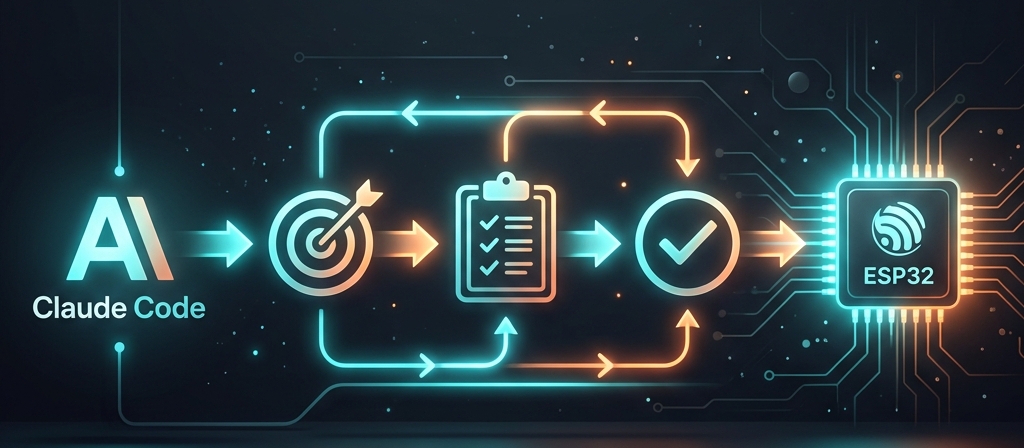
Deterministic AI workflow for ESP32 firmware development.


Stop prompting. Start engineering.
Quick Start · Skills · Playbooks · Testing · Contributing
ESP32 Claude Workbench is a structured workflow system for using Claude Code in ESP32 firmware development. It turns ad-hoc AI prompting into a disciplined, testable, repeatable development process.
This is not another prompt collection. It is a reliability layer for AI-assisted embedded development.
Most AI coding setups fail in firmware because they are:
| Problem | Impact |
|---|---|
| Too chat-based | No persistent state across sessions |
| Not hardware-aware | Wrong pin assumptions, unsafe RTOS calls |
| Weak on testing | Code compiles but doesn't work |
| Hard to review | AI-generated changes lack rationale and evidence |
| No debugging flow | Same Guru Meditation errors waste hours repeatedly |
This repository provides:
# Clone the repository
git clone https://github.com/agodianel/esp32-claude-workbench.git
cd esp32-claude-workbench

# Create virtual environment
python3 -m venv .venv
source .venv/bin/activate

# Install for development
pip install -e ".[dev]"
pytest tests/ -v
Copy the mission template:
cp missions/templates/mission_template.md missions/2026-03-my-feature.md
Fill in the sections: Goal, Board, Constraints, Acceptance Criteria.
Use Claude to generate an implementation contract:
generate-contract "Add Wi-Fi reconnection with exponential backoff" \
  --files "main/wifi_manager.c|CREATE|Reconnection handler" \
  --tests "Verify backoff timing" "Test retry counter reset" \
  --risks "Race condition on shared connection flag"
Review the contract, then implement.
Validate your mission file:
validate-mission missions/2026-03-my-feature.md
cd mcp
pip install -r requirements.txt
python scripts/index_esp_docs.py
This downloads ESP32 TRMs and datasheets and builds a local vector search index. No API key required. Everything runs on your machine.
claude mcp add esp32-workbench -- python /path/to/esp32-claude-workbench/mcp/mcp_server.py
Or add .mcp.json to your ESP32 project root:
{
  "mcpServers": {
    "esp32-workbench": {
      "command": "python",
      "args": ["/path/to/esp32-claude-workbench/mcp/mcp_server.py"]
    }
  }
}
In Claude Code, ask: "Search ESP docs for ADC2 Wi-Fi conflict"
Claude should call the search_esp_docs tool and return grounded results.
If you do not have Claude Code installed, or just want to test the tools manually, you can use the official MCP Inspector. This spins up a visual web interface to run the tools.
cd mcp
npx -y @modelcontextprotocol/inspector uv run mcp_server.py
esp32-claude-workbench/
├── CLAUDE.md                    # Claude Code rules for ESP32
├── CONTRIBUTING.md              # Contribution guide
├── .claude/skills/              # Claude Code skill definitions
│   ├── hardware_check/          #   Verify board hardware limitations
│   ├── repo_scout/              #   Scan project structure
│   ├── feature_contract/        #   Generate implementation contracts
│   ├── esp32_pin_audit/         #   Audit GPIO pin usage
│   ├── esp32_arch_review/       #   Review firmware architecture
│   ├── esp32_test_plan/         #   Generate test plans
│   ├── esp32_log_triage/        #   Parse serial logs
│   ├── esp32_crash_review/      #   Analyze crash dumps
│   └── pr_prepare/              #   Prepare pull requests
├── boards/                      # Board-specific pinouts and limitations
├── docs_sources.yaml            # Documentation sources for FAISS RAG index
├── mcp/                         # FastMCP Server Backend
│   ├── mcp_server.py            #   Main server entrypoint
│   ├── requirements.txt         #   ML/RAG python dependencies
│   └── tools/                   #   MCP Python Tools
│       ├── mission_generator.py #     Create standardized mission files
│       ├── pin_audit.py         #     Audit GPIO conflicts and rules
│       ├── sdkconfig_check.py   #     Verify production readiness
│       └── search_docs.py       #     Query the local FAISS index
├── missions/
│   ├── templates/               # Mission & contract templates
│   └── examples/                # Worked example missions
├── playbooks/                   # Debug & triage playbooks
│   ├── hardware_limitations.md  #   Hardware quirks, strapping pins, ADC2
│   ├── build_failure.md         #   Build error triage
│   ├── guru_meditation.md       #   Crash analysis
│   ├── wifi_debug.md            #   Wi-Fi troubleshooting
│   ├── i2c_bringup.md           #   I2C peripheral setup
│   ├── spi_bringup.md           #   SPI peripheral setup
│   ├── ble_debug.md             #   BLE debugging
│   ├── ota_update.md            #   OTA update issues
│   ├── watchdog_reset.md        #   Watchdog timer issues
│   └── memory_review.md         #   Memory leak & corruption
├── scripts/
│   └── index_esp_docs.py        # Crawler and FAISS RAG vector indexer
├── templates/
│   ├── esp-idf-basic/           # Minimal ESP-IDF starter
│   ├── wifi-station/            # Wi-Fi station with reconnect
│   └── mqtt-node/               # MQTT telemetry with LWT
├── tools/                       # Python CLI automation
│   ├── validate_mission.py      #   Mission file validator
│   ├── generate_contract.py     #   Contract generator
│   ├── summarize_logs.py        #   Log analyzer
│   ├── scan_pins.py             #   GPIO pin scanner & conflict detector
│   ├── analyze_sdkconfig.py     #   sdkconfig misconfiguration checker
│   └── check_task_stacks.py     #   FreeRTOS task stack analyzer
├── tests/                       # 148+ pytest unit and integration tests
└── .github/workflows/           # GitHub Actions CI pipelines
Skills are structured Claude Code instructions for specific tasks. Use them as slash commands:
| Command | Skill | What It Does |
|---|---|---|
/scout | repo_scout | Scan project structure, map components, identify dependencies |
/contract | feature_contract | Generate implementation contract before any code changes |
/hw-check | esp32_hardware_check | Verify user board against hardware limitations |
/pin-audit | esp32_pin_audit | Audit GPIO usage for conflicts and reserved pin violations |
/arch-review | esp32_arch_review | Review architecture for RTOS safety, memory, error handling |
/test-plan | esp32_test_plan | Generate multi-layer test plan |
/triage-log | esp32_log_triage | Parse serial logs, classify errors, identify boot issues |
/review-crash | esp32_crash_review | Analyze Guru Meditation errors and crash dumps |
/prcraft | pr_prepare | Prepare PR with test evidence and risk assessment |
Before writing any code, generate a contract:
You: /contract

Claude: I'll generate an implementation contract.

# Implementation Contract

## Change Summary
Add exponential backoff to Wi-Fi reconnection handler.

## Affected Files
| File | Action | Description |
|------|--------|-------------|
| main/wifi_manager.c | MODIFY | Add backoff timer logic |
| main/wifi_manager.h | MODIFY | Add backoff config struct |

## Risk Assessment
### Concurrency: MEDIUM
- Backoff timer accessed from event handler and reconnect task.
- Mitigation: Use atomic variable for backoff delay.

## Test Plan
- [ ] Backoff sequence: 1s → 2s → 4s → 8s → 16s → 32s → 60s
- [ ] Reset after successful connection
- [ ] Maximum retry limit enforced
Step-by-step triage guides for common ESP32 failures:
| Playbook | When to Use |
|---|---|
| Hardware Limitations | Pin constraints, strapping pins, ADC2/Wi-Fi conflicts |
| Build Failure | Compilation errors, linker failures, CMake issues |
| Guru Meditation | CPU exceptions, crashes, backtrace analysis |
| Wi-Fi Debug | Connection failures, drops, authentication issues |
| I2C Bring-Up | I2C communication failures, bus hangs |
| SPI Bring-Up | SPI peripheral misconfiguration, clock speed issues |
| BLE Debugging | BLE advertising failures, GATT connection drops |
| OTA Updates | Firmware update failures, boot loops, invalid partitions |
| Watchdog Reset | Task/interrupt watchdog triggers |
| Memory Review | Heap exhaustion, leaks, stack overflows |
Each playbook includes triggers, symptoms, triage steps, resolution checklists, and prevention guidance.
Every task gets a persistent markdown file that preserves state across sessions:
# Mission: ESP32 Wi-Fi Reconnect Handler

## Goal
Implement robust Wi-Fi reconnection with exponential backoff.

## Board / Target
- Chip: ESP32
- ESP-IDF: v5.2

## Acceptance Criteria
- [ ] Auto-reconnects after AP disconnect
- [ ] Exponential backoff: 1s → 2s → 4s → ... → 60s
- [ ] Status queryable via wifi_manager_is_connected()

## Current Status
- State: IN PROGRESS
- Last updated: 2026-03-26
- Next Step: Implement backoff timer
This creates visible project memory — Claude can resume work by reading the mission file.
Testing is a first-class citizen, organized in layers:
| Layer | What | Tools | Hardware Needed? |
|---|---|---|---|
| 1. Repository Logic | Validate templates, tooling, playbooks | pytest | No |
| 2. Host-Side Logic | Test pure C (parsers, state machines) | pytest + native compile | No |
| 3. ESP-IDF Unit Tests | Test components in isolation | ESP-IDF Unity | Yes |
| 4. Target Integration | Flash and validate on device | pytest-embedded | Yes |
| 5. CI Publishing | JUnit XML, coverage, artifacts | GitHub Actions | No |
You don't need an ESP32 to get value. Layers 1–2 and 5 work without hardware:
# Run all no-hardware tests
pytest tests/ -v -m "not hardware"

# With coverage
pytest tests/ -v --cov=tools --cov-report=term-missing
pytest                  # Test runner
pytest-cov              # Coverage reporting
pytest-xdist            # Parallel execution
pytest-embedded         # ESP32 target testing (when hardware available)
validate-missionValidate mission files for required sections:
validate-mission missions/2026-03-my-feature.md
# ✅ All required sections present
generate-contractGenerate implementation contracts from the command line:
generate-contract "Add BLE temperature service" \
  --files "main/ble_temp.c|CREATE|BLE GATT service" \
  --risks "Stack size for BLE task" \
  --tests "Service discovery" "Temperature read" "Notification subscribe"
summarize-logsAnalyze ESP32 serial log output:
summarize-logs serial_capture.log
# Outputs: error count, crash detection, reset reason, component breakdown
scan-pinsScan C/H files for GPIO pin assignments to detect conflicts, unsafe strapping pin usage, and ADC2/Wi-Fi incompatibilities:
scan-pins main/ --uses-wifi
# Flags if ADC2 pins are used while Wi-Fi is enabled
analyze-sdkconfigAnalyze sdkconfig files against a comprehensive set of security, stability, and ESP-IDF production readiness rules:
analyze-sdkconfig sdkconfig
# Warns about missing heap poisoning, low tick rates, or weak passwords
check-stacksScan source code for FreeRTOS xTaskCreate calls to statically detect tasks with potentially insufficient stack sizes:
check-stacks main/
# Flags Wi-Fi/TLS tasks that are given dangerously small stacks
Here's a complete example of the workbench workflow:
1. Issue: "Wi-Fi drops after 30 minutes"

2. /scout
   → Scan project, identify Wi-Fi components and task architecture

3. Create mission file
   → missions/2026-03-wifi-stability.md

4. /contract
   → Generate implementation contract with scope, risks, tests

5. Review and accept contract

6. Implement changes
   → Follow contract scope, update mission status

7. /test-plan
   → Generate test plan covering all layers

8. Run tests
   → pytest tests/ -v

9. /arch-review
   → Check RTOS safety, error handling, memory impact

10. /pin-audit (if GPIO changes)
    → Verify no pin conflicts

11. /prcraft
    → Generate PR with evidence, risk notes, and review checklist

12. Update mission → State: DONE
Start new ESP-IDF projects with a ready-to-go template:
cp -r templates/esp-idf-basic/ ~/my-new-project/
cd ~/my-new-project/
idf.py set-target esp32
idf.py build
The template includes:
CMakeLists.txt structuresdkconfig.defaultsWe welcome contributions! See CONTRIBUTING.md for details.
You can contribute:
# Development setup
pip install -e ".[dev]"
pytest tests/ -v
Built with the assistance of Claude by Anthropic.
MIT — see LICENSE.
ESP32 Claude Workbench — Structure over magic. Testing over claims. Workflows over prompts.
1000+ skills curated from Anthropic, Vercel, Stripe, and other engineering teams
Design enforcement with memory — keeps your UI consistent across a project
Detects 37 AI writing patterns and rewrites text with human rhythm across 5 voice profiles
WCAG accessibility audit — automated scanning, manual review, remediation