

Are you the author? Sign in to claim
Pure-Rust native GUI framework with web-grade aesthetics and first-class headless PNG rendering — winit + wgpu + vello +




The UI stack built for the agent loop: describe a UI as JSON, render
it natively, verify it in CI — no compile step, no screenshot flakiness.
fenestra is a pure-Rust GUI framework whose headless renderer is
deterministic, so both humans and AI coding agents can see — and prove —
what they build. It also speaks A2UI, the open
Agent-to-UI standard, as its first native Rust renderer
(fenestra-a2ui). The web-grade widget kit and design
system below are the proof of what that loop can produce.
▶ Try the live demo — the dashboard and widget galleries running in your browser via WebGPU. No DOM, no CSS: every pixel is vello on wgpu, the same code as the native window. Read the book for the guided tour.
| Light | Dark |
|---|---|
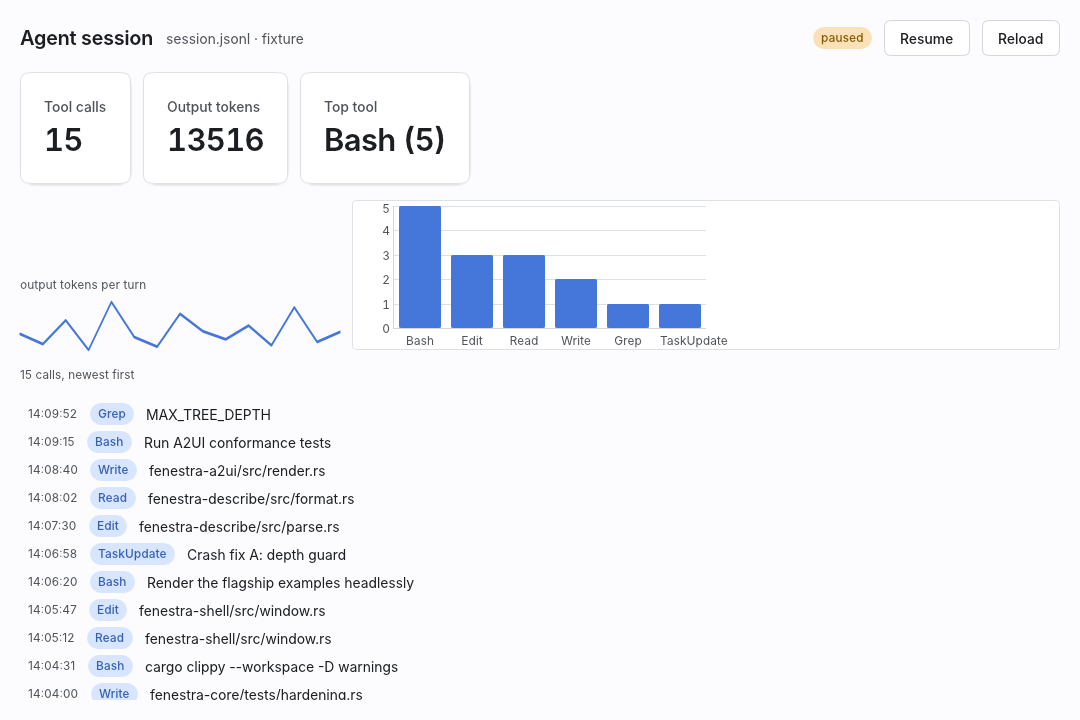 | 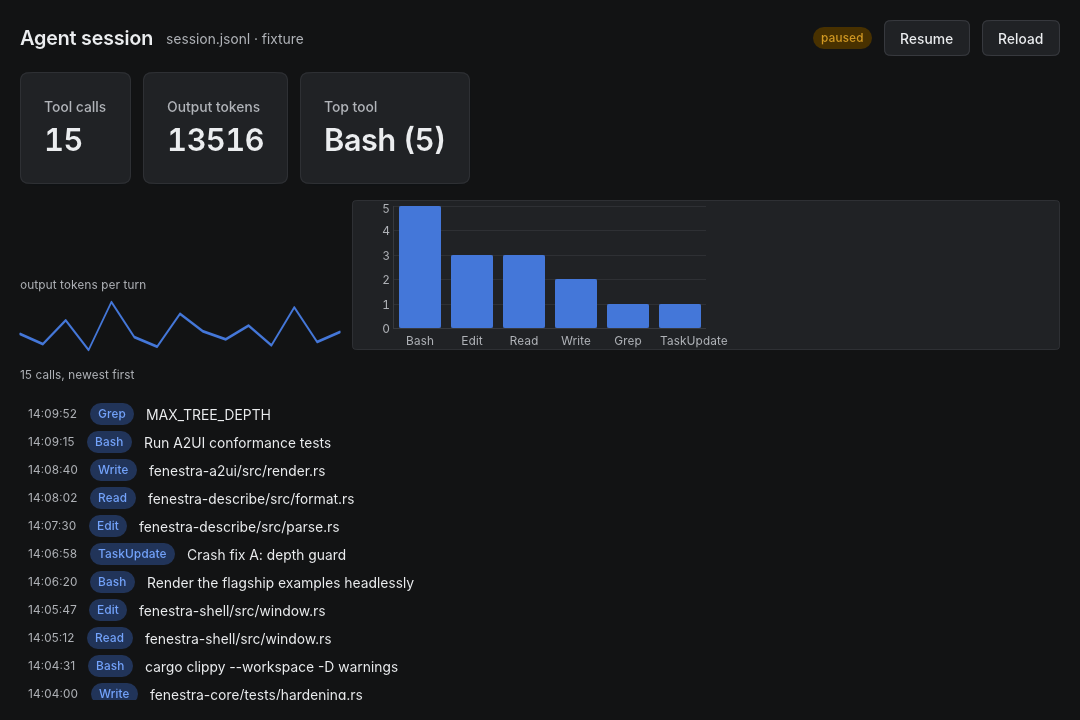 |
The hero is a real tool — examples/agent_dashboard.rs, a live dashboard
over an AI coding session (virtualized feed, charts, live tail via the
effect layer). The SaaS-style widget showcase lives on as
examples/dashboard.rs:
| Light | Dark |
|---|---|
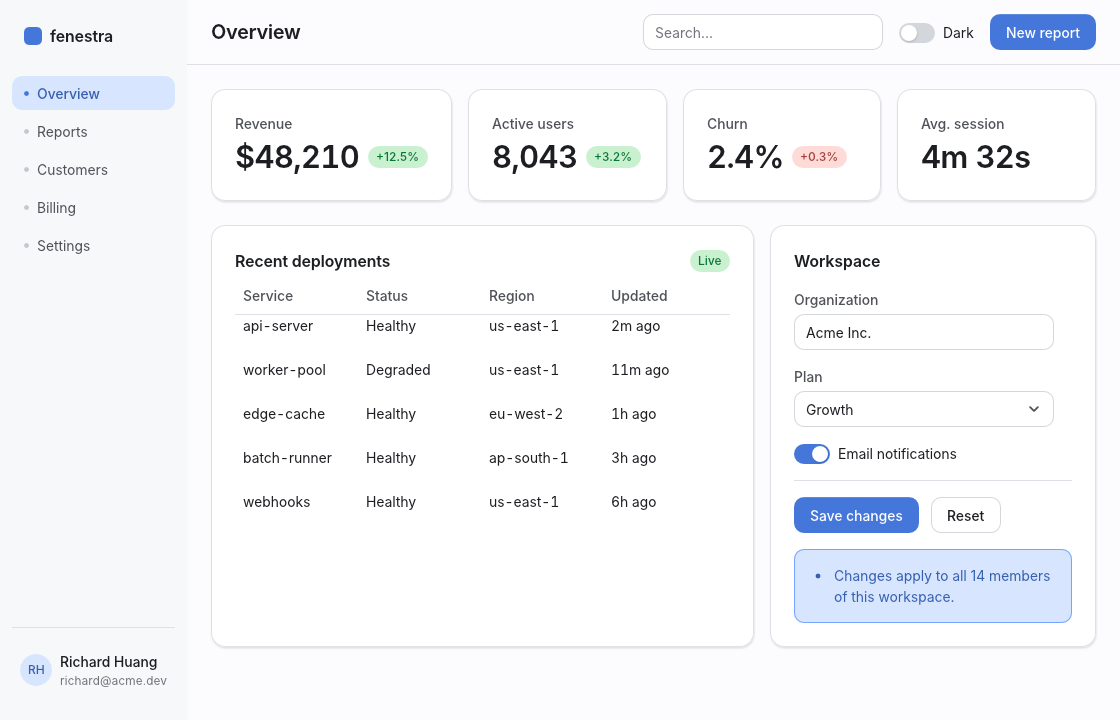 | 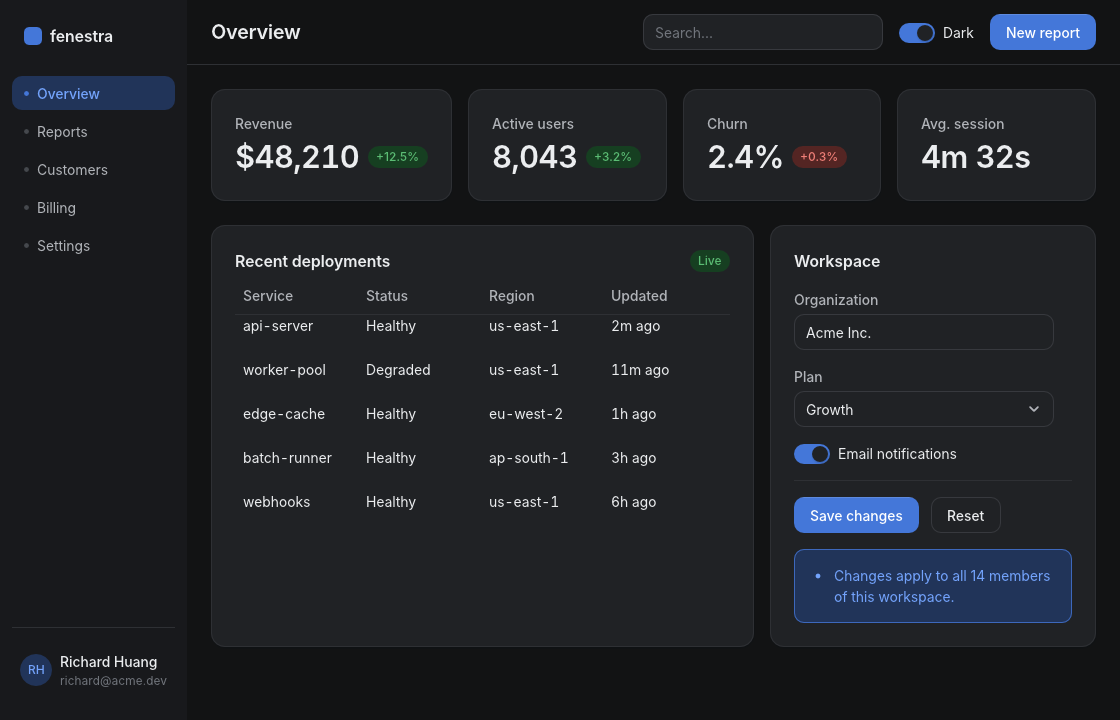 |
No browser. No webview. No HTML or CSS parser. fenestra draws everything itself with vello on wgpu, lays out with taffy (flexbox + grid), shapes text with parley, and ships a themed widget kit that looks like a polished modern web app: layered soft shadows, OKLCH color ramps, real typographic hierarchy, hover/focus transitions, and first-class light and dark themes.
use fenestra::prelude::*;

struct Counter { n: i64 }

#[derive(Clone)]
enum Msg { Inc, Dec }

impl App for Counter {
    type Msg = Msg;

    fn update(&mut self, msg: Msg) {
        match msg { Msg::Inc => self.n += 1, Msg::Dec => self.n -= 1 }
    }

    fn view(&self) -> Element<Msg> {
        col().p(SP6).gap(SP4).items_center().children([
            text(self.n.to_string()).size(TextSize::Xl2).weight(Weight::Semibold),
            row().gap(SP3).children([
                button("Decrement").variant(ButtonVariant::Secondary).on_click(Msg::Dec),
                button("Increment").on_click(Msg::Inc),
            ]),
        ])
    }
}

fn main() { fenestra::run(Counter { n: 0 }, WindowOptions::titled("Counter")) }
cargo add fenestra, paste, cargo run. Or start from the template —
cargo generate richer-richard/fenestra-template — which includes a
headless UI test and CI. The whole view is rebuilt, laid out, and
repainted on every redraw — no diffing, no macros, everything
autocompletes.
Rendering (element tree, theme, size) to pixels is a pure function, and it
runs without a window or display server:
use fenestra::shell::{SyntheticEvent, render_app, render_element};

// A picture of any element tree:
let image = render_element(my_view(), &Theme::dark(), (800, 600));
image.save("preview.png")?;

// Or drive a full app with scripted input and look at the result:
let image = render_app(
    &mut app,
    &[
        SyntheticEvent::MouseMove { x: 50.0, y: 34.0 },
        SyntheticEvent::MouseDown,
        SyntheticEvent::MouseUp,
        SyntheticEvent::Text("hello".into()),
    ],
    (800, 600),
    &Theme::light(),
);
assert_eq!(app.value, "hello");
Headless rendering is deterministic (embedded fonts, fixed scale, reduced motion), which makes pixel-exact golden tests practical — fenestra's own widget kit is tested this way, on CI, with no GPU display attached.
The same pipeline backs a JSON authoring format, fenestra/1, for agents and
tools that don't want to compile Rust: describe a UI — now including an
image node and fourteen widgets that used to be code-only (data tables,
trees, popovers, command palettes, the OKLCH color picker, and more) — and
fenestra-describe parses it into the identical
Element tree the builders above produce. fenestra render renders it,
fenestra preview <file> opens a live-reload window that re-renders on
every save, and the fenestra-mcp server exposes the whole
loop — render, query, interact, verify — as fourteen MCP tools (including render_a2ui). Motion is
watchable too, not just single frames: Harness::film (or fenestra film,
or the MCP film_ui tool) captures a sequence with real motion turned on and
composes it into one captioned filmstrip.
The verification envelope, stated plainly. A headless render is a
deliberate subset of the live window — that subset is what makes it
deterministic — so trust it accordingly. It uses the embedded fonts (Inter
covers Latin; the real monospace, CJK, emoji, and RTL faces come from the OS
and so appear only in a real window), forces reduced motion, and is
referenced against one GPU backend (macOS/Metal; Linux/lavapipe within a
wider tolerance). The full Liquid-Glass optics — backdrop blur, edge lensing,
adaptive vibrancy — render only in the headless/golden path; the live
single-pass window shows the translucent tint plus the specular rim and
sheen. Scale is no longer pinned: render_element_scaled runs the same two-pass
pipeline at any device scale, so retina-only regressions (hairlines, blur
radii) are verifiable headlessly too. So headless is the right oracle for
layout, semantics, color, and the large majority of pixels — but confirm
non-Latin/monospace text and full glass in a window. On the web target,
copy-out reaches the system clipboard (paste-in from other apps stays
in-app), the glass story equals the native live window (tint-only, like
every single-pass swapchain), and AccessKit awaits an upstream web
adapter — the precise ledger is in ARCHITECTURE.md.
Working with an AI agent? AGENTS.md is the manual for the build → render → look → verify loop (and llms.txt for context loaders).
The web's look — soft elevation, tinted neutrals, OKLCH ramps, 4px-grid
spacing, focus rings, 120–300ms easing — is the best-tested visual language
in software. The web platform is a heavy way to get it. fenestra encodes
that language as typed Rust values: a Theme generated from one accent hue,
spacing/radius/shadow/motion tokens, and a builder vocabulary (row(),
.p(SP4), .rounded(R_MD), .shadow(ShadowToken::Sm)) small enough to
memorize and regular enough for rust-analyzer (or a language model) to
autocomplete. Every widget routes every color through the theme; flip one
Mode and the whole app is dark.
Button, IconButton, Checkbox, Switch, Radio, Slider, Color Picker (OKLCH lightness×chroma pad, hue/alpha strips, forgiving hex entry), SegmentedControl, TextInput (parley editing, clipboard, IME), TextArea (multiline, auto-growing), Select, Tooltip, Modal (focus trap + backdrop), Toasts, Tabs, Card, StatCard, Badge, Avatar, StatusIndicator (with a live pulse), Kbd key-caps, Skeleton loaders, Divider, Progress (including a Material-3 Expressive wavy bar), Spinner, Table, Callout, and a vendored Lucide icon subset — every state, both themes:
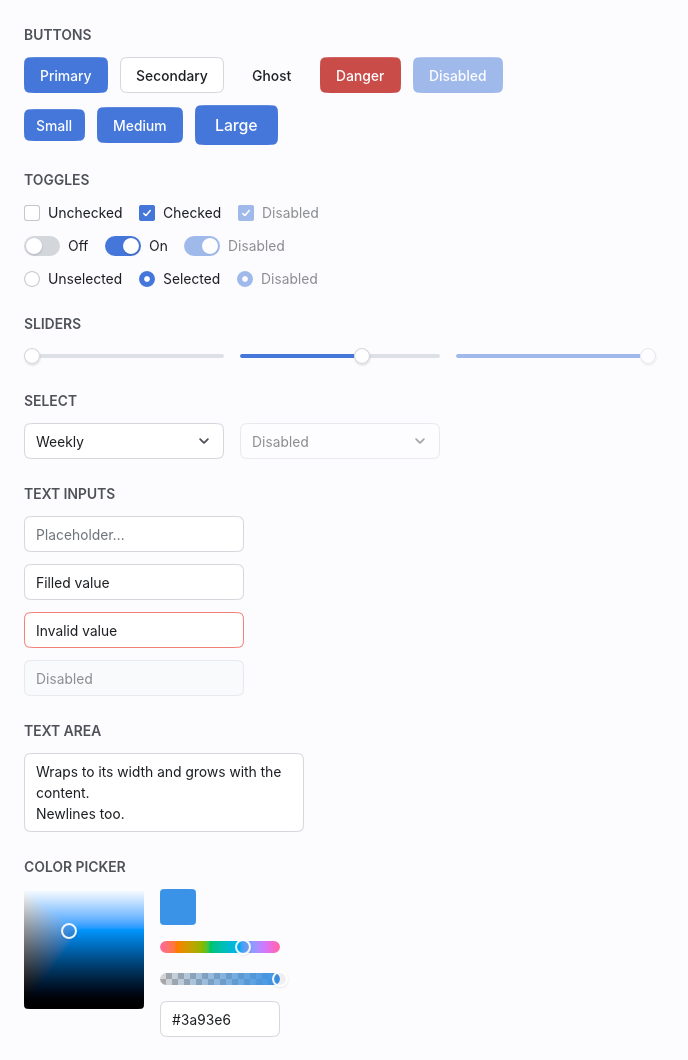 | 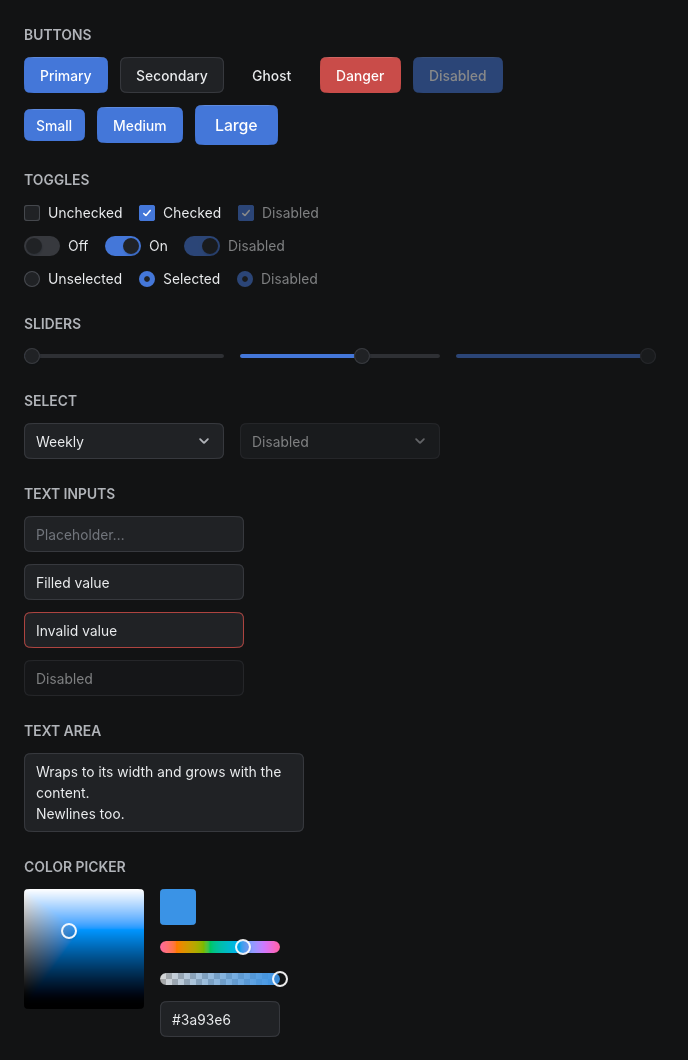 |
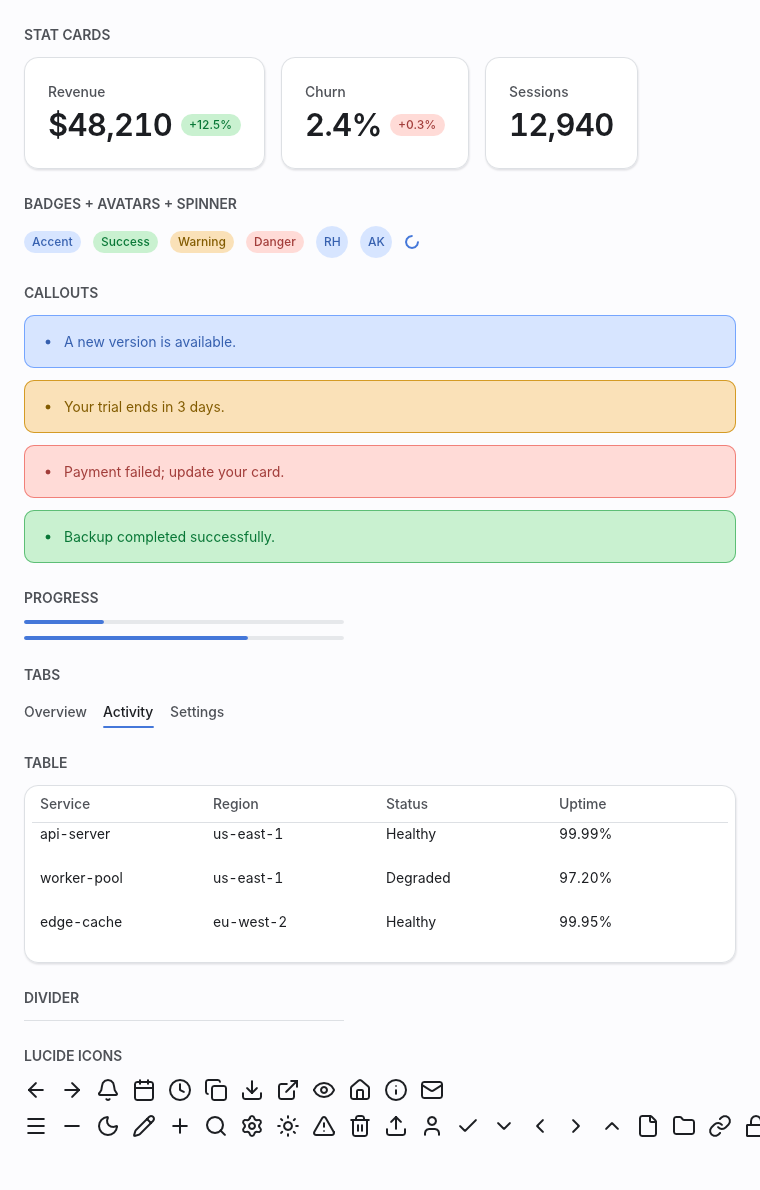 | 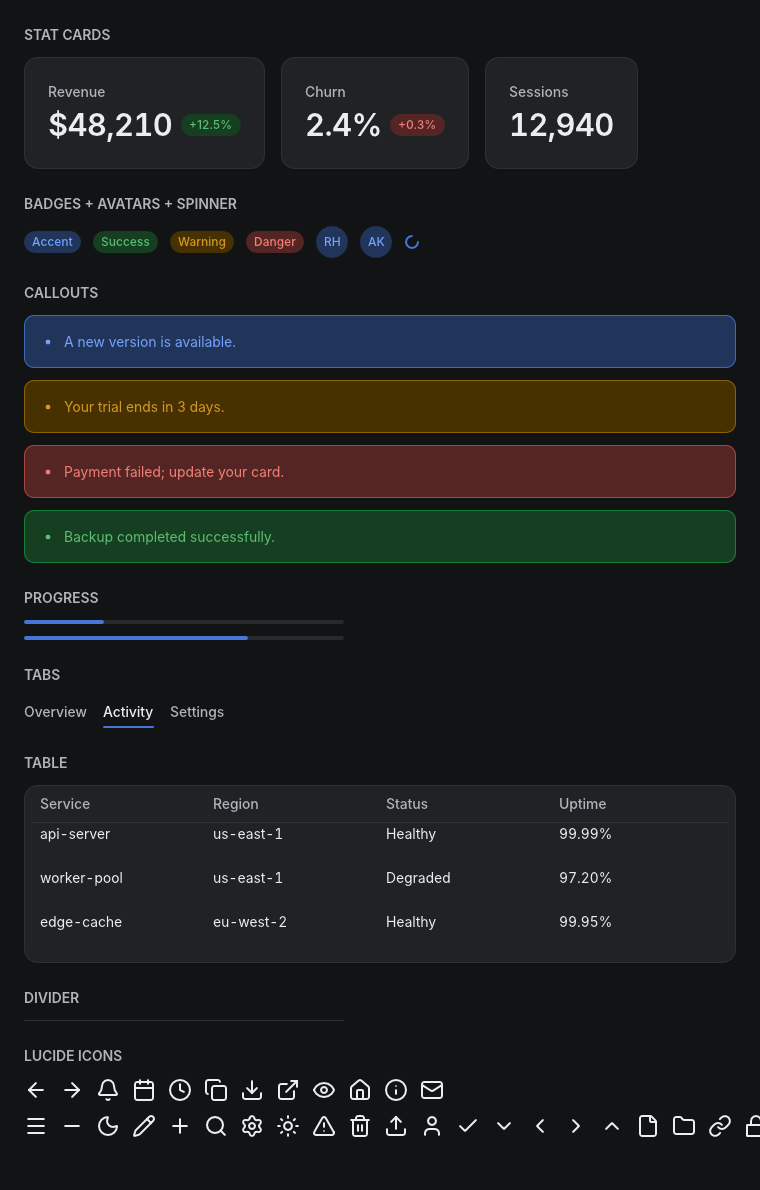 |
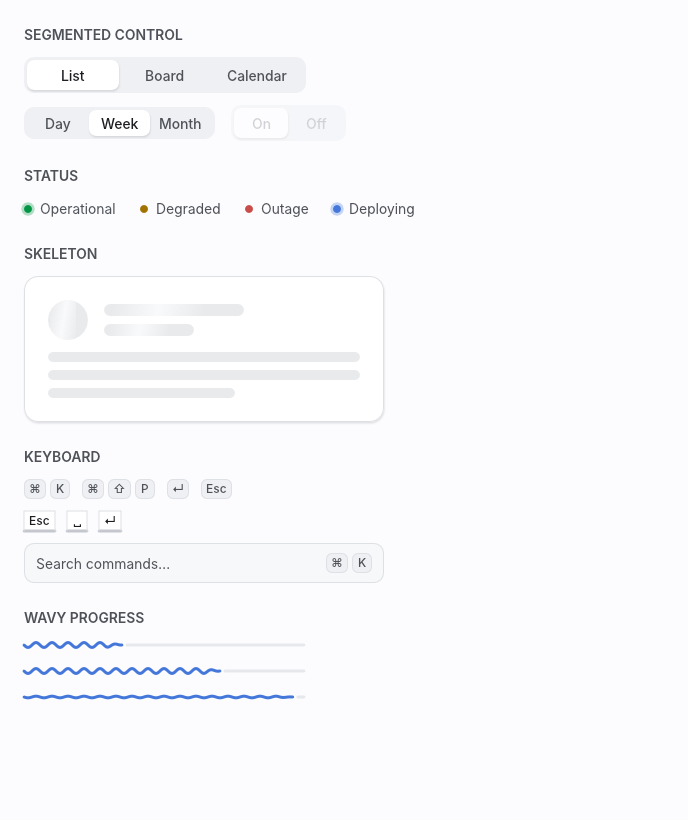 | 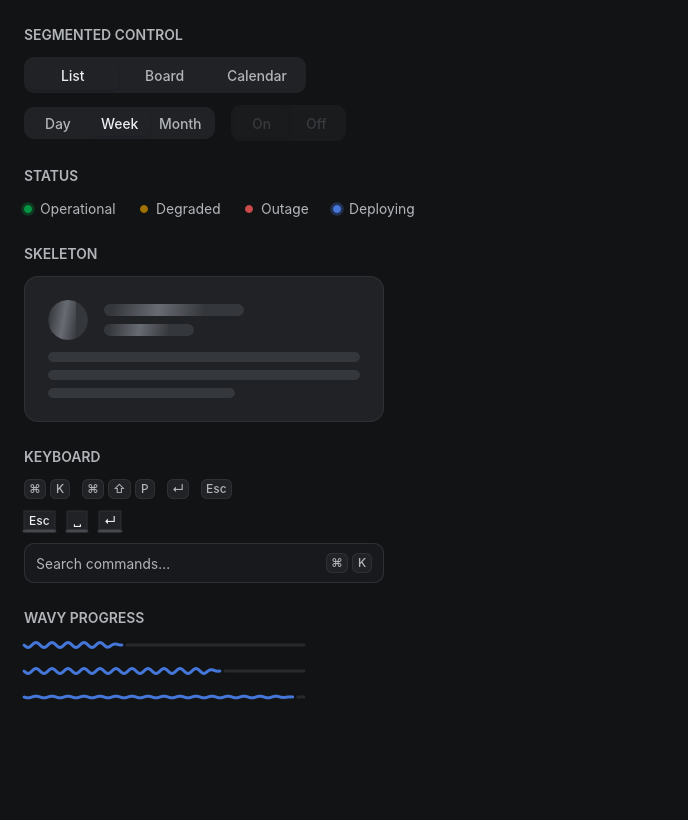 |
Regenerate this corpus any time with cargo run --example gallery — it
renders headlessly.
fenestra-motion renders frame-pure compositions headlessly — no live
window, no screen recorder — and the same pipeline is what fenestra film
and the MCP film_ui tool use to let an agent watch a transition play. A
fenestra-charts bar chart, rebuilt every frame from rank-sorted,
track-interpolated data:
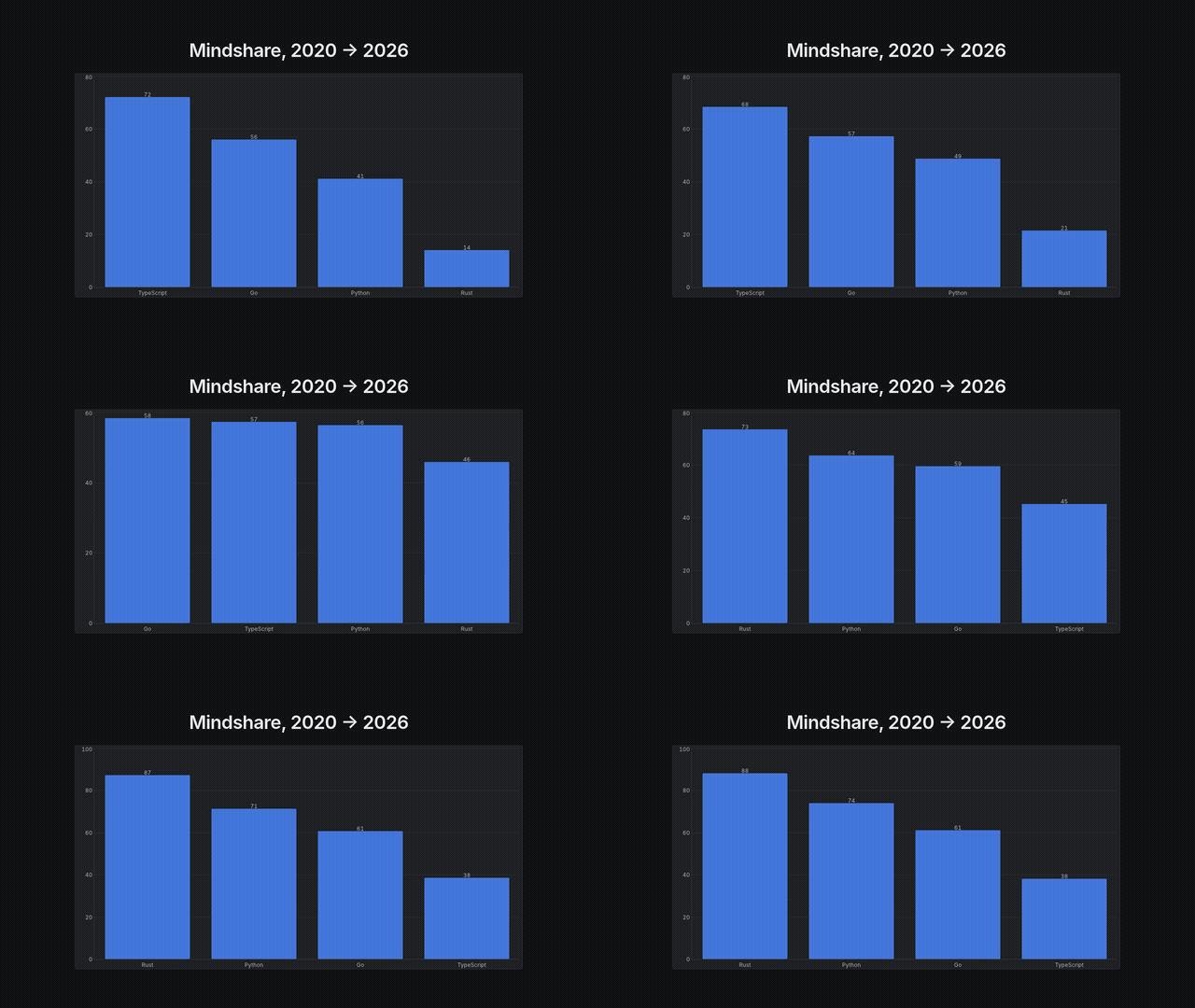
cargo run -p fenestra-motion --example chart_race -- --mp4 renders this
exact sequence — the lead changes hands partway through, verified
structurally in the example itself, not just eyeballed. Two more shipped
demos render the same way: a broadcast lower-third
(examples/lower_third.rs) and a per-word title stagger
(examples/title_stagger.rs).
| Crate | Role |
|---|---|
fenestra | Facade: prelude, run(), examples |
fenestra-core | Element IR, theme/tokens, layout, text, paint, input, transitions |
fenestra-shell | winit + wgpu window runner and the headless renderer |
fenestra-kit | The themed widget kit, built only on core's public API |
fenestra-charts | Sparklines, line and bar charts — the reference third-party widget crate |
fenestra-markdown | CommonMark rendered as native fenestra elements |
fenestra-looks | Six ready-made design languages (product, editorial, terminal, console, warm-editorial, playful), applied in one call |
fenestra-describe | Parses fenestra/1 JSON into the same Element tree the builders produce |
fenestra-render | The fenestra CLI: render, preview, film, query, verify, lint — from the command line |
fenestra-mcp | MCP server exposing render, query, interact, and verify as thirteen tools to AI agents |
fenestra-motion | Frame-pure motion graphics: timelines, headless frame/video rendering, temporal lints, the motion CLI |
fenestra-anim | Keyframe animation math — easing, springs, an exact rational timebase |
fenestra-anim is versioned independently (0.1.x): a standalone leaf crate
with zero dependency on any fenestra crate, wgpu, vello, parley, taffy, or
winit, extracted from fenestra-core and fenestra-motion so any
frame/tick-based sampler — inside this workspace or out — can depend on the
animation math alone. fenestra-mcp is also versioned independently, so the
MCP server can ship on its own release cadence.
See ARCHITECTURE.md for how the pipeline, widget identity, transitions, and overlays work — recorded decision-by-decision as the framework was built — and BENCHMARKS.md for honest frame-cost numbers (a full screen rebuilds, lays out, and paints in ~0.3 ms; 100k-row lists virtualize to ~0.09 ms).
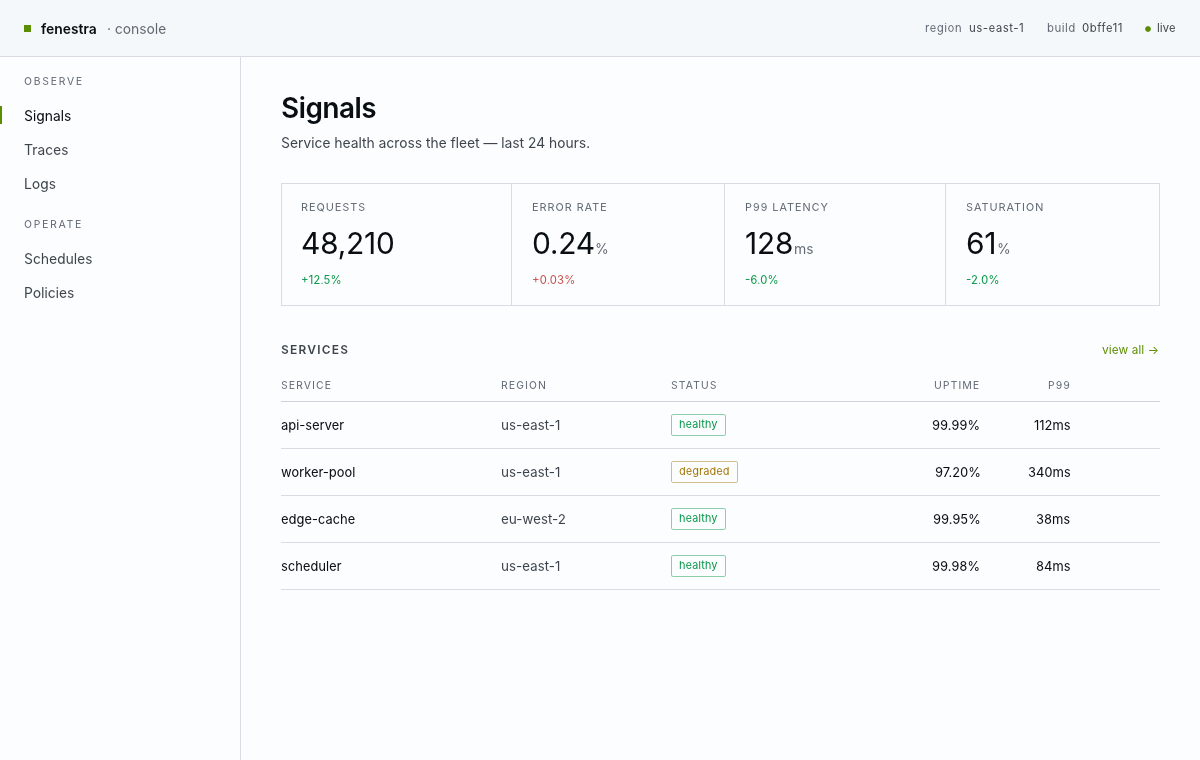
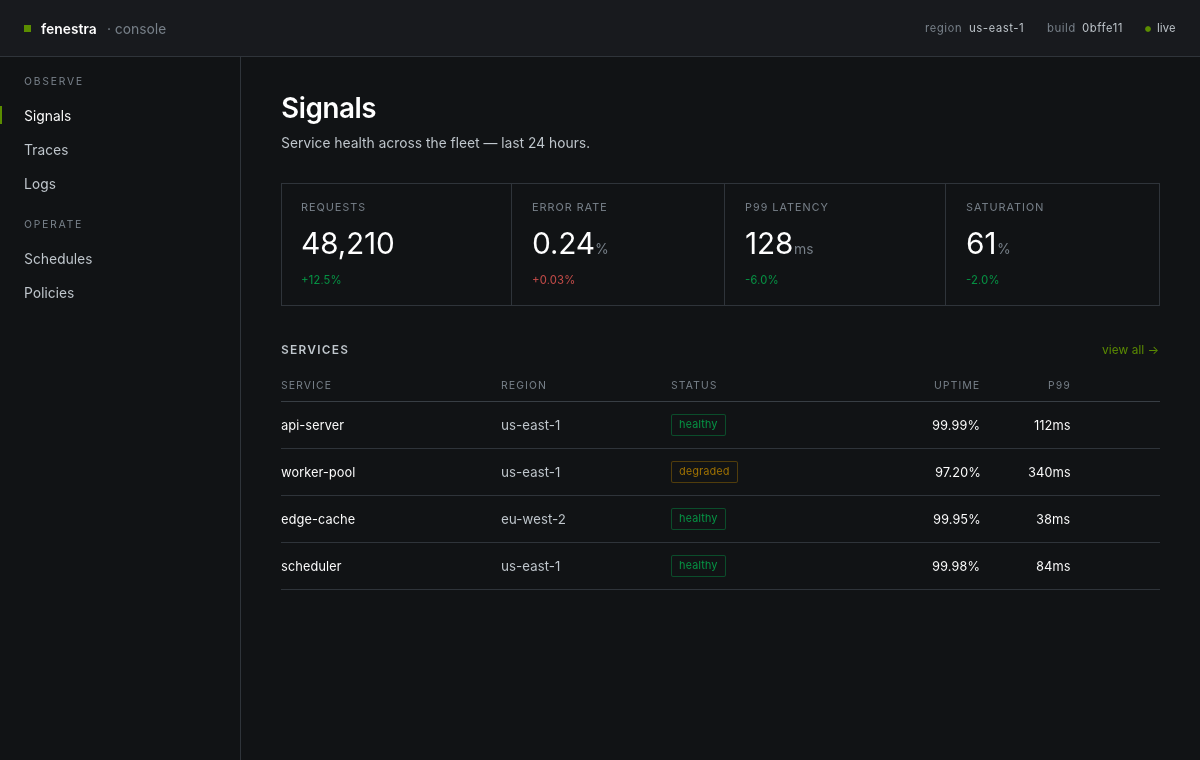
The same framework, the same tokens — a different design language. The
fenestra-looks crate bundles six ready voices (product, editorial, terminal,
console, warm-editorial, playful — enumerate them with all()), and one knob
re-skins the whole kit: Theme::with_radius(RadiusScale::sharp()) for
un-rounded tech chrome, Theme::with_elevation(Elevation::Flat) for
border-not-shadow surfaces, and Theme::duotone for atmospheric fields instead
of neutral grays (custom display faces register under font roles via
Fonts::register). The opposite end of the range from the soft default
dashboard above — a sharp, hairline-ruled console: slate with a single lime
accent and mono numerals, rendered headlessly and golden-tested.
| Light | Dark |
|---|---|
 |  |
Components written around their own message type compose with
Element::map. Background work flows in through App::init, which hands
the app a cloneable Proxy<Msg> — spawn a thread, send messages, the
window repaints (examples/clock.rs, examples/toasts.rs). Every widget
exposes its role, state, and name: headlessly via Frame::access_tree()
(assert your UI is labeled, in CI), and to real assistive technology
through AccessKit in the windowed runner. Ambient motion comes from
looping Keyframes timelines; images from image_rgba8 (round avatars
via .rounded_full()).
fenestra is at 0.40.0, built and recorded decision-by-decision in
ARCHITECTURE.md. Shipped: the full interactive widget kit
in light and dark themes; six ready-made design languages
(fenestra-looks); a frosted-glass material system; reference third-party
widget crates for charts and markdown; the fenestra/1 JSON format
authoring the entire kit, parsed by fenestra-describe and rendered/verified
by the fenestra CLI and the fenestra-mcp server's thirteen tools; a
live-reload fenestra preview window for authoring; and fenestra-motion
for frame-pure motion graphics with its own temporal-lint verification and
filmstrip capture. Every change goes through the same gate before it merges —
cargo fmt --check, clippy -D warnings, the full test suite, and a
headless golden-PNG comparison on macOS/Metal and Linux/lavapipe — plus a
weekly cargo audit sweep in CI. Open work is tracked as a ranked list in
ARCHITECTURE.md's "Deferred" notes; the two largest remaining gaps are a JSON
authoring bridge for charts/markdown (they're Rust-only today) and hi-DPI
headless rendering (every headless build site currently pins scale 1.0).
MIT or Apache-2.0, at your option. The embedded Inter font, the Playfair
Display faces (poster and editorial looks), the Fraunces variable text serif
(the opsz/optical-sizing serif in the warm-editorial look), and JetBrains
Mono (terminal look) are licensed under the SIL Open Font License 1.1; the
vendored Lucide icon path data is ISC (see fenestra-kit/LICENSE-LUCIDE.txt).
 @microsoft✓ Official
Browser automation using accessibility snapshots instead of screenshots
Run Claude Code as an MCP server so any agent can delegate coding tasks to it
 @googleapis✓ Official
Google's universal MCP server supporting PostgreSQL, MySQL, MongoDB, Redis, and 10+ databases
 @github✓ Official
Official GitHub integration for repos, issues, PRs, and CI/CD workflows