

Are you the author? Sign in to claim
One command turns an empty folder into a structured, TDD-driven, security-gated project for agentic coding (Python, Type
One command turns an empty folder into a structured, TDD-driven, security-gated project — built for agentic coding.
Senior-team discipline for your AI coding agent. You bring the idea plus working development and agentic-coding experience -- ForgeWorks wraps your agent in a senior team's discipline (planning, a real test pyramid, a security review, a second-opinion reviewer), so a solo developer can turn a prompt into a product that is actually tested, secure, and shippable -- not a throwaway demo. (If you have never driven an AI coding agent before, expect a learning curve: the machine enforces design memos, TDD, and security gates.)
It is not a starter app. It installs the rules, specialist roles, and deterministic gates that make an AI coding agent produce code you can actually review, ship, and maintain. The core is stack-agnostic; your language and tooling are chosen in a short interview, not hard-coded.
mkdir my-project && cd my-project && git init
bash <(curl -fsSL https://raw.githubusercontent.com/Kpakfar/ForgeWorks/v2.5.0/bootstrap/install.sh)
# then open your agent and run:  /init-project
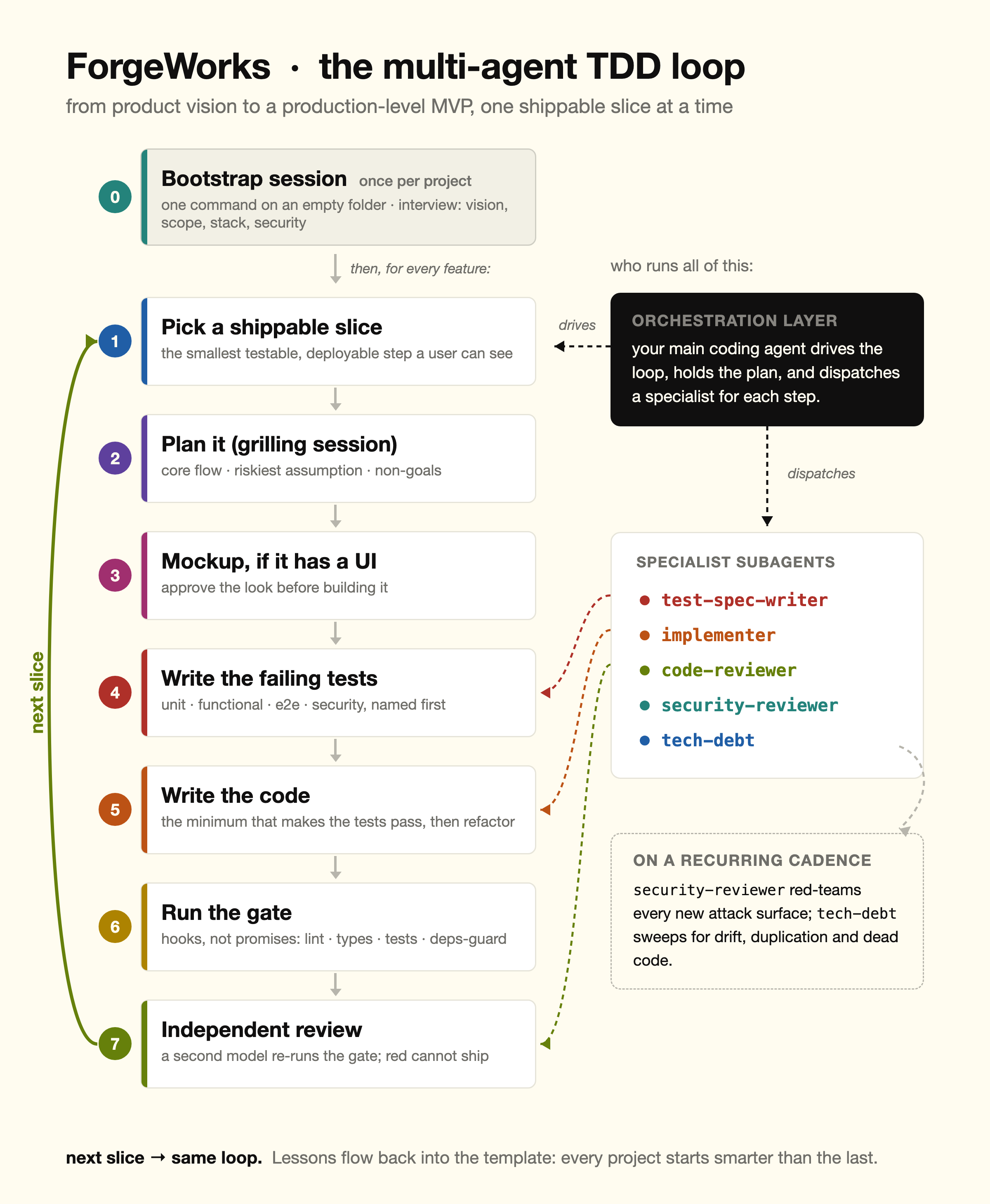
AGENTS.md (symlinked to CLAUDE.md) — the cross-tool standard read by Claude Code, Codex, Cursor, opencode, and others. The rules and docs (AGENTS.md) are portable to any agent; the deep orchestration and local gates (subagents, hooks, MCP) run in Claude Code today, and other agents ignore the Claude-specific parts gracefully.AGENTS.md + docs/SECURITY.md, backed by a real PreToolUse supply-chain hook (a best-effort guard, not a sandbox) — because prompt-level security is theater./upgrade-project, non-destructively.AGENTS.md constitution — architecture, security, test, planning, and design (mockup-over-ASCII) discipline, all in one source of truth.@test-spec-writer, @implementer, @code-reviewer (+ optional Codex second opinion), @security-reviewer, @tech-debt, and @utility (haiku-pinned, for mechanical chores that should never burn expensive-model tokens).qa (plus a local fix), a supply-chain deps-guard hook, and CI (fast gate + separate e2e job).The main agent orchestrates the loop; tdd and grill-me (from mattpocock/skills) drive the methodology and planning. Two mandatory reviewers (code review always, security red-team on a canonical trigger) pair with the per-slice Red → Green → Refactor → Review loop; three optional workers isolate the heavier phases, and every shipped slice leaves a durable, hook-audited ship record. Tasks with no behavioral effect (typos, doc wording, formatting) skip the ceremony — anything that changes what the product does, however small, does not. The same gate runs locally (Stop + PreToolUse hooks that block a red build or an evidence-free ship) and in CI.
Run the same command inside it — install.sh detects a generated project and installs /upgrade-project instead of bootstrapping:
bash <(curl -fsSL https://raw.githubusercontent.com/Kpakfar/ForgeWorks/v2.5.0/bootstrap/install.sh)
# then run:  /upgrade-project
It reconciles your project against the current template — copying missing files and grafting new rule blocks without overwriting your content. Non-destructive and idempotent. (Never re-run /init-project on an existing project; that overwrites your filled-in docs.)
bootstrap/        seed kit + install.sh (bootstraps empty dirs, routes existing ones to upgrade)
init-project/     /init-project skill — interview + generation; templates/core/ + templates/profiles/<lang>/
upgrade-project/  /upgrade-project skill — non-destructive reconcile for existing projects
docs/             how-to-use.md and ROADMAP.md
VERSION           stamped into generated projects
Python, TypeScript, Go, and Rust are complete profiles — pick any in the interview and you get only that language's toolchain (no cross-language leakage). All four are verified green on the first run by CI, on the merged core+profile tree (the exact shape a generated project has). "Other" isn't built yet (the interview tells you so and gets consent). Adding a language is a documented recipe (docs/how-to-use.md). Releases are versioned tags (current: v2.5.0): a pinned tag gives you the same template files tomorrow, though runtime inputs (npm/degit/Context7) aren't fully reproducible yet — see docs/ROADMAP.md.
ForgeWorks is an opinionated harness — a capable product with a clear roadmap. Be aware of what is and isn't mechanically true today:
init-project/render.py) turns it into the project tree — same answers, same bytes, locked by golden-fixture CI (six answer sets, byte-for-byte against committed expected trees, hostile values included). Only the interview itself and dependency installs remain agent work.deps-guard hook reduces risk; it is not a sandbox. The real controls are lockfile review and CI scanning.MIT. Use it, change it.
⚠️ Experimentelle Skill-Sammlung für deutsches Recht (Arbeits-, Gesellschafts-, Insolvenz-, Datenschutz-, Prozessrecht u
Manage multiple Claude Code agents from TUI or Web with tmux and git worktrees
Project management using GitHub Issues + Git worktrees for parallel agent execution
Core skills library for Claude Code with 20+ battle-tested skills including TDD, debugging, and brainstorming