

Are you the author? Sign in to claim
Secure on device personal agents
[!WARNING] Gloamy is currently in active development. This is an early preview. Expect breaking changes, frequent updates, and evolving core subsystem contracts as we move toward a stable 1.0 release.

When the claws 🦞 are asleep the gloamies 🦉 come out to play !
Hi I'm Gloamy, I execute tasks on your behalf without deleting your stuff, leaking your private business, oh and I'm lightweight unlike that damn lobster (openclaw).
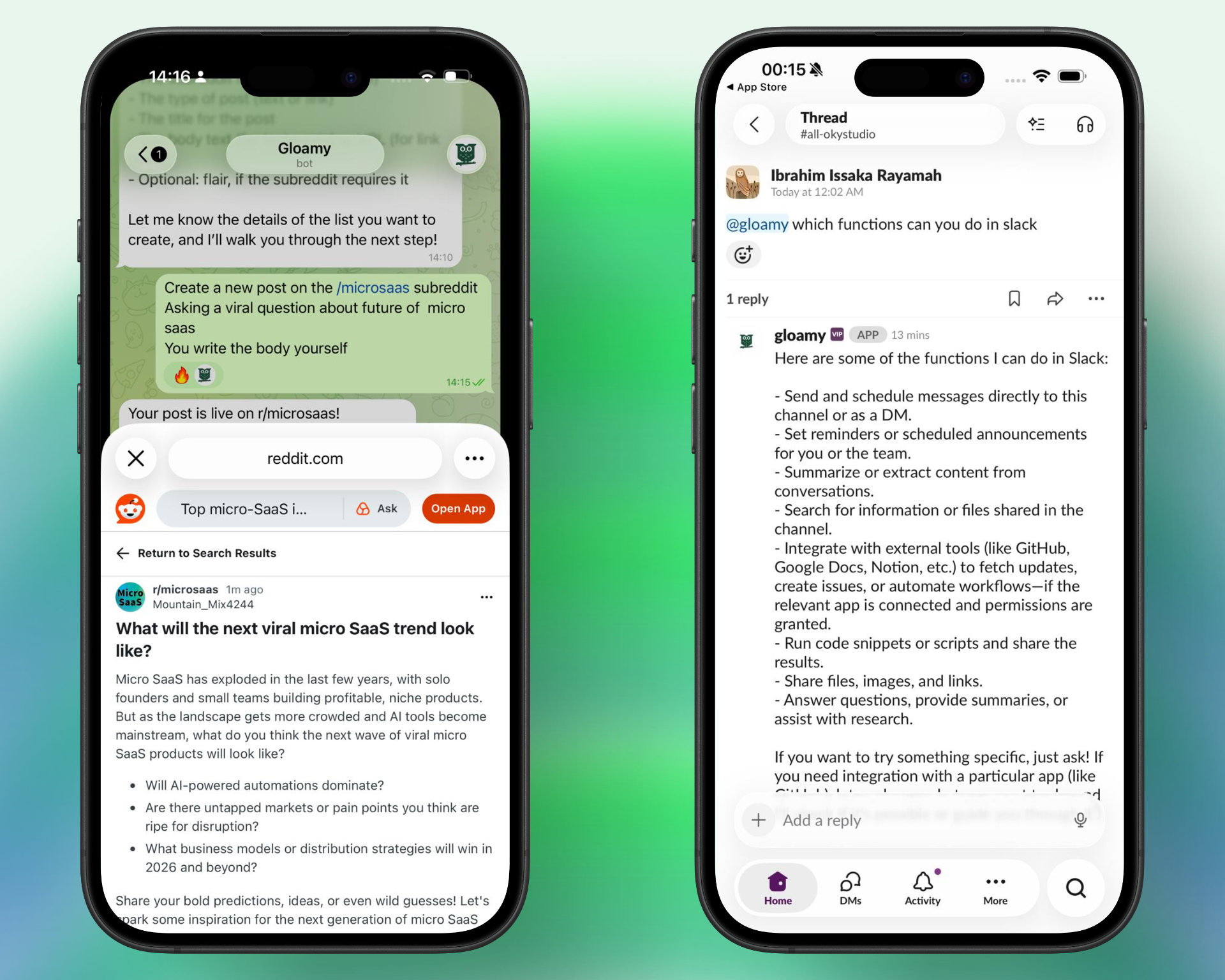
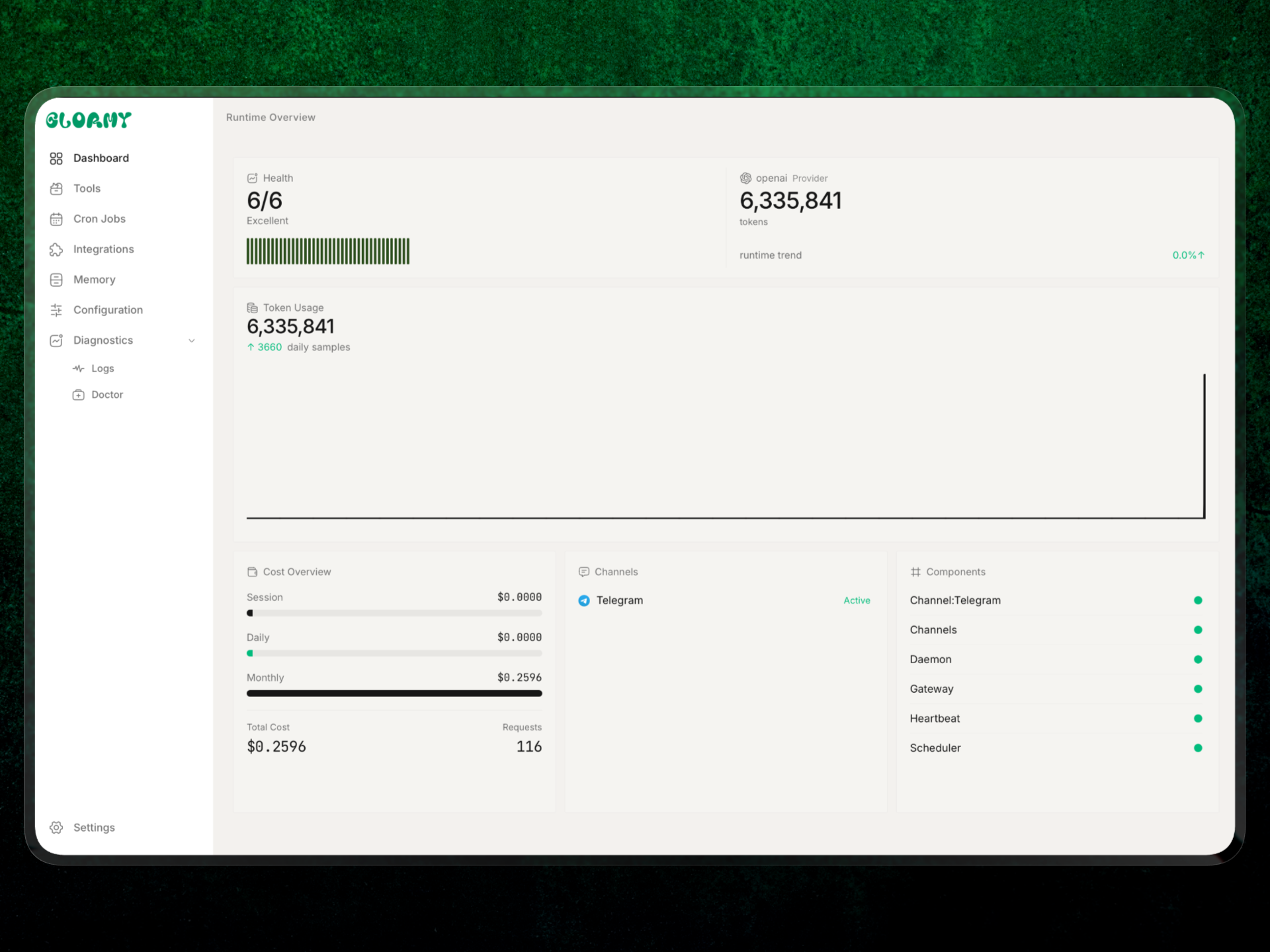
Gloamy is built around explicit subsystem contracts:
Provider for model backendsChannel for messaging platformsTool for execution surfacesMemory for persistence and recallObserver for observabilityRuntimeAdapter for runtime isolationPeripheral for boards and device integrationsThe project goal is simple: Local first agents for real-world tasks
Gloamy can:
Out of the box, the runtime supports:
High-level repository map:
src/main.rs: CLI entrypoint and command routingsrc/lib.rs: shared exports and command enumssrc/agent/: orchestration loopsrc/config/: config schema, loading, merging, env overridessrc/providers/: model provider implementations and factory wiringsrc/channels/: channel integrationssrc/tools/: tool execution surfacesrc/memory/: memory backendssrc/security/: policy, pairing, secret handlingsrc/gateway/: HTTP and websocket gatewaysrc/runtime/: runtime adapterssrc/peripherals/: hardware integrationsdesktop/: Tauri + Vue desktop applicationdocs/: operator, reference, and contribution docsThe repository also includes crates/robot, a standalone robot-control crate for motion, sensing, speech, vision, simple robot expression, and safety-gated drive control.
Use it when you want to experiment with Raspberry Pi or robot hardware integrations without wiring those surfaces directly into the main runtime. It is a workspace member, but it is not auto-registered into gloamy's core tool factory.
Start here:
crates/robot/README.md for the crate surface and integration modelcrates/robot/robot.toml for the sample configurationcrates/robot/PI5_SETUP.md for Raspberry Pi 5 setup notesYou need:
On macOS:
xcode-select --install
On Debian or Ubuntu:
sudo apt install build-essential pkg-config
Install Rust:
curl --proto '=https' --tlsv1.2 -sSf https://sh.rustup.rs | sh
rustup default stable
Verify:
rustc --version
cargo --version
Install from crates.io:
cargo install gloamy --locked
Then run full onboarding:
gloamy onboard --interactive
If you prefer to run from source, clone the repository and start onboarding:
git clone https://github.com/iBz-04/gloamy.git
cd gloamy
cargo run -- onboard --interactive
The crates.io install is the recommended default for end users. The source path is better when you want to develop, patch, or test unreleased changes.
The full onboarding flow lets you:
After onboarding, start a direct CLI session:
cargo run -- agent
If you want persistent channel operation after setup:
cargo run -- daemon
If you prefer the bootstrap path:
./bootstrap.sh --interactive-onboard
Useful bootstrap variants:
./bootstrap.sh
./bootstrap.sh --install-system-deps --install-rust
./bootstrap.sh --prefer-prebuilt
./bootstrap.sh --prebuilt-only
./bootstrap.sh --docker
Reference: docs/one-click-bootstrap.md
If you already know exactly what you want, you can skip the full wizard:
cargo run -- onboard --api-key YOUR_OPENAI_KEY --provider openai --model gpt-5-mini
This path is faster, but the interactive onboarding flow is the better default for first setup.
Gloamy can import memory from an existing OpenClaw workspace into your current Gloamy workspace.
Preview the migration first:
cargo run -- migrate openclaw --dry-run
Run the import:
cargo run -- migrate openclaw
Use a custom OpenClaw workspace path if needed:
cargo run -- migrate openclaw --source /path/to/openclaw/workspace
What the migration does:
~/.openclaw/workspace by defaultmemory/brain.db, MEMORY.md, and memory/*.mdWhat it does not do:
config.tomlIf you want a safe preview of the candidate entries without writing data, use --dry-run.
This repository also includes a desktop application in desktop/, built with Tauri (Rust backend) and Vue 3 (frontend).
Use the desktop app for the primary UI, and use the gateway for webhook/API access.
If you want to run the desktop UI locally:
cd desktop
pnpm install
pnpm tauri dev
For desktop-specific setup, development, and packaging details, see desktop/README.md.
Start a direct chat session:
cargo run -- agent
Run a one-shot prompt:
cargo run -- agent -m "Summarize today's logs"
Override provider and model for one run:
cargo run -- agent --provider openai --model gpt-5-mini -m "hello"
Run the long-lived runtime:
cargo run -- daemon
The daemon starts:
Use this mode when you want Telegram or other channels to stay online.
Use the service commands when you want Gloamy to run as an OS-managed background service:
gloamy service install
gloamy service start
gloamy service restart
gloamy service status
This is the right choice for always-on use and boot persistence.
gloamy service install registers the service with your OSgloamy service start starts the installed servicegloamy service restart reloads it after config changesgloamy daemon runs the runtime directly in your terminal without OS service managementRun only the local gateway:
cargo run -- gateway
The gateway exposes HTTP, webhook, and websocket endpoints for external integrations. It no longer serves a browser dashboard.
Run the configured channels without the full daemon stack:
cargo run -- channel start
The primary setup command is:
gloamy onboard
Common variants:
gloamy onboard --interactive
gloamy onboard --channels-only
gloamy onboard --force
gloamy onboard --api-key YOUR_KEY --provider openai --model gpt-5-mini
If you already have a config and only want to wire channels, use:
gloamy onboard --channels-only
Gloamy supports multiple inbound and outbound channels. Channel setup is stored in config, and the daemon uses that config at runtime.
Typical flow:
gloamy onboard --channels-onlygloamy daemongloamy status and gloamy channel doctorImportant operational note:
gloamy agent is for direct CLI usegloamy daemon is what you run for persistent channel operation in the foregroundgloamy service is what you run when you want the OS to manage the daemon and start it on bootCanonical reference: docs/channels-reference.md
Default config location:
~/.gloamy/config.toml
Default workspace:
~/.gloamy/workspace
Minimal example:
api_key = "sk-..."
default_provider = "openai"
default_model = "gpt-5-mini"
default_temperature = 0.7

[memory]
backend = "sqlite"
auto_save = true
embedding_provider = "none"
vector_weight = 0.7
keyword_weight = 0.3
Notes:
default_provider controls the main runtime providerdefault_model controls the default model for CLI, channel, and daemon flowsdefault_temperature may be ignored by some providers or modelsCanonical reference: docs/config-reference.md
Gloamy supports:
Examples:
gloamy agent --provider openai --model gpt-5-mini -m "hello"
gloamy agent --provider anthropic -m "hello"
gloamy agent --provider openai-codex -m "hello"
References:
Gloamy stores auth per provider and per profile, so you can keep separate accounts for different workflows and switch between them explicitly.
Supported login flows:
gloamy auth login --provider openai-codex --device-codegloamy auth refresh --provider openai-codex --profile defaultgloamy auth login --provider gemini --profile defaultgloamy auth refresh --provider gemini --profile defaultgloamy auth paste-token --provider anthropic --profile default --auth-kind authorization--auth-kind can be omitted when Gloamy can auto-detect the token styleUseful auth management commands:
gloamy auth status
gloamy auth list
gloamy auth use --provider openai-codex --profile work
gloamy auth logout --provider anthropic --profile default
Notes:
auth use changes the active profile for a provider.auth status shows active profiles, token kind, and expiry information.auth refresh only applies to OAuth-based profiles like OpenAI Codex and Gemini.auth list is helpful when you want to see all stored profiles before switching.Gloamy is designed to fail closed where practical.
Important defaults:
Operational guidance:
allowed_commands is runtime-updatable through config reload, so you can tighten or widen shell access without restarting the daemonReferences:
Supported memory backends include:
noneSQLite is the usual default because it gives:
Reference: docs/config-reference.md
gloamy status
gloamy doctor
gloamy channel doctor
gloamy agent
gloamy daemon
gloamy gateway
gloamy onboard --interactive
gloamy onboard --channels-only
gloamy auth status
gloamy service install
gloamy service status
gloamy service restart
Canonical command reference: docs/commands-reference.md
Recommended local validation:
cargo fmt --all -- --check
cargo clippy --all-targets -- -D warnings
cargo test
Preferred full local validation path when available:
./dev/ci.sh all
Useful development commands:
cargo run -- status
cargo run -- doctor
cargo run -- agent -m "hello"
cargo run -- daemon
If you are working on docs, start here:
If you want Gloamy to stay running after reboot, use gloamy service install and gloamy service start instead of running cargo run -- daemon manually.
Start from the docs hub:
docs/README.mddocs/SUMMARY.mddocs/feature-overview.mddocs/getting-started/README.mddocs/reference/README.mddocs/operations/README.mddocs/security/README.mddocs/hardware/README.mddocs/pr-workflow.mdHigh-signal runtime references:
docs/commands-reference.mddocs/providers-reference.mddocs/channels-reference.mddocs/config-reference.mddocs/operations-runbook.mddocs/troubleshooting.mdOfficial source of truth:
If you encounter impersonation or a misleading fork, open an issue in the official repository.
If you want to contribute:
AGENTS.md for repository engineering expectationsdocs/pr-workflow.mddocs/reviewer-playbook.md for review standardsGood entry points:
src/providers/src/channels/src/tools/src/memory/src/observability/Gloamy is licensed under MIT.
reach me @ issakaibrahimrayamah@gmail.com
Ask questions in GitHub Discussions
Manage multiple Claude Code agents from TUI or Web with tmux and git worktrees
Kanban-based orchestration for 10+ coding agents with isolated git worktrees per agent
⚠️ Experimentelle Skill-Sammlung für deutsches Recht (Arbeits-, Gesellschafts-, Insolvenz-, Datenschutz-, Prozessrecht u
Project management using GitHub Issues + Git worktrees for parallel agent execution