

Are you the author? Sign in to claim
Glyphic is an open source diagram engine that lets AI agents generate production-quality diagrams from structured JSON,
A diagram is data, not a drawing.
Your model describes the diagram as typed JSON; Glyphic renders it — deterministic SVG & PNG across 18 types, validated before it draws, with no DSL and no headless browser. Diagram infrastructure for LLMs and agents that you own and build on.




Live playground · Quick Start · Examples Gallery · Documentation · 18 Diagram Types
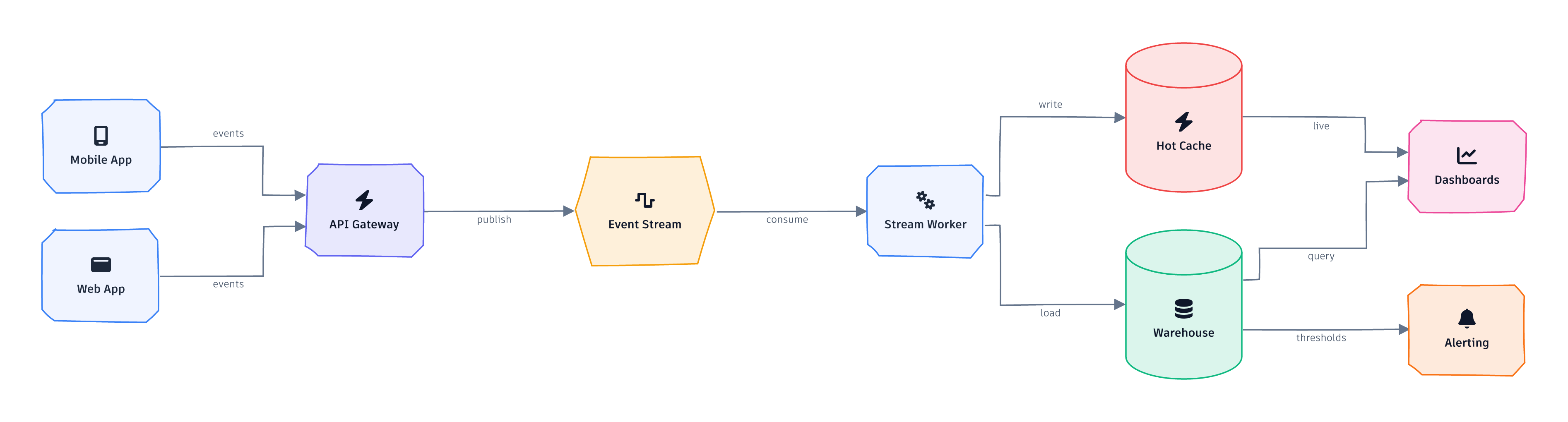
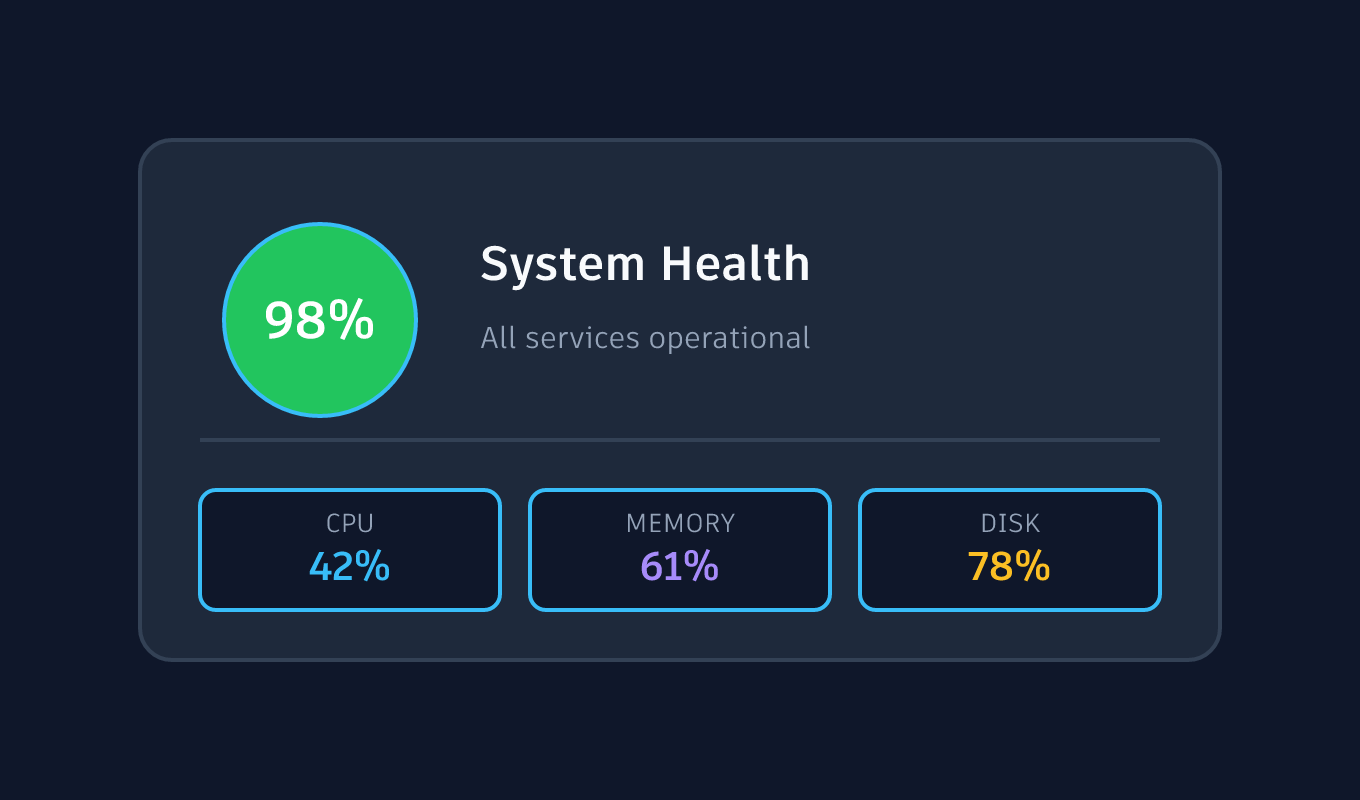
Glyphic gives an LLM structured data in and hands you a finished diagram out. Use it three ways.
It runs over stdio via npx, no install:
# Claude Code
claude mcp add glyphic -- npx -y @glyphicjs/mcp-server
For Cursor, Claude Desktop, VS Code, Windsurf, and Antigravity, add it to your client's MCP config:
{
  "mcpServers": {
    "glyphic": { "command": "npx", "args": ["-y", "@glyphicjs/mcp-server"] }
  }
}
Then just ask: "Draw an ERD for a blog with users, posts, and comments." The model emits the JSON, calls the tool, and the rendered diagram appears inline. See the MCP setup guide.
npm install @glyphicjs/core @glyphicjs/schema
import { processDiagram } from "@glyphicjs/core";
import { writeFileSync } from "node:fs";

const result = await processDiagram({
  type: "architecture",
  title: "Web App",
  nodes: [
    { id: "web", label: "Web App", shape: "rounded", icon: "fab-react" },
    { id: "api", label: "API", shape: "hexagon", icon: "fas-bolt" },
    { id: "db", label: "PostgreSQL", shape: "database", icon: "fas-database" }
  ],
  edges: [
    { source: "web", target: "api", label: "REST" },
    { source: "api", target: "db", label: "SQL" }
  ]
});

writeFileSync("diagram.png", result.png);   // Buffer (high-res PNG)
writeFileSync("diagram.svg", result.svg);   // string (scalable SVG)
console.log(result.reactFlow);              // interactive React Flow JSON
See the Core API reference.
Need it behind your own endpoint? Glyphic can be self-hosted as an HTTP service that wraps the exact same engine — same schema in, same SVG/PNG/React Flow out — so your product or platform can generate diagrams without shipping the library to every client.
Glyphic is infrastructure for generating diagrams from structured data. You give it a strict, semantic JSON document — arrays of nodes and edges, or entities, or commits — and it returns a polished diagram as:
role="img" + <title>).@resvg/resvg-js).It supports 18 diagram types (architecture, sequence, ERD, UML class, state machines, flowcharts, Gantt, timelines, Sankey, Git trees, mindmaps, pie, quadrant, user journeys, Kanban, C4, treemaps, and a freeform canvas) behind a single validated schema.
Yes — a modern LLM can draw a clean six-box flowchart as raw SVG. Go ask one; for a single throwaway diagram, that's the right tool. This isn't a bet that models "can't draw."
The problem is that a drawn SVG is a dead picture. It comes out different every generation, it falls apart exactly where real diagrams live — many nodes and later edits — and to change one box you regenerate the whole thing and it drifts. Glyphic treats the diagram as data: your model describes what it means as typed JSON, and a real engine renders it. Three reasons that holds up no matter how good the model gets:
-->|label|).elkjs, d3-hierarchy/d3-sankey) and SVG is rasterized to PNG by Rust (@resvg/resvg-js) — no DOM, no headless browser, no Chromium. It runs in a CI job, a Lambda, an agent loop, or a Docker container as a normal Node dependency. This stays true regardless of model capability.And because a real engine owns the layout, the diagram scales and stays editable: it nests clusters and routes edges around obstacles where hand-placed SVG turns into diagonal lines cutting through boxes, its output is byte-identical (versionable, snapshot-testable), and the JSON stays a source of truth you can diff and re-render — not a house of cards of absolute coordinates.
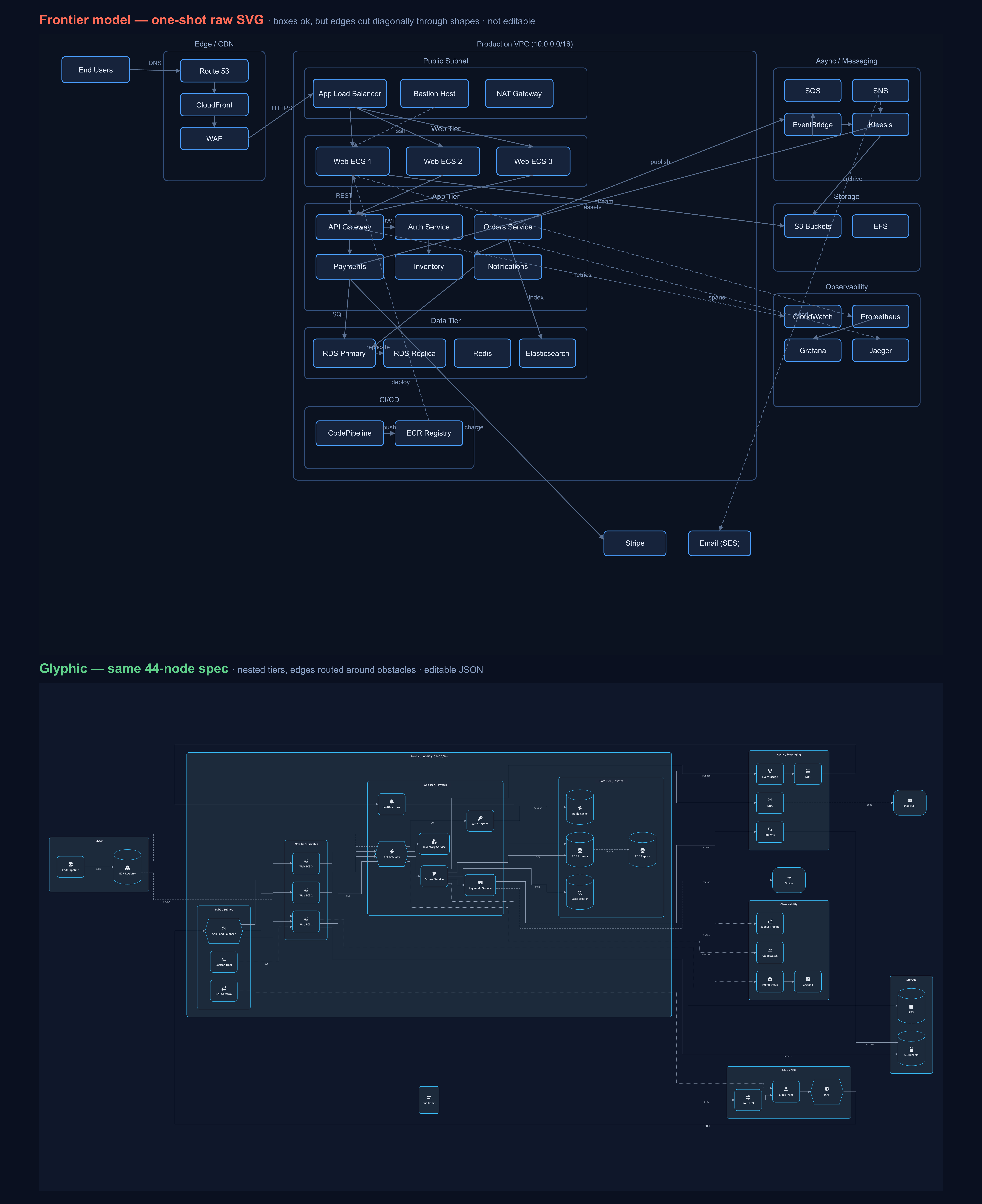
The same 44-node spec. Top: a current frontier model asked for raw SVG — the boxes are fine, but the edges cut diagonally through shapes and the result can't be edited without regenerating it. Bottom: Glyphic renders the identical JSON — nested tiers, edges routed around obstacles, still an editable source of truth.
Method: both produced by the same model (Claude Opus 4.8) from one brief — the top by asking it to hand-write SVG in a single pass; the bottom by asking it to emit Glyphic's typed JSON, then rendering with @glyphicjs/core (ELK layout + resvg, no browser). Same author, same content — only the draw-vs-describe boundary differs.
| Feature | Glyphic | Claude Artifacts | Mermaid | D2 |
|---|---|---|---|---|
| Input format | Typed JSON (Zod schema) | Natural language → SVG | Text DSL | Text DSL |
| Renders without a browser | ✅ Rust (resvg) | N/A (cloud-only) | ❌ Puppeteer/Chromium | ✅ Go binary |
| Model-agnostic | ✅ Any JSON-capable LLM | ❌ Claude only | ✅ | ✅ |
| Schema validation | ✅ Zod + fixable errors | ❌ | ❌ Parse-or-crash | ❌ |
| Native MCP server | ✅ @glyphicjs/mcp-server | N/A (built-in to Claude) | ❌ | ❌ |
| React Flow output | ✅ Interactive nodes/edges | ❌ | ❌ | ❌ |
| Deterministic output | ✅ Byte-identical | ❌ | ⚠️ Mostly | ✅ |
| License | FSL → Apache-2.0 | Proprietary | MIT | MPL-2.0 |
See the full comparison + benchmarks.
"theme": "dark", plus light / pastel / mono) or a full custom palette. Theming guide."style": "compact" (default), clean, minimal, or hand-drawn sketch. Styles guide."aspectRatio"), by padding — never cropping."theme": { "fontFamily": "Outfit" }) or your own .ttf."icon": "fas-database", "icon": "fab-aws") or your own SVG via customIcons.elkjs + d3 compute nesting (VPCs/clusters), crow's-foot/UML markers, and edge routing around obstacles — staying clean at the node counts where hand-placed SVG tangles into diagonals through boxes.role="img" and a <title>.18 first-class types — explore them in the Examples Gallery and the Diagram Types reference.
| Architecture (nested VPCs/clusters) | C4 context | Flowchart |
| Sequence | State machine | ERD (crow's-foot) |
| UML Class | Mindmap | Gantt |
| Timeline | User Journey | Kanban |
| Pie | Quadrant | Sankey |
| Git graph | Treemap | Canvas (freeform SVG) |
A pnpm + Turborepo monorepo of three open-source libraries.
| Package | What it is |
|---|---|
@glyphicjs/schema | The pure Zod validation layer — the LLM-facing contract. Validate model output before rendering. |
@glyphicjs/core | The engine: layout adapters, scene graph, SVG rendering, and rasterization. |
@glyphicjs/mcp-server | Official Model Context Protocol server — exposes Glyphic as a native tool to Claude Desktop / Cursor. |
Adding a new diagram type is one entry in packages/core/src/registry.ts plus a schema and a layout adapter — see CONTRIBUTING.
LICENSE — FSL / MIT.
Run Claude Code as an MCP server so any agent can delegate coding tasks to it
 @microsoft✓ Official
Browser automation using accessibility snapshots instead of screenshots
 @googleapis✓ Official
Google's universal MCP server supporting PostgreSQL, MySQL, MongoDB, Redis, and 10+ databases
 @github✓ Official
Official GitHub integration for repos, issues, PRs, and CI/CD workflows