

Are you the author? Sign in to claim
A lightweight, zero-footprint TypeScript MCP server that lets AI assistants interact with the Godot 4.x game engine.



A lightweight MCP server that pairs comprehensive headless editing with full runtime control over a Godot 4.x project. Scene, node, autoload, and validation ops cover everything short of the most niche corners of the engine; the runtime bridge adds screenshots, input simulation, UI discovery, and live GDScript against the running scene tree.
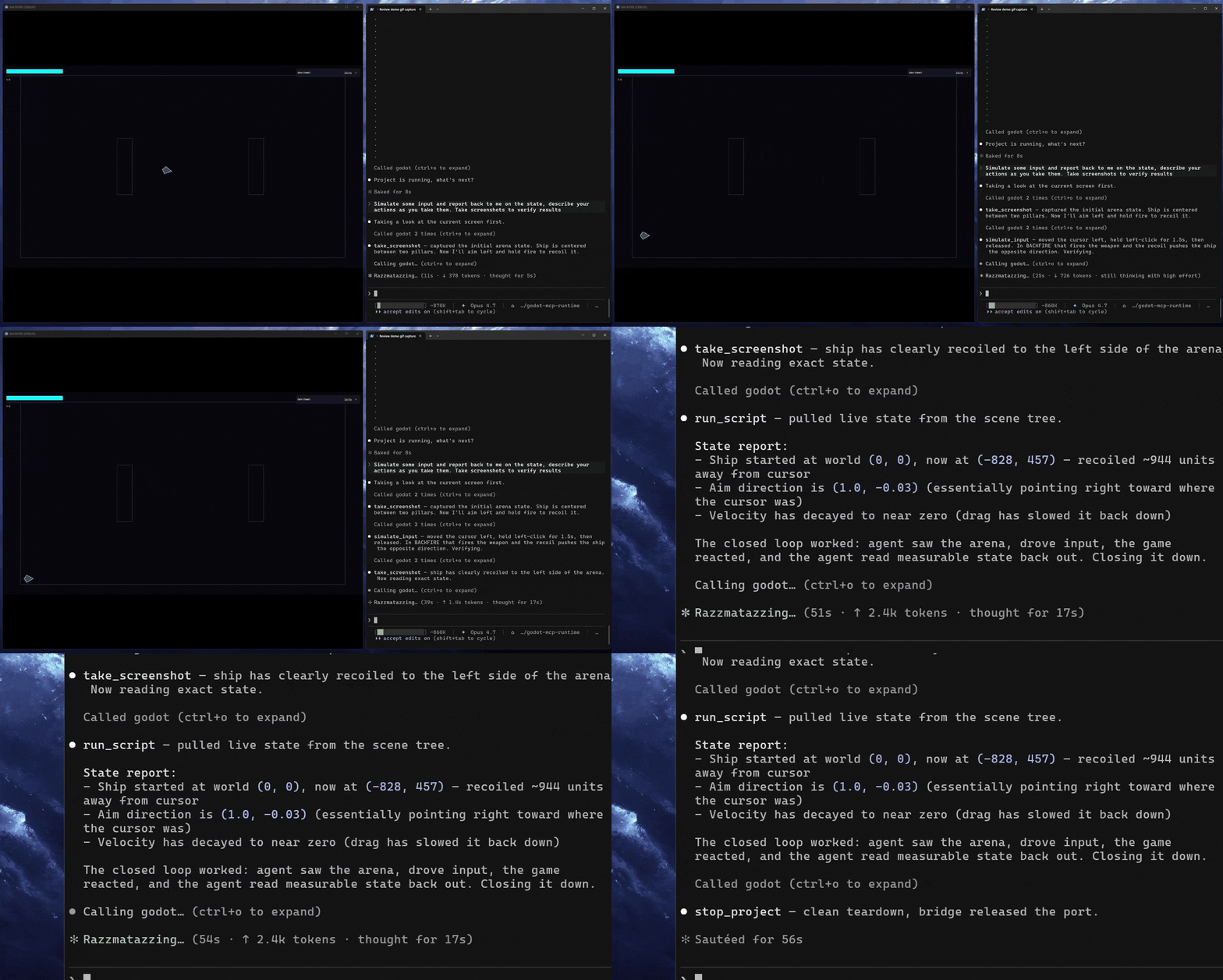
No addon required. Most Godot MCP servers that offer runtime support ship as a Godot addon, something you install into your project, commit to version control, and manage as a dependency. Use npx and there's no install or setup needed.
Think of it as Playwright MCP, but for Godot. This does the same thing for games: run the project, take a screenshot, simulate input, read what's on screen, execute a script against the live scene tree. The agent closes the loop on its own changes rather than handing off to you to verify.
[!NOTE] This is not a playtesting replacement. It doesn't catch the subtle feel issues that only a human notices, and it won't tell you if your game is fun. What it does is let an agent confirm that a scene loads, a button responds, a value updated, a script ran without errors. The ability to check work is crucial for AI driven workflows.
Built for agents. Every tool is purpose-built and self-documenting. When something fails, the response tells the agent how to fix it; when something succeeds, it points toward the next step. The result is an AI that stays unstuck and self-corrects without needing you to nudge it along.
Headless editing. Create scenes, add nodes, set properties, attach scripts, connect signals, validate GDScript. All the standard operations, no editor window required.
Runtime bridge. When run_project or attach_project is called, the server injects McpBridge as an autoload. This opens a localhost-only TCP listener (both auto-select a free port when bridgePort is omitted; pass bridgePort to pin a specific port) and enables:
responseMode: 'full' for pixel-perfect or 'path_only' to skip the inline imageBackground mode. Pass background: true to run_project and the Godot window moves off-screen (positioned at (-9999, -9999)) with physical input blocked: borderless, unfocusable, mouse-passthrough. Programmatic input, screenshots, and all runtime tools work exactly the same. Useful for automated agent-driven testing where the window shouldn't be visible or interactive.
Manual attach mode. When something other than MCP launches the game (a CI pipeline, an external debugger, your own shell), call attach_project first. It injects the bridge and marks the project active without spawning Godot, so when you launch the game manually, runtime tools work against it. Use detach_project when done.
[!IMPORTANT]
get_debug_outputis unavailable in attached mode. stdout and stderr only flow through processes MCP started itself, so when Godot is launched externally there's no captured output to return. Userun_projectif you need the debug stream.
The bridge cleans itself up automatically when stop_project or detach_project is called. No leftover autoloads, no modified project files.
That's it. No Godot addon, no project modifications.
Add the following to your MCP client config. Works with Claude Code, Claude Desktop, Cursor, or any MCP-compatible client.
Zero-install via npx (recommended):
{
  "mcpServers": {
    "godot": {
      "command": "npx",
      "args": ["-y", "godot-mcp-runtime"],
      "env": {
        "GODOT_PATH": "<path-to-godot-executable>"
      }
    }
  }
}
Or install globally:
npm install -g godot-mcp-runtime
{
  "mcpServers": {
    "godot": {
      "command": "godot-mcp-runtime",
      "env": {
        "GODOT_PATH": "<path-to-godot-executable>"
      }
    }
  }
}
Or clone from source:
git clone https://github.com/Erodenn/godot-mcp-runtime.git
cd godot-mcp-runtime
npm install
npm run build
{
  "mcpServers": {
    "godot": {
      "command": "node",
      "args": ["<path-to>/godot-mcp-runtime/dist/index.js"],
      "env": {
        "GODOT_PATH": "<path-to-godot-executable>"
      }
    }
  }
}
[!TIP] Prefer pnpm? All three install paths work with pnpm. Substitute
pnpm dlx godot-mcp-runtimefornpx -y godot-mcp-runtime,pnpm add -g godot-mcp-runtimefor the global install, orpnpm install && pnpm run buildfor the source build. pnpm ships stronger defaults against npm supply-chain attacks; see pnpm's supply chain security guide.
If Godot is on your PATH, you can omit GODOT_PATH entirely. The server will auto-detect it. Set "DEBUG": "true" in env for verbose logging.
[!IMPORTANT] Windows path gotchas.
GODOT_PATHmust point at the Godot executable itself, not its install folder. Backslashes in JSON must be escaped or replaced with forward slashes:hljs language-json"GODOT_PATH": "D:\\Godot\\Godot_v4.4-stable_win64.exe" // or equivalently "GODOT_PATH": "D:/Godot/Godot_v4.4-stable_win64.exe"Setting the variable from a wrapper
.batdoes not propagate to the MCP server — the path must live in the client'senvblock above.
Ask your AI assistant to call get_project_info. If it returns a Godot version string (e.g., 4.4.stable), you're connected and working.
docs/tools.md — full tool reference, grouped by categorydocs/tool-authoring.md — standards for adding or modifying toolsdocs/architecture.md — source layout, bridge sequence diagram, lifecycle steps, runtime artifact behaviorBuilt on the foundation laid by Coding-Solo/godot-mcp for headless Godot operations.
Developed with Claude Code.
Run Claude Code as an MCP server so any agent can delegate coding tasks to it
 @microsoft✓ Official
Browser automation using accessibility snapshots instead of screenshots
 @googleapis✓ Official
Google's universal MCP server supporting PostgreSQL, MySQL, MongoDB, Redis, and 10+ databases
 @github✓ Official
Official GitHub integration for repos, issues, PRs, and CI/CD workflows