

Are you the author? Sign in to claim
A deliberately lite personal brain: Obsidian to browse, Claude Code for everything else. No vector DB, no embeddings, no
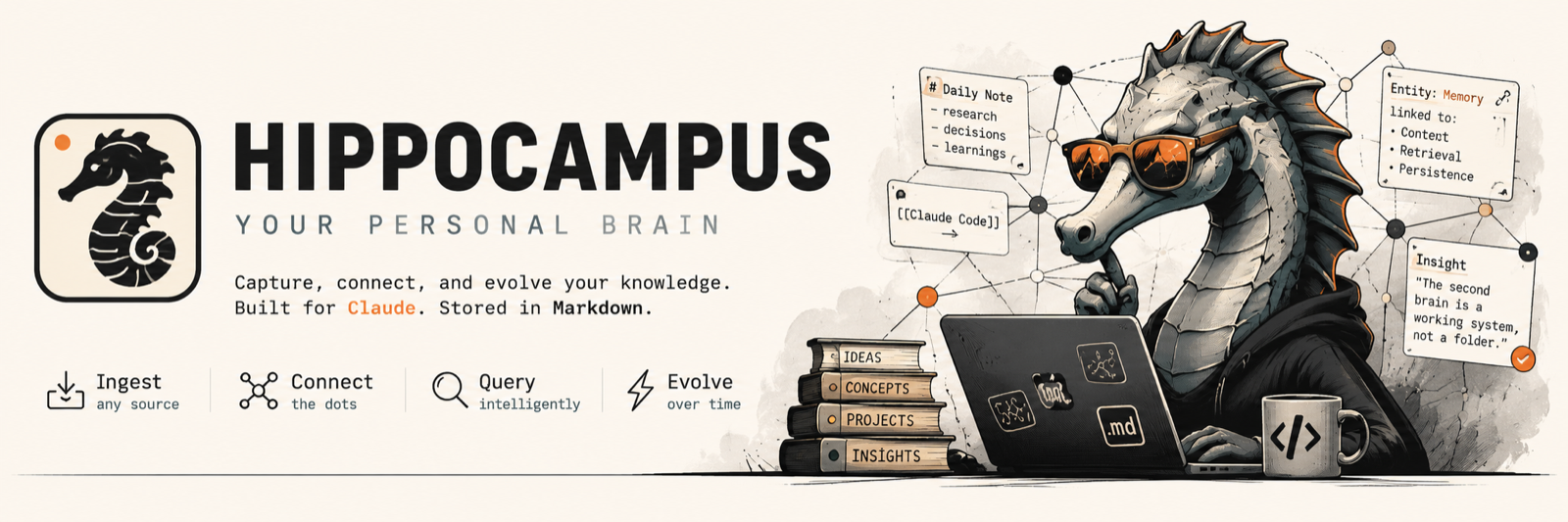
A deliberately lite personal brain: Obsidian to browse, Claude Code for everything else. Zero dependencies, zero infrastructure — the intelligence lives in the structure.




Drop messy notes into an inbox. Claude consolidates them into a structured, cross-linked Obsidian vault — YAML frontmatter, wikilinks, a master index — and remembers where you left off between sessions. You talk to your notes from the terminal; Obsidian is just the (beautiful) viewer. Nothing is hidden: every step of that pipeline is a file you can open.
Named after the brain structure that consolidates raw experience into long-term memory, because that is literally the pipeline: inbox/ (raw experience) → ingest (consolidation) → wiki/ (long-term memory), with wiki/hot.md as working memory carrying recent context from session to session.
Based on Andrej Karpathy's LLM Wiki pattern, stripped to the essentials.
Most AI second-brain setups accumulate machinery: vector databases, embedding pipelines, MCP servers, sync daemons, plugin stacks. Hippocampus bets the other way — the intelligence lives in the structure, not the infrastructure:
This substrate — markdown + YAML frontmatter, typed pages, index.md/log.md, a link graph — is the same pattern Google's Open Knowledge Format (OKF) formalizes as an open standard for agent-readable knowledge. Hippocampus vaults are OKF-adjacent by construction; exporting one to an OKF bundle would be a trivial transform (wikilinks → path links).
inbox/_done/ with full provenance links.index.md (master catalog), log.md (append-only journal), hot.md (≤500-word session cache): cheap retrieval, full auditability, session-to-session memory.sync_framework.sh update pulls the latest structure into your existing vault without ever touching your notes, and export ports your improvements back to a template checkout so you can PR them.Requirements: Claude Code · git · Python 3.10+ · Obsidian (optional, for browsing)
Option A — GitHub-backed (recommended). Click Use this template, create a private repo, then:
git clone https://github.com/YOU/my-brain.git
cd my-brain
claude
Fresh history, private remote already wired — backup is just git push.
Option B — local-only. No GitHub repo of your own; the vault lives only on your machine:
git clone https://github.com/sturlese/hippocampus my-brain
cd my-brain
rm -rf .git && git init && git add -A && git commit -m "My brain, day zero"
claude
You can wire a private remote later — see the FAQ.
Either way, drop a messy note into inbox/ and tell Claude: "ingest".
To browse: Obsidian → Manage vaults → Open folder as vault → select the directory. Graph colors, folder colors and search exclusions come pre-configured.
⚠️ Your vault repo will contain your notes — keep it private. The framework itself lives in the open here; pull future improvements into your vault with
.claude/tools/sync_framework.sh update.
| You say | What happens |
|---|---|
ingest / "process the inbox" | Every pending inbox note → structured wiki pages + index/log/hot updates; originals moved to inbox/_done/ |
| "ingest this URL / this file" | Fetches or reads it, saves the raw copy for provenance, then ingests |
| "what do you know about X?" | Reads hot cache → index → the few relevant pages; answers with (Source: [[Page]]) citations — and says so when the vault doesn't know |
lint | Runs the deterministic linter + an editorial pass (unlinked mentions, stale claims); fixes what you approve |
| "save this" | Files the current conversation's conclusions as a structured note |
| "what were we on?" (new session) | Answered instantly from the auto-injected hot cache |
A typical personal note yields 1 source page + 0–4 entity/concept pages. The bar for creating a page: would you plausibly look it up again? Passing mentions stay plain text.
 you                     Claude Code                        Obsidian
  │                          │                                  │
  │  messy note              │                                  │
  ├───────────► inbox/       │                                  │
  │             │  "ingest"  │                                  │
  │             └───────────►│ creates wiki/sources/…           │
  │                          │         wiki/entities/…          │  graph view
  │                          │         wiki/concepts/…          │  backlinks
  │                          │ updates index.md · log.md        │  properties
  │                          │ refreshes hot.md (≤500 words)    │
  │                          │ moves original → inbox/_done/    │
  │                          │                                  │
  │  turn ends (wiki changed)│ Stop hook: refresh hot.md,       │
  │                          │            local git auto-commit │
  │  next session            │ SessionStart hook: hot.md        │
  │                          │ auto-injected → context restored │
CLAUDE.md (vault layout, frontmatter schema, conventions, read order) — loaded automatically every session. Skills in .claude/skills/ encode the workflows; _templates/ are the canonical page skeletons.├── CLAUDE.md # the contract: schema, conventions, read order
├── inbox/ # messy notes land here (immutable)
│ └── _done/ # processed originals (provenance)
├── wiki/
│ ├── index.md # master catalog
│ ├── log.md # append-only operations journal
│ ├── hot.md # recent-context cache (≤500 words)
│ ├── sources/ entities/ concepts/ projects/ notes/ meta/
├── _templates/ # skeletons per note type
├── _attachments/ # images/PDFs referenced by pages
├── docs/ # framework docs: the ingest walkthrough, design rationale
├── .claude/
│ ├── skills/ # ingest · lint · save
│ ├── hooks/ # per-turn: hot-cache refresh + local auto-commit
│ ├── tools/ # vault_lint.py · sync_framework.sh
│ └── settings.json # hook wiring + permissions
└── .obsidian/ # pre-configured graph/folder colors, exclusions
Does my data leave my machine? Your notes are local markdown in your own git repo. They're sent to the model provider only when you actively work with Claude Code on the vault — the same trust boundary as any Claude Code project. No other service is involved.
Which model should I use? Sonnet with default effort is enough for daily ingest/query/save — the contracts and the deterministic linter do the heavy lifting. Switch to a bigger model for large batches, deep cross-vault synthesis, or changing the framework itself.
Do I need to keep Obsidian open? No. Obsidian is a viewer; everything works from the terminal.
Can the wiki be in another language? Yes — pages are written in English by default; change one line in CLAUDE.md → Conventions.
Multiple machines? It's a git repo: push to your private remote and pull elsewhere. Hooks and skills travel with it. Started with Option B? Create an empty private repo on your host, then git remote add origin <url> && git push -u origin main.
How do I get framework improvements into my existing vault?
.claude/tools/sync_framework.sh update — it fetches this repo, overlays only framework files (never inbox/, wiki/ or _attachments/), and leaves everything uncommitted for you to review. It refuses to overwrite files carrying uncommitted local edits, so nothing of yours can be lost. diff shows the drift without writing; export <checkout> moves your own framework improvements to a local clone of this repo so you can open a PR — shipping only files the template already tracks, so personal extras in framework folders (your own skills, plugin data) stay home unless you --add them.
The framework is developed here, in the open — issues and PRs welcome. Two ways in:
touch .claude/template.local first. The marker (gitignored) tells the hooks this checkout is a template, not a vault, so hot-cache enforcement and auto-commits stay off..claude/tools/sync_framework.sh export <path-to-a-clone-of-this-repo> copies the framework files — never your notes, and only files the template already tracks (new ones need an explicit --add) — into the clone, ready to review, commit and PR.Run Claude Code as an MCP server so any agent can delegate coding tasks to it
 @microsoft✓ Official
Browser automation using accessibility snapshots instead of screenshots
 @googleapis✓ Official
Google's universal MCP server supporting PostgreSQL, MySQL, MongoDB, Redis, and 10+ databases
 @github✓ Official
Official GitHub integration for repos, issues, PRs, and CI/CD workflows
