

Are you the author? Sign in to claim
Just-PRS MCP server








just-prs-mcp brings the
just-prs bioinformatics toolbox into
Claude, Cursor, Codex, and any other
Model Context Protocol client. It exposes
typed tools for searching 5,000+ published polygenic scoring models,
normalizing VCF and consumer-array data, computing PRS, comparing results with
reference populations, estimating absolute risk, and assessing result quality.
It is useful whether you are:
The server runs locally by default, needs no API key, and does not upload your
genome. The underlying scoring, catalog, and reference-panel logic remains in
just-prs; this repository provides the MCP tools, Claude plugin, packaging,
prompts, and guided interpretation workflows.
The server is published in the BioContextAI Registry, a community registry for agentic biomedical systems, where researchers can discover its scientific scope, supported features, and registry metadata.
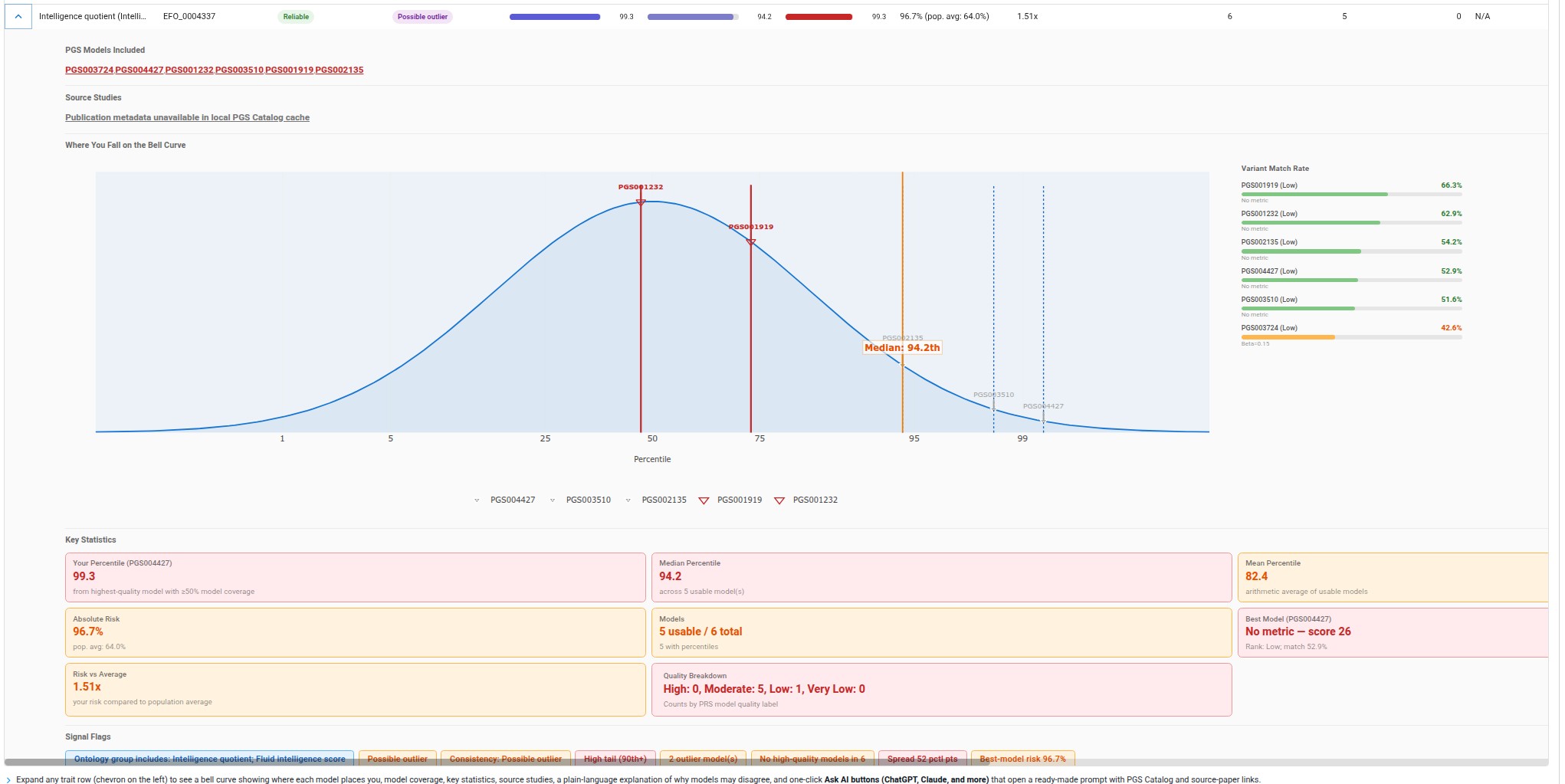
Instead of hiding uncertainty behind one number, the server gives clients the evidence needed to judge a result: PGS IDs, variant-match rates, model quality, reference population, percentiles, absolute-risk context, and agreement or conflict across models for the same trait.
flowchart LR
    U["Researcher, bioinformatician,<br/>or genome owner"]
    C["Claude · Cursor · Codex<br/>or another MCP client"]
    M["just-prs-mcp<br/>typed tools + prompts + skill"]
    J["just-prs<br/>scoring and catalog engine"]
    V["Local VCF / array"]
    P["PGS Catalog metadata<br/>and reference distributions"]

    U --> C --> M --> J
    V --> J
    P --> J
    J --> M --> C
| Use case | Recommended interface |
|---|---|
| Ask questions and receive an evidence-aware interpretation | Claude plugin |
| Add structured PRS tools to Claude, Cursor, Codex, or an internal system | MCP server |
| Build scripts, notebooks, pipelines, or a browser UI directly | just-prs |
| Evaluate quickly without personal genomic data | Public test genomes |
"Search the PGS Catalog for type 2 diabetes models and explain which are best supported."

"Normalize this local VCF, compute PRS for coronary artery disease, and report
the match rate, percentile, reference population, and absolute-risk context."

"Run every suitable model for this trait and show where the models agree or conflict."

"Compare the same trait across Anton's and Livia's public genomes."

"List the available reference panels and score these PGS IDs in a batch."
The client chooses the tools and preserves the provenance of the result. You can also call every tool directly from your own MCP application.
Local use requires uv. uvx creates an isolated
environment for the published package, so there is no repository clone or
project-level installation step.
Add the MCP server:
claude mcp add just-prs -- uvx just-prs-mcp@latest stdio
claude mcp list
Use a pinned version in reproducible research environments:
claude mcp add just-prs -- uvx just-prs-mcp@0.2.0 stdio
For the MCP server plus the bundled trait-interpretation skill, use the Claude plugin.
Add to .cursor/mcp.json (project) or your user MCP config
(Cursor MCP docs):
{
  "mcpServers": {
    "just-prs": {
      "command": "uvx",
      "args": ["just-prs-mcp@latest", "stdio"],
      "env": { "PRS_MCP_MODE": "essentials" }
    }
  }
}
In ~/.codex/config.toml:
[mcp_servers.just-prs]
command = "uvx"
args = ["just-prs-mcp@latest", "stdio"]
Use the same local stdio process:
{
  "command": "uvx",
  "args": ["just-prs-mcp@latest", "stdio"],
  "env": {
    "PRS_MCP_MODE": "essentials"
  }
}
The server is built with FastMCP and returns structured Pydantic outputs, so it can be used interactively or orchestrated by your own MCP client.
The repository is also packaged as a Claude Code / Cowork plugin.
.claude-plugin/plugin.json registers the
prs-trait-interpretation skill, while .mcp.json launches the
MCP server through uvx. The skill guides Claude through model selection,
quality filtering, percentile interpretation, model agreement, and research-use
caveats rather than treating the first available score as definitive.
Use it directly from a checkout:
claude plugin validate .
claude --plugin-dir .
Or build the minimal ZIP for manual upload in Claude Desktop / Cowork:
uv run pack plugin
# dist/just-prs-claude-plugin-<version>.zip
The ZIP contains only the plugin manifest, MCP configuration, skill, README, and license. See the official Claude plugin documentation.
.mcpb extension)If you only need the MCP tools, package a Claude Desktop extension:
uv run pack mcpb
# dist/just-prs-mcp-<version>.mcpb
Double-click the .mcpb or drag it into Claude Desktop. The extension still
runs the server locally. Metadata and configurable options are declared in
manifest.json.
uvx caches the first version it resolves for a bare package name. Prefer
just-prs-mcp@latest or just-prs-mcp@<version> — avoid the bare name.
Use --mode extended or PRS_MCP_MODE=extended for bulk downloads, HuggingFace
upload, prevalence priors, multi-method absolute risk, and reference-panel
scoring.
The plugin's .mcp.json launches the pinned PyPI release. To run the working
tree while developing:
[mcp_servers.just-prs]
command = "uv"
args = ["run", "just-prs-mcp", "stdio"]
Many traits and common diseases — type 2 diabetes, coronary artery disease, height, longevity — are polygenic: influenced by thousands of small genetic effects. A Polygenic Risk Score adds those effects and places the result relative to a reference population. It is not a diagnosis; it can visualize inherited predisposition and, where evidence allows, translate a percentile into an absolute-risk estimate.
The Model Context Protocol lets AI assistants
and applications call external tools through a shared protocol. Here, MCP turns
the just-prs Python API into discoverable, typed operations with structured
inputs and outputs. A chat client can use them conversationally; a
bioinformatics platform can orchestrate the same operations programmatically.
uv sync                                    # deps (incl. dev)
uv sync --extra reference                  # + pgenlib (Linux/WSL)

uv run just-prs-mcp stdio                  # stdio for MCP clients
uv run just-prs-mcp stdio --mode extended  # full tool surface
uv run just-prs-mcp http                   # HTTP (default :3011)
uv run fastmcp dev fastmcp.json            # MCP Inspector

uv run pytest
uv run ruff check .
uv run pyright
The server boots with no environment configured — every setting is optional.
Two public WGS datasets from just-dna-lite are built in:
| Sample | Zenodo | VCF | Size | License | Parameter |
|---|---|---|---|---|---|
| Anton Kulaga | 18370498 | antonkulaga.vcf | ~482 MB | CC0 | sample="anton" |
| Livia Zaharia | 19487816 | SIMHIFQTILQ.hard-filtered.vcf.gz | ~349 MB | CC-BY-4.0 | sample="livia" |
"Download Anton's sample genome, normalize it, and compute the PRS for type 2 diabetes."
Typical tool chain: download_sample_genome → (auto-normalize) →
compute_prs_by_trait → percentile → absolute_risk → optional
plot_trait_panel.
| Tool | Description |
|---|---|
search_scores | Search the PGS Catalog by free text |
score_info | Cleaned metadata for one PGS ID |
best_performance | Best evaluation metrics (OR / HR / AUROC / C-index) |
search_traits | REST trait search with synonym retry |
trait_info | Trait by EFO / MONDO ID + associated PGS IDs |
list_genomes | Inventory of downloaded and normalized genomes in the cache |
download_sample_genome | Fetch a public sample WGS VCF from Zenodo (background task; auto-normalizes by default) |
normalize_vcf | VCF → genotype Parquet (background task) |
compute_prs | Score one VCF against one PGS model |
compute_prs_batch | Score one VCF against many PGS models (background task) |
compute_prs_by_trait | Score models for a trait; auto-save result (background task) |
percentile | Population percentile (reference panel / theoretical / AUROC fallback) |
absolute_risk | Absolute disease risk from a PRS z-score + prevalence |
assess_quality | Quality label + interpretation (pure logic, no I/O) |
compare_genomes | Cross-genome comparison from saved by-trait results |
plot_trait_panel | Plotly figure (JSON / optional HTML) from a saved trait report |
--mode extended)| Tool | Description |
|---|---|
normalize_array | 23andMe / AncestryDNA → Parquet (background task) |
download_scoring_file | One harmonized scoring file from EBI FTP |
list_pgs_ids | All PGS IDs on EBI FTP |
download_all_metadata | All metadata sheets as Parquet (background task) |
bulk_download_scores | Many/all scoring files (background task) |
prevalence_info | Population prevalence priors for a score or trait |
absolute_risk_bundle | Multi-method absolute-risk estimation |
push_catalog_to_hf | Upload cleaned catalog to HuggingFace (needs token) |
download_reference_panel | Fetch 1000G / HGDP+1kGP panel (background task) |
reference_score / reference_score_batch | Score against a reference panel (needs pgenlib) |
pgen_read_pvar / pgen_read_psam / pgen_score | PLINK2 binary ops (needs pgenlib) |
File paths: computation tools take local paths on the server filesystem. Over stdio that is your machine. Reference / pgen tools need
uv sync --extra reference(Linux/WSL).
| Prompt | Description |
|---|---|
compute_prs_for_trait | Step-by-step: search → normalize → score → interpret |
interpret_prs_for_trait | End-to-end trait read with quality shortlist and consensus |
interpret_prs_result | Interpret a single PRS result |
interpret_trait_results | Interpret combined results across models for one trait |
Resource: resource://prs/panels — reference panels, genome builds, and active
cache directory.
1. search_traits("venous thromboembolism")     → trait ID (e.g. EFO_0001645)
2. download_sample_genome(sample="anton")       → VCF (+ normalized Parquet)
3. compute_prs_by_trait(trait_id, genotypes_path) → score models, auto-save JSON
4. percentile(prs_score, pgs_id)                → percentile + z-score
5. absolute_risk(pgs_id, z_score)               → lifetime probability + risk ratio
6. assess_quality(...)                          → quality label
7. plot_trait_panel(result_path)                → optional chart for the client
For cross-genome comparison, repeat scoring per genome, then:
8. compare_genomes(result_paths=[...]) → ranked comparison
compute_prs_by_trait returns result_path; pass those paths to
compare_genomes or plot_trait_panel.
PRS_MCP_MODE (env) or --mode (CLI), default essentials:
| Mode | What's registered |
|---|---|
essentials | Catalog + core compute/analyze + comparison. Smaller tool list for clients. |
extended | Batch downloads, HF upload, prevalence, multi-method risk, reference/pgen. |
All settings are optional. See .env.example and
settings.py.
| Variable | Description |
|---|---|
PRS_MCP_MODE | essentials (default) or extended |
PRS_MCP_CACHE_DIR | Cache for catalog data, scoring files, panels, results |
PRS_MCP_DEFAULT_GENOME_BUILD | Default genome build (GRCh38) |
PRS_MCP_DEFAULT_PANEL | Default reference panel (1000g) |
PRS_MCP_DUCKDB_MEMORY_LIMIT | DuckDB memory for batch scoring (e.g. 8GB) |
PRS_MCP_HF_TOKEN | HuggingFace token for push_catalog_to_hf (also HF_TOKEN) |
PRS_MCP_TRANSPORT | stdio / http / sse |
PRS_MCP_HOST / PRS_MCP_PORT | Bind address for HTTP/SSE (default 0.0.0.0:3011) |
PRS_MCP_LOG_LEVEL | Logging level (info by default) |
Percentiles use the 1000 Genomes Project phase 3 panel (2,504 individuals;
AFR, AMR, EAS, EUR, SAS) on GRCh38 harmonized scoring files. PRS is
Σ(effect_weight × dosage) for matched variants; the user sample is placed on
the same distribution.
Synthetic quality score (0–100) from four tiers:
Also factors cohort size, coverage, and harmonized-score penalty. Labels: High (≥70), Normal (≥50), Moderate (≥30), Low (<30).
For disease traits, absolute_risk converts a z-score into lifetime probability
and risk ratio vs population average. risk_ratio 1.0 = average; >1 elevated;
<1 reduced. If prevalence data is unavailable, the tool reports that explicitly.
Built-in instructions guide agents to:
absolute_risk after percentile for disease traitsSee the just-prs interpretation guide.
PRS results are for research and educational purposes only and do not constitute medical advice.
A high PRS is not a diagnosis; a low PRS is not a guarantee.
Genomic computation is designed to stay local:
push_catalog_to_hf, extended mode) sends
catalog metadata, not personal genotype files, and only when you invoke it
with a token.docker build -t just-prs-mcp . && docker run -p 3011:3011 just-prs-mcpsmithery.yaml (runtime: python)
[tool.smithery] pointing at just_prs_mcp.server:start_mcp_smithery.PRS_MCP_MODE=extended (or other PRS_MCP_*) in the Smithery
project env if you want the full tool surface on the hosted instance.
Local smoke-test of the same entrypoint:
uv run smithery dev / uv run playground / uv run start.fastmcp.json for fastmcp run / fastmcp devsrc/just_prs_mcp/
server.py build_server(), CLI, graceful shutdown, Smithery entrypoint
settings.py pydantic-settings (PRS_MCP_*), safe defaults
client.py shared PRSCatalog / REST-client construction + adapters
models.py Pydantic tool I/O models (+ reused just-prs models)
plugin_package.py minimal Claude plugin ZIP builder
logging_setup.py stdlib logging → stderr
tools/
catalog.py essentials — PGS Catalog search and lookup
compute.py essentials — normalize, compute, analyze, compare
extended.py extended — batch downloads, HF upload, prevalence, multi-risk
reference.py extended — reference-panel / pgen scoring (pgenlib)
tests/ in-memory client tests (wiring + logic, no network)
MIT — see LICENSE.
Run Claude Code as an MCP server so any agent can delegate coding tasks to it
 @microsoft✓ Official
Browser automation using accessibility snapshots instead of screenshots
 @googleapis✓ Official
Google's universal MCP server supporting PostgreSQL, MySQL, MongoDB, Redis, and 10+ databases
 @github✓ Official
Official GitHub integration for repos, issues, PRs, and CI/CD workflows