

Are you the author? Sign in to claim
Kali Linux penetration testing skill for AI agents (Claude Code, OpenClaw, Hermes Agent). 200+ CLI tools, 15 scenario pl
English | 简体中文
A penetration testing skill built on Kali Linux for AI agents such as Claude Code, OpenClaw, and Hermes Agent. Currently includes 269 CLI tools across 14 categories. Built-in coverage matrices, zero-findings fallbacks, and objective stopping conditions for each scenario ensure testing depth.
Unlike traditional automated penetration testing tools, the AI agent connects to a Kali environment via SSH or Docker, then autonomously plans the attack path based on the target, selects tools, integrates and analyzes results across phases to adapt the penetration strategy, and produces a structured report — with mandatory authorization checks and human approval gates for high-risk actions.
[!WARNING] Authorized Use Only — This project is intended solely for authorized penetration testing, security research, and educational purposes. Always obtain explicit written permission before testing any target. Unauthorized access to computer systems is illegal.
A simulated end-to-end penetration test with mock data.
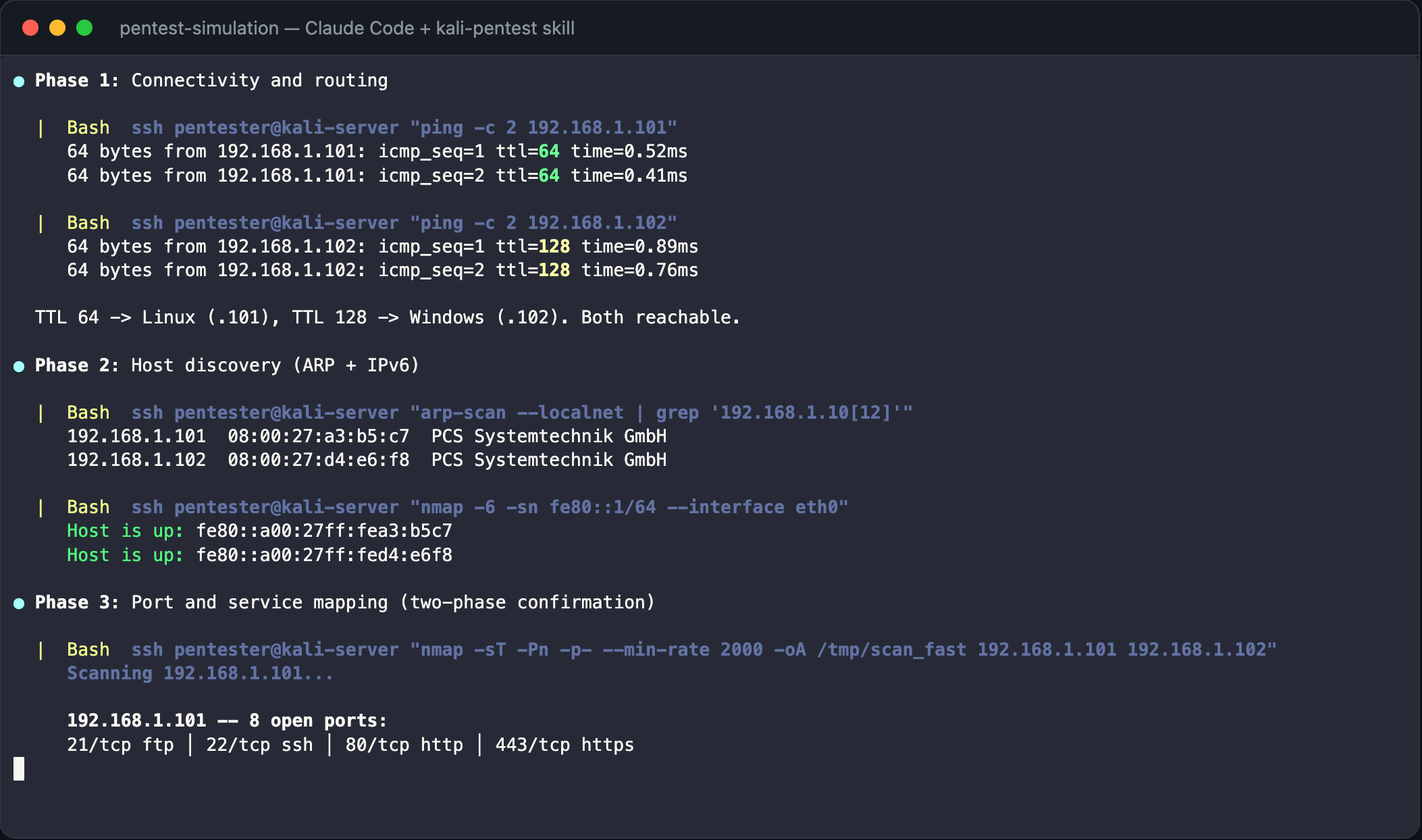
Targets: 192.168.1.101 (Ubuntu 24 — 8 services) + 192.168.1.102 (Windows Server 2022 — 8 services).
Initial phases — connectivity verification, host discovery, and port scanning:
Deep testing phase — vulnerability detection and zero-findings fallback:
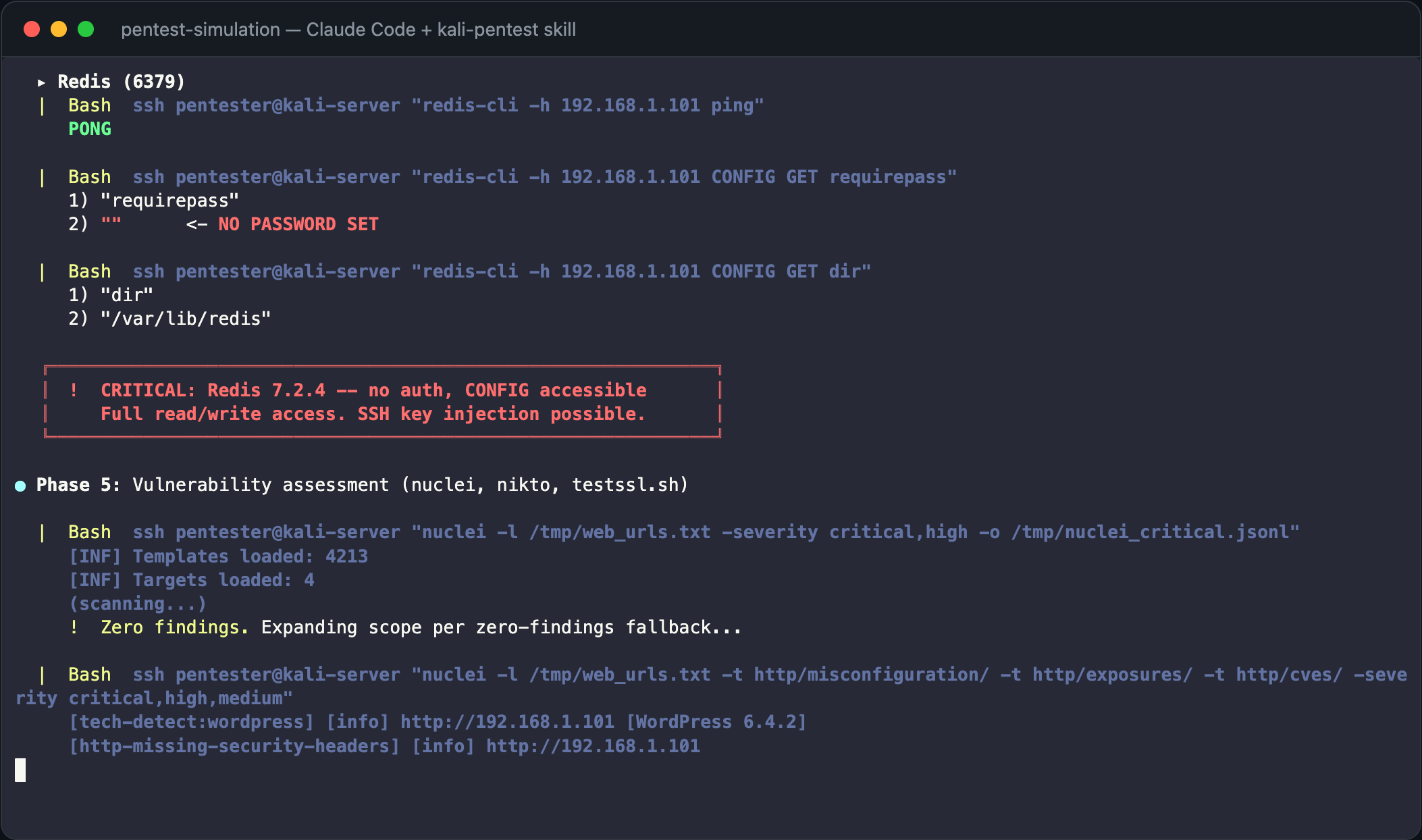
Attack chain discovered: Redis no-auth → SSH shell → SUID privesc → root → path traversal reads MSSQL creds → xp_cmdshell → credential reuse → domain admin → secretsdump

Open demo/player.html in a browser to watch the recording with the asciinema player. Or play from the command line:
# Install asciinema if needed: pip install asciinema
asciinema play demo/pentest-simulation.cast
Report attachments:
demo/simulation-report.md — Full Markdown report with evidence, reproduction steps, and remediationdemo/simulation-report.html — Beautified HTML report (dark theme, attack chain diagram, severity badges)flowchart LR
A[Receive Task] --> B[Step 1: Environment]
B --> C[Step 2: Plan]
C --> D[Step 3: Execute]
D --> E[Step 4: Analyze & Iterate]
E -->|Adapt strategy| D
E --> F[Step 5: Report]
C --- C1[Confirm authorization & scope]
C --- C2[Plan attack path & select depth]
C --- C3[Select playbook from decision tree]
E --- E1[Integrate results across phases]
flowchart TD
    PB[Select Playbook] --> CAT[Read category README]
    CAT --> TOOL[Select tool & run]
    TOOL --> OUT[Collect output]
    OUT --> EVAL{Findings?}
    EVAL -->|Yes| NEXT{New target type?}
    EVAL -->|No| DEEPER[Escalate: deeper scan or alternate tool]
    NEXT -->|AD| AD[active-directory.md]
    NEXT -->|Web app| WEB[web-application.md]
    NEXT -->|Credentials| PWD[password-audit.md]
    NEXT -->|Initial access| POST[post-exploitation.md]
    NEXT -->|No| ITER[Next iteration]
    AD --> ITER
    WEB --> ITER
    PWD --> ITER
    POST --> ITER
    DEEPER --> ITER
    ITER --> TOOL
Copy the skill directory into your AI agent's skills folder:
cp -r kali-pentest /path/to/your/agent/skills/kali-pentest
| Agent | Skills path |
|---|---|
| Claude Code | ~/.claude/skills/ (personal) or .claude/skills/ (project) |
| OpenClaw | ~/.openclaw/skills/ |
| Hermes Agent | ~/.hermes/skills/ |
The agent needs a Kali Linux environment. Three options:
Local mode: the agent runs directly on a Kali system — tools are invoked via bash without SSH or Docker overhead. Ideal when the AI agent itself is running on a Kali host.
Documentation: Kali installation guide, Local mode guide.
Server mode (preferred for remote): full Kali over SSH — avoids Docker networking, raw-socket, wireless, and GPU limitations.
Documentation: Kali installation guide, Server mode guide.
Docker mode: pre-build a persistent container with tools installed. Best for CLI information gathering, vulnerability scanning, web/API and cloud-native testing, and reporting.
Documentation: Kali Docker guide, Docker mode guide.
Tell the agent how to connect:
Kali tools are available locally (this machine is Kali).
Or use a remote Kali server (SSH key recommended):
Kali server: ssh -i ~/.ssh/kali_key root@192.168.1.100
Or use Docker locally:
The persistent Docker container `kali-pentest` is initialized with the full toolset.
For OpenClaw and similar AI assistants, you can also configure Kali connection details in TOOLS.md so the agent reads them automatically without asking each time.
Use natural language to assign a penetration testing task. The agent confirms scope and proceeds autonomously.
Slash command:
For Claude Code and compatible agents.
/kali-pentest
Conversational:
For OpenClaw, Hermes Agent, and other AI assistants.
The skill workflow has been optimized and tested with:
claude-opus-4.6claude-sonnet-4.6deepseek-v4-proqwen3.6:27b — local fallback for air-gapped environments (requires context length ≥ 128K)The agent supports three testing depths — Quick (fast check), Standard (default), and Deep (maximum coverage). Control it with natural language in your task description:
| Phrase in your prompt | Depth |
|---|---|
| "quick scan", "fast check" | Quick |
| (no qualifier) | Standard |
| "full assessment", "comprehensive", "deep" | Deep |
Example 1 (Quick) — "quickly scan":
Kali tools are available locally (this machine is Kali).
Target: 10.0.0.0/24
Quickly scan the target network for open ports along with their service/protocol names and versions, then produce a report.
I have authorization.
Example 2 (Standard) — no depth qualifier:
The persistent Docker container `kali-pentest` is initialized with the full toolset.
Use Docker mode to run a web application penetration test against http://192.168.1.50 and produce a detailed report.
I have authorization.
Example 3 (Deep) — "in-depth":
Kali server: ssh -i ~/.ssh/kali_key root@192.168.1.100
First run a full port scan and service fingerprinting against 192.168.1.50, then plan and execute an in-depth penetration test based on the results — do not overlook any potential weakness. After testing, produce a detailed report.
I have authorization.
[!TIP] A thorough, deep penetration test may require multiple conversation turns to complete. If the agent finishes too early or coverage is insufficient, you can point out the issue directly, or follow up with:
- "Did you fully utilize Kali Linux tools during the penetration test?"
- "Are the current pentest results comprehensive and deep enough?"
- "Check the playbook's Stop When conditions — have all checklist items been satisfied?"
Target domain: corp.example.com, domain controller 10.0.0.5
Perform an Active Directory security assessment covering enumeration, Kerberoasting, ACL abuse, and certificate template checks.
Target API: https://api.example.com, OpenAPI spec at /tmp/openapi.yaml
Perform an API security assessment covering authentication, authorization, and schema-driven testing.
Target: Kubernetes cluster context prod-audit and container registry registry.example.com
Run a read-only cloud-native security assessment and produce a findings report.
Target app: /tmp/app.apk with test account user@example.com
Perform an Android application security assessment, including static analysis, runtime checks, and backend endpoint mapping.
Authorized SSID: CorpWiFi, BSSID: AA:BB:CC:DD:EE:FF, channel 6
Perform a wireless security assessment including passive discovery, handshake capture, WPS detection, and evil twin testing.
Target repository: /tmp/source-repo (including Git history)
Perform a source code and dependency audit including secret scanning, SAST, and CI/CD pipeline security checks.
Target: SIP service 10.10.20.15 and Modbus host 10.10.30.20
Conservative read-only VoIP/ICS protocol assessment. Do not place calls or write PLC/Modbus values.
demo/                          ← Simulation recording and report attachments
├── pentest-simulation.cast    ← asciicast v2 recording
├── player.html                ← Browser-based asciinema player
├── simulation-report.md       ← Full Markdown report
└── simulation-report.html     ← Beautified HTML report

kali-pentest/
├── SKILL.md                   ← Agent entry point: planning, execution, error handling
└── references/
    ├── playbooks/             ← 16 scenario workflows (AD, web, internal, cloud, wireless, ...)
    ├── environment/           ← Server mode and Docker mode setup
    ├── information-gathering/ ← 48 tools
    ├── vulnerability/         ← 17 tools
    ├── sniffing-spoofing/     ← 10 tools
    ├── web/                   ← 38 tools
    ├── exploitation/          ← 24 tools
    ├── password/              ← 21 tools
    ├── wireless/              ← 27 tools
    ├── cloud-native/          ← 8 tools
    ├── rfid-nfc/              ← 5 tools
    ├── voip-ics/              ← 8 tools
    ├── reverse-engineering/   ← 17 tools
    ├── forensics/             ← 23 tools
    ├── post-exploitation/     ← 22 tools
    └── reporting/             ← 1 tool + report template
The kali-pentest-zh/ directory is the Chinese mirror and stays structurally synchronized with kali-pentest/.
The skill uses a four-layer document hierarchy. Each layer has a distinct responsibility, and the agent reads top-down:
| Layer | Files | Responsibility |
|---|---|---|
| Entry point | SKILL.md | Global workflow (Steps 1–5), execution standards, general testing principles |
| Scenario workflows | playbooks/*.md | Phase-by-phase procedures, decision trees, concrete command pipelines, depth-enforcement directives, stopping conditions |
| Tool selection | <category>/README.md | Category overview, tool comparison, selection guidance |
| Tool reference | <category>/tools/<name>.md | Parameters, command examples, installation, notes, official links |
General principles live in SKILL.md (brief, no code blocks). Scenario-specific implementations live in playbooks (concrete commands, test matrices, coverage requirements). The layered structure prevents duplication while ensuring both global coverage and per-scenario depth.
Each playbook includes bold-labeled directives at key workflow decision points to prevent the agent from doing shallow, surface-level work:
Every playbook has objective, verifiable stopping conditions — not "testing is complete" but specific artifacts, matrices, and checklists that must be filled. Every confirmed finding must include the complete reproducible command and its actual output as evidence.
Playbooks form a connected graph. When a workflow phase discovers targets that belong to a different scenario (e.g., AD signals during internal network scanning, API endpoints during web testing), the playbook directs the agent to switch. All such handoffs are listed in each playbook's Cross-References section.
Reusable methodology (e.g., the scanning procedures in internal-network.md and protocol enumeration in internal-network-protocols.md) can be referenced from other playbooks.
16 scenario workflows with phases, decision trees, risk gates, and stopping conditions:
| Playbook | Scenario |
|---|---|
internal-network.md | Host discovery, port scanning, service enumeration, pivoting |
internal-network-protocols.md | SMB, MSRPC, SNMP, SMTP, DNS, database, RDP protocol-specific enumeration |
external-attack-surface.md | OSINT, subdomain enumeration, exposed service scanning |
web-application.md | OWASP Top 10, CMS, injection, auth, business logic |
api-security.md | REST, GraphQL, gRPC, WebSocket, JWT, BOLA/IDOR |
active-directory.md | Kerberoasting, ADCS, relay, ACL abuse, DCSync |
password-audit.md | Hash cracking, spraying, credential reuse, capture |
wireless-assessment.md | WPA/WPA3, WPS, evil twin, Bluetooth/BLE |
cloud-native-assessment.md | AWS/Azure/GCP IAM, Kubernetes, containers, serverless |
mobile-application.md | Android/iOS static + dynamic analysis, SSL pinning bypass |
post-exploitation.md | Privilege escalation, lateral movement, persistence, C2 |
forensics-triage.md | Disk imaging, memory forensics, log analysis, steganography |
rfid-nfc.md | NFC/RFID cloning, smart cards, firmware extraction |
voip-ics.md | VoIP/SIP, ICS/OT/Modbus, IPMI/BMC (safety-first) |
source-code-audit.md | Secret scanning, SAST, dependency audit, CI/CD checks |
reporting-workflow.md | Evidence packaging, CVSS scoring, report generation |
All tools are selected for autonomous agent operation:
strings, checksec, radare2 one-shot, Ghidra Headlesstshark instead of WiresharkThis project is provided as-is for educational purposes and authorized security testing. Users are solely responsible for obtaining written authorization and complying with applicable laws and regulations. The authors assume no liability for damage caused by this project.
Security vulnerabilities discovered during authorized testing must be reported privately to the asset owner through agreed-upon channels. Do not publicly disclose vulnerability details before the owner has had reasonable time to remediate. Follow responsible disclosure practices and any coordinated disclosure agreements in your engagement scope.
Issues and pull requests are welcome.
1000+ skills curated from Anthropic, Vercel, Stripe, and other engineering teams
Design enforcement with memory — keeps your UI consistent across a project
Detects 37 AI writing patterns and rewrites text with human rhythm across 5 voice profiles
WCAG accessibility audit — automated scanning, manual review, remediation