

Are you the author? Sign in to claim
Open-source AI coding agent for the terminal. Claude Code-grade accuracy with smart model routing — uses the right AI mo

The terminal-native AI coding agent, powered by Klaatu smart model routing.
Claude Code-grade accuracy, at a fraction of the cost — and it's reproducible, not a marketing claim.
npm install -g klaatcode
klaatcode




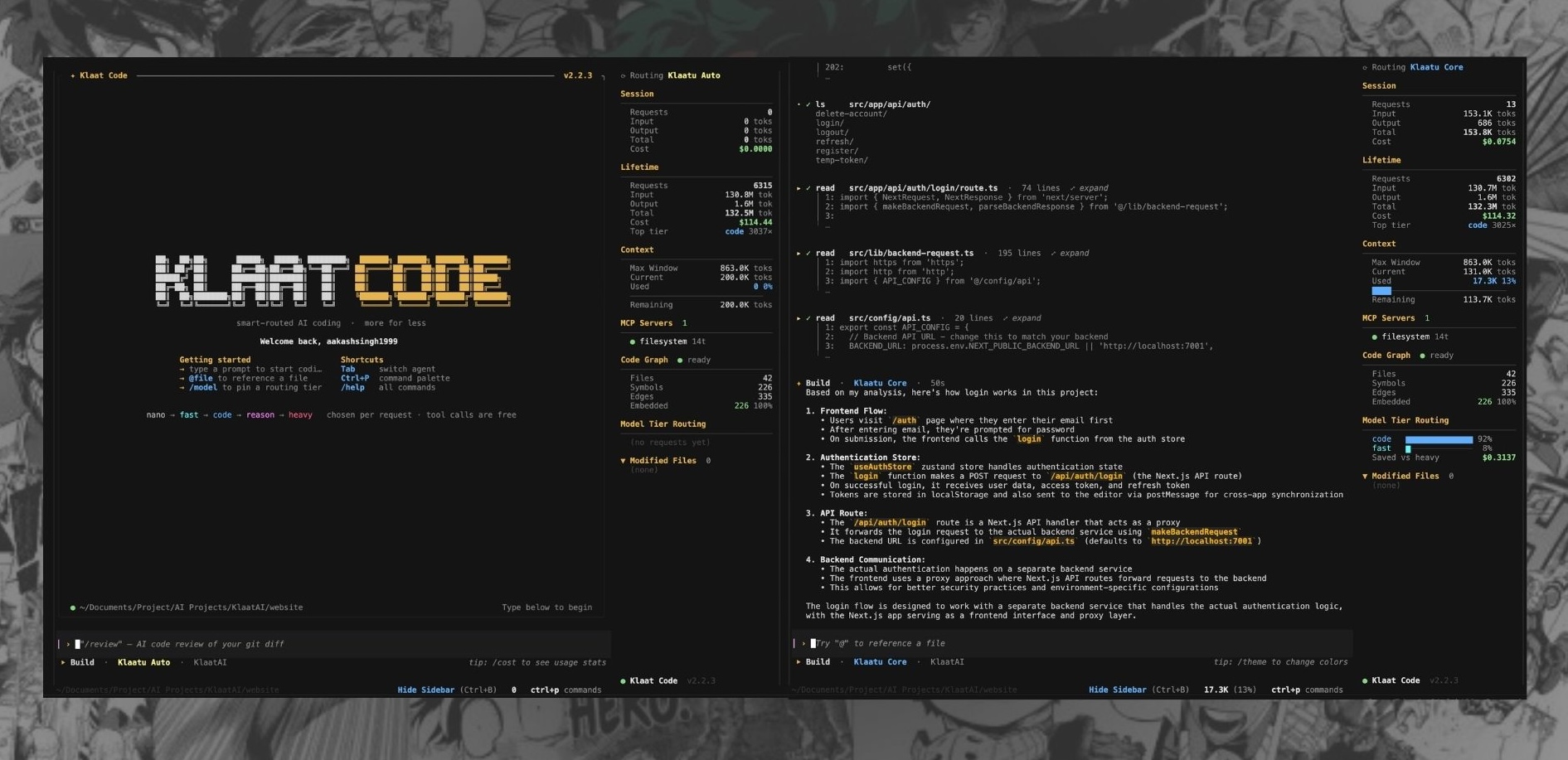
KlaatAI is an AI platform built around Klaatu-o1, a small, fast, agentic router model. Instead of sending every request to one large, expensive model, Klaatu-o1 reads what you're asking, decides which model tier actually needs to handle it, and dispatches accordingly — automatically, per request. Three products sit on top of it: KlaatAI Web Chat (browser), Klaat Code (this CLI), and the KlaatAI API for developers building on the same router directly.
Klaatu is the routing brain — a hosted service, not something that runs on your machine. Every message you send from Klaat Code goes to Klaatu, which classifies it and routes it through one of five cost tiers (nano → fast → code → reason → heavy), escalating automatically when a task turns out harder than it looked, and never charging you frontier prices for a trivial turn. Tool calls inside a single request — reads, edits, shell commands, searches — are free; only your messages count against quota. This is also the architectural reason Klaat Code can be open source without giving away the thing that makes it good: the client is a thin terminal to a service, the same relationship gh has to GitHub. The intelligence — routing decisions, model health tracking, pricing, the code-graph index — lives server-side, at klaatai.com.
Klaat Code is this repo: a terminal-native coding agent you install once and run in any project. It reads your code, edits files, runs commands, and verifies its own work — asking permission before anything risky. Functionally it sits in the same category as Claude Code, opencode, Codex CLI, and Aider — same agentic loop, same terminal-first philosophy — but six things are genuinely different:
plan_exploration uses that graph to plan the optimal file-read order before reading anything. Typically 5–15× fewer tokens per task.--max-cost for CI. No other CLI watches spend rate./context shows what's in the window vs. compacted away. Tool output is noise-filtered (progress bars, passing-test spam) before it ever costs you tokens.bun run bench, and verify the numbers yourself against the same fixtures we used.What's new in each release: CHANGELOG.md.
Same 33 fixtures, same prompts, same verify command, run against KlaatCode, Claude Code, opencode, Cursor, and Grok Build in one harness. Full methodology and honesty notes: bench/README.md. Interactive version with per-task drill-down: klaatai.com/benchmarks.
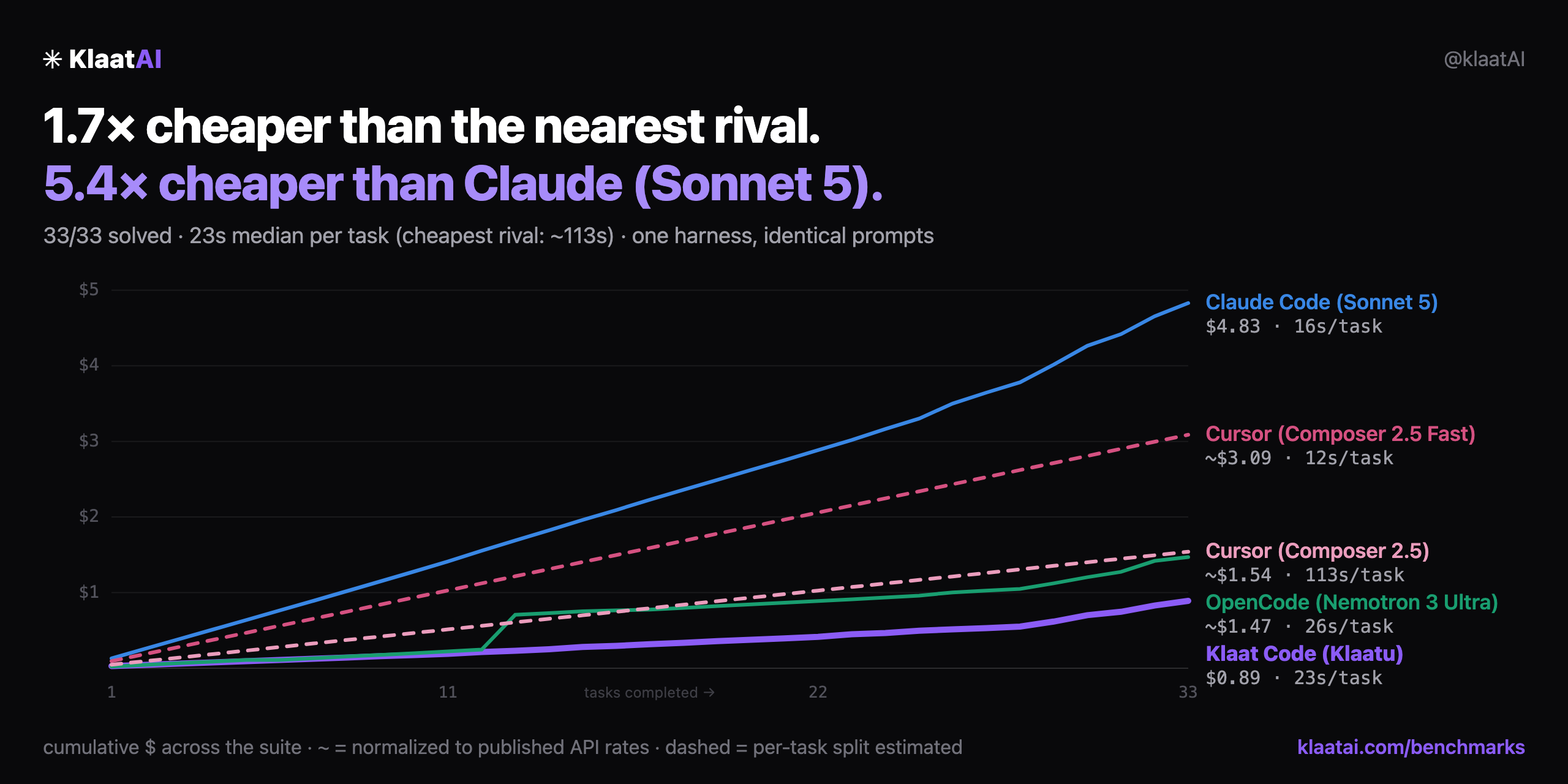
Latest run — 2026-07-20, 33 tasks:
| Metric | Klaat Code (Klaatu-o1) | Claude (Sonnet 5) | Cursor (Composer 2.5) | Cursor (Composer 2.5 Fast) | opencode (Nemotron 3 Ultra) |
|---|---|---|---|---|---|
| Solved | 33/33 | 33/33 | 33/33 | 33/33 | 31/33 |
| Cost per solved task | $0.027 | $0.146 | ~$0.047 est | ~$0.094 est | ~$0.048 est |
| Tokens per solved task | 51.7K | 171.5K | ~86K | ~28.9K | 89.1K |
| Median time per task | 23s | 16s | ~113s | ~12s | 26s |
5.4× cheaper than Claude Code, 1.7× cheaper than the nearest rival, at a perfect solve rate — and no rival is both cheap and fast. Agents near our cost are ~5× slower (Composer 2.5 standard: ~113s/task vs our 23s) or drop tasks; agents near our speed cost 3.5–5.4× more. Promo-free and subsidized lanes are normalized to published per-token rates so the comparison reflects real token cost (details in the honesty notes). Grok Build's refresh on this suite is pending an API rate-limit window; on the previous 30-task suite it solved 30/30 at ~$0.058 est.
Reproduce it:
git clone https://github.com/KlaatAI/klaatcode.git && cd klaatcode
bun install
bun run bench                              # klaatcode
bun bench/compare-agents.ts --agent claude # or opencode / grok / cursor
Pick any method — all install a standalone compiled binary (no Node or Bun runtime required at runtime):
npm (Node ≥ 18 or Bun ≥ 1)
npm install -g klaatcode
macOS
EACCESerror? Prefix withsudo, or fix npm's global prefix once:hljs language-bashmkdir -p ~/.npm-global && npm config set prefix ~/.npm-global echo 'export PATH="$HOME/.npm-global/bin:$PATH"' >> ~/.zshrc && source ~/.zshrc
One-line installer (macOS/Linux)
curl -fsSL https://klaatai.com/api/install | bash
Windows (PowerShell)
irm https://klaatai.com/api/install-windows | iex
Homebrew (macOS/Linux)
brew install KlaatAI/klaatcode/klaatcode
All methods install both klaatcode and klaatai — identical commands, use whichever you like.
Shell completions (bash / zsh / fish)
# bash
klaatai completions bash >> ~/.bashrc

# zsh
mkdir -p ~/.zfunc
klaatai completions zsh > ~/.zfunc/_klaatai
# ensure fpath includes ~/.zfunc, then: autoload -Uz compinit && compinit

# fish
klaatai completions fish > ~/.config/fish/completions/klaatai.fish
klaatcode login                     # browser sign-in — your KlaatAI account, no API keys to manage
klaatcode                           # open current directory
klaatcode ~/projects/my-app         # open a specific project
klaatcode run "Fix all TS errors"   # headless / CI mode
klaatcode whoami                    # check auth
Each request is classified and routed to one of five tiers by Klaatu. You see which tier answered (badge in the header) and why.
/tier           # lock a tier, or open the picker
/tier smart     # restore automatic routing
/model          # switch between Klaatu and your own third-party models
/why            # explain the last routing decision
/cost           # session spend + what routing saved you
| Tier | Used for |
|---|---|
nano | Trivial turns, completions |
fast | Quick questions, small edits |
code | Default — most coding work |
reason | Debugging, architecture, tricky logic |
heavy | Large refactors, hardest problems |
The router escalates automatically when a task turns out harder than it looked and de-escalates when you don't need the big guns. Tool rounds, retries, and failovers are never billed — one user message = one request.
Bring your own model. Don't want Klaatu for a task? Add any OpenAI-compatible endpoint and switch to it per-session:
/model add gpt4o https://api.openai.com gpt-4o env:OPENAI_API_KEY
/model gpt4o
After a successful edit, Klaat Code runs your project's typechecker/linter on the changed file (auto-detects eslint/biome, ruff, gofmt, rubocop, swiftlint, phpstan/pint, ktlint, shellcheck, or a configured command) and hands any errors straight back to the model in the same turn — it fixes them before returning control to you, instead of costing you a round-trip.
Markdown responses render with per-language syntax highlighting directly in the terminal. Code blocks show language labels and are mouse-selectable (drag to auto-copy).
/ for a fuzzy-filtered live suggestion stripdark, light, dracula, nord, ayu, catppuccin, gruvbox, neon, synthwave, ember, matrix, cobalt, midnight, tokyo-night (/theme)/vimmode on)Switch to Plan mode (Tab) and the model gets only read-only tools — it researches and proposes a plan, you approve, it switches back to Build with the full toolset to implement. No accidental edits while you're just trying to think something through.
| Tool | What it does |
|---|---|
read_file | Read files with line numbers, offset/limit for big files |
write_file | Create/overwrite files (parent dirs auto-created) |
edit_file / multi_edit | Surgical string replacement, single or batched atomic |
apply_patch | Multi-file envelope-diff patch — add/update/delete/move, applied atomically |
glob / grep / list_dir | Find files and search code |
run_command | Execute shell commands (permission-gated) |
web_fetch / web_search | Read pages, search the web |
todo_write / todo_read | Persistent task list the agent maintains |
ask_user | The agent can ask you a blocking multiple-choice question mid-task |
delegate_task | Spawn a sub-agent for a scoped piece of work, optionally in the background |
task_status | Check on or list background sub-agents |
plan_exploration | Plan the optimal file-read order for a task from the code graph — before reading anything |
project_graph_query | Query the code graph: symbols, callers, callees |
project_semantic_search | Meaning-based code search (Pro) |
file_outline | Symbol outline of a file without reading it all |
impact_check | Blast-radius analysis: what breaks if this changes |
browser_* | Navigate, read, and click pages (5 tools) |
The agent can delegate scoped work to sub-agents with their own context — keeping your main conversation small and cheap. Sub-agent tool rounds are free like all tool calls.
> explore the auth and billing modules, then implement token refresh
✻ delegate_task: "map auth module structure" …
✻ delegate_task: "map billing module usage of tokens" …
Sub-agents can also run in the background (background: true): you keep chatting while they work, a ◔ N bg agents chip tracks them, and results are injected into the conversation when they finish (task_status / /agents to check in).
Long sessions stay affordable without losing the thread:
nano compacts harder than one on heavy, so requests never overflow the smaller model's window./compact triggers it manually; /context shows what's in the window vs. compacted away; the sidebar shows context-window fill so you're never surprised.The viral horror stories — $6,500 overnight bills, agents looping on the same failing call — can't happen here:
/cost: see what each request cost and where the tokens went (explore / implement / verify).maxSessionCost in config pauses agent rounds at your limit; klaatcode run --max-cost 0.50 for CI/cron (exit code 3).Every conversation is saved as a transcript in ~/.klaatai/sessions/.
/sessions       # list saved sessions
/resume <id>    # pick up exactly where you left off
/export         # export session to Markdown (optional path)
/share          # alias for /export
Three-layer model — safe read-only tools run silently; everything else asks:
~/.klaatai/permissions.jsonrm -rf /, fork bombs, etc. denied by default)/etc, ~/.ssh, …) refused even with the sandbox off{
"allowed_commands": ["git status", "git diff *"],
"denied_commands": ["rm -rf /"],
"trusted_tools": ["read_file", "glob", "grep"]
}
Full MCP client, both transports:
.klaatai/mcp.json, built-in presets (filesystem, GitHub, Postgres, Puppeteer, Brave Search, Fetch, …)"url" config or /mcp add <url>; SSE and JSON responses, session management, and OAuth 2.1 (discovery + dynamic client registration + PKCE browser flow) when the server requires auth — tokens cached in ~/.klaatai/mcp-oauth.jsonManage live with /mcp. On startup, KlaatCode can also import MCP servers from existing tool configs in the project (.mcp.json, .claude.json, .cursor/mcp.json) — native .klaatai/mcp.json always wins on name collisions. Disable with "compat": { "importMcpConfigs": false } in config.json.
/diff           # show git diff
/review         # AI code review of current changes
/commit         # AI-generated commit message + confirm
/undo           # undo last AI file changes
/checkpoint     # snapshot project state
/rollback       # restore a checkpoint
Save prompts as .md files, invoke by name. Project skills in .klaatai/skills/, global in ~/.klaatai/skills/.
/skill list
/skill fix-types
/skill new fix-types     # create in $EDITOR
Run shell commands on agent lifecycle events. Hooks receive a JSON payload on stdin (tool name, arguments, result) plus KLAATAI_* env vars, can be scoped with a matcher regex, and before_tool hooks can block a tool call (exit code 2, or print {"decision":"block","reason":"…"}).
// .klaatai/hooks.json
{
  "after_message": ["afplay /System/Library/Sounds/Glass.aiff"],
  "before_tool": [
    { "matcher": "run_command", "command": "./scripts/guard-shell.sh" }
  ],
  "after_tool":     ["notify-send \"$KLAATAI_TOOL_NAME done\""]
}
Events: before_message · after_message · before_tool · after_tool
.klaatai/rules.md in your repo is injected into every session — coding standards, architecture notes, dos and don'ts. /init auto-generates one from your tech stack. AGENTS.md is also respected.
Custom tools as JavaScript modules — ~/.klaatai/plugins/*.js (global) or .klaatai/tools/*.js (project). /plugin list · /plugin reload.
This README covers the highlights. For every shell flag, slash command, config key, and MCP/hooks/skills detail: klaatai.com/docs.
| Command | Description |
|---|---|
/help | Show all commands |
/tier [name] | Lock a Klaatu routing tier, or open the picker |
/model | Switch between Klaatu and custom third-party models |
/why | Explain last routing decision |
/cost | Session cost, burn rate, per-task + per-phase breakdown |
/context | What's in the context window vs. compacted away |
/compact | Summarize context to free the window |
/diff [file] · /review [ref] · /commit | Git workflows |
/undo · /checkpoint [label] · /rollback [id] | Safety nets |
/test [args] | Run tests (auto-detects Bun/Vitest/Jest/pytest/Go/Cargo) |
/skill <name> · /hooks | Skills and hooks |
/init | Generate project rules from your stack |
/sessions · /resume <id> · /export [path] · /share | Session management |
/mcp | Manage MCP servers |
/agents | List agent personas + running background sub-agents |
/perms | Review tool permissions |
/theme <name> · /vimmode on|off | UI |
/logout | Sign out and clear stored credentials |
/doctor | Diagnose auth, API, MCP, project health |
/clear | Clear chat |
Typing / shows a live, fuzzy-filtered autocomplete strip for all of the above.
| Shortcut | Action |
|---|---|
ctrl+p | Command palette |
ctrl+r | Fuzzy history search |
ctrl+v | Attach image from clipboard (screenshots) |
ctrl+y | Copy last AI response |
ctrl+b | Collapse/expand thinking blocks |
ctrl+d | Quit |
ctrl+c / esc | Cancel streaming |
ctrl+x ctrl+e | Compose message in $EDITOR |
@ | Fuzzy file picker — inserts file reference |
!cmd | Run shell command, inject output |
Tab | Switch Build / Plan mode |
| Mouse drag | Select + auto-copy |
/vimmode on)| Key | Action |
|---|---|
esc | NORMAL mode |
i / a / A / I | INSERT mode |
h / l | Move cursor |
j / k | Scroll chat |
w / b / e | Word motion |
0 / $ | Line start / end |
dd / D | Clear input / kill to EOL |
gg / G | Top / bottom |
ctrl+u / ctrl+d | Half-page scroll |
klaatcode run "Summarise CHANGELOG.md"                 # streams to stdout
echo "Explain this function" | klaatcode run -          # pipe input
klaatcode run "Fix type errors" --model fast            # with options
klaatcode run "Security-check auth.ts" < auth.ts        # in CI
# GitHub Actions
- name: Fix lint errors
  env:
    KLAATAI_API_KEY: ${{ secrets.KLAATAI_API_KEY }}
  run: klaatcode run --model code "Fix all ESLint errors and commit"
klaatcode serve --port 4200
GET /v1/health — health checkGET /v1/info — session infoPOST /v1/chat — chat with SSE streamingPOST /v1/run — single prompt → SSE streamklaatcode web serves a browser UI on top of the same server.
~/.klaatai/config.json:
{
  "baseUrl": "https://api.klaatai.com",
  "routingDisplay": "minimal",
  "theme": "dark",
  "vimMode": false
}
| Key | Values | Description |
|---|---|---|
routingDisplay | off / minimal / full | Routing detail in chat header |
theme | see theme list above | UI theme |
vimMode | true / false | Vim keybindings |
sandbox | project / off | Write sandbox scope |
diagnostics | on / off | Post-edit typecheck/lint feedback loop |
customModels | array | Third-party OpenAI-compatible models (see /model add) |
outputFilter | on / off | Noise-filter command output (progress bars, passing-test spam) before it costs tokens |
attentionOrder | on / off | Arrange old history so the most relevant turns sit where models attend |
maxSessionCost | USD number | Hard session cost cap — pauses agent rounds when reached |
phaseBudgets | on / off | Per-phase token budgets; pause a stuck explore phase before it burns the budget |
compat.importClaudeSkills | true / false | Discover skills from Claude Code directories (default: on) |
compat.importMcpConfigs | true / false | Import MCP servers from .mcp.json, .claude.json, .cursor/mcp.json (default: on) |
Full reference, incl. every config key: klaatai.com/docs/configuration.
~/.klaatai/
  credentials.json    # auth tokens (never committed, never shared)
  config.json         # user preferences
  permissions.json    # tool permission rules
  mcp.json            # global MCP servers
  mcp-oauth.json      # cached OAuth tokens for remote MCP servers
  hooks.json          # global lifecycle hooks
  sessions/           # saved session transcripts
  skills/             # global prompt skills (.md)
  plugins/            # custom tool plugins (.js)
  todos.json          # persistent todo list

.klaatai/             # project-level (in your repo)
  rules.md            # project rules (injected every session)
  mcp.json            # project MCP servers
  hooks.json          # project lifecycle hooks
  skills/             # project prompt skills
  tools/              # project tool plugins (.js)
Sign-in is browser-based OAuth against your KlaatAI account — there are no API keys to generate or paste. klaatcode login opens a browser tab, you authenticate with KlaatAI, and a short-lived JWT plus refresh token are stored locally in ~/.klaatai/credentials.json (mode 0600, never synced or logged). The CLI silently refreshes the token in the background and recovers automatically from expiry mid-session; klaatcode logout clears everything. Every chat request goes straight to Klaatu over HTTPS with that token — the server enforces your plan's quota and never proxies your credentials anywhere else.
We welcome contributions — see CONTRIBUTING.md for dev setup, the PR process, and what bun run bench:selfcheck needs to pass before a PR is reviewed.
Found a vulnerability? Please don't open a public issue — see SECURITY.md for how to report it responsibly.
klaat org commandsApache License 2.0 © KlaatAI — see LICENSE.
The KlaatAI, Klaat Code, and Klaatu names and logos are trademarks of KlaatAI and are not covered by this license — see LICENSE for the trademark notice.
1000+ skills curated from Anthropic, Vercel, Stripe, and other engineering teams
Agent harness performance optimization with skills, instincts, memory, and security
Design enforcement with memory — keeps your UI consistent across a project
Detects 37 AI writing patterns and rewrites text with human rhythm across 5 voice profiles