

Are you the author? Sign in to claim
[SOSP'25] Automatic checker synthesis for system-level static analysis
 KNighter: Transforming Static Analysis with LLM-Synthesized Checkers

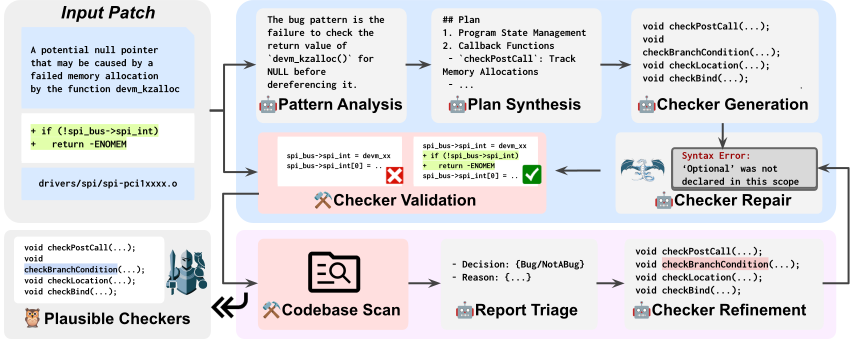
KNighter is an innovative checker synthesis tool that leverages Large Language Models (LLMs) to automatically generate static analysis checkers from historical patch commits.
The detected bugs 🐛 can be found here.
[!IMPORTANT] We are continuously improving the documentation and adding new features. Please stay tuned for updates.
docker pull knighterhub/knighter
git clone https://github.com/ise-uiuc/KNighter.git KNighter
cd KNighter

docker build -t knighter .
# Pull from Docker Hub
docker run -it knighterhub/knighter

# Build from source
docker run -it knighter
When running the container for the first time, initialize the environment:
cd /app
# This would take a while to download the dependencies and compile the LLVM
python3 scripts/init_docker.py
This downloads LLVM and Linux kernel source code into /data/llvm and /data/linux.
API Key Configuration:
echo 'openai_key: "YOUR_OPENAI_API_KEY"' > /app/llm_keys.yaml
Note: For detailed setup steps, refer to
scripts/init_docker.pywhich contains the complete initialization process.
Step 1: Install Dependencies
Download and build LLVM-18.1.8:
wget https://github.com/llvm/llvm-project/archive/refs/tags/llvmorg-18.1.8.zip
unzip llvmorg-18.1.8.zip
Git clone the Linux kernel source code:
git clone https://github.com/torvalds/linux.git
Install Python dependencies:
# Option 1: Using uv (recommended for faster installs)
curl -LsSf https://astral.sh/uv/install.sh | sh
source $HOME/.cargo/env
uv pip install -r requirements.txt

# Option 2: Using regular pip
pip3 install -r requirements.txt

git submodule update --init --recursive
Step 2: Configuration Files
Set up your config.yaml (see scripts/init_docker.py for reference):
result_dir: "result-checkers"
LLVM_dir: "/PATH/TO/LLVM_DIR"
checker_nums: 10
linux_dir: "/PATH/TO/LINUX_DIR"
key_file: "llm_keys.yaml"
model: "o3-mini"
Set up the llm_keys.yaml file (see llm_keys_example.yaml for reference):
openai_key: "sk-..."
claude_key: "sk-ant-..."
google_key: "AIza..."
deepseek_key: "sk-..."

# For local models (optional)
# In config, use "local:model_name" format to use local models
# Like "local:openai/gpt-oss-120b"
base_url: "http://localhost:8000/v1"
api_key: "dummy"
Step 3: LLVM Setup
python3 scripts/setup_llvm.py LLVM_PATH
For rapid evaluation, use the debug dataset:
cd /app/src

# Step 1: Generate checkers for debug commits
python3 main.py gen --config_file /app/config-generate.yaml --commit_file=/app/commits/commits-debug.txt

# Step 2: Refine generated checkers
python3 main.py refine --config_file /app/config-refine-debug.yaml /app/result-generate

# Step 3: Triage and analyze results
python3 main.py triage --config_file /app/config-triage-debug.yaml /app/result-refine-debug
Available Operation Modes:
| Mode | Purpose | Description |
|---|---|---|
gen | Generation | Generate new checkers from commit patches |
refine | Refinement | Improve and validate generated checkers |
scan | Scanning | Scan the kernel with validated checkers |
triage | Analysis | Analyze and categorize scan results |
Basic Usage (Manual Setup):
cd src
python3 main.py <mode> --commit_file=<commits.txt> --config_file=<config.yaml>
Example:
python3 main.py gen --commit_file=../commits/commits-selected.txt --config_file=config.yaml
| File | Purpose | Key Parameters |
|---|---|---|
config-generate.yaml | Checker generation | model, checker_nums, result_dir |
config-refine.yaml | Refinement process | jobs, scan_timeout, scan_commit |
config-triage.yaml | Result analysis | Analysis parameters |
Modify these files to experiment with different parameters from the paper evaluation.
KNighter implements a multi-stage pipeline for automated checker synthesis:
For comprehensive architecture documentation, see ARCHITECTURE.md.
Citation: If you use KNighter in your research, please cite our paper:
@inproceedings{knighter,
    title = {KNighter: Transforming Static Analysis with LLM-Synthesized Checkers},
    author = {Yang, Chenyuan and Zhao, Zijie and Xie, Zichen and Li, Haoyu and Zhang, Lingming},
    year = {2025},
    publisher = {Association for Computing Machinery},
    address = {New York, NY, USA},
    url = {https://doi.org/10.1145/3731569.3764827},
    doi = {10.1145/3731569.3764827},
    booktitle = {Proceedings of the ACM SIGOPS 31st Symposium on Operating Systems Principles},
    location = {Seoul, Republic of Korea},
    series = {SOSP '25}
}
⚠️ Experimentelle Skill-Sammlung für deutsches Recht (Arbeits-, Gesellschafts-, Insolvenz-, Datenschutz-, Prozessrecht u
Manage multiple Claude Code agents from TUI or Web with tmux and git worktrees
Project management using GitHub Issues + Git worktrees for parallel agent execution
Core skills library for Claude Code with 20+ battle-tested skills including TDD, debugging, and brainstorming