

Are you the author? Sign in to claim
MCP server exposing the sources, public API and KDoc of Maven-published Kotlin/Java libraries




Give your AI agent the real sources of any Maven-published Kotlin/Java library.
An MCP server that, on request, downloads the sources of a
library (e.g. io.ktor:ktor-client-core:3.5.1), parses them with the Kotlin Analysis API
(standalone K2/FIR mode), and exposes structured information — public API surface, KDoc,
dependencies/metadata, raw source + search — to MCP clients such as Claude Code and Claude
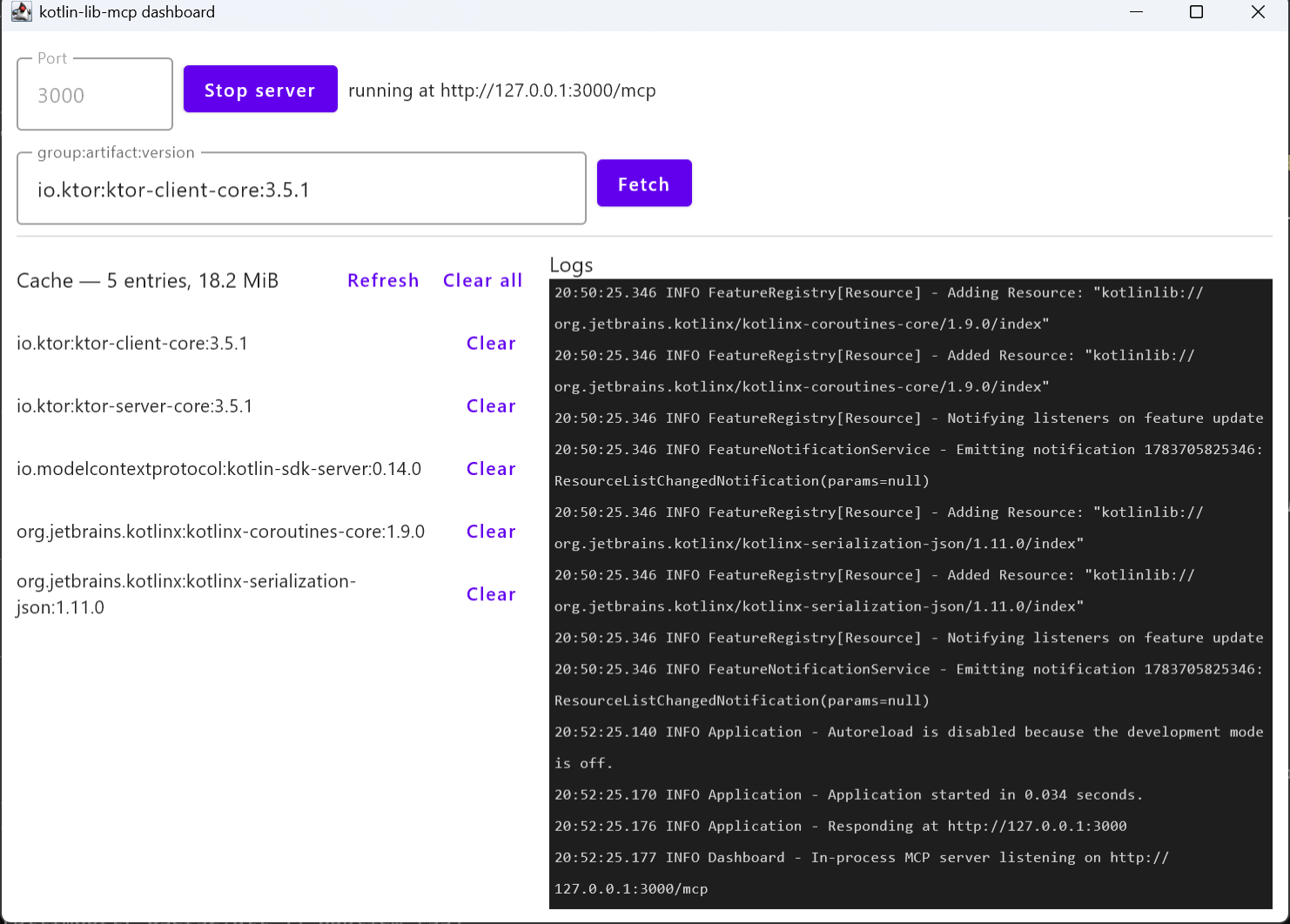
Desktop. An optional Compose Desktop dashboard runs the same server in-process.
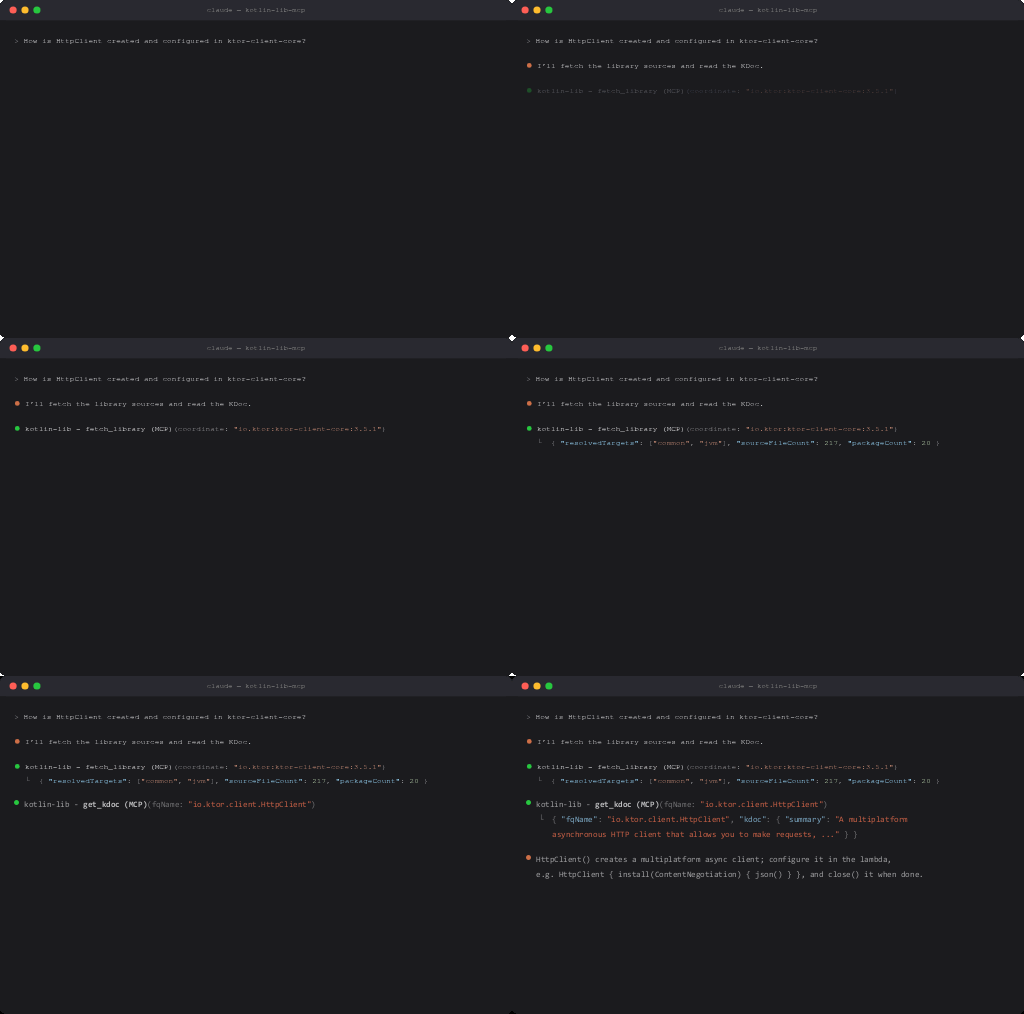
Most documentation MCP servers scrape rendered doc sites or feed the model pre-digested summaries. This one works from the published sources jar — the ground truth:
get_api_signature returns real, type-resolved
signatures (with graceful best-effort fallback when transitive dependencies are missing)..module Gradle metadata, and every symbol is tagged with its targets.group/artifact/version; no re-downloads, no drift between the docs and the
version you actually depend on.get_source and bounded search_source let the agent
read the actual implementation, not just the API.Option 1 — release zip. Download the latest release, unzip (needs a Java 21+ runtime), then:
claude mcp add kotlin-lib -- /path/to/kotlin-lib-mcp-server-<version>/bin/server --transport stdio
Option 2 — Docker.
claude mcp add kotlin-lib -- docker run -i --rm -v kotlin-lib-mcp-cache:/home/mcp/.cache ghcr.io/aoreshkov/kotlin-lib-mcp
Option 3 — MCP Registry. The server is published to the
official MCP registry as
io.github.aoreshkov/kotlin-lib-mcp; registry-aware clients can install it from there.
Or in .mcp.json / Claude Desktop config:
{
  "mcpServers": {
    "kotlin-lib": {
      "command": "C:/path/to/kotlin-lib-mcp-server-<version>/bin/server.bat",
      "args": ["--transport", "stdio"]
    }
  }
}
For remote use, run the http transport (--transport http --port 3000) and point the client
at http://127.0.0.1:3000/mcp — DNS-rebinding protection admits localhost hosts by default;
--allowed-host/--allowed-origin extend the allowlist for non-localhost deployments.
CLI flags: --transport stdio|http, --port <int> (default 3000), --allowed-host <host> /
--allowed-origin <url> (repeatable; extend the http transport's localhost-only defaults),
--cache-dir <path>, --repo <url> (repeatable; Maven Central is the default),
--forward-logs-to-client (opt into mirroring logs to the client; off by default, stderr-only),
--otel (opt into OTLP/HTTP trace export; off by default — see Telemetry), --help.
All tools take a Maven coordinate (group:artifact:version). Call fetch_library first —
it downloads, extracts and analyzes the sources once; every other tool answers from the cached
index. fetch_library, list_versions and get_latest_version also accept group:artifact, and
fetch_library accepts group:artifact:latest to resolve the latest stable release.
| Tool | Purpose |
|---|---|
fetch_library | Download + analyze + cache; returns a summary. Idempotent. Version may be omitted or latest |
list_packages | Packages with declaration counts and KMP targets |
list_declarations | Declarations with signatures; filter by package and visibility |
get_api_signature | Resolved signature of one declaration by FQ name |
get_kdoc | KDoc (summary, description, tags) of one declaration |
get_source | Raw source of a file (path) or one declaration (fqName) |
search_source | Substring/regex search; bounded, returns file:line snippets |
get_dependencies | Dependency tree from .pom/.module; bounded depth |
list_versions | Published versions from maven-metadata.xml, newest-first |
get_latest_version | Latest stable release (and newest overall) from maven-metadata.xml |
Every tool ships the metadata the MCP spec encourages clients to use: a display title,
behavior annotations (readOnlyHint: true everywhere except fetch_library, which is
additive-only — destructiveHint: false, idempotentHint: true; tools that reach Maven
repositories set openWorldHint: true, cache-only tools false), a typed outputSchema
derived from the response DTO's serializer, and an icon. Results carry both pretty-printed JSON
text and the matching structuredContent object, so structured-output clients and plain-text
clients see the same payload.
fetch_library also reports progress notifications (download → analyze → cache) when the
client sends a progressToken. Logs go to stderr by default (which the spec blesses for all
stdio logging); the deprecated MCP logging capability — mirroring logs to clients as
notifications/message (respecting logging/setLevel) — is opt-in via --forward-logs-to-client,
for stdio clients that surface MCP log messages but drop stderr.
Pass --otel to export a trace span for every MCP request (tools/call, resources/read,
prompts/get, completion/complete) over OTLP/HTTP. It is off by default, and off means
inert: no SDK, no exporter threads, no network.
Configuration is the standard OpenTelemetry environment surface — there are no bespoke flags:
export OTEL_EXPORTER_OTLP_ENDPOINT=http://localhost:4318   # '/v1/traces' is appended for you
export OTEL_SERVICE_NAME=kotlin-lib-mcp                    # this is also the default
export OTEL_RESOURCE_ATTRIBUTES=deployment.environment=dev
server --transport stdio --otel
The protocol defaults to http/protobuf, the endpoint to http://localhost:4318, and the
exporter uses the JDK's built-in HTTP client (no OkHttp on the classpath). Everything is
overridable: OTEL_EXPORTER_OTLP_HEADERS for a hosted collector's API key, OTEL_TRACES_EXPORTER,
OTEL_BSP_SCHEDULE_DELAY, and so on.
Endpoint gotcha. With the generic
OTEL_EXPORTER_OTLP_ENDPOINT,/v1/tracesis appended automatically. With the per-signalOTEL_EXPORTER_OTLP_TRACES_ENDPOINT, the URL is used as-is — you must spell out the path yourself. This is the most common OTLP misconfiguration.
Spans follow the MCP semantic conventions: named {method} {target} (e.g.
tools/call fetch_library), SpanKind.SERVER, and carrying mcp.method.name, gen_ai.tool.name,
mcp.session.id, and network.transport (pipe for stdio, tcp for http). A tool that returns
isError is marked error.type=tool_error. Inbound trace context is picked up from the JSON-RPC
params._meta bag (traceparent/tracestate, per SEP-414), so a client that traces
its own work gets one connected trace.
Those mcp.* and gen_ai.* attributes are still Development status upstream and may be
renamed — one more reason the whole feature is opt-in.
Resources: each cached library is readable at
kotlinlib://{group}/{artifact}/{version}/index (the parsed index as JSON); the list updates as
libraries are fetched, and the same URI shape is published as a resource template, so any
cached coordinate is directly addressable. Prompt: explain_public_api(coordinate, package?)
renders an explanation request grounded in the cached signatures and KDoc.
Icons: the server, every tool, the prompt and the library-index resource/template each declare
an SEP-973 icon, so a client can show the surface visually instead of as a wall of
snake_case. They are inlined as data: URIs rather than hosted URLs — a stdio server has no
origin, and the spec asks consumers to prefer same-origin icons and fetch them without credentials,
so inlining removes the third-party fetch entirely and keeps the icons working offline and inside
the container image. The payload is PNG, the one format icon-rendering clients must support
(image/svg+xml is only a SHOULD, and the spec warns it may carry executable content). The glyphs
are drawn by assets/icons/GenerateIcons.java and kept small —
about 800 bytes encoded each, since they ride in every tools/list.
./gradlew build                                    # build everything
./gradlew test                                     # unit tests
./gradlew :server:run --args="--transport stdio"   # local MCP over stdio (default)
./gradlew :server:run --args="--transport http --port 3000"   # Streamable HTTP at /mcp
./gradlew :dashboard:run                           # Compose Desktop UI
./gradlew :server:installDist                      # standalone launcher in server/build/install/server/bin
Requires JDK 21 (resolved automatically via Gradle toolchains).
| Module | What it is |
|---|---|
core/ | KMP library: domain model + ports (commonMain); Maven fetcher, zip extractor, Analysis API analyzer, on-disk cache (jvmMain) |
server/ | JVM app: MCP tools/resources/prompts + stdio and Streamable HTTP transports |
dashboard/ | Compose Desktop control panel embedding the server (optional) |
Downloads and the parsed index live under the OS cache dir + kotlin-lib-mcp
(%LOCALAPPDATA%\kotlin-lib-mcp on Windows, ~/Library/Caches/kotlin-lib-mcp on macOS,
$XDG_CACHE_HOME/kotlin-lib-mcp elsewhere), keyed by group/artifact/version — browsable and
safe to delete. --cache-dir overrides it.
logback.xml).gradle/libs.versions.toml —
bump them together. Symbols whose types can't be resolved (missing transitive deps) degrade
to bestEffort: true PSI signatures instead of failing.Contributions welcome — see CONTRIBUTING.md. Release history lives in CHANGELOG.md; security reports go through private vulnerability reporting.
If kotlin-lib-mcp saves you time, consider
sponsoring its maintenance. Sponsorship funds
keeping the Analysis API version-lock current with new Kotlin releases and the
supply-chain-hardened release pipeline. Every tier is appreciated.
Run Claude Code as an MCP server so any agent can delegate coding tasks to it
 @microsoft✓ Official
Browser automation using accessibility snapshots instead of screenshots
 @googleapis✓ Official
Google's universal MCP server supporting PostgreSQL, MySQL, MongoDB, Redis, and 10+ databases
 @github✓ Official
Official GitHub integration for repos, issues, PRs, and CI/CD workflows