

Are you the author? Sign in to claim
MCP to LangChain Tools Conversion Utility / Python


A simple, lightweight library to use Model Context Protocol (MCP) server tools from LangChain.
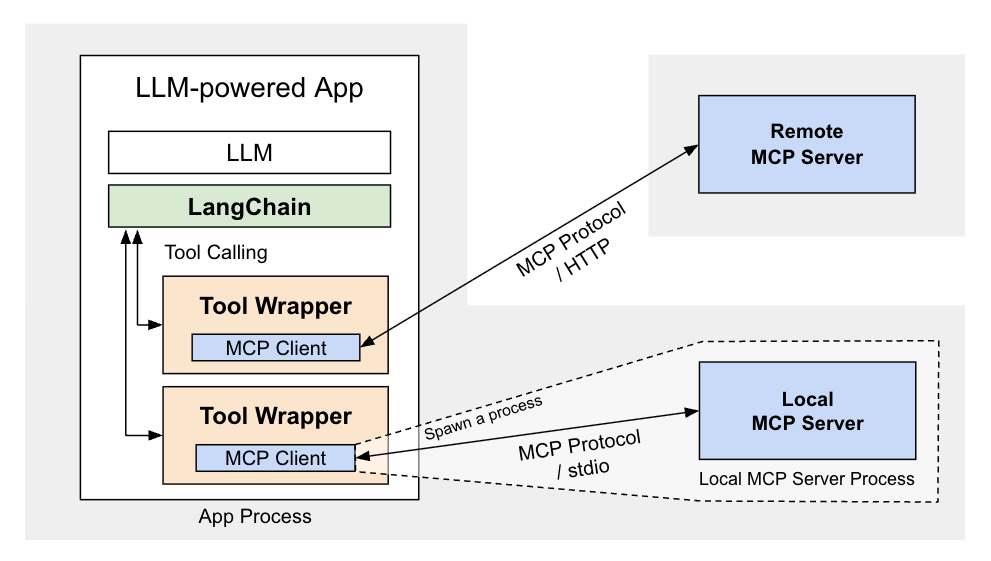
Its simplicity and extra features for local MCP servers can make it useful as a basis for your own customizations. However, it only supports text results of tool calls and does not support MCP features other than tools.
LangChain's official LangChain MCP Adapters library, which supports comprehensive integration with LangChain, has been released. You might want to consider using it if the extra features that this library supports are not necessary.
uv (uvx)
installed to run Python package-based local MCP serversnpx)
to run Node.js package-based local MCP serverspip install langchain-mcp-tools
convert_mcp_to_langchain_tools() utility function accepts MCP server configurations
that follow the same structure as
Claude for Desktop,
but only the contents of the mcpServers property,
and is expressed as a dict, e.g.:
mcp_servers = {
    "filesystem": {
        "command": "npx",
        "args": ["-y", "@modelcontextprotocol/server-filesystem", "."]
    },
    "fetch": {
        "command": "uvx",
        "args": ["mcp-server-fetch"]
    },
    "brave-search": {
        "command": "npx",
        "args": ["-y", "@modelcontextprotocol/server-brave-search"],
        "env": {
            "BRAVE_API_KEY": os.environ.get("BRAVE_API_KEY")
        }
    },
    "github": {
        "type": "http",
        "url": "https://api.githubcopilot.com/mcp/",
        "headers": {
            "Authorization": f"Bearer {os.environ.get('GITHUB_PERSONAL_ACCESS_TOKEN')}"
        }
    },
    "notion": {  # For remote MCP servers that require OAuth, consider using "mcp-remote"
        "command": "npx",
        "args": ["-y", "mcp-remote", "https://mcp.notion.com/mcp"],
    },
}

tools, cleanup = await convert_mcp_to_langchain_tools(
    mcp_servers
)
This utility function initializes all specified MCP servers in parallel,
and returns LangChain Tools
(tools: list[BaseTool])
by gathering available MCP tools from the servers,
and by wrapping them into LangChain tools.
It also returns an async callback function (cleanup: McpServerCleanupFn)
to be invoked to close all MCP server sessions when finished.
The returned tools can be used with LangChain, e.g.:
# from langchain.chat_models import init_chat_model
model = init_chat_model("google_genai:gemini-2.5-flash")

# from langchain.agents import create_agent
agent = create_agent(
    model,
    tools
)
The returned cleanup function properly handles resource cleanup:
It is typically invoked in a finally block:
try:
    tools, cleanup = await convert_mcp_to_langchain_tools(mcp_servers)

    # Use tools with your LLM

finally:
    # `cleanup` can be undefined when an exeption occurs during initialization
    if "cleanup" in locals():
        await cleanup()
A simple working usage example can be found in this example in the langchain-mcp-tools-py-usage repo
For hands-on experimentation with MCP server integration, try this MCP Client CLI tool built with this library
A TypeScript equivalent of this utility is available here
Can be found here
Can be found here
Can be found in this example in the langchain-mcp-tools-py-usage repo
See README_DEV.md for details.
This package is intended to simplify the use of Model Context Protocol (MCP) server tools with LangChain / Python.
Model Context Protocol (MCP) is the de facto industry standard that dramatically expands the scope of LLMs by enabling the integration of external tools and resources, including DBs, Cloud Storages, GitHub, Docker, Slack, and more. There are quite a few useful MCP servers already available. See MCP Server Listing on the Official Site.
This utility's goal is to make these numerous MCP servers easily accessible from LangChain.
It contains a utility function convert_mcp_to_langchain_tools().
This async function handles parallel initialization of specified multiple MCP servers
and converts their available tools into a list of LangChain-compatible tools.
For detailed information on how to use this library, please refer to the following document: "Supercharging LangChain: Integrating 2000+ MCP with ReAct".
This library supports MCP Protocol version 2025-03-26 and maintains backwards compatibility with version 2024-11-05. It follows the official MCP specification for transport selection and backwards compatibility.
response_format: 'content' (the default), which only supports text strings.
While MCP tools can return multiple content types (text, images, etc.), this library currently filters and uses only text content.PATH environment variable to local server configrations, if not explicitly provided, to ensure servers can find required executables.If you need to pass an API key or other configurations to a local MCP server via environment variables, use this example as a guide:
    "brave-search": {
        "command": "npx",
        "args": ["-y", "@modelcontextprotocol/server-brave-search"],
        "env": {
            "BRAVE_API_KEY": os.environ.get("BRAVE_API_KEY")
        }
    },
Note: The library automatically adds the PATH environment variable to local server configrations, if not explicitly provided, to ensure servers can find required executables.
A new key "errlog" has been introduced to specify a file-like object to which local MCP server's stderr is redirected.
    log_path = f"mcp-server-{server_name}.log"
    log_file = open(log_path, "w")
    mcp_servers[server_name]["errlog"] = log_file
A usage example can be found here.
The key name errlog is derived from
stdio_client()'s argument errlog.
The working directory that is used when spawning a local MCP server
can be specified with the "cwd" key as follows:
    "local-server-name": {
        "command": "...",
        "args": [...],
        "cwd": "/working/directory"  # the working dir to be use by the server
    },
The key name cwd is derived from
Python SDK's StdioServerParameters.
The library selects transports using the following priority order:
This ensures predictable behavior while allowing flexibility for different deployment scenarios.
Note: SSE transport is deprecated as of protocol version 2025-03-26; Streamable HTTP is the recommended approach.
mcp_servers configuration for Streamable HTTP, SSE (Server-Sent Events) and Websocket servers are as follows:
    # Auto-detection: tries Streamable HTTP first, falls back to SSE on 4xx errors
    "auto-detect-server": {
       "url": f"http://{server_host}:{server_port}/..."
    },

    # Explicit Streamable HTTP
    "streamable-http-server": {
        "url": f"http://{server_host}:{server_port}/...",
        "transport": "streamable_http"
        # "type": "http"  # VSCode-style config also works instead of the above
    },

    # Explicit SSE (Note: SSE transport is deprecated)
    "sse-server-name": {
        "url": f"http://{sse_server_host}:{sse_server_port}/...",
        "transport": "sse"  # or `"type": "sse"`
    },

    # WebSocket
    "ws-server-name": {
        "url": f"ws://${ws_server_host}:${ws_server_port}/..."
        # optionally `"transport": "ws"` or `"type": "ws"`
    },
The "headers" key can be used to pass HTTP headers to Streamable HTTP and SSE connection.
    "github": {
        "type": "http",
        "url": "https://api.githubcopilot.com/mcp/",
        "headers": {
            "Authorization": f"Bearer {os.environ.get('GITHUB_PERSONAL_ACCESS_TOKEN')}"
        }
    },
Auto-detection behavior (default):
transport, the library follows MCP specification recommendationsExplicit transport selection:
"transport": "streamable_http" (or VSCode-style config "type": "http") to force Streamable HTTP (no fallback)"transport": "sse" to force SSE transport (SSE transport is deprecated)ws:// or wss://) always use WebSocket transportStreamable HTTP is the modern MCP transport that replaces the older HTTP+SSE transport. According to the official MCP documentation: "SSE as a standalone transport is deprecated as of protocol version 2025-03-26. It has been replaced by Streamable HTTP, which incorporates SSE as an optional streaming mechanism."
If you need to use remote MCP servers that require OAuth, consider using "mcp-remote".
    "notion": {
        "command": "npx",
        "args": ["-y", "mcp-remote", "https://mcp.notion.com/mcp"],
    },
The library supports OAuth 2.1 authentication for Streamable HTTP connections:
from mcp.client.auth import OAuthClientProvider
...

    # Create OAuth authentication provider
    oauth_auth = OAuthClientProvider(
        server_url="https://...",
        client_metadata=...,
        storage=...,
        redirect_handler=...,
        callback_handler=...,
    )

    # Test configuration with OAuth auth
    mcp_servers = {
        "secure-streamable-server": {
            "url": "https://.../mcp/",
            // To avoid auto protocol fallback, specify the protocol explicitly when using authentication
            "transport": "streamable_http",  // or `"type": "http",`
            "auth": oauth_auth,
            "timeout": 30.0
        },
    }
Test implementations are provided:
The library also supports authentication for SSE connections to MCP servers. Note that SSE transport is deprecated; Streamable HTTP is the recommended approach.
Enable debug logging: Set the log level to DEBUG to see detailed connection and execution logs:
tools, cleanup = await convert_mcp_to_langchain_tools(
    mcp_servers,
    logging.DEBUG
)
Check server errlog: For local MCP servers, use errlog redirection to capture server error output
Test explicit transports: Try forcing specific transport types to isolate auto-detection issues
Verify server independently: Refer to Debugging Section in MCP documentation
When authentication errors occur, they often generate massive logs that make it difficult to identify that authentication is the root cause.
To address this problem, this library performs authentication pre-validation for HTTP/HTTPS MCP servers before attempting the actual MCP connection.
This ensures that clear error messages like Authentication failed (401 Unauthorized) or Authentication failed (403 Forbidden) appear at the end of the logs, rather than being buried in the middle of extensive error output.
Important: This pre-validation is specific to this library and not part of the official MCP specification. In rare cases, it may interfere with certain MCP server behaviors.
Set "__pre_validate_authentication": False in your server config if:
Example:
"oauth-server": {
    "url": "https://api.example.com/mcp/",
    "auth": oauth_provider,  # Complex OAuth provider
    "__pre_validate_authentication": False  # Skip the pre-validation
}
Check your tokens/credentials - Most auth failures are due to expired or incorrect tokens
Verify token permissions - Some MCP servers require specific scopes (e.g., GitHub Copilot license)
Test with curl - Try a simple HTTP request to verify your auth setup:
curl -H "Authorization: Bearer your-token" https://api.example.com/mcp/
See TECHNICAL.md for technical details about implementation challenges and solutions.
MIT License - see LICENSE file for details.
Issues and
pull requests welcome!
In particular, please share any issues relating to the latest versions of LangChain and LLM models, as well as specific MCP servers.
Run Claude Code as an MCP server so any agent can delegate coding tasks to it
 @microsoft✓ Official
Browser automation using accessibility snapshots instead of screenshots
 @googleapis✓ Official
Google's universal MCP server supporting PostgreSQL, MySQL, MongoDB, Redis, and 10+ databases
 @github✓ Official
Official GitHub integration for repos, issues, PRs, and CI/CD workflows