

Are you the author? Sign in to claim
Control what your AI can see. LeanCTX (Lean Context) is the context intelligence layer for AI agents — one local Rust bi
██╗     ███████╗ █████╗ ███╗   ██╗     ██████╗████████╗██╗  ██╗
██║     ██╔════╝██╔══██╗████╗  ██║    ██╔════╝╚══██╔══╝╚██╗██╔╝
██║     █████╗  ███████║██╔██╗ ██║    ██║        ██║    ╚███╔╝
██║     ██╔══╝  ██╔══██║██║╚██╗██║    ██║        ██║    ██╔██╗
███████╗███████╗██║  ██║██║ ╚████║    ╚██████╗   ██║   ██╔╝ ██╗
╚══════╝╚══════╝╚═╝  ╚═╝╚═╝  ╚═══╝     ╚═════╝   ╚═╝   ╚═╝  ╚═╝
LeanCTX — Lean Context Intelligence for AI agents
LeanCTX — short for Lean Context — is the context intelligence layer for AI agents. It runs as a single local binary between your agents and your code, shell and data: it decides what they read, remembers what they learn, guards what they touch — and proves what they save with a signed, verifiable savings ledger. The result: 60–90% fewer tokens — and that's the receipt, not the product. Zero config required. Local-first.
| Problem | With LeanCTX |
|---|---|
| Repeated file reads: ~2000 tokens each | Cached re-reads: ~13 tokens |
Raw git status: ~800 tokens | Compressed: ~120 tokens |
| Context resets every chat | Session memory persists across chats |
| No visibility into context usage | Real-time dashboard + budget control |






Website · Docs · Install · Scenarios · Demo · Benchmarks · Cookbook · Security · Changelog
Control what your AI can see. LeanCTX — short for Lean Context — is the context intelligence layer for AI agents: one local Rust binary that decides what your agents read, remembers what they learn, guards what they touch — and proves what they save.
Token savings are the receipt. Intelligence is the product. Works with Cursor, Claude Code, Copilot, Windsurf, Codex, Gemini and 30+ other agents — no config needed.
See it in action:
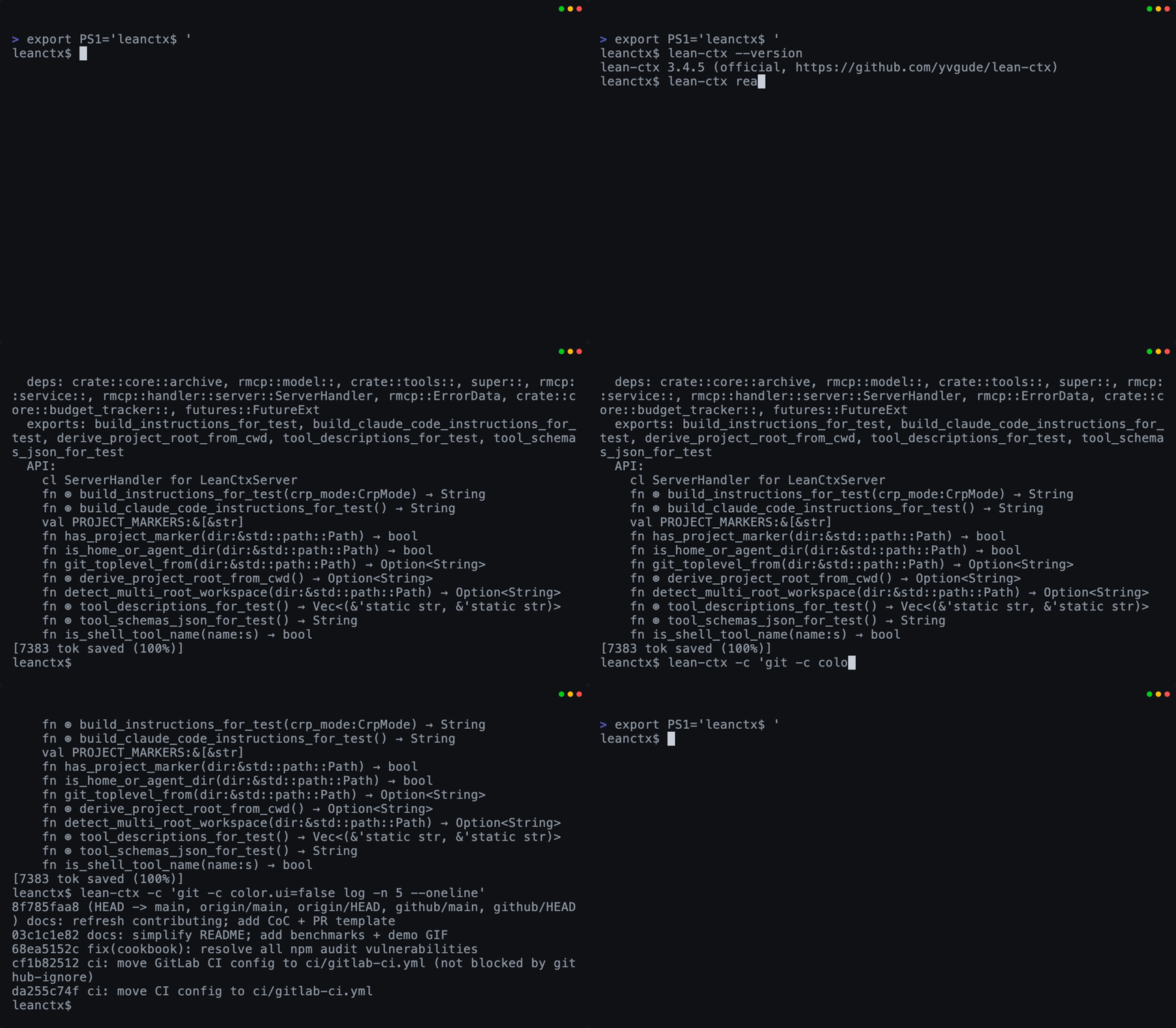
Read + Shell Map-mode reads + compressed CLI output |
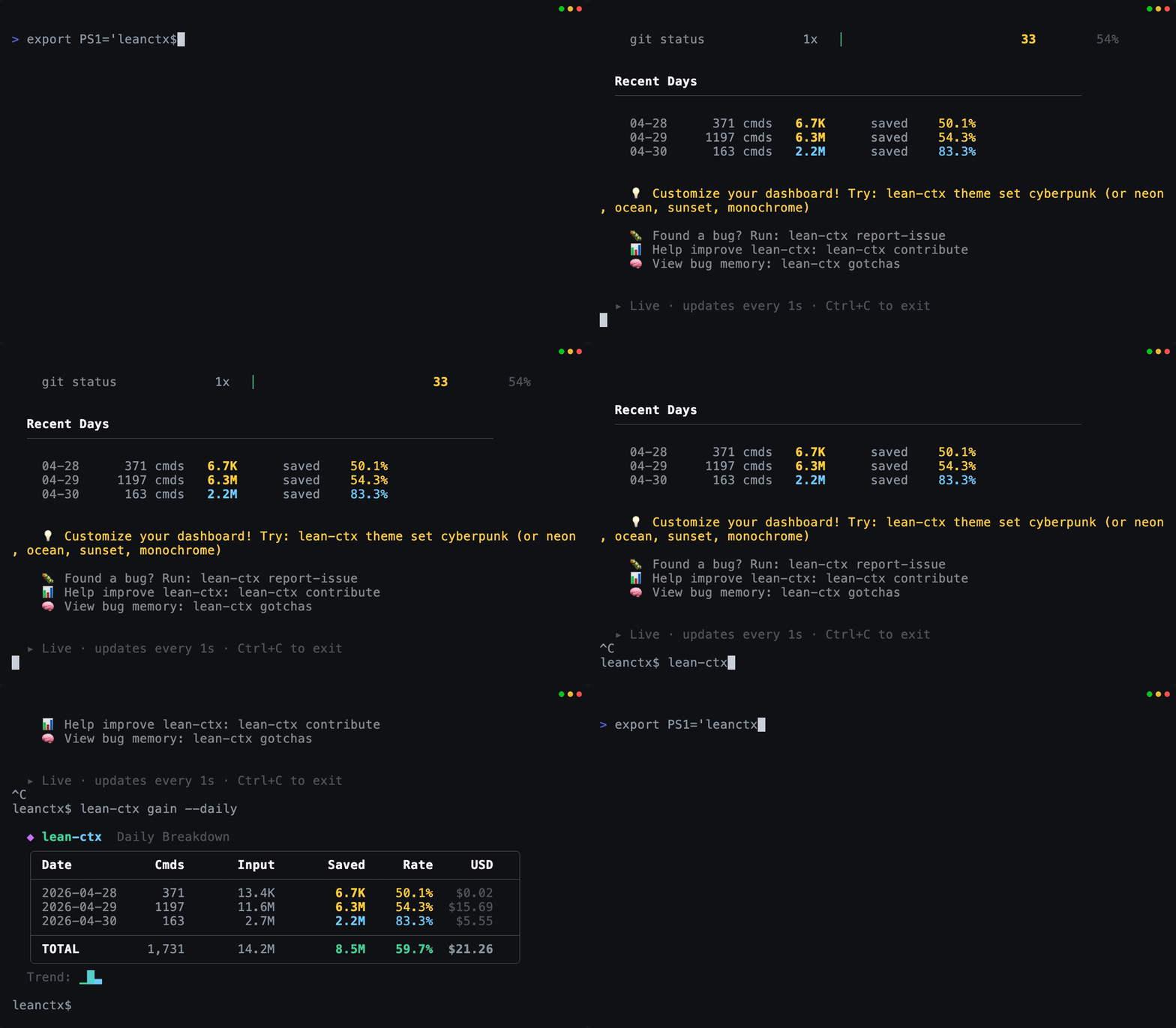
Gain (live) Tokens + USD savings in real time |
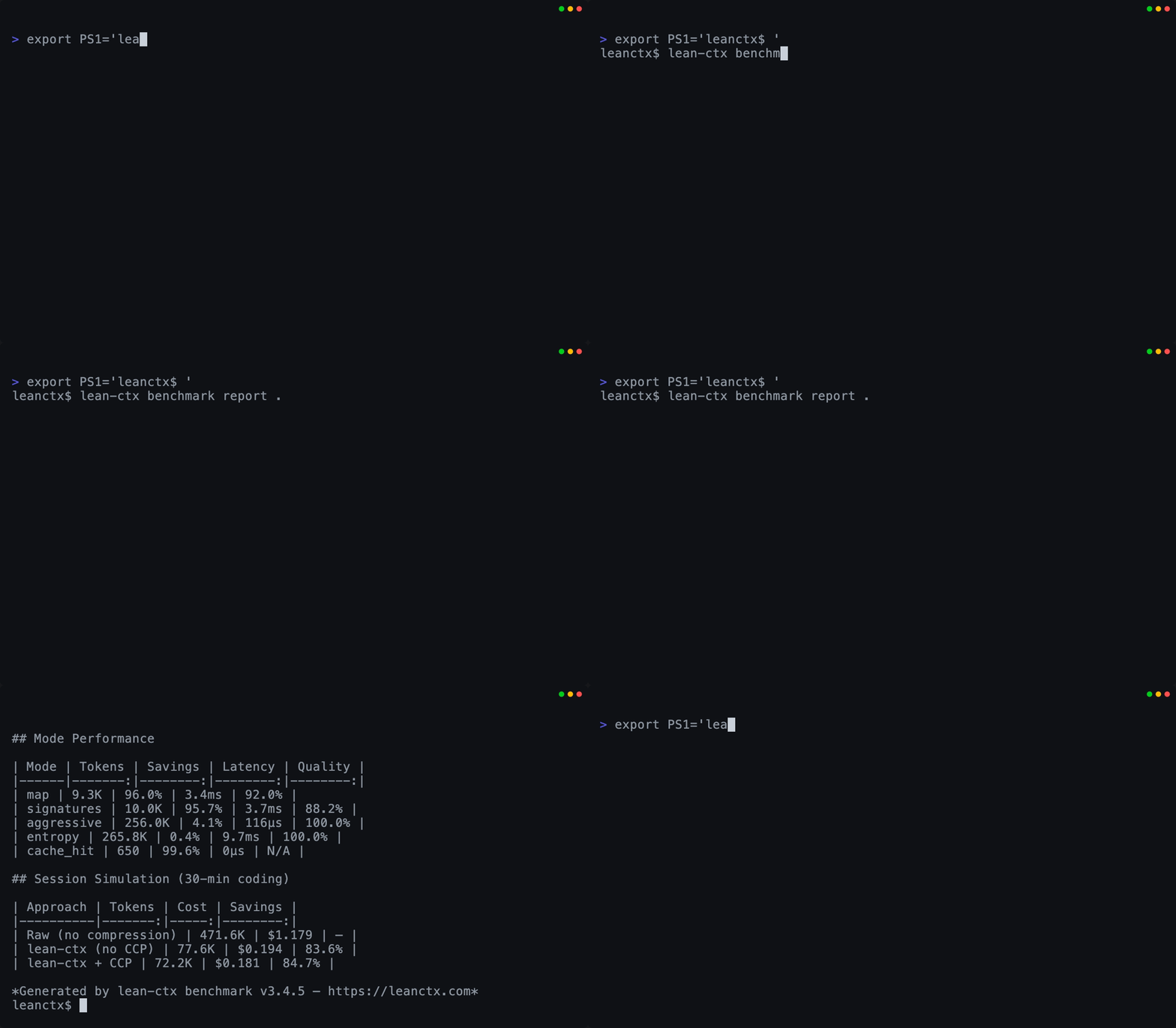
Benchmark proof Measure compression by language + mode |
All GIFs are generated from reproducible VHS tapes in demo/.
lean-ctx setup command, no config changes neededSaves you tokens? Give it a star — it helps others discover LeanCTX.
LeanCTX treats context as a managed resource, not an afterthought. One binary covers the four dimensions that decide how well an AI agent actually performs:
Your AI agent reads files and runs commands. LeanCTX compresses both automatically.
full, map, signatures, diff, lines:N-M, density:X, …) — cached re-reads cost ~13 tokensdensity:0.4): SDE-style budget compression — keeps the highest-entropy lines until ~40% of the original tokens remain, deterministicsignatures carries line spans and points at lines:N-M for targeted expansion — outline first, bodies on demandNot every file needs the same depth. LeanCTX sends the signal, not the noise.
ModePredictor: learns the optimal read mode per file type from past sessionsIntentEngine: classifies query complexity so simple lookups stay cheapContext doesn't disappear between chats anymore.
Performance is accuracy, not just speed. You stay in control of the window.
ctx_proof, ctx_verify): 4-layer verification engine with CI drift gatesctx_url_read): pull a public web page, PDF, or YouTube transcript into context as compressed, citation-backed text — facts/quotes return claims with a confidence score + source URL, relevance-ranked research-compression distils to a token budget, SSRF-guarded (http/https only)ctx_refactor): language-server-powered rename, references, go-to-definition via rust-analyzer, typescript-language-server, pylsp, goplsctx_agent, ctx_handoff): agent handoff with context transfer bundles, diary system, synchronized shared statectx_expand search_all): FTS5-powered cross-archive search over all previously archived tool outputslean-ctx pack --pr builds a PR-ready context pack (changed files, related tests, impact, artifacts)lean-ctx pack create bundles Knowledge + Graph + Session into portable .ctxpkg files with SHA-256 integritylean-ctx gain --live for real-time savings, lean-ctx wrapped for weekly/monthly summaries (gain --svg/--share for a shareable card or self-hostable page), lean-ctx watch for TUI monitoringlean-ctx savings is an auditable, per-event ledger (tokenizer transparency, bounce-netting, tamper-evident SHA-256 chain) — local-only, on by defaultlean-ctx serve for Streamable HTTP MCP + /v1/tools/call (used by the Cookbook + SDK)LeanCTX is growing from a single context layer into a full cognitive context layer for whole teams: version-controlled context strategy, one unified graph, and a governance layer across many agents.
The full roadmap lives in VISION.md.
AI tool → (MCP tools + shell commands) → lean-ctx → your repo + CLI
ctx_* tools (read modes, caching, deltas, search, memory, multi-agent)# 1) Install (pick one)
curl -fsSL https://leanctx.com/install.sh | sh # universal (no Rust needed)
brew tap yvgude/lean-ctx && brew install lean-ctx # macOS / Linux
npm install -g lean-ctx-bin # Node.js
cargo install lean-ctx # Rust
pi install npm:pi-lean-ctx # Pi Coding Agent
# 2) Connect your AI tools (zero prompts, sensible defaults)
lean-ctx onboard # or: lean-ctx setup (guided, full control)
# 3) Verify
lean-ctx doctor
# 4) Restart your shell + AI tool, use it normally, then see the payoff
lean-ctx gain # savings appear after your AI's first lean-ctx call
After onboarding, restart your shell and your editor/AI tool once so the MCP + hooks are active. lean-ctx gain is empty until your AI tool makes its first lean-ctx call — that's expected, not a misconfiguration.
lean-ctx-offlean-ctx -c --raw "git status"shell_activation = "agents-only" in ~/.config/lean-ctx/config.toml.lean-ctx.toml in your project root (auto-merged with global config)/workspace: create .lean-ctx-id with a unique name to prevent context collisionslean-ctx updatelean-ctx doctor --jsonLeanCTX grows with you. Below are the journeys most people actually take — each links to a complete, function-by-function walkthrough in the Reference (every CLI command and all 76 MCP tools are documented there).
🟢 Your first 60 seconds"I just installed it — now what?" hljs language-bash One command auto-detects Cursor/Claude/Codex/… and configures MCP + hooks. → Journey 1 — Setup & Onboarding |
📖 Coding every day"Stop re-reading the same files." hljs language-bash Your agent reads less and searches smarter — automatically. → Journey 2 — Daily Use |
🧠 Resume where you left off"My new chat forgot everything." hljs language-bash Session memory + a project knowledge graph persist across chats. → Journey 3 — Memory & Knowledge |
🗺️ Understand a new codebase"Where does this function ripple to?" hljs language-bash A multi-edge property graph powers impact analysis + ranked search. → Journey 4 — Code Intelligence |
🔌 Wire in proxy, providers, plugins"Pull in GitHub issues and our Postgres schema." hljs language-bash External data flows through the same consolidation pipeline. → Journey 5 — Advanced & Integrations |
🛠️ Keep it healthy"Update, fix, or cleanly remove." hljs language-bash Self-healing diagnostics; surgical uninstall that only removes its own blocks. → Journey 6 — Lifecycle & Troubleshooting |
🎛️ Take control of the window"Budget my context like a pro." hljs language-bash Phi-scored planning + knapsack compilation + a context ledger. → Journey 7 — Context Engineering |
🤝 Run a team of agents"Planner + coder + reviewer on one repo." hljs language-text Shared message bus, diaries, knowledge, and deterministic handoffs. → Journey 8 — Multi-Agent Collaboration |
🏢 Share across a team / CI"One shared index, headless in pipelines." hljs language-bash Scoped tokens, optional cloud sync, verifiable context gates. → Journey 9 — Team, Cloud & CI |
🎚️ Tune & govern"Make it behave exactly how we want." hljs language-bash Compression levels, tool profiles, themes, and rules governance. → Journey 10 — Customization & Governance |
📊 Prove the payoff"Show me the numbers." hljs language-bash All analytics live in the CLI/dashboard — never burning agent tokens. → Journey 11 — Analytics & Insights |
📚 The full reference"I want to read everything." Every command and all 76 MCP tools, organized as user journeys, plus appendices for the CLI map, MCP tools, and paths & config. → Reference index |
LeanCTX is a standard MCP server, so it works with any MCP-compatible client. Two integration modes are auto-selected per agent:
| Mode | How it works | Best for |
|---|---|---|
| Hybrid | MCP for cached reads (~13 tokens) + shell hooks for command compression | Agents with shell access (Cursor, Claude Code, Codex, ...) |
| MCP | All 76 tools via MCP protocol, no shell hooks | Protocol-only agents (JetBrains, VS Code, Zed, ...) |
| Agent | Hybrid | MCP | Setup |
|---|---|---|---|
| Cursor | ● | lean-ctx init --agent cursor | |
| Claude Code | ● | lean-ctx init --agent claude | |
| CodeBuddy | ● | lean-ctx init --agent codebuddy | |
| Augment CLI / VS Code | ● | lean-ctx init --agent augment | |
| Codex CLI | ● | lean-ctx init --agent codex | |
| Gemini CLI | ● | lean-ctx init --agent gemini | |
| Windsurf | ● | lean-ctx init --agent windsurf | |
| GitHub Copilot | ● | lean-ctx init --agent copilot | |
| CRUSH | ● | lean-ctx init --agent crush | |
| Hermes | ● | lean-ctx init --agent hermes | |
| OpenCode | ● | lean-ctx init --agent opencode | |
| Pi | ● | lean-ctx init --agent pi | |
| Qoder | ● | lean-ctx init --agent qoder | |
| Amp | ● | lean-ctx init --agent amp | |
| Cline | ● | lean-ctx init --agent cline | |
| Roo Code | ● | lean-ctx init --agent roo | |
| Kiro | ● | lean-ctx init --agent kiro | |
| Antigravity | ● | lean-ctx init --agent antigravity | |
| Amazon Q | ● | lean-ctx init --agent amazonq | |
| Qwen | ● | lean-ctx init --agent qwen | |
| Trae | ● | lean-ctx init --agent trae | |
| Verdent | ● | lean-ctx init --agent verdent | |
| Aider | ● | lean-ctx init --agent aider | |
| Continue | ● | lean-ctx init --agent continue | |
| JetBrains IDEs | ● | lean-ctx init --agent jetbrains | |
| QoderWork | ● | lean-ctx init --agent qoderwork | |
| VS Code | ● | lean-ctx init --agent vscode | |
| Zed | ● | lean-ctx init --agent zed | |
| Neovim | ● | lean-ctx init --agent neovim | |
| Emacs | ● | lean-ctx init --agent emacs | |
| Sublime Text | ● | lean-ctx init --agent sublime |
Any MCP-compatible client works out of the box — the table above shows agents with first-class auto-setup.
Great fit if you...
Skip it if you...
--raw, but ROI is lower)Try these in any repo:
lean-ctx read rust/src/server/mod.rs -m map
lean-ctx -c "git log -n 5 --oneline"
lean-ctx gain --live
lean-ctx dashboard                              # Context Manager (browser)
lean-ctx watch                                  # TUI monitor
lean-ctx benchmark report .
demo/vhs demo/leanctx.tape
vhs demo/gain.tape
vhs demo/benchmark.tape
lean-ctx benchmark report .
update_check_disabled = true or LEAN_CTX_NO_UPDATE_CHECK=1)See SECURITY.md.
One command removes everything — it stops all processes, then deletes hooks, editor configs, rules, autostart (LaunchAgent/systemd), the data dir, and the binary itself:
lean-ctx uninstall                 # full clean removal
lean-ctx uninstall --dry-run       # preview every change, write nothing
lean-ctx uninstall --keep-config   # keep MCP configs + rules (for reinstall)
lean-ctx-off                       # or just disable for the current shell session
No binary on PATH (or you used the curl installer)? Run the same removal from the installer:
curl -fsSL https://leanctx.com/install.sh | sh -s -- --uninstall
If you installed via a package manager, uninstall removes everything it wrote and
tells you the one command to finish removing the binary:
brew uninstall lean-ctx        # Homebrew
cargo uninstall lean-ctx       # cargo install
npm uninstall -g lean-ctx-bin  # npm
pi uninstall npm:pi-lean-ctx   # Pi Coding Agent
Start with CONTRIBUTING.md. Easy first PR: propose a new CLI compression pattern via the issue template.
Apache License 2.0 — see LICENSE.
Run Claude Code as an MCP server so any agent can delegate coding tasks to it
 @microsoft✓ Official
Browser automation using accessibility snapshots instead of screenshots
 @googleapis✓ Official
Google's universal MCP server supporting PostgreSQL, MySQL, MongoDB, Redis, and 10+ databases
 @github✓ Official
Official GitHub integration for repos, issues, PRs, and CI/CD workflows