

Are you the author? Sign in to claim
LeanKG: Stop Burning Tokens. Start Coding Lean.

Local-first code knowledge graph for AI coding agents
Surgical context · fewer tool calls · blast-radius awareness · 100% local
Pre-index your repo. Serve precise subgraphs over MCP to Cursor, Claude Code, OpenCode, and more — no cloud, no external database.
Live Demo → · Docs · Docker Hub
















One command — binary, MCP wiring, and agent docs for your tool of choice:
# macOS / Linux
curl -fsSL https://raw.githubusercontent.com/FreePeak/LeanKG/main/scripts/install.sh | bash -s -- <target>
| Target | What you get |
|---|---|
cursor | Binary + MCP + skill + AGENTS.md + session hook |
claude | Binary + MCP + plugin + skill + CLAUDE.md + hooks |
opencode | Binary + MCP + plugin + skill + AGENTS.md |
gemini / kilo / antigravity | Binary + MCP + skill + agent docs |
docker | Hub image + index + embed + MCP HTTP (no Rust) |
curl -fsSL https://raw.githubusercontent.com/FreePeak/LeanKG/main/scripts/install.sh | bash -s -- cursor
cargo install leankg
# or
git clone https://github.com/FreePeak/LeanKG.git && cd LeanKG && cargo build --release
curl -fsSL https://raw.githubusercontent.com/FreePeak/LeanKG/main/scripts/docker-up.sh | bash
curl http://localhost:9699/health
Point your MCP client at http://localhost:9699/mcp. Multi-project RocksDB mounts: AGENTS.md.
Published Hub tags currently target
linux/arm64. Onlinux/amd64, build withdocker compose -f docker-compose.rocksdb.yml up --build.
Installing the binary alone does not connect your agent. Run setup (or use an install target above) so MCP is registered:
leankg setup
This configures Cursor, Claude Code, OpenCode, Gemini, and other supported clients with LeanKG’s MCP server, skills, and hooks where available.
cd your-project
leankg init
leankg index ./src
leankg status
Optional: enable watch mode so the graph stays fresh while you and your agent edit code:
leankg mcp-stdio --watch
leankg impact src/main.rs --depth 3
leankg path "Handler" "Repository"
leankg explain "APIRouter"
leankg graph-query "what connects auth to the database?"
leankg web    # UI at http://localhost:8080
Upgrade anytime:
leankg update
When an AI agent needs to understand code, it usually discovers structure the slow way: grep, glob, and Read — one file at a time — rebuilding call paths and dependencies by hand. That is a pile of tool calls and round-trips before the real work starts.
LeanKG hands the agent the exact subgraph it needs. It indexes symbols, edges, tests, docs, and (optionally) embeddings into a local knowledge graph, then exposes them over MCP. Instead of crawling the tree, the agent asks one question and gets back callers, dependents, blast radius, and targeted source — surgical context, not a file-by-file search.
graph LR
    A[AI Agent] -->|intent| B[LeanKG MCP]
    B --> C[Graph + Embeddings]
    C -->|targeted context| A
| Without LeanKG | With LeanKG |
|---|---|
| Grep → open many files → large context | Query the graph → minimal, relevant subgraph |
| No blast-radius awareness | Impact radius with confidence + severity |
| Keyword-only search | Keyword + semantic (HNSW) + ontology |
| Stale mental model of the repo | Index + optional --watch incremental updates |
On cost: LeanKG’s win on every codebase is precision and speed — fewer tool calls, faster answers. Token savings are real and scale-dependent: modest on small repos, material on large monorepos multiplied by team-wide agent usage.
For engineering managers choosing a team-wide stack: LeanKG vs Graphify — Company ROI Brief (token/tool-call floors, multi-repo Docker TCO, mega-graph safety, ops/traceability). The primary adoption lever is always-on graph-first install (curl …/install.sh | bash -s -- cursor or claude) so agents query the graph before grep.
Vector-engine A/B gate (100 tasks, synthetic agent workload vs grep/cat-style baseline) — see docs/benchmarks/vector_engine_gate_results.json:
| Metric | Result | Floor |
|---|---|---|
| Token reduction | −65.0% | ≥ 60% |
| Tool-call reduction | −84.6% | ≥ 80% |
| Speedup | 2.50× | ≥ 2× |
| 1M SQ8 ANN P95 | ~0.055 ms | < 50 ms |
Unified agent A/B (19 cases vs grep baseline): ~30% input token savings, ~3× tokens/result efficiency.
Load test (~100K nodes):
| Operation | Throughput |
|---|---|
| Insert elements | ~57k / sec |
| Insert relationships | ~67k / sec |
| Retrieve elements | ~419k / sec |
| Cache speedup (cold → warm) | 345–461× |
cargo build --release
target/release/leankg benchmark-unified --project .
cargo bench --bench vector_engine_ab
Full methodology: docs/benchmark.md
ontology/workflows.yaml while serving; watcher re-syncs so kg_trace_workflow returns corrected steps without restartimports, calls, tested_by, http_calls, service_calls, tunnels, and more--features embeddings; included in Docker)gitnexus-web (Force / Tree / Circles, filters, search, code panel); data plane is LeanKG /api/* (ui-v2/ + leankg serve)Architecture: docs/architecture.md · MCP catalog: docs/mcp-tools.md · UI v2: ui-v2/README.md
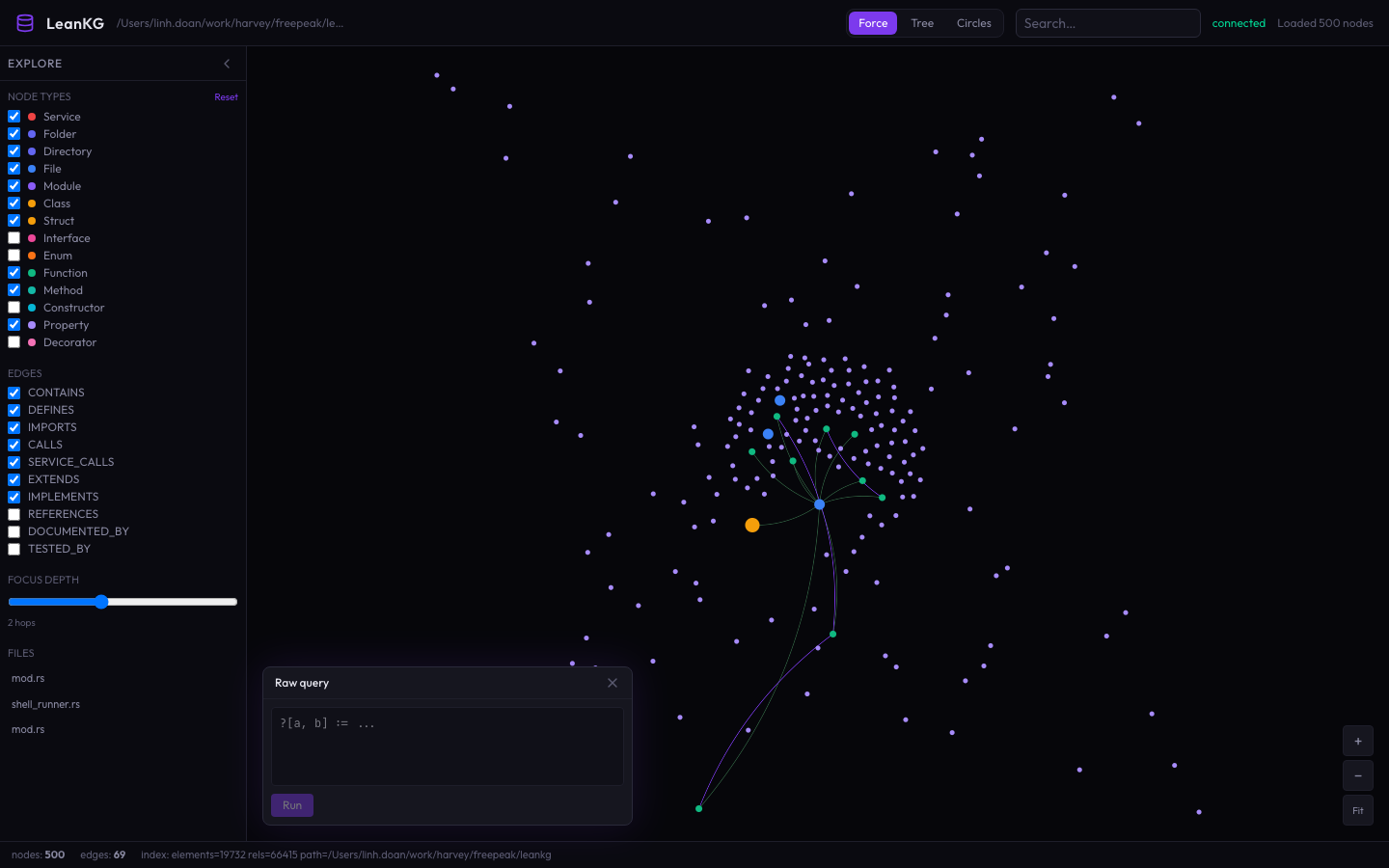
UI v2 uses the GitNexus web exploring shell (layout modes, 3-pane chrome, Sigma) with LeanKG’s REST graph API.
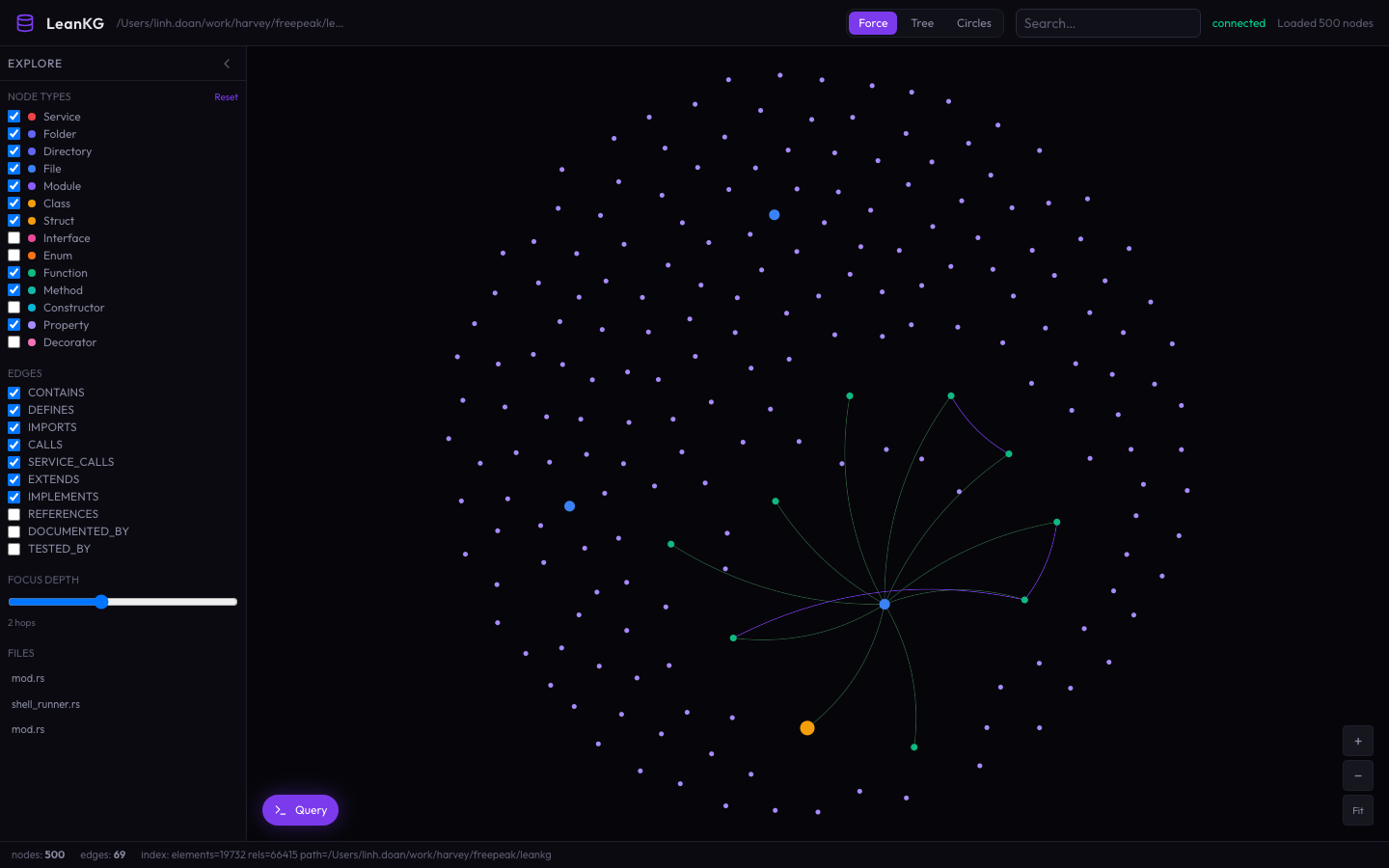
UI v2 — Force layout (Sigma), filters, and status bar against leankg serve.
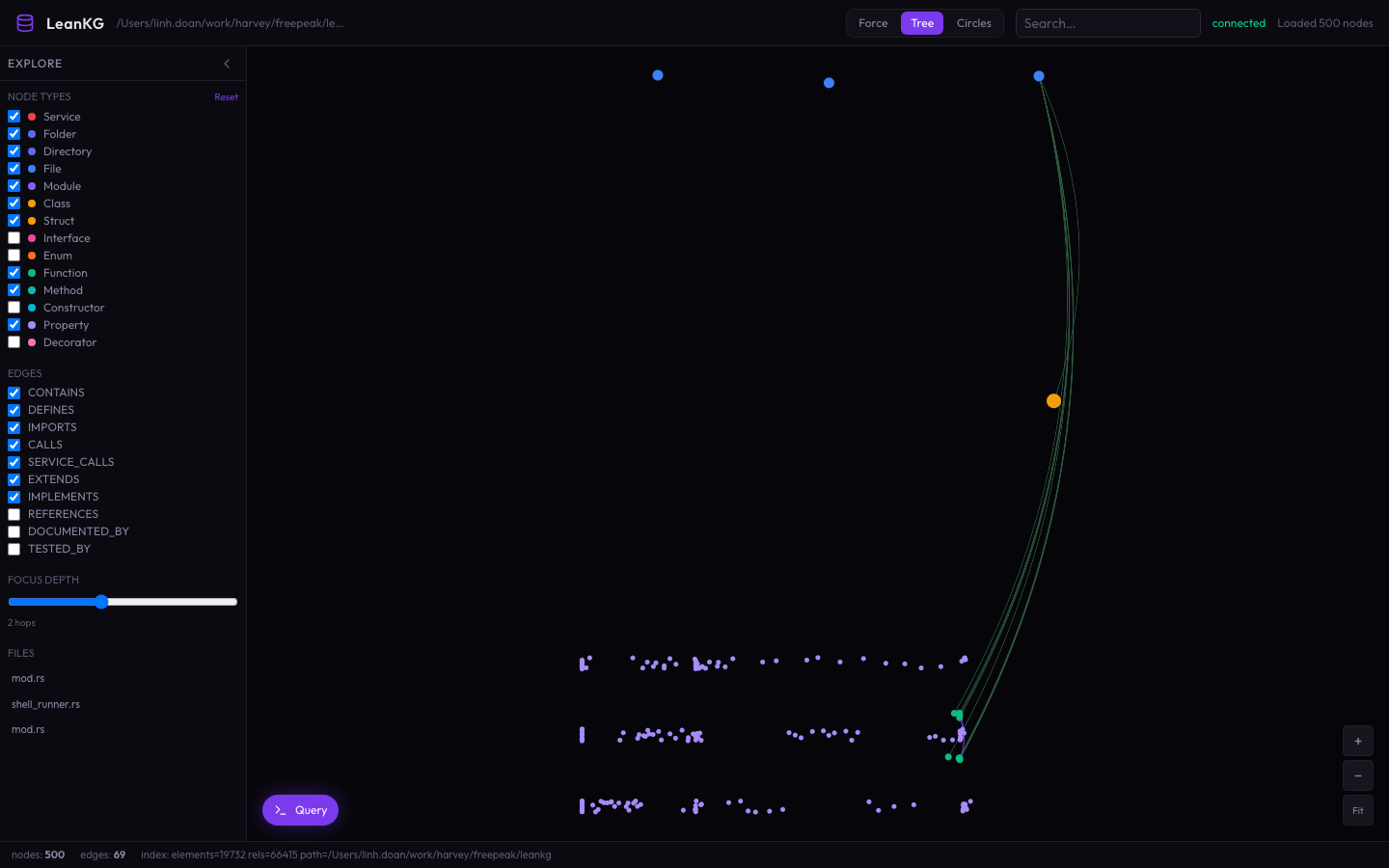
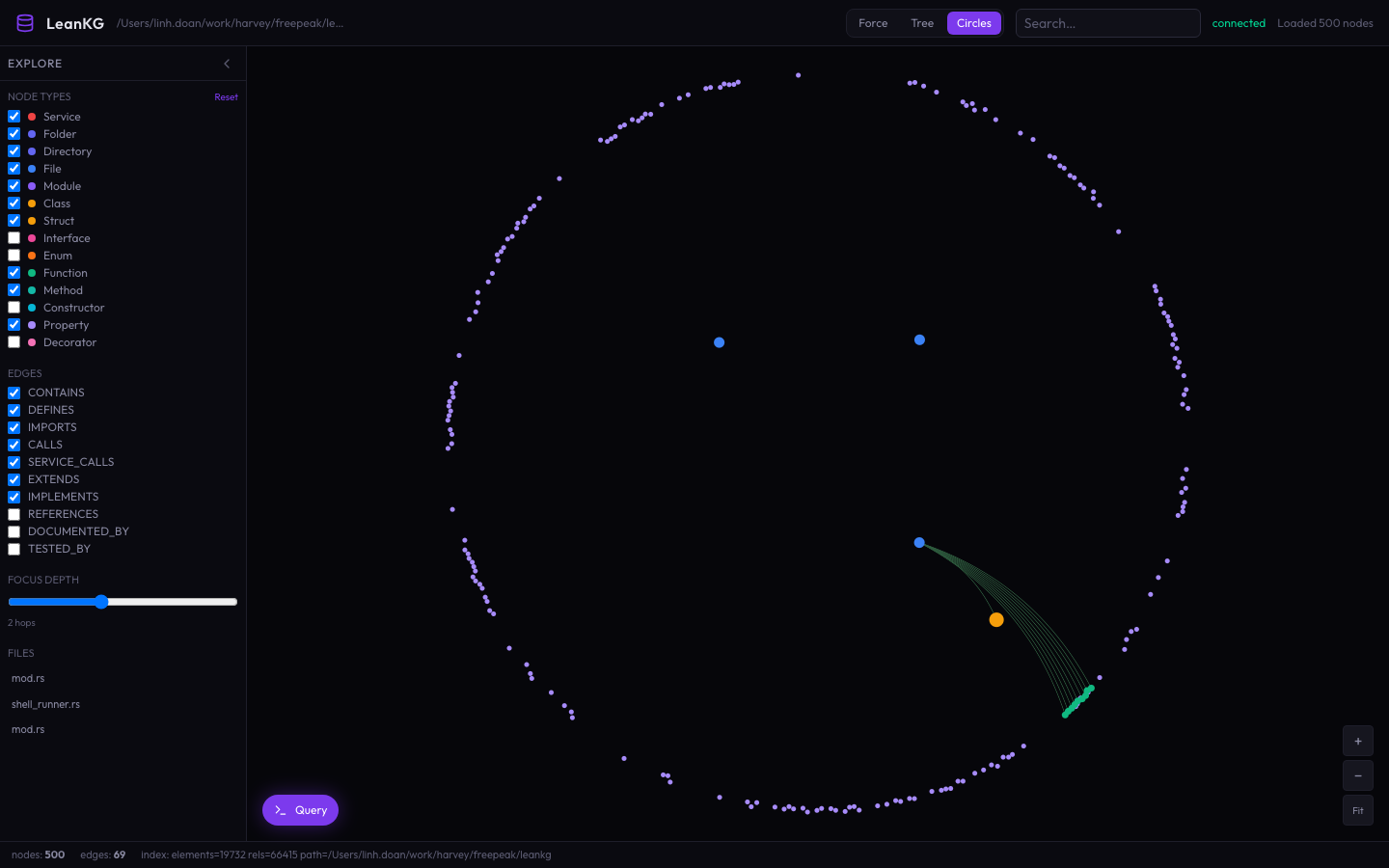
Tree and Circles layouts on the same subgraph.
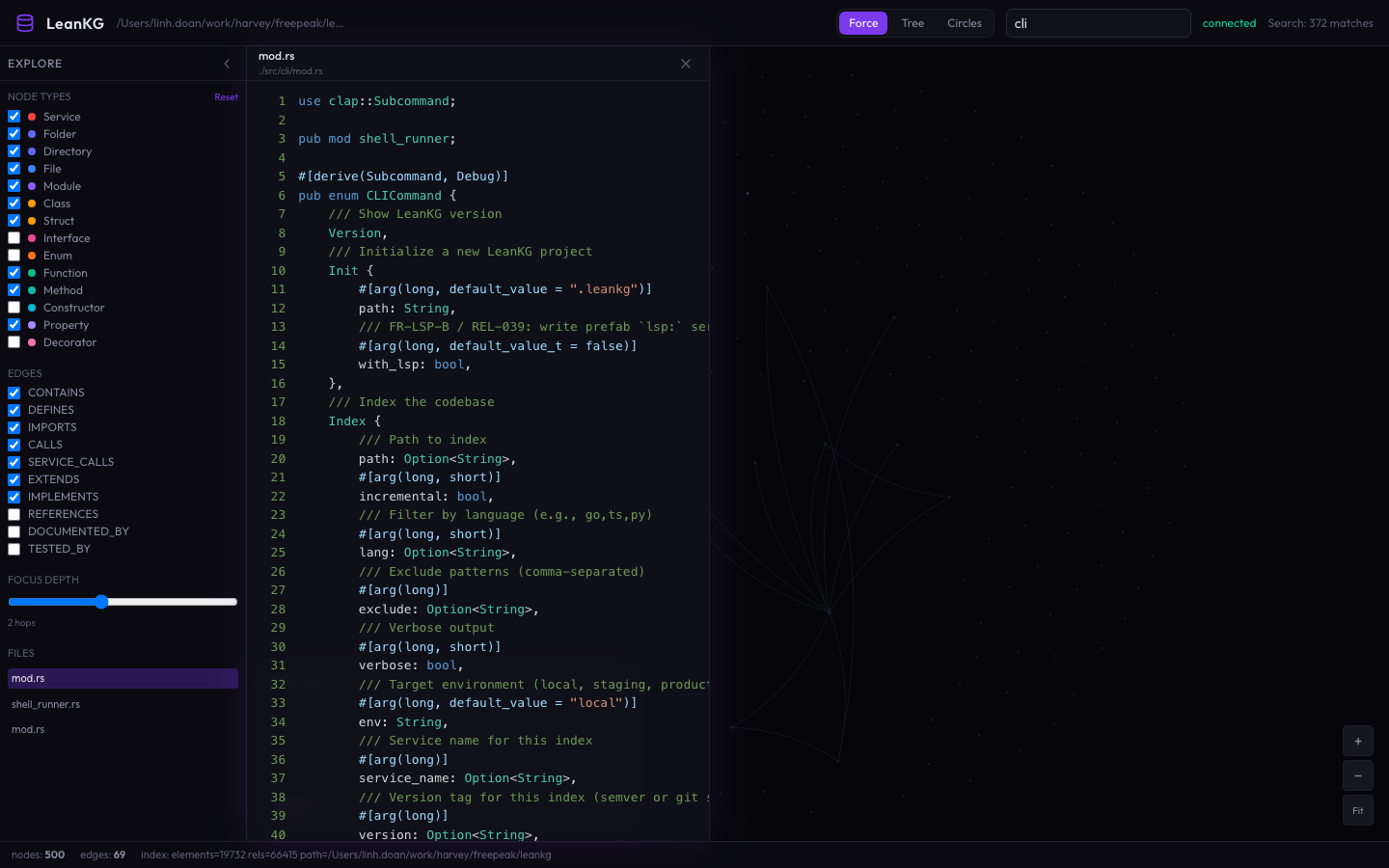
Node select opens syntax-highlighted source via /api/file.
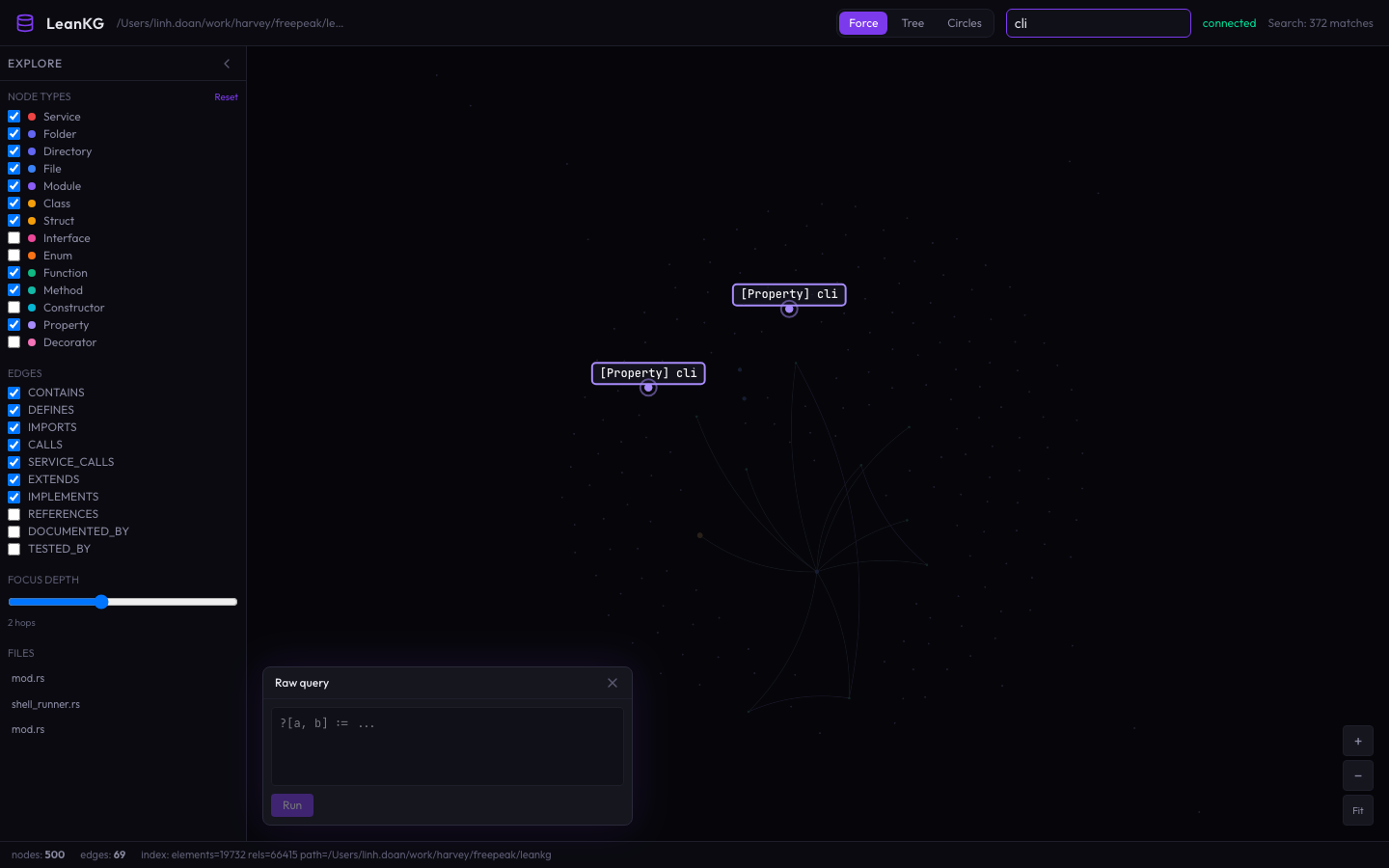
Header search (/api/search) and Query FAB (/api/query).
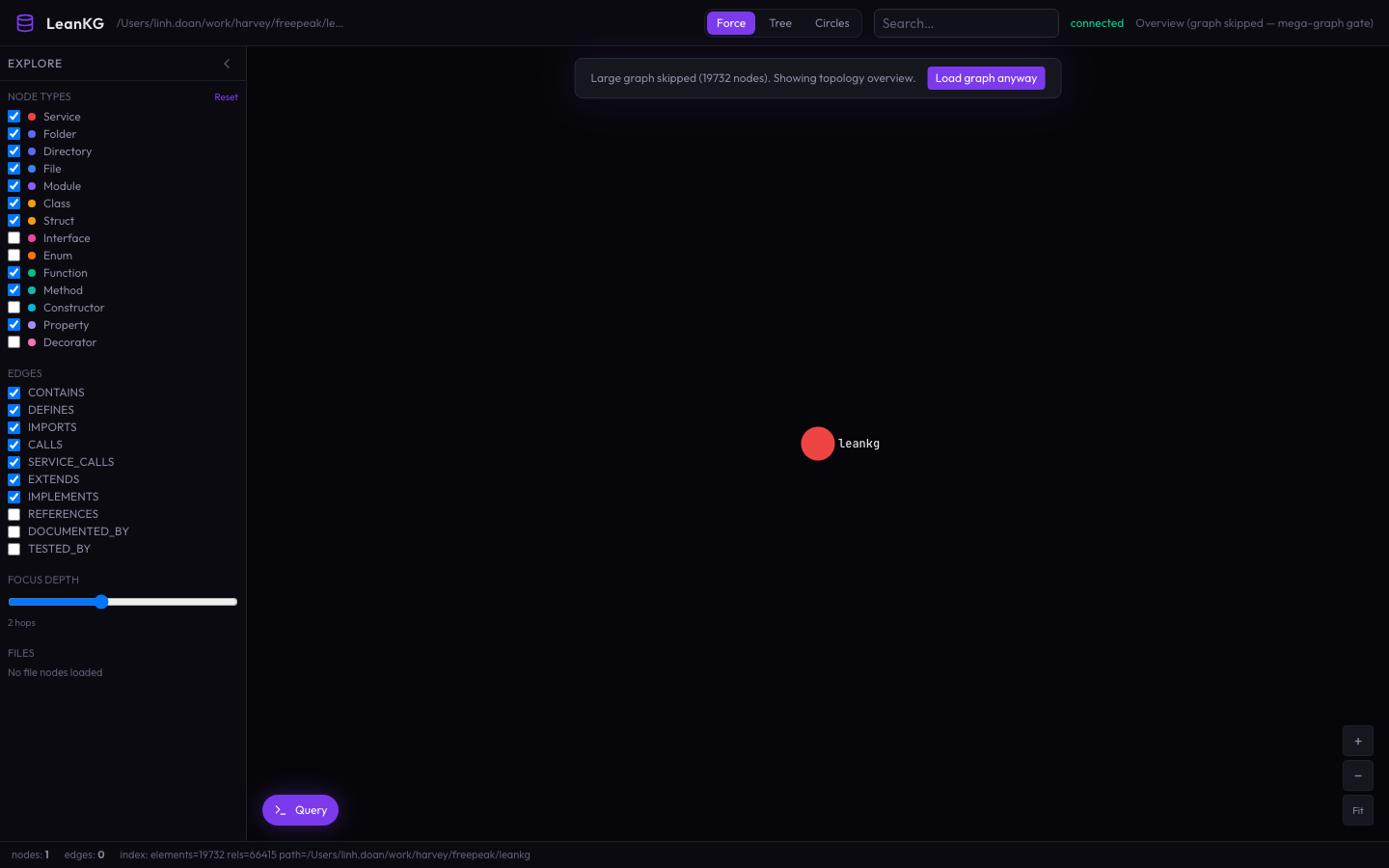
Mega-graph skip gate with “Load graph anyway”.
CodeElement nodes and typed relationships.get_impact_radius, search_code, semantic_search, get_architecture.--watch and incremental index keep code edges fresh; ontology YAML watch keeps procedural workflows aligned.Repo ──► Indexer ──► Knowledge Graph ──► MCP Tools ──► AI Agent
│ │
└─ embeddings ─┘ (optional)
| Agent | Auto-setup | Notes |
|---|---|---|
| Cursor | Yes | Per-project install; always-on graph-first rule + session hook; skill using-leankg |
| Claude Code | Yes | Plugin + full lifecycle hooks (PreToolUse nudge) |
| OpenCode | Yes | Plugin + skill |
| Gemini CLI | Yes | MCP + skill / agent docs |
| Codex / Antigravity / Kilo | Yes | MCP + skill / agent docs |
| Docker MCP HTTP | Yes | Shared RocksDB; multi-repo mounts |
curl -fsSL https://raw.githubusercontent.com/FreePeak/LeanKG/main/scripts/install.sh | bash -s -- cursor
leankg mcp-stdio --watch     # local AI tools
leankg mcp-http --port 9699  # HTTP/SSE for Docker / remote
When :9699 health is OK, for fuzzy / NL / “where is X?” questions discover first — do not open with query_graph:
get_overview_context → mcp_status → concept_search → semantic_search → search_code / find_function → then connection verbs → get_context / impact / deps.
| Question type | First tools |
|---|---|
| Fuzzy / meaning / domain NL | concept_search → semantic_search → search_code |
| Exact symbol / file name | find_function / search_code / query_file |
| How A↔B? (known endpoints) | shortest_path |
| What is this known symbol? | explain_node |
| Expand subgraph after seeds | query_graph (after semantic/concept hits) |
Docker MCP: pass container project= (/workspace); override with LEANKG_MCP_PROJECT.
While mcp-http / mcp-stdio / leankg serve runs, LeanKG watches ontology/concepts.yaml and ontology/workflows.yaml, debounces (≥1s), and replaces the ontology layer in the served DB so kg_trace_workflow stays fresh without a restart.
Typical agent loop:
kg_trace_workflow returns themOntology also refreshes after index, and Docker boot re-syncs when .leankg/ontology_synced is older than either YAML file. Prefer kg_trace_workflow after edits; use ontology_control(action=sync|status) when you need an explicit refresh.
| Knob | Default | Purpose |
|---|---|---|
LEANKG_ONTOLOGY_DIR | <project>/ontology | Override ontology YAML directory |
LEANKG_ONTOLOGY_WATCH_DEBOUNCE_MS | 1500 (min 1000) | Debounce for in-process YAML watch |
LEANKG_ONTOLOGY_SYNC_ON_BOOT | timeout | Docker: skip / force / timeout |
MCP ontology_control | — | action=sync|status (Admin) |
Details: docs/mcp-tools.md · Smoke: docs/reports/ontology-proc-auto-smoke-2026-07-21.md
Setup details: docs/agentic-instructions.md · Skill: instructions/using-leankg/SKILL.md · Tool catalog: docs/mcp-tools.md
Structural extraction and cross-file edges into one graph (no per-language product setup):
| Family | Languages / formats |
|---|---|
| Systems | Rust, Go, C / C++* |
| JVM | Java, Kotlin |
| Web | TypeScript, JavaScript |
| Scripting | Python, Ruby*, PHP* |
| Mobile | Dart, Android XML |
| Infra | Terraform, CI YAML |
*Depth varies by extractor maturity — see the PRD / roadmap for parity status.
leankg init
leankg index ./src
leankg status
leankg impact <file> --depth 3
leankg path <from> <to>
leankg explain <symbol>
leankg graph-query "<question>"
leankg detect-clusters
leankg embed --init && leankg embed   # needs --features embeddings
leankg web
leankg mcp-stdio --watch
leankg mcp-http --port 9699
leankg ontology sync                  # concepts + workflows → DB
leankg ontology trace <workflow>      # ordered procedural steps
leankg update
Full CLI: docs/cli-reference.md
| Doc | Description |
|---|---|
| docs/cli-reference.md | All CLI commands |
| docs/mcp-tools.md | MCP tool reference |
| docs/agentic-instructions.md | AI tool setup & auto-trigger |
| docs/architecture.md | System design & data model |
| docs/web-ui.md | Web UI |
| docs/benchmark.md | Benchmark methodology |
| src/embeddings/EMBEDDINGS.md | Embeddings / HNSW internals |
| INSTRUCTION.md | Memory tuning & ops playbook |
| docs/roadmap.md | Roadmap |
| AGENTS.md | Agent / Docker deployment notes |
| Issue | Fix |
|---|---|
| High RAM on macOS | export LEANKG_MMAP_SIZE=134217728 and LEANKG_CACHE_MAX_TOKENS=100000 — see INSTRUCTION.md |
database is locked | leankg proc kill (stop web/MCP before re-index) |
| Embeddings / cold embed | src/embeddings/EMBEDDINGS.md |
| MCP “not initialized” in Docker | Pass container project= paths (e.g. /workspace), not the host Mac path — see AGENTS.md |
Issues and PRs are welcome. For larger changes, open an issue first so we can align on design.
docs/prd.md / task tracker as needed)cargo build --release && cargo testRun Claude Code as an MCP server so any agent can delegate coding tasks to it
 @microsoft✓ Official
Browser automation using accessibility snapshots instead of screenshots
 @googleapis✓ Official
Google's universal MCP server supporting PostgreSQL, MySQL, MongoDB, Redis, and 10+ databases
 @github✓ Official
Official GitHub integration for repos, issues, PRs, and CI/CD workflows