

Are you the author? Sign in to claim
Advanced MCP server for unified knowledge management with PostgreSQL+pgvector, knowledge graphs, research workflows, and
lore-knowledge-mcp · Operational knowledge layer for engineering teams and their AI agents.





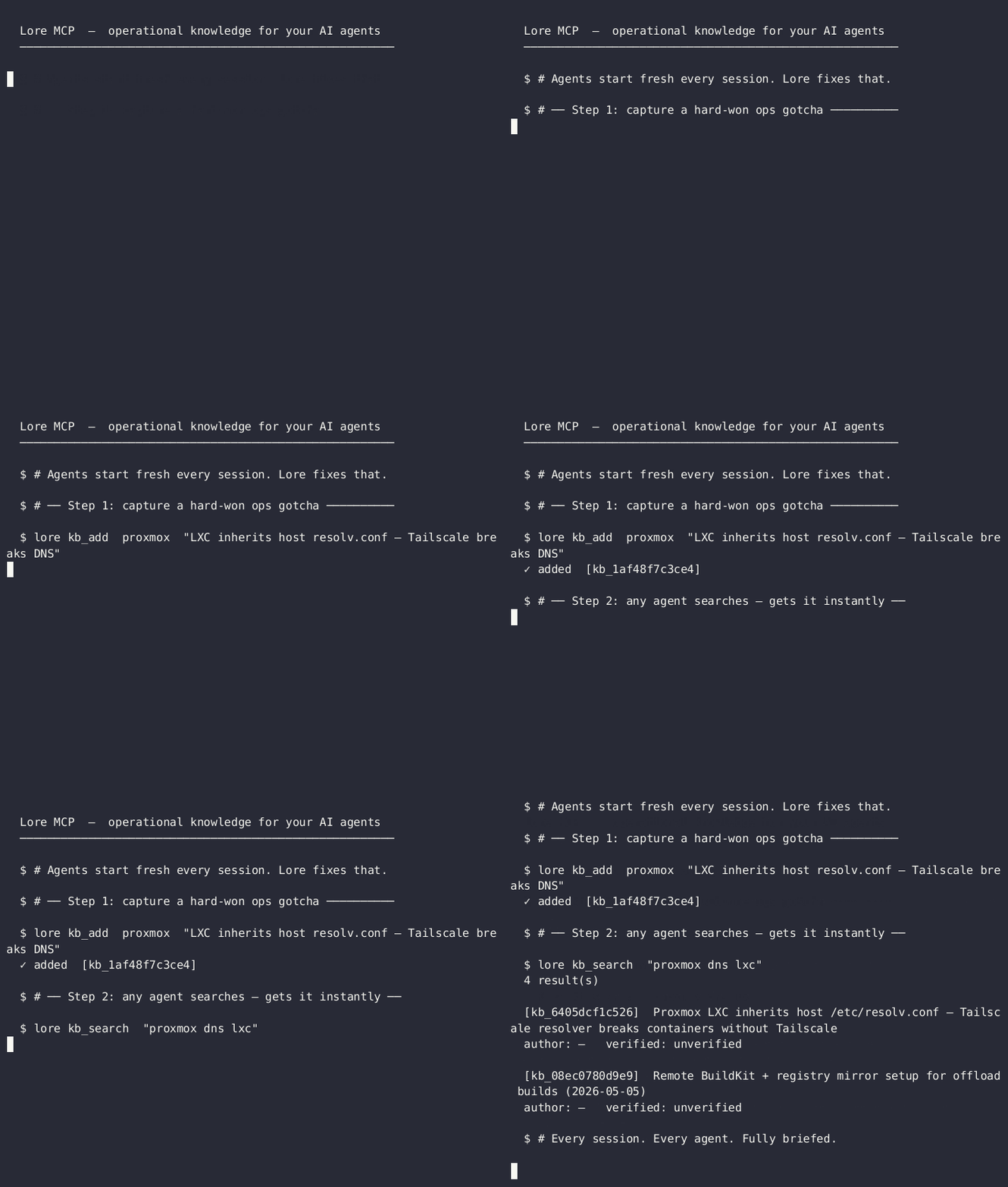
Your agents start every session knowing nothing about your systems. Every runbook you've written. Every gotcha you've hit. Every incident you've debugged. None of it carries forward.
You re-explain. They re-discover. Context vanishes when the session ends.
Lore fixes that.
Without Lore                     With Lore
─────────────────────────────    ──────────────────────────────────
Agent starts fresh every time    Agent queries Lore on startup
"How does our infra work?"       Gets: topology, gotchas, runbooks,
You re-explain everything        past incidents, verified decisions
Context lost at session end      Knowledge persists across all sessions
| Tool | Built for | What it remembers | Agent-native |
|---|---|---|---|
| OB1 / personal memory | One person | Your thoughts and captures | No |
| Mem0 / Zep | App developers | User preferences, conversations | Partially |
| Confluence / Notion | Human teams | Documentation (human-browsed) | No |
| Lore | Engineering teams + AI agents | How your systems actually work — searchable by meaning, not just keywords | Yes |
Lore is not a second brain. It's the operational intelligence your agents need to work in your environment — not just any environment.
Your team's operational knowledge — always queryable by any agent. Capture the things that matter: runbooks, hard-won gotchas, architecture decisions, deployment state. Every entry carries attribution so agents know who wrote it and whether a human has verified it.
When something breaks, open a structured investigation. Document the symptom, test hypotheses, record what you tried and what you found. Six months later when the same issue resurfaces — different engineer, different agent — the trail is there.
A permanent record of milestones, architecture decisions, and buying decisions. The kind of thing that lives in someone's head until they leave the team.
In a multi-agent environment, provenance matters. Every Lore entry carries author, source_type, and verified.
kb_search("proxmox lxc dns")

  [1] "LXC inherits host resolv.conf — Tailscale breaks containers"
      david · human · ✓ verified

  [2] "LXC DNS fix after Tailscale install"
      engineer-agent · agent · unreviewed

  [3] "LXC DNS configuration reference"
      research-agent · agent · ✗ disputed
Your agents know: result 1 is production-safe. Result 2, spot-check before acting. Result 3, review first.
Lore finds entries by meaning, not just keywords. Search "DNS broken in containers" and it returns an entry titled "LXC containers inherit resolv.conf from the host" — no keyword overlap required.
Powered by local sentence-transformers embeddings (no API key, no external calls), combined with lexical full-text search and Reciprocal Rank Fusion. The same model used by mcp-memory-service, fully self-hosted. On SQLite the lexical leg uses FTS5; on PostgreSQL it uses a GIN full-text index plus pgvector for the semantic leg.
pip install lore-knowledge-mcp[semantic]
LORE_SEMANTIC_SEARCH=true lore-mcp
kb_search resolves its mode from (in order): an explicit search_mode/semantic/hybrid argument, then LORE_SEARCH_MODE_DEFAULT, then the built-in default of hybrid. Every search response echoes requested_mode (the caller's intent) alongside search_mode (the mode actually executed, after any degradation).
| Mode | When to use |
|---|---|
fts | Exact term matches. |
semantic | Meaning-based retrieval, no keyword overlap needed. |
hybrid | Best of both — lexical + vector via RRF (default). |
The
summarymode was removed — passingsearch_mode="summary"now returns a validation error. Lore is LLM-free by design; summarisation is the caller's responsibility.
If you already have entries, generate embeddings for them:
kb_backfill_embeddings()    # idempotent, safe to re-run
kb_embedding_status()       # check coverage
| Variable | Default | Notes |
|---|---|---|
LORE_SEMANTIC_SEARCH | false | Master switch — off = lexical-only behaviour. |
LORE_SEARCH_MODE_DEFAULT | hybrid | Default mode for kb_search when no mode is passed (fts, semantic, or hybrid). |
LORE_EMBEDDING_MODEL | all-MiniLM-L6-v2 | 384d, ~90MB, English-optimized. |
LORE_RRF_K | 10 | Increase to 30–60 for corpora >10k entries. |
For multilingual content, set LORE_EMBEDDING_MODEL=paraphrase-multilingual-MiniLM-L12-v2 (same 384d, no schema change).
Lore can extract durable memories from agent conversations automatically. At the end of a session, conversation turns are sent asynchronously to a fast LLM, which extracts facts, preferences, goals, events, and system facts — then deduplicates them against the existing KB before writing.
auto_extract.enabled: false).source:auto-extracted, with an optional review queue (topic="auto-memory-pending") for human approval.Set OPENROUTER_API_KEY (or CEREBRAS_API_KEY) and enable it in your plugin config.
→ Full setup guide: docs/auto-extraction-setup.md — API keys, provider config, tuning thresholds, review mode, and inspecting or removing extracted entries.
Add one line to every agent's system prompt and one entry to ~/.mcp.json — that's the entire integration. Each phase of your engineering workflow reads prior knowledge from Lore and writes its findings back, so nothing is re-discovered from scratch.
→ How to wire Lore into a 6-phase multi-agent pipeline — full walkthrough with code examples for every phase: research, architecture review, implementation, adversarial code review, QA, and documentation.
No database setup required. Lore runs out of the box with SQLite.
pip install lore-knowledge-mcp
pip install lore-knowledge-mcp[semantic]
Then set LORE_SEMANTIC_SEARCH=true. See Semantic Search for details.
# Stdio mode (for local MCP clients like Claude Code)
lore-mcp

# HTTP mode (for remote or multi-agent access)
lore-mcp --host 0.0.0.0 --port 8000

# HTTP mode WITH authentication (recommended for teams / LAN exposure)
LORE_API_KEY="$(openssl rand -hex 32)" lore-mcp --host 0.0.0.0 --port 8000
LORE_API_KEY)HTTP auth is opt-in and off by default:
LORE_API_KEY unset → the HTTP server is open (no auth), exactly as
before. This keeps existing no-auth deployments working. When you bind to a
non-localhost host (0.0.0.0 or a LAN IP) without a key, Lore logs a
prominent startup WARNING that the server is reachable on your network
with no authentication.LORE_API_KEY set → every HTTP/SSE request must include
Authorization: Bearer <key>. Missing or wrong tokens get
401 {"error":"unauthorized"} (token compared in constant time). Health
endpoints (/health, /healthz, /) stay open so liveness probes keep
working. stdio mode is never affected — it has no network surface.The same rule applies to the HTTP entry point (lore-mcp --host/--port,
which invokes the FastMCP server).
CORS: origins default to * with credentials disabled (the spec forbids
* + credentials). Set LORE_CORS_ORIGINS to a comma-separated allow-list
(e.g. https://app.example.com,https://admin.example.com) to restrict origins;
credentialed CORS is enabled automatically when origins are explicit.
Claude Code / Claude Desktop — add to ~/.mcp.json:
{
  "mcpServers": {
    "lore": {
      "type": "stdio",
      "command": "lore-mcp"
    }
  }
}
Or for HTTP mode (recommended for teams). When the server is started with
LORE_API_KEY set, include a matching bearer token in the client config:
{
  "mcpServers": {
    "lore": {
      "type": "http",
      "url": "http://localhost:8000/mcp",
      "headers": {
        "Authorization": "Bearer <your LORE_API_KEY>"
      }
    }
  }
}
If the server is started without LORE_API_KEY, omit the headers block — the
endpoint is open.
That’s it. Lore is ready.
| Tool | What it does |
|---|---|
kb_add | Add an entry. Accepts author, source_type for attribution. |
kb_search | Semantic / hybrid / FTS search with optional topic filter. |
kb_get | Fetch full entry by ID. |
kb_get_batch | Fetch multiple entries by ID in a single call (re-keyed by kb_id). |
kb_list | List entries, filter by topic. |
kb_update | Update content, tags, or set verified flag. |
kb_delete | Delete entry (requires confirm=true). |
kb_backfill_embeddings | Generate embeddings for existing entries (idempotent). |
kb_embedding_status | Report embedding coverage across the KB. |
| Tool | What it does |
|---|---|
investigation_add | Open or add to an investigation. |
investigation_list | List investigations, filter by topic. |
investigation_get | Fetch full investigation by ID. |
investigation_log_experiment | Log a structured hypothesis → result → conclusion. |
investigation_list_experiments | List all logged experiments. |
investigation_delete_note | Hard-delete a note (requires confirm=true; production guard). |
investigation_delete_experiment | Hard-delete an experiment (requires confirm=true; production guard). |
| Tool | What it does |
|---|---|
journal_append | Add a milestone, decision, or reflection. |
journal_list | List recent entries (default 20). |
journal_get | Fetch entry by ID. |
journal_delete | Hard-delete an entry (requires confirm=true; production guard). |
snapshot_config | Snapshot a config object to the journal. |
| Tool | What it does |
|---|---|
kb_ingest_doc | Ingest a markdown file into the KB (strategy: full or chunked). |
kb_ingest_dir | Batch-ingest a directory, with change detection. |
kb_sync_status | Check what's changed since last sync. |
| Tool | What it does |
|---|---|
mcp_index_scan | Scan all configured MCP servers and index their tools. |
mcp_index_search | Search indexed tools by description. |
mcp_index_get_server | Get all tools for a specific MCP server. |
mcp_index_rebuild | Force a full rescan. |
| Tool | What it does |
|---|---|
multi_search | Search across KB, investigations, journal, and transcripts at once. |
search_local | Search local files by content. |
search_transcripts | Search Whisper transcript segments. |
deduplicate_results | Deduplicate a result set by similarity threshold. |
cluster_results | Cluster results by topic. |
| SQLite | PostgreSQL | |
|---|---|---|
| Setup required | None | Existing PostgreSQL instance |
| Best for | Solo developers, local use | Teams, shared agents, production |
| Config | DB_BACKEND=sqlite (default) | DB_BACKEND=postgres + connection vars |
| Data location | ./knowledge-data/ (override with KNOWLEDGE_DATA_DIR) | Your database |
| Semantic search | sqlite-vec + FTS5 | pgvector + GIN full-text index |
SQLite is the default. No configuration needed — just install and run. The
SQLite database and any local-file search corpus live under
KNOWLEDGE_DATA_DIR, which defaults to ./knowledge-data (a portable, relative
path — set it to an absolute path for a stable on-disk location).
PostgreSQL is for teams who want a shared knowledge layer accessible from
multiple machines or agents simultaneously. DB_BACKEND=postgres (and the
postgresql alias) select the bundled local PostgreSQL client — the same path
as DB_BACKEND=local. Connection defaults are generic (DB_NAME=lore,
DB_USER=lore_user); override them with the connection variables below. On
PostgreSQL, hybrid search uses a combined title+content GIN full-text index for
the lexical leg and pgvector for the semantic leg.
# PostgreSQL setup
export DB_BACKEND=postgres          # "postgresql" and "local" also work
export DB_HOST=your-db-host
export DB_PORT=5432
export DB_NAME=lore                 # default: lore
export DB_USER=your-user            # default: lore_user
export DB_PASSWORD=your-password
lore-mcp
| Env var | Default | Purpose |
|---|---|---|
DB_BACKEND | sqlite | sqlite, postgres/postgresql/local, or supabase. |
KNOWLEDGE_DATA_DIR | ./knowledge-data | Root for the SQLite DB and local-file search. Portable by default — no /srv paths. |
DB_NAME | lore | PostgreSQL database name. |
DB_USER | lore_user | PostgreSQL user. |
LORE_SEMANTIC_SEARCH | false | Master switch for semantic/hybrid search (requires the [semantic] extra). |
LORE_SEARCH_MODE_DEFAULT | hybrid | Default kb_search mode when none is passed (fts, semantic, hybrid). |
OPENROUTER_API_KEY | (unset) | API key for automatic memory extraction via OpenRouter. See Automatic Memory Extraction. |
CEREBRAS_API_KEY | (unset) | API key for automatic memory extraction via the Cerebras direct API. |
LATVIAN_LEARNING_ROOT | (unset) | Optional corpus root for search_local. Unset → that source is skipped. |
LATVIAN_XTTS_ROOT | (unset) | Optional transcript root for search_transcripts. Unset → returns a clean "not configured" result. |
INGEST_ROOT | (unset) | Optional corpora root for search_corpora. Unset → returns a clean "not configured" result. |
LORE_API_KEY | (unset) | Opt-in HTTP auth. Set → require Authorization: Bearer <key> on HTTP/SSE requests (401 otherwise). Unset → HTTP is open (and a warning is logged on non-localhost binds). stdio is never affected. |
LORE_CORS_ORIGINS | * | Comma-separated CORS allow-list. * (default) disables credentials per the CORS spec; explicit origins enable credentialed CORS. |
The deployment-specific search roots (LATVIAN_LEARNING_ROOT,
LATVIAN_XTTS_ROOT, INGEST_ROOT) are unset by default. When a root is not
configured, the dependent search tool returns an empty, clearly-labelled "not
configured" result instead of scanning a nonexistent path — so a fresh install
works out of the box.
A Hermes agent memory provider plugin that backs conversation memory with Lore is available as a separate package:
hermes-lore-plugin — drop-in memory provider for the Hermes agent. Stores KB entries in Lore, prefetches relevant context on session start, and deduplicates before storing. It also drives the automatic memory extraction pipeline.
MIT — see LICENSE
 @googleapis✓ Official
Google's universal MCP server supporting PostgreSQL, MySQL, MongoDB, Redis, and 10+ databases
Official MongoDB integration — query collections, run aggregations, inspect schemas
 @designcomputer
Secure MCP server for MySQL database interaction, queries, and schema management
Run Claude Code as an MCP server so any agent can delegate coding tasks to it