

Are you the author? Sign in to claim
Encrypted, bidirectional local memory for your Claude Code Telegram bot — captures both sides at the plugin source, reca

Your Claude Code Telegram bot — but it remembers.

📖 Read the story — why inbound Telegram messages skip every hook
中文版 → README.zh-TW.md
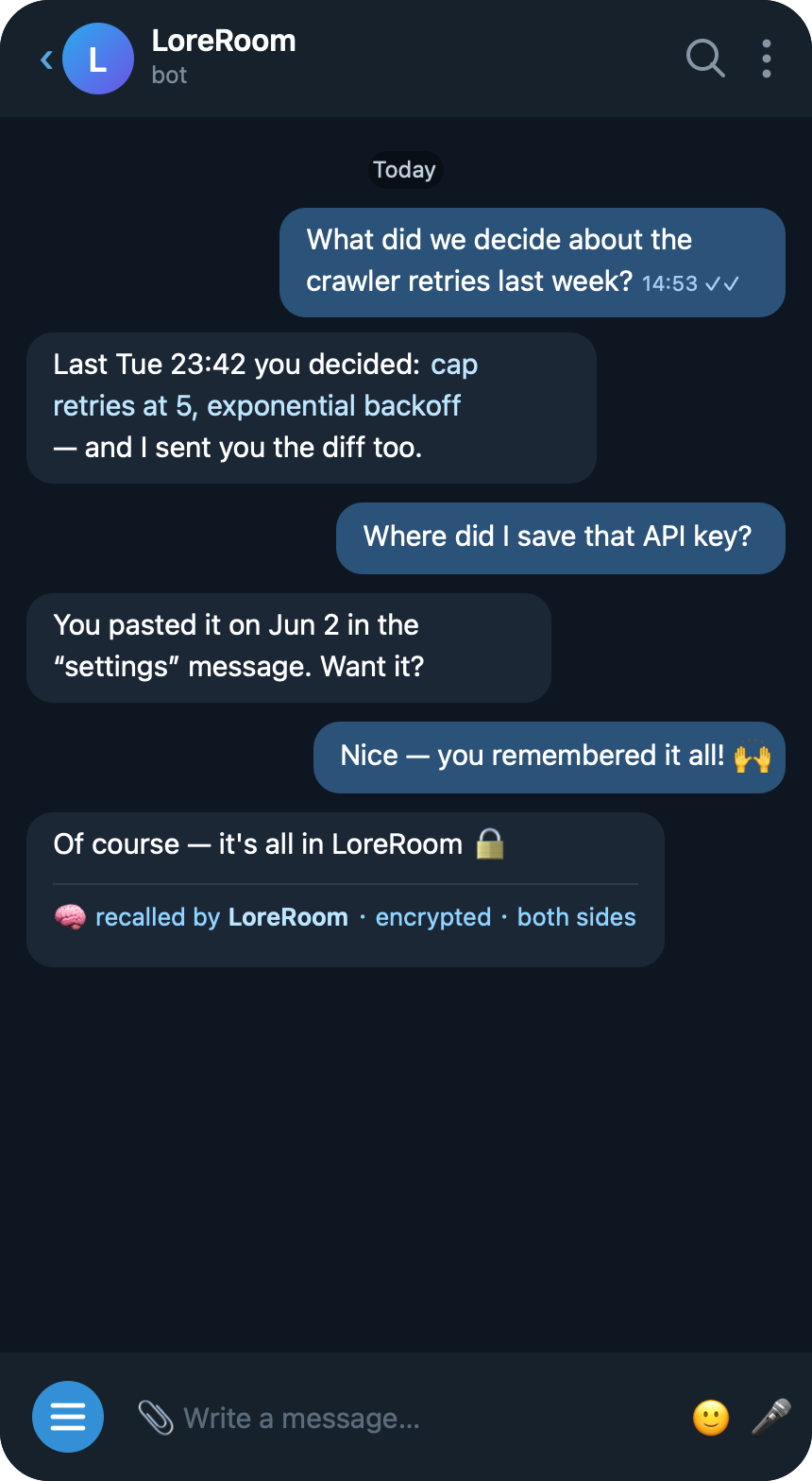
A private, encrypted room that remembers every conversation with your Claude Code Telegram bot — both sides — so it never forgets.
You chat with Claude Code from your phone through the official Telegram plugin. But every Claude Code session is amnesiac: restart it and the whole conversation is gone. LoreRoom captures both sides of that Telegram conversation into a single, whole-file-encrypted SQLite database and hands it back to Claude as searchable memory.
So you can ask your bot:
You: what did I ask you to do last night? Bot: (searches LoreRoom) You asked me to fix the crawler retry logic and send you the diff…
Local-first. No cloud, no extra API keys, it never touches your bot token.
The Claude Code Telegram plugin delivers your incoming messages to Claude through an internal channel push — not through any hook. Worse, when Claude is busy those messages queue invisibly, and if the bot never replies they're simply gone. So the obvious approaches (hooks, reading the transcript) silently lose your messages.
LoreRoom captures at the plugin's source, the instant a message arrives from Telegram:
Both are written to a small spool file that an ingester drains into the encrypted database. Nothing is lost — even when your bot is unresponsive. (Messages that were stuck while the bot was busy get captured the moment it restarts and re-fetches them.)
No Claude Code hooks are used, so LoreRoom never interferes with your other Claude Code work.
You ⇄ Telegram ──(patched plugin)──> spool ──(ingester)──> encrypted SQLite (SQLCipher + FTS5)
                  captures in + out      drained on a timer        ▲
                                                                   │ MCP server
                                                          get_recent_context · search_tg_history
                                                                   │
                                                            Claude recalls — both sides, with time & sender
LoreRoom adds memory to an existing Claude Code Telegram bot. So you first need that bot working. If you can already chat with your bot from Telegram, skip to Install. Otherwise, set this up once (~5 minutes):
1. Node.js 20 or newer. Check with node -v. If missing, get it from nodejs.org.
2. Claude Code — Anthropic's command-line tool. See the install guide.
3. A Telegram bot connected to Claude Code:
/newbot, follow the prompts, and copy the bot token it gives you (a long string)./telegram:configure <your-bot-token>./telegram:access pair <code> in Claude Code.claude --channels plugin:telegram@claude-plugins-official, then send your bot "hi" in Telegram. It should reply.Once "hi" gets a reply, your bot works. Now give it memory with LoreRoom 👇
Scope: LoreRoom only works with Claude Code + the official Telegram plugin (it is not a general Telegram bot framework). It captures by patching the plugin — one idempotent command you re-run after plugin updates. See Why patch the plugin.
git clone https://github.com/fenghaochang/LoreRoom.git && cd LoreRoom
npm install
npm run build
node dist/cli.js init        # creates config.json + a fresh encryption key, prints the next steps
node dist/patch-plugin.js    # patches the Telegram plugin to capture in + out
# register the recall server (it also auto-drains the spool):
claude mcp add --scope user loreroom -- "$(command -v node)" "$PWD/dist/mcp-server.js"
Then restart your bot session (claude --channels …) so it loads the patched plugin. Done — every Telegram message is now captured automatically.
Node version note: the encrypted-SQLite native module is ABI-bound to one Node version, and
initpins the exactnodethat ran it. If you later upgrade or remove that Node, re-runnpm install && npm run buildand re-register.
get_recent_context with hours: 1 — you'll see your message with the correct time and sender, even if the bot never replied.search_tg_history for a keyword from that message — it comes back.Nothing to do — that's the point. Once it's set up, just chat with your bot normally. Every message, both yours and the bot's, is saved automatically.
When you want it to remember something, just ask in plain language:
"what did we decide about the database yesterday?" "what did I send you last night?" "find where I mentioned the API key"
The bot searches its own memory and answers. You never run a command — it calls the search tools for you behind the scenes.
Two things to keep in mind:
claude --channels …). If it stops, restart it — messages that arrived while it was down are captured when it comes back.node dist/patch-plugin.js once to re-apply the patch (it's a no-op if already patched).There is no hook and no on-disk record for inbound Telegram messages, so the only reliable capture point is inside the plugin itself. The patch is tiny — a helper plus two one-line calls at the plugin's inbound and outbound choke points — and idempotent (running it twice is a no-op). Plugin updates overwrite it, so re-run node dist/patch-plugin.js after an update.
Everything LoreRoom owns lives inside this project folder:
config.json — your settings + encryption key (git-ignored, chmod 600, created by init)data/memory.sqlite — the encrypted database (git-ignored)The spool is a short-lived plaintext file in the plugin's own ~/.claude/channels/telegram/ state dir (mode 0700), drained continuously and deleted.
config.json)| Key | Meaning |
|---|---|
dbPath | DB location. Relative paths resolve inside the project (default data/memory.sqlite). |
encryptionKey | 64-char hex (32 bytes). node -e "console.log(require('crypto').randomBytes(32).toString('hex'))". |
spoolPath | Spool the plugin writes (default ~/.claude/channels/telegram/loreroom-spool.jsonl; must match the plugin state dir). |
capture.chatAllow / chatDeny / skipPatterns | Optional filters. Default [] = capture everything (both sides, including repeated/automated messages). |
The MCP server drains on startup, every 20s, and before each query — so whenever any Claude Code session is open, capture flows into the DB automatically. For draining independent of sessions:
node dist/cli.js ingest   # drain once
node dist/cli.js watch    # drain continuously (good for launchd/cron)
get_recent_context({ hours, chat_id? }) — messages from the last N hours.search_tg_history({ keyword, chat_id? }) — full-text search across all history (FTS5 trigram, works for CJK; LIKE fallback for short keywords).Both return each hit with timestamp, sender, role, chat id, and text.
config.json (git-ignored, chmod 600) — never committed, never logged.data/memory.sqlite to another machine is useless without the key.patch-plugin).sqlite-vec layer could add it without breaking the single-file design).MIT
 @googleapis✓ Official
Google's universal MCP server supporting PostgreSQL, MySQL, MongoDB, Redis, and 10+ databases
Official MongoDB integration — query collections, run aggregations, inspect schemas
 @designcomputer
Secure MCP server for MySQL database interaction, queries, and schema management
Run Claude Code as an MCP server so any agent can delegate coding tasks to it