

Are you the author? Sign in to claim
mcp-advanced-starter
A notes server built to exercise every advanced feature of the Model Context Protocol.
Follow-up project for Anthropic Academy's Model Context Protocol: Advanced Topics course.
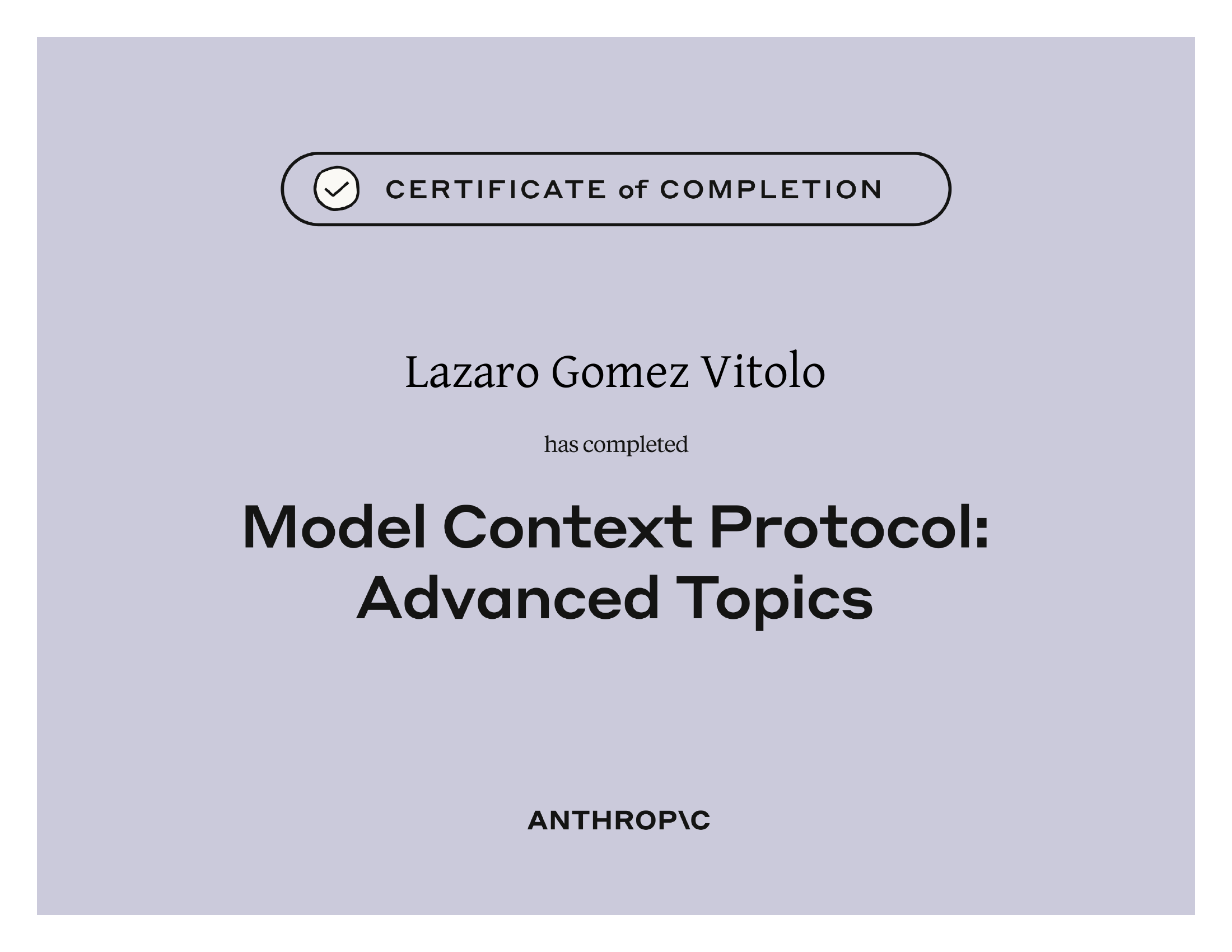
DevNotes is a small, in-memory notes server — think a minimal Notion, exposed over MCP instead of a web UI. It's deliberately not trying to be a real product; every tool exists to be a clean, runnable example of one specific advanced MCP feature, and the notes themselves are just the excuse to have something worth calling a tool on.
| Course topic | Where it lives |
|---|---|
| Sampling — server asks the client's LLM to do the work | summarize-note |
| Elicitation — server pauses to ask the user something | create-note (priority, if omitted) |
| Roots — client grants the server a specific local folder | index-roots |
| Progress & logging notifications | also index-roots, via sendNotification/sendLoggingMessage |
| Pagination | search-notes, cursor-based |
| Structured output | every tool returns structuredContent alongside its text |
| stdio vs. Streamable HTTP transports | stdio.ts / http.ts |
| Resumable transport | eventStore.ts, stateful HTTP mode |
| Stateless transport | http.ts --stateless |
| OAuth 2.1 + PKCE authorization | auth.ts, http.ts --oauth |
flowchart LR
    subgraph client["interactiveClient.ts"]
        cap["declares: sampling, roots, elicitation"]
    end

    subgraph transport["pick one"]
        stdio["stdio.ts"]
        http["http.ts (Streamable HTTP)"]
    end

    subgraph server["createServer.ts"]
        t1["create-note<br/><i>elicitation</i>"]
        t2["search-notes<br/><i>pagination</i>"]
        t3["summarize-note<br/><i>sampling</i>"]
        t4["index-roots<br/><i>roots + notifications</i>"]
        store[("NotesStore<br/>(in-memory)")]
    end

    auth["auth.ts<br/>OAuth 2.1 + PKCE"]
    evt["eventStore.ts<br/>resumability"]

    client <-->|JSON-RPC over stdio or HTTP| transport
    transport --> server
    t1 & t2 & t3 & t4 --> store
    http -. "--oauth protects" .-> auth
    http -. "stateful mode uses" .-> evt
Sampling is the one genuinely bidirectional flow in the demo — the server calls back into whichever process holds the model credentials — so it's worth seeing on its own:
sequenceDiagram
    participant You
    participant Client as interactiveClient.ts
    participant Server as DevNotes server
    You->>Client: summarize-note
    Client->>Server: tools/call
    Server->>Client: sampling/createMessage
    alt ANTHROPIC_API_KEY set
        Client->>Anthropic API: messages.create()
        Anthropic API-->>Client: completion
    else no key configured
        Client->>Client: return a mock completion
    end
    Client-->>Server: CreateMessageResult
    Server-->>Client: tool result (the summary)
    Client-->>You: print it
The server never holds a model API key itself — that's the point of sampling. Only the client in this diagram needs one, and only optionally (see Quick start).
npm install
cp .env.example .env   # optional — see below
Everything runs with zero configuration. .env only matters if you want real Claude
completions for summarize-note instead of a mocked one — set ANTHROPIC_API_KEY there.
Local (stdio) — what Claude Desktop and the MCP Inspector use:
npm run client            # spawns the server itself, opens an interactive prompt
# or, to poke at it directly:
npm run inspector
Remote (Streamable HTTP):
npm run start:http                # stateful, resumable — default
npm run start:http:stateless      # no session id, horizontally scalable
npm run start:http:oauth          # requires a bearer token (see below)
npm run start:http:oauth-strict   # + RFC 8707 resource-indicator enforcement

npm run client:http               # talk to whichever one is running on :3000
Try roots by pointing the client at the bundled example notes:
npm run client -- --root ./examples
# then call index-roots from the prompt
Try the full OAuth flow: run npm run start:http:oauth, then open the MCP Inspector
(npx @modelcontextprotocol/inspector) and connect to http://127.0.0.1:3000/mcp — its
built-in "Connect" flow walks through dynamic client registration, the authorization
redirect, and the PKCE token exchange for you. auth.ts has a header-comment listing
exactly what it does and doesn't do — it's a real OAuth 2.1 authorization server, but an
intentionally minimal one (in-memory storage, no real login screen); the same file explains
what a production deployment needs to add back.
src/
  server/
    createServer.ts     factory: builds one McpServer + registers all four tools
    store.ts             the in-memory NotesStore (create/search/importFromRoot)
    stdio.ts              entrypoint: stdio transport
    http.ts                entrypoint: Streamable HTTP, stateful/stateless/oauth
    auth.ts               demo OAuth 2.1 + PKCE authorization server
    eventStore.ts        in-memory EventStore for resumable HTTP
    tools/
      createNote.ts        elicitation
      searchNotes.ts       pagination
      summarizeNote.ts     sampling
      indexRoots.ts        roots + progress/logging notifications
  client/
    interactiveClient.ts  demo client: implements the handlers a server can call back into
examples/                sample notes for the index-roots demo
assets/                   the certificate this repo is a follow-up to
store.importFromRoot only ever reads
the file:// URI it's handed, one directory level deep, capped at 200 files / 200 KB each.
The server never picks its own path.createMcpExpressApp enables DNS-rebinding protection automatically for 127.0.0.1 —
see http.ts.auth.ts is explicitly a demo authorization server (see the header comment in that
file for the exact list of what it skips). In a real deployment you'd almost always point
verifyAccessToken at an existing IdP rather than writing one.createMessage, listRoots, elicitInput) passes
relatedRequestId, so responses route to the right session under concurrent HTTP load
instead of the first one that happens to be listening.Part of a series built while working through Anthropic Academy:
claude-api-starter — Building with the Claude APImcp-advanced-starter — MCP: Advanced Topics (this repo)claude-code-starter — Claude Code in Actionlazaro.503.alaba.mpahogada.duras.focaMIT — see LICENSE.
Run Claude Code as an MCP server so any agent can delegate coding tasks to it
 @microsoft✓ Official
Browser automation using accessibility snapshots instead of screenshots
 @googleapis✓ Official
Google's universal MCP server supporting PostgreSQL, MySQL, MongoDB, Redis, and 10+ databases
 @github✓ Official
Official GitHub integration for repos, issues, PRs, and CI/CD workflows