

Are you the author? Sign in to claim
Give any AI assistant real architectural understanding of a codebase — local, private, zero-config MCP serve
Stop pasting your file tree into Claude. Give any AI assistant real architectural understanding of a codebase — local, private, zero‑config.



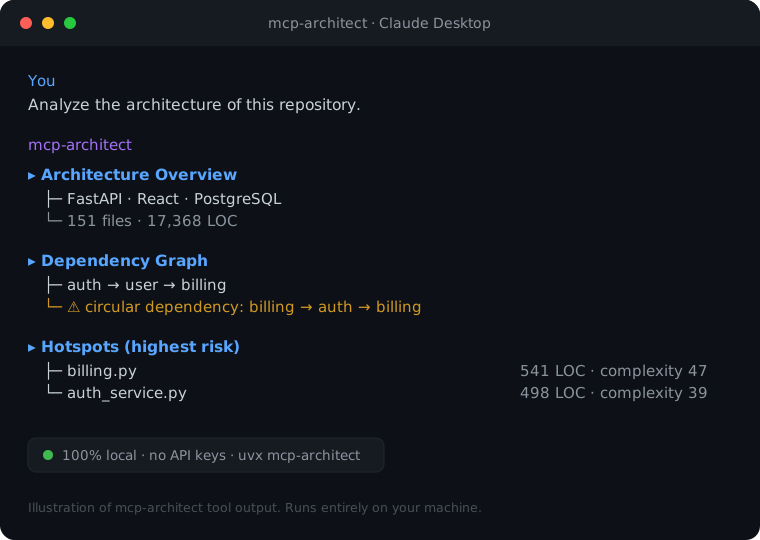
AI coding assistants are great at files but blind to architecture. Every session you re‑explain the structure, paste the file tree, and hope it guesses your module boundaries right. mcp-architect is an MCP server that hands your assistant a structured map of any codebase — tech stack, dependency graph, hotspots, and module summaries — computed 100% locally with no API keys and no model required.
It works with Claude Desktop, Cursor, Windsurf, Cline, or any MCP client.
| Without mcp-architect | With mcp-architect |
|---|---|
| "Here's my file tree, please figure out the structure…" | architecture_overview → stack, entry points, structure in one call |
| AI guesses how modules relate | dependency_graph → real import graph + circular‑dependency detection |
| "Which files matter?" | hotspots → largest, most complex, most‑changed, highest‑risk |
| Re‑explaining a package every time | explain → classes, functions, and deps of any folder |
Everything runs on your machine. Your code never leaves it.
pip install mcp-architect
…or skip the install entirely and let your MCP client fetch it on demand with uvx (shown below).
Claude Desktop — edit claude_desktop_config.json:
{
  "mcpServers": {
    "architect": {
      "command": "uvx",
      "args": ["mcp-architect"]
    }
  }
}
Prefer pip?
pip install mcp-architect. Or run the latest straight from source:hljs language-json{ "mcpServers": { "architect": { "command": "uvx", "args": ["--from", "git+https://github.com/kannajune/mcp-architect", "mcp-architect"] } } }
Restart your client. That's it — no keys, no model download.
"Use the architect tools to give me an overview of
~/code/my-app, then show me its dependency graph and the highest‑risk files."
# Architecture Overview — my-app

**151 files · 17,368 lines of code**

## Languages
- **Python** — 93 files, 13,683 LOC
- **TypeScript** — 23 files, 3,120 LOC

## Frameworks / key libraries
- FastAPI
- React
- Tailwind CSS

## Entry points
- main.py
# Dependency Graph — my-app

**118 modules · 172 internal import edges**

## Most depended-upon (architectural hubs)
- `app.signals.signal_parser` — imported by 12 modules
- `app.core.integrations_registry` — imported by 11 modules

## Circular dependencies
✅ no circular dependencies found
| Tool | What it tells the AI |
|---|---|
architecture_overview | Languages, frameworks, ecosystems, size, top‑level structure, entry points |
dependency_graph | Internal import graph, architectural hubs, circular dependencies |
impact_analysis | What breaks if you change X — direct importers + transitive blast radius, hub risk |
hotspots | Largest / most complex / most‑changed (git) / highest‑risk files |
explain | Deep‑dive a folder or file: classes, functions, external deps |
ast, os, re). The only runtime dep is the MCP SDK itself. Installs in seconds.mcp_architect.analysis) is importable and testable on its own — use it as a plain Python library too.from mcp_architect.analysis import get_overview, get_dependency_graph
print(get_overview("~/code/my-app")["frameworks"])
The dependency and complexity analysis is heuristic — designed to give an AI useful, fast situational awareness, not to replace a full static analyzer.
Set MCP_ARCHITECT_ROOT so tools default to a fixed repo and you can omit paths:
{ "mcpServers": { "architect": {
    "command": "uvx", "args": ["mcp-architect"],
    "env": { "MCP_ARCHITECT_ROOT": "/Users/you/code/my-app" }
} } }
mcp-architect isn't a semantic search engine or a context packer — it's a structural lens any AI assistant can call on demand. It's designed to complement the tools below, not replace them:
| Tool / approach | Great at | What mcp-architect adds |
|---|---|---|
| Cursor codebase indexing | Semantic snippet retrieval, inside Cursor | Works in any MCP client (Claude Desktop, Cline, Windsurf, Cursor…), 100% local (no cloud embeddings), and returns architecture — dependency graph, cycles, hotspots — not just relevant snippets |
| Serena (LSP-based code agent) | Precise symbol-level navigation & edits | Zero-config, zero heavy deps (stdlib — no language servers to install) and a high-level architectural map instead of symbol-by-symbol operations |
| RepoPrompt (context packing) | Hand-picking files into a prompt | The assistant pulls structured architecture on demand via tools — no manual file selection, no token-budget juggling |
In one line: Cursor and Serena help the AI read your code; mcp-architect helps it understand the architecture — locally, in any client. They stack well together.
compare tool for before/after architecture diffsContributions welcome — see CONTRIBUTING.
PRs and issues welcome! Run the tests with:
pip install -e ".[dev]"
pytest
MIT © Kannan Dharmalingam
Run Claude Code as an MCP server so any agent can delegate coding tasks to it
 @microsoft✓ Official
Browser automation using accessibility snapshots instead of screenshots
 @googleapis✓ Official
Google's universal MCP server supporting PostgreSQL, MySQL, MongoDB, Redis, and 10+ databases
 @github✓ Official
Official GitHub integration for repos, issues, PRs, and CI/CD workflows