

Are you the author? Sign in to claim
MCP server and Claude Code skill for Excalidraw — programmatic canvas toolkit to create, edit, and export diagrams via A


Run a live Excalidraw canvas and control it from AI agents. This repo provides:
Keywords: Excalidraw agent skill, Excalidraw MCP server, AI diagramming, Claude Code skill, Codex CLI skill, Claude Desktop MCP, Cursor MCP, Mermaid to Excalidraw.
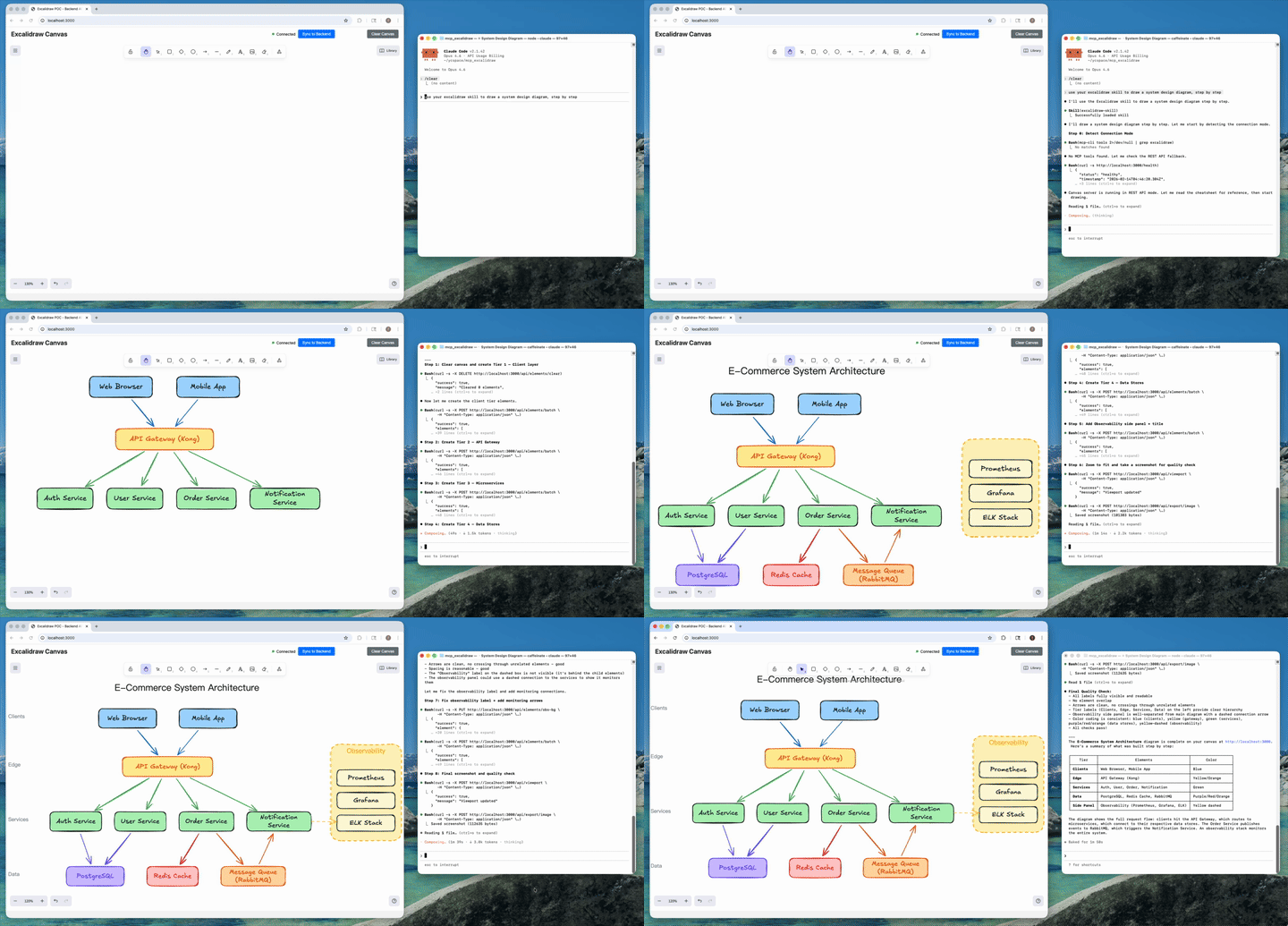
AI agent creates a complete architecture diagram from a single prompt (4x speed). Watch full video on YouTube
This repo contains two separate processes:
http://127.0.0.1:3000)EXPRESS_SERVER_URLExcalidraw now has an official MCP — it's great for quick, prompt-to-diagram generation rendered inline in chat. We solve a different problem.
| Official Excalidraw MCP | This Project | |
|---|---|---|
| Approach | Prompt in, diagram out (one-shot) | Programmatic element-level control (26 tools) |
| State | Stateless — each call is independent | Persistent live canvas with real-time sync |
| Element CRUD | No | Full create / read / update / delete per element |
| AI sees the canvas | No | describe_scene (structured text) + get_canvas_screenshot (image) |
| Iterative refinement | No — regenerate the whole diagram | Draw → look → adjust → look again, element by element |
| Layout tools | No | align_elements, distribute_elements, group / ungroup |
| File I/O | No | export_scene / import_scene (.excalidraw JSON) |
| Snapshot & rollback | No | snapshot_scene / restore_snapshot |
| Mermaid conversion | No | create_from_mermaid |
| Shareable URLs | Yes | Yes — export_to_excalidraw_url |
| Design guide | read_me cheat sheet | read_diagram_guide (colors, sizing, layout, anti-patterns) |
| Viewport control | Camera animations | set_viewport (zoom-to-fit, center on element, manual zoom) |
| Live canvas UI | Rendered inline in chat | Standalone Excalidraw app synced via WebSocket |
| Multi-agent | Single user | Multiple agents can draw on the same canvas concurrently |
| Works without MCP | No | Yes — REST API fallback via agent skill |
TL;DR — The official MCP generates diagrams. We give AI agents a full canvas toolkit to build, inspect, and iteratively refine diagrams — including the ability to see what they drew.
get_element, clear_canvas, export_scene, import_scene, export_to_image, duplicate_elements, snapshot_scene, restore_snapshot, describe_scene, get_canvas_screenshot, read_diagram_guide, export_to_excalidraw_url, set_viewportdescribe_scene) and see it (get_canvas_screenshot returns an image) — enabling iterative refinementread_diagram_guide returns best-practice color palettes, sizing rules, layout patterns, and anti-patterns — dramatically improves AI-generated diagram qualityexport_to_excalidraw_url encrypts and uploads the scene to excalidraw.com, returns a shareable link anyone can openset_viewport with scrollToContent, scrollToElementId, or manual zoom/offset — agents can auto-fit diagrams after creation.excalidraw JSON filesalign_elements / distribute_elements fully implemented, points type normalization, removed invalid label type, removed HTTP transport dead code, ungroup_elements now errors on failureskills/excalidraw-skill/ (portable instructions + helper scripts for export/import and repeatable CRUD)agent-browser)main.tsx)Prereqs: Node >= 18, npm
npm ci
npm run build
Terminal 1: start the canvas
PORT=3000 npm run canvas
Security note: The server defaults to binding on
127.0.0.1only. If you need to expose it on a network interface (e.g. Docker, remote access), setHOST=0.0.0.0— but ensure you have network-level access controls in place, as the API has no built-in authentication.
Open http://127.0.0.1:3000.
Terminal 2: run the MCP server (stdio)
EXPRESS_SERVER_URL=http://127.0.0.1:3000 node dist/index.js
Canvas server:
docker run -d -p 3000:3000 --name mcp-excalidraw-canvas ghcr.io/yctimlin/mcp_excalidraw-canvas:latest
MCP server (stdio) is typically launched by your MCP client (Claude Desktop/Cursor/etc.). If you want a local container for it, use the image ghcr.io/yctimlin/mcp_excalidraw:latest and set EXPRESS_SERVER_URL to point at the canvas.
The MCP server runs over stdio and can be configured with any MCP-compatible client. Below are configurations for both local (requires cloning and building) and Docker (pull-and-run) setups.
| Variable | Description | Default |
|---|---|---|
EXPRESS_SERVER_URL | URL of the canvas server | http://127.0.0.1:3000 |
ENABLE_CANVAS_SYNC | Enable real-time canvas sync | true |
Config location:
~/Library/Application Support/Claude/claude_desktop_config.json%APPDATA%\Claude\claude_desktop_config.json~/.config/Claude/claude_desktop_config.jsonLocal (node)
{
  "mcpServers": {
    "excalidraw": {
      "command": "node",
      "args": ["/absolute/path/to/mcp_excalidraw/dist/index.js"],
      "env": {
        "EXPRESS_SERVER_URL": "http://127.0.0.1:3000",
        "ENABLE_CANVAS_SYNC": "true"
      }
    }
  }
}
Docker
{
  "mcpServers": {
    "excalidraw": {
      "command": "docker",
      "args": [
        "run", "-i", "--rm",
        "-e", "EXPRESS_SERVER_URL=http://host.docker.internal:3000",
        "-e", "ENABLE_CANVAS_SYNC=true",
        "ghcr.io/yctimlin/mcp_excalidraw:latest"
      ]
    }
  }
}
Use the claude mcp add command to register the MCP server.
Local (node) - User-level (available across all projects):
claude mcp add excalidraw --scope user \
  -e EXPRESS_SERVER_URL=http://127.0.0.1:3000 \
  -e ENABLE_CANVAS_SYNC=true \
  -- node /absolute/path/to/mcp_excalidraw/dist/index.js
Local (node) - Project-level (shared via .mcp.json):
claude mcp add excalidraw --scope project \
  -e EXPRESS_SERVER_URL=http://127.0.0.1:3000 \
  -e ENABLE_CANVAS_SYNC=true \
  -- node /absolute/path/to/mcp_excalidraw/dist/index.js
Docker
claude mcp add excalidraw --scope user \
  -- docker run -i --rm \
  -e EXPRESS_SERVER_URL=http://host.docker.internal:3000 \
  -e ENABLE_CANVAS_SYNC=true \
  ghcr.io/yctimlin/mcp_excalidraw:latest
Manage servers:
claude mcp list              # List configured servers
claude mcp remove excalidraw # Remove a server
Config location: .cursor/mcp.json in your project root (or ~/.cursor/mcp.json for global config)
Local (node)
{
  "mcpServers": {
    "excalidraw": {
      "command": "node",
      "args": ["/absolute/path/to/mcp_excalidraw/dist/index.js"],
      "env": {
        "EXPRESS_SERVER_URL": "http://127.0.0.1:3000",
        "ENABLE_CANVAS_SYNC": "true"
      }
    }
  }
}
Docker
{
  "mcpServers": {
    "excalidraw": {
      "command": "docker",
      "args": [
        "run", "-i", "--rm",
        "-e", "EXPRESS_SERVER_URL=http://host.docker.internal:3000",
        "-e", "ENABLE_CANVAS_SYNC=true",
        "ghcr.io/yctimlin/mcp_excalidraw:latest"
      ]
    }
  }
}
Use the codex mcp add command to register the MCP server.
Local (node)
codex mcp add excalidraw \
  --env EXPRESS_SERVER_URL=http://127.0.0.1:3000 \
  --env ENABLE_CANVAS_SYNC=true \
  -- node /absolute/path/to/mcp_excalidraw/dist/index.js
Docker
codex mcp add excalidraw \
  -- docker run -i --rm \
  -e EXPRESS_SERVER_URL=http://host.docker.internal:3000 \
  -e ENABLE_CANVAS_SYNC=true \
  ghcr.io/yctimlin/mcp_excalidraw:latest
Manage servers:
codex mcp list              # List configured servers
codex mcp remove excalidraw # Remove a server
Config location: ~/.config/opencode/opencode.json or project-level opencode.json
Local (node)
{
  "$schema": "https://opencode.ai/config.json",
  "mcp": {
    "excalidraw": {
      "type": "local",
      "command": ["node", "/absolute/path/to/mcp_excalidraw/dist/index.js"],
      "enabled": true,
      "environment": {
        "EXPRESS_SERVER_URL": "http://127.0.0.1:3000",
        "ENABLE_CANVAS_SYNC": "true"
      }
    }
  }
}
Docker
{
  "$schema": "https://opencode.ai/config.json",
  "mcp": {
    "excalidraw": {
      "type": "local",
      "command": ["docker", "run", "-i", "--rm", "-e", "EXPRESS_SERVER_URL=http://host.docker.internal:3000", "-e", "ENABLE_CANVAS_SYNC=true", "ghcr.io/yctimlin/mcp_excalidraw:latest"],
      "enabled": true
    }
  }
}
Config location: ~/.gemini/antigravity/mcp_config.json
Local (node)
{
  "mcpServers": {
    "excalidraw": {
      "command": "node",
      "args": ["/absolute/path/to/mcp_excalidraw/dist/index.js"],
      "env": {
        "EXPRESS_SERVER_URL": "http://127.0.0.1:3000",
        "ENABLE_CANVAS_SYNC": "true"
      }
    }
  }
}
Docker
{
  "mcpServers": {
    "excalidraw": {
      "command": "docker",
      "args": [
        "run", "-i", "--rm",
        "-e", "EXPRESS_SERVER_URL=http://host.docker.internal:3000",
        "-e", "ENABLE_CANVAS_SYNC=true",
        "ghcr.io/yctimlin/mcp_excalidraw:latest"
      ]
    }
  }
}
host.docker.internal to reach the canvas server running on your host machine. On Linux, you may need --add-host=host.docker.internal:host-gateway or use 172.17.0.1.npm run canvas (local) or docker run -d -p 3000:3000 ghcr.io/yctimlin/mcp_excalidraw-canvas:latest (Docker)./absolute/path/to/mcp_excalidraw with the actual path where you cloned and built the repo.This repo includes a skill at skills/excalidraw-skill/ that provides:
SKILL.md): step-by-step guidance for drawing, refining, and exporting diagramsreferences/cheatsheet.md): MCP tool and REST API referencescripts/*.cjs): export, import, clear, healthcheck, CRUD operationsThe skill complements the MCP server by giving your AI agent structured workflows to follow.
mkdir -p ~/.codex/skills
cp -R skills/excalidraw-skill ~/.codex/skills/excalidraw-skill
To update an existing installation, remove the old folder first (rm -rf ~/.codex/skills/excalidraw-skill) then re-copy.
User-level (available across all your projects):
mkdir -p ~/.claude/skills
cp -R skills/excalidraw-skill ~/.claude/skills/excalidraw-skill
Project-level (scoped to a specific project, can be committed to the repo):
mkdir -p /path/to/your/project/.claude/skills
cp -R skills/excalidraw-skill /path/to/your/project/.claude/skills/excalidraw-skill
Then invoke the skill in Claude Code with /excalidraw-skill.
To update an existing installation, remove the old folder first then re-copy.
All scripts respect EXPRESS_SERVER_URL (default http://127.0.0.1:3000) or accept --url.
EXPRESS_SERVER_URL=http://127.0.0.1:3000 node skills/excalidraw-skill/scripts/healthcheck.cjs
EXPRESS_SERVER_URL=http://127.0.0.1:3000 node skills/excalidraw-skill/scripts/export-elements.cjs --out diagram.elements.json
EXPRESS_SERVER_URL=http://127.0.0.1:3000 node skills/excalidraw-skill/scripts/import-elements.cjs --in diagram.elements.json --mode batch
sync mode to make canvas match a file.See skills/excalidraw-skill/SKILL.md and skills/excalidraw-skill/references/cheatsheet.md.
| Category | Tools |
|---|---|
| Element CRUD | create_element, get_element, update_element, delete_element, query_elements, batch_create_elements, duplicate_elements |
| Layout | align_elements, distribute_elements, group_elements, ungroup_elements, lock_elements, unlock_elements |
| Scene Awareness | describe_scene, get_canvas_screenshot |
| File I/O | export_scene, import_scene, export_to_image, export_to_excalidraw_url, create_from_mermaid |
| State Management | clear_canvas, snapshot_scene, restore_snapshot |
| Viewport | set_viewport |
| Design Guide | read_diagram_guide |
| Resources | get_resource |
Full schemas are discoverable via tools/list or in skills/excalidraw-skill/references/cheatsheet.md.
curl http://127.0.0.1:3000/health
npm run test:bind
List tools:
npx @modelcontextprotocol/inspector --cli \
  -e EXPRESS_SERVER_URL=http://127.0.0.1:3000 \
  -e ENABLE_CANVAS_SYNC=true -- \
  node dist/index.js --method tools/list
Create a rectangle:
npx @modelcontextprotocol/inspector --cli \
  -e EXPRESS_SERVER_URL=http://127.0.0.1:3000 \
  -e ENABLE_CANVAS_SYNC=true -- \
  node dist/index.js --method tools/call --tool-name create_element \
  --tool-arg type=rectangle --tool-arg x=100 --tool-arg y=100 \
  --tool-arg width=300 --tool-arg height=200
If you use agent-browser for UI checks:
agent-browser install
agent-browser open http://127.0.0.1:3000
agent-browser wait --load networkidle
agent-browser screenshot /tmp/canvas.png
EXPRESS_SERVER_URL points at the running canvas server.All previously listed bugs have been fixed in v2.0. Remaining items:
export_scene / snapshots as a workaround.export_to_image and get_canvas_screenshot rely on the frontend doing the actual rendering. The canvas UI must be open in a browser.Contributions welcome!
npm run type-check
npm run build
Run Claude Code as an MCP server so any agent can delegate coding tasks to it
 @microsoft✓ Official
Browser automation using accessibility snapshots instead of screenshots
 @googleapis✓ Official
Google's universal MCP server supporting PostgreSQL, MySQL, MongoDB, Redis, and 10+ databases
 @github✓ Official
Official GitHub integration for repos, issues, PRs, and CI/CD workflows