

Are you the author? Sign in to claim
Security scanner for MCP (Model Context Protocol) servers — reads the real published npm/PyPI source, not just metadata,
Know whether a Model Context Protocol server is safe before you connect it to your data.










npx mcptrustchecker # 🔍 scan every MCP server you already have installed — zero config
Zero install? Run the same deterministic engine in your browser — mcptrustchecker.com/scan — or as a free public web API → mcptrustchecker.com/api
· offline · deterministic · no account · OAuth browser login for protected servers · reads the real published npm/PyPI source · one novel core ·
The Capability-Flow Trust Model (methodology mcptrustchecker-1.9) is an original algorithm designed from scratch for this project by Illia Haidar — it is not a wrapper around, or derivative of, any existing scanner or methodology. It is named, versioned, fully specified in docs/methodology.md, and citable via CITATION.cff.
It is refined against 30,000+ real MCP servers — and still improving. The model is not theoretical: it is calibrated on a continuously-scanned corpus of 30,000+ MCP servers published on npm and PyPI. Each revision comes from a full-population audit of that corpus — every server in a grade band re-examined for both false positives (benign code graded down) and false negatives (real threats graded up), each change measured against the threats it must keep catching, and the whole corpus re-scanned before the version ships. That loop produced mcptrustchecker-1.9, which moved "evaluating a runtime value" off the threat axis after the data showed it was charging capability as malice. The corpus keeps growing and the audits keep running, so the methodology is expected to keep tightening — which is why every score carries the version that produced it.
MCP Trust Checker scores an MCP server the way an attacker reasons about it — not as a bag of regex hits, but as a Capability-Flow Trust Model. Every tool is reduced to the roles it can actually play — untrusted-input ingress, sensitive-data source, external / exec sink — derived from behavior, never from the server's own (attacker-controllable) annotations. Those roles are wired into a cross-tool toxic-flow graph that hunts the lethal trifecta: the moment untrusted content, private data, and an exfiltration path co-exist in one agent session — whether inside a single tool or composed across several tools plus the client's built-ins. That is the exact shape behind real-world MCP data-exfiltration exploits, and MCP Trust Checker proves the primitive exists statically, with an honest confidence split so a single-tool completion reads confirmed and a cross-tool composition reads strong — never overclaiming.
Three more things sit under that graph:
~/.ssh/id_rsa and BCC the attacker" becomes visible text instead of a silent flag.confirmed finding with a per-tool diff.And it is comprehensive by design: the full catalog of known MCP attack techniques is covered in one offline pass — no API key, no LLM. See the full coverage map ↓
Jump to: Why it's different · Quick start · The algorithm · Coverage · Scoring · Embed as a library · CI / GitHub · Rules
"Is this server safe to give access to my files, my tokens, and my conversations?"
An MCP server hands an AI assistant a set of tools. Those tool descriptions are read by the model, not by you — a perfect place to hide instructions. A single server that can read a file and make an HTTP request is already a data-exfiltration weapon. And a server can look harmless on day one, then silently redefine its tools after you approve it. MCP Trust Checker turns all of that into a transparent letter grade you can act on.
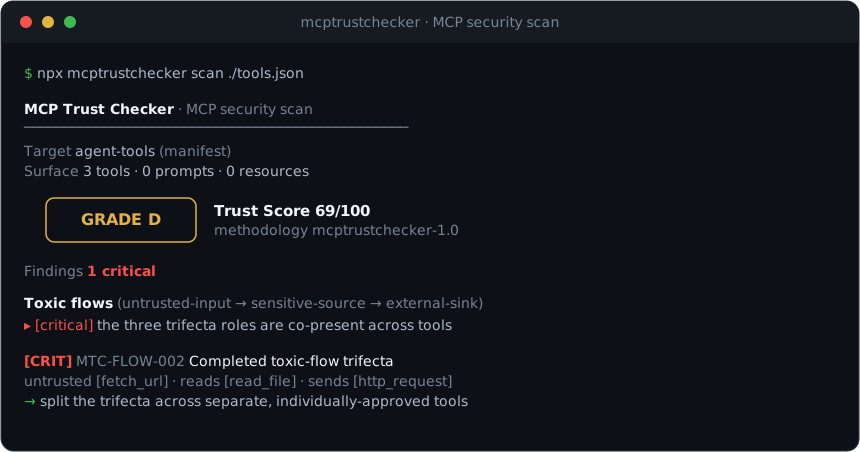
   ╭────────────╮
   │  GRADE  D  │   Trust Score 69/100
   ╰────────────╯   methodology mcptrustchecker-1.9

Toxic flows (untrusted-input → sensitive-source → external-sink)
  [critical] The three trifecta roles are co-present across tools;
             a prompt-injected agent can chain them.
MCP Trust Checker's wedge is accuracy + explainability + privacy, with one genuinely novel core — the cross-tool toxic-flow graph. Every property below holds together in a single offline binary — no account, no LLM in the loop, no telemetry:
--login runs the full OAuth 2.0 browser sign-in (discovery → dynamic client registration → PKCE → token), so it can audit auth-gated remote MCP endpoints, not just public ones — something most scanners can't do. (Or pass a static --header "Authorization: Bearer …".) Tokens stay in memory for the scan only.scan <name> --online fetches the npm/PyPI artifact, verifies it against the registry-declared hash, and runs the full source-analysis engine on the exact bytes npx/pip would install — in memory, without installing or executing anything. Also scans packed release artifacts directly: scan ./server.tgz, .whl, .zip.critical, confirmed finding (MTC-TOFU-002) — the attack an unchanged tool surface hides from every metadata-only check.confirmed finding with a per-tool diff.Most scanners assert they have a low false-positive rate. This one measures it. A labeled corpus of malicious and benign MCP servers lives in benchmark/; npm run benchmark scores it and reports the numbers (and fails CI on a regression):
| Metric | Score |
|---|---|
| Precision | 100% |
| Recall | 100% |
| F1 | 100% |
| False-positive rate | 0% |
(64 labeled servers, held-out cases flagged; "concerning" := Trust grade C or worse. Reproduce with npm run benchmark.) The corpus is honest and versioned — it grows with every calibration case, and the CI gate holds precision/recall ≥ 90%.
npx mcptrustchecker scan ./tools.json      # zero-install
npm i -g mcptrustchecker                    # CLI everywhere
npm i mcptrustchecker                       # embed the engine in your app
Requires Node ≥ 20. Live scanning uses the official @modelcontextprotocol/sdk.
Zero-config — one command, scans everything you have installed:
npx mcptrustchecker # auto-discovers Claude Desktop/Code, Cursor, Windsurf, Continue, VS Code configs
Or point it at anything:
mcptrustchecker scan ./tools.json                          # an offline manifest (deterministic)
mcptrustchecker scan ./path/to/mcp-server                  # a local package dir — analyzes the CODE too
mcptrustchecker scan --command "npx -y @some/mcp-server"   # a local stdio server (sandboxed)
mcptrustchecker scan https://mcp.example.com/mcp           # a live HTTP/SSE endpoint
mcptrustchecker scan https://mcp.example.com/mcp --login   # an OAuth-protected endpoint (browser sign-in)
mcptrustchecker scan https://mcp.example.com/mcp --header "Authorization: Bearer <token>"   # static auth
mcptrustchecker scan @modelcontextprotocol/server-filesystem --online   # fetches + verifies + reads the PUBLISHED source
mcptrustchecker scan mcp-server-fetch --online --registry pypi          # same for PyPI (sdist/wheel)
mcptrustchecker scan ./server-1.2.0.tgz                    # a packed release artifact (.tgz/.whl/.zip) — offline
Outputs & CI gates:
mcptrustchecker scan ./tools.json --sarif > mcptrustchecker.sarif   # GitHub code scanning
mcptrustchecker scan ./tools.json --md    > report.md        # PR comment
mcptrustchecker scan ./tools.json --json  > report.json      # machine-readable
mcptrustchecker scan ./tools.json --badge > badge.json       # shields.io endpoint
mcptrustchecker scan ./tools.json --fail-under 80            # exit 1 below a threshold
mcptrustchecker scan ./tools.json --min-grade B             # exit 1 below a grade
The terminal report is detailed by default — every finding prints its full description (what the problem is and why it matters), the exact location, the offending evidence, a fix, and its OWASP mapping, grouped most-severe-first. Add --details for external references, or --quiet for just the grade line.
No install? Scan it in the browser. The online scanner runs this exact engine with no signup and no key. Paste an npm or PyPI package name, a GitHub repository, a live remote endpoint (OAuth sign-in supported), a tools.json manifest — or your whole client config (claude_desktop_config.json, .cursor/mcp.json), and every server in it is graded at once. Each result gets a shareable link and a live Trust Score badge for your README.
Or call it as an API. A hosted version of the exact same deterministic engine runs at mcptrustchecker.com/api — POST a tools.json manifest or a published npm/PyPI package name over a single HTTPS request and get the same auditable A–F Trust Score back as JSON. It is completely free (grab a key in seconds, no card, no account), and it's the quickest way to try the scanner without installing anything. The CLI and library stay 100% offline — the hosted API is an optional convenience.
Browse the MCP Trust Registry — a growing, security-scanned catalog of MCP servers with an A–F Trust Score for each, all computed by this exact engine: mcptrustchecker.com/registry.
A 9-stage pipeline over a normalized, transport-agnostic surface (tools, prompts, resources, server instructions, transport, package metadata). Each stage emits findings; the scorer turns them into an auditable grade.
INPUT ─ manifest.json │ live stdio/http │ client config │ package name
  │
  ▼
[0] SAFE ACQUISITION        allow-listed command (bare-name only) · scrubbed env · timeouts · SSRF guard
  ▼
[1] UNICODE INTEGRITY       decode Tags/variation-selector payloads; BiDi; zero-width; homoglyph; ANSI
  ▼
[2] INJECTION HEURISTICS    tool-poisoning · line-jumping · shadowing · secrecy · exfil · embedded secrets
  ▼
[3] CAPABILITY EXTRACTION   tag tools (untrusted-input / sensitive-source / sink / exec / write);
  │                         annotation mismatch; sampling/elicitation; schema injection preconditions
  ▼
[4] TOXIC-FLOW GRAPH  ★     the lethal trifecta across tools AND client built-ins; + name-collision
  ▼
[5] SUPPLY-CHAIN            typosquat/combosquat/homoglyph · install-scripts · provenance · unpinned · deps
  ▼
[6] TRANSPORT POSTURE       stdio-RCE · plaintext HTTP · 0.0.0.0 · DNS-rebinding · known-CVE version matcher
  ▼
[7] RUG-PULL INTEGRITY      SHA-256 pin of the full schema → diff on every rescan
  ▼
[8] SCORING                 deterministic penalties · diminishing returns · category caps · hard gates
  ▼
OUTPUT ─ terminal │ JSON │ SARIF 2.1.0 │ Markdown │ badge
★ The flagship — cross-tool toxic-flow analysis. The most dangerous MCP failures aren't one bad tool; they're an innocent combination. Give an agent (1) exposure to untrusted content, (2) access to sensitive data, and (3) a way to communicate externally, and you have an exfiltration primitive. MCP Trust Checker derives each tool's roles from behavior (not from its self-declared, attacker-controllable annotations) and checks whether the three are co-reachable across every tool, every server, and optionally the client's own built-ins (--include-builtins). One tool holding all three → critical, confirmed; the roles spread across tools → critical, strong.
Full depth: docs/methodology.md.
MCP Trust Checker covers the full catalog of known MCP attack techniques in one offline pass — from tool-poisoning and Unicode smuggling to supply-chain risk and cross-tool toxic flows — plus the flow graph, the decoder, the integrity pin, and the auditable score on top. ★ marks a check that goes beyond what static scanners typically catch.
| Attack / technique | MCP Trust Checker rule(s) |
|---|---|
| Tool poisoning (hidden instructions in descriptions) | MTC-INJ-AUTH-*, MTC-INJ-SECRECY-*, MTC-INJ-TARGET-*, MTC-INJ-POISON |
| Prompt injection / instruction override | MTC-INJ-AUTH-2, MTC-INJ-SECRECY-1 |
| Line jumping (pre-invocation seeding) | MTC-INJ-SEQ-1 |
| Tool shadowing via description redirect | MTC-INJ-SHADOW-1 |
| Cross-server tool-name collision / homoglyph name | MTC-INJ-SHADOW-2 ★ |
| Tool-selection ranking manipulation | MTC-INJ-SHADOW-3 ★ |
| Invisible-Unicode channels (zero-width/BiDi/Tags/VS) | MTC-UNI-001..008 (decoded) ★ |
| Homoglyph / mixed-script | MTC-UNI-009 |
| ANSI terminal-escape deception | MTC-UNI-010 ★ |
| Encoded-payload smuggling (base64 + decode) | MTC-INJ-ENC-1/2 |
| Shell/command-injection strings in prose | MTC-INJ-CMD-1, MTC-CAP-001 |
| Command/code-execution capability | MTC-CAP-001 |
| Filesystem-mutation capability | MTC-CAP-002 |
| Annotation spoofing (readOnly/destructive lie) | MTC-CAP-003 |
| openWorldHint + sensitive read (trifecta signal) | MTC-CAP-004 ★ |
| Toxic-flow analysis / lethal trifecta | MTC-FLOW-001..005 ★ |
| Command-injection sink precondition (schema) | MTC-CAP-006 ★ |
| SSRF / cloud-metadata sink precondition (schema) | MTC-CAP-007 ★ |
| Path-traversal precondition (schema) | MTC-CAP-008 ★ |
| Sampling-capability abuse | MTC-CAP-009 ★ (static proxy) |
| Elicitation abuse / consent phishing | MTC-CAP-010 ★ (static proxy) |
| Rug pull / silent tool-definition mutation | MTC-TOFU-001 + lockfile |
| Unpinned / @latest auto-update (rug-pull enabler) | MTC-SUP-013 ★ |
| Typosquat / combosquat / homoglyph squat | MTC-SUP-001..006 |
| Install-script / provenance risk | MTC-SUP-010/011/012 |
| Dependency squat / advisory match | MTC-SUP-014 ★ |
| Known-CVE version matching | MTC-NET-001 |
| stdio-RCE (unallowlisted command) | MTC-NET-002 + sandboxed acquisition |
| Plaintext HTTP / 0.0.0.0 bind | MTC-NET-003/004 |
| DNS rebinding on localhost transport | MTC-NET-006 ★ |
| Embedded credential value in metadata | MTC-INJ-SECRET-1 ★ |
| Empty/malformed surface ≠ clean | MTC-META-001 ★ |
| Config discovery across MCP clients | client-config parser + zero-config auto-discovery |
| Malicious URL / exfil endpoint in tool metadata | MTC-INJ-URL-1 ★ |
| Implementation-level sinks — eval / shell-spawn / hardcoded egress / deserialization | MTC-SRC-001…011 ★ |
| Credential-path read / environment dump in server code | MTC-SRC-006 ★ |
| Hardcoded secret in the server's source (not just metadata) | MTC-SRC-008 ★ |
Deliberately out of scope (so the deterministic, offline, no-account promise holds): LLM-as-judge semantic classification, hosted threat-intel, a runtime guardrail proxy, live authN/replay/signing probing, and OAuth-endpoint source analysis. Where a runtime-only class has a static proxy — a declared sampling/elicitation capability, an unbounded URL/command/path parameter — MCP Trust Checker flags the precondition offline instead.
Full list: docs/rules.md · run mcptrustchecker rules.
A single number can't answer "should I use this server?" — because "powerful" and "malicious" are different questions, and a clean grade means nothing if the scan barely saw the server. So MCP Trust Checker separates the signals, then folds the client-adoption-risk ones back into the grade transparently (see scoring ↓):
threatScore, preserved on every report.metadata-only scan (no tools enumerated, no code read) is not the assurance of a Grade A from a live scan that saw the real runtime tools. It contributes a small coverage-honesty term, so a shallow scan is never mistaken for a clean bill of health. When coverage is partial, the report says exactly what it could not see.--online scan so the CLI, registry and hosted API all agree. It contributes a small verification-discount term. Offline it is Unknown and the term is skipped (a caveat says so), because an unchecked signal must never read as verified.firecrawl Trust B (81/100) Capability CRITICAL Coverage LIVE → trustworthy, but huge blast radius — grant carefully
poisoned Trust F Capability HIGH Coverage LIVE → actual malice signals — avoid
memory Trust A (100) Capability MINIMAL Coverage LIVE → safe and low-power
some-pkg Trust A (98) Capability MINIMAL Coverage METADATA → clean *so far* — 0 tools seen; scan the live server
This is why MCP Trust Checker doesn't collapse every capable server into "F" (which would make the grade useless). Popularity is never an input — popular packages get compromised — but a legitimate powerful server keeps a high Trust grade while its Capability and the scan's Coverage are surfaced honestly.
Every scan mode answers one question: how safe is this MCP for the user who wants to adopt it — the client's adoption risk, not a judgement of the developer. So the score is computed in two auditable stages: a pure threat score, then three small, subtract-only client-adoption-risk terms that evolve it into the final client score. Both stages ship in the itemized vector.
Stage 1 — the threat score (unchanged; malice/negligence only):
ThreatScore = clamp( 100 − Σ_categories min(CategoryCap, Σ penalty), 0, 100 )
penalty     = severity_weight × confidence_multiplier × diminishing_factor    (threat findings only)
| Severity | Weight | Confidence | × | |
|---|---|---|---|---|
| Critical | 45 | Confirmed | 1.0 | |
| High | 22 | Strong | 0.7 | |
| Medium | 9 | Heuristic | 0.4 | |
| Low | 3 | Speculative | 0.2 |
1 · ½ · ¼ · …) so 40 copies of one nit can't tank a server and benign passes can't dilute one critical.confirmed findings so a guess never forces a cap — but no critical of any confidence can score above D.Stage 2 — the client score (the number you read):
ClientScore = clamp( round( ThreatScore − E_cap − E_ver − E_cov ), 0, 100 )
Grade       = stricter( band(ClientScore), threat_gate_cap )        // the F-gate is never softened
Three subtract-only terms, each one itemized line in vector — no black box, and the score can never rise above the threat score:
| Term | Meaning (the client's risk in adopting) | Points |
|---|---|---|
| E_cap — capability exposure | blast radius if the model driving the server is manipulated | minimal 0 · moderate 3 · high 6 · critical 10 |
| E_ver — verification discount | how verifiable the source is (build provenance / vendor scope / public repo) | vendor 0 · provenance 0 · public repo 1 · none 5 · unknown → term skipped |
| E_cov — coverage honesty | how much of the target the scan could actually inspect | live 0 · source 0 · manifest 4 · metadata 8 · empty 10 |
--online scan — identical logic in the CLI, the registry and the hosted API, so every mode agrees. An offline scan cannot check provenance, so verification is unknown, the term is skipped, and a coverage caveat records the omission — an unchecked signal never reads as clean.Every report ships the full itemized vector (threat penalties and the three client terms), the preserved threatScore, and the methodologyVersion. Same methodology version + same target ⇒ byte-identical score. Details: docs/scoring.md.
MCP Trust Checker is a library first. A marketplace can vet every listed server with the identical, versioned open-source engine users audit on GitHub — so "we run unique security checks on every MCP server" becomes a verifiable claim.
import { surfaceFromManifest, scanSurface, renderBadge } from 'mcptrustchecker';

const surface = surfaceFromManifest(toolsJson, 'acme/weather-mcp');
const report  = await scanSurface(surface);

report.score.grade;              // 'A' … 'F'
report.score.score;              // 0 … 100
report.score.methodologyVersion; // 'mcptrustchecker-1.9'  ← pin & display this
report.toxicFlows;               // enumerated exfiltration primitives
renderBadge(report);             // shields.io endpoint JSON for a live trust badge
scanSurface is pure, deterministic, and offline. See examples/programmatic.ts.
mcptrustchecker pin  ./tools.json    # writes mcptrustchecker.lock — commit it to git
mcptrustchecker diff ./tools.json    # exits non-zero if the surface changed
A tool that quietly rewrites its description after you approve it (the MCPoison / rug-pull class) shows up as drift with a human-readable diff, and re-approval is required.
Scanned a package worth listing? You can submit it to the public MCP Trust Registry so everyone else can look it up before installing it.
mcptrustchecker publish @scope/server --token <key>    # scan it, then submit it
mcptrustchecker scan @scope/server --online            # just scan — never publishes, never asks
Publishing is a separate command, never a side effect of scanning. scan does not publish, does not ask, and does not change behaviour when a key happens to be in your environment — the only way anything is submitted is by typing publish, and typing it is the consent. There is no prompt to dismiss and no telemetry. Only npm and PyPI packages can be submitted for now; a target with no registry identity (a local directory, a .tgz, a manifest, a live URL, a spawned stdio command) is refused with an explanation rather than silently skipped.
publish always reads the real published source — it implies --online, because submitting a package graded from its name alone would be worse than not grading it at all.
What is sent is an application, not a verdict. The request carries the package identity (registry + name, optionally the version) and your explicit consent — no scan report, no findings, no source, nothing about your machine or your configs. mcptrustchecker.com re-scans the package with its own copy of this engine, and only that server-side scan is ever published. Your local grade travels along as localGrade for comparison only and can never become the listed grade — which is exactly what stops a key-holder from publishing "grade A" for a malicious package.
A missing key or an unpublishable target fails fast, before the package is downloaded. A network failure while submitting warns on stderr and leaves stdout untouched.
Publishing from CI is deliberately not something the GitHub Action does for you — a workflow that submits packages because a secret happens to exist is the same side effect this design removes. Write it as its own step when you want it:
- name: Publish to the MCP Trust Registry
  run: npx mcptrustchecker publish @scope/server --token "$MCPTRUSTCHECKER_TOKEN"
  env:
    MCPTRUSTCHECKER_TOKEN: ${{ secrets.MCPTRUSTCHECKER_TOKEN }}
Getting a key. Grab a free API key at mcptrustchecker.com/api — the same key the hosted scan endpoints use, no card, no account. Store it in the environment rather than in a committed file:
export MCPTRUSTCHECKER_TOKEN=<key>          # the key, read automatically
export MCPTRUSTCHECKER_PUBLISH_URL=https://mcp.internal   # self-hosted deployment (optional)
| Flag | What it does |
|---|---|
publish <package> | the command — scan the package, then submit it |
--category <slug> | registry category to file it under (default other) |
--token <key> | API key (env: MCPTRUSTCHECKER_TOKEN) |
--publish-url <origin> | publish to a self-hosted deployment (env: MCPTRUSTCHECKER_PUBLISH_URL) |
Credentials also live in mcptrustchecker.config.json as publishToken, publishUrl and publishCategory, resolved flag → environment → config file. There is deliberately no config key that turns publishing on: a file you inherited from someone else must never be able to submit your packages.
# .github/workflows/mcptrustchecker.yml
name: MCP Trust Checker
on: [push, pull_request]
jobs:
  scan:
    runs-on: ubuntu-latest
    permissions: { contents: read, security-events: write }
    steps:
      - uses: actions/checkout@v4
      - uses: illiahaidar/mcptrustchecker@v0
        with:
          target: ./tools.json
          min-grade: B
          sarif: true          # uploads to the Security tab
See docs/ci-integration.md and action.yml.
Connecting to an MCP config can run arbitrary commands. MCP Trust Checker's acquisition is sandboxed by default:
npx, uvx, python, python3, node, docker, deno) — a path-qualified command (e.g. /tmp/evil/node) is refused, closing the basename-spoof bypass.NODE_OPTIONS, LD_PRELOAD, DYLD_*, PYTHON*, ()-functions) — an allow-listed runtime can't be redirected.--run; config-derived HTTP targets are SSRF-guarded — private, loopback, link-local, CGNAT, multicast and reserved ranges are blocked, and the host is checked after DNS resolution, so a public name that resolves inward (DNS rebinding) is refused too. --allowed-hosts overrides the guard for a host you name deliberately.mcptrustchecker.config.json (auto-discovered) overrides any default — see examples/mcptrustchecker.config.json. Two adoption features worth calling out:
suppress: [{ rule, tool?, field?, reason }]), or drop a standalone .mtcignore JSON array in your repo. Location-scoped waivers keep CI green without silencing a rule everywhere.policy: { minGrade, maxCapability, denyRules, denyCapabilities }. Violations print and fail the run.confidence, and grade gates fire only on confirmed findings — so a guess never forces a grade. Report false positives; the rules are open.Issues, rules, and PRs welcome — see CONTRIBUTING.md. New detectors implement one small interface; new threat data is a plain, reviewable data file with a test.
MIT © Illia Haidar · mcptrustchecker.com · support@mcptrustchecker.com.
Created and maintained by Illia Haidar — author of the Capability-Flow Trust Model.
Run Claude Code as an MCP server so any agent can delegate coding tasks to it
 @microsoft✓ Official
Browser automation using accessibility snapshots instead of screenshots
 @googleapis✓ Official
Google's universal MCP server supporting PostgreSQL, MySQL, MongoDB, Redis, and 10+ databases
 @github✓ Official
Official GitHub integration for repos, issues, PRs, and CI/CD workflows