

Are you the author? Sign in to claim
AI-first security scanner with 79 analyzers, 40,000+ detection rules, and repo poisoning detection for AI/ML, LLM agents






AI-first security scanner with 40,000+ detection patterns for AI/ML, agents, and LLM applications.
🤖 Works out of the box - no tool installation required.
🚨 200 CVEs: Log4Shell, Spring4Shell, XZ Utils, LangChain RCE, MCP-Remote RCE, React2Shell
🔥 medusa scan --git <URL> — Scan any repo for AI supply chain attacks (repo poisoning, prompt injection, MCP tool poisoning)
🔐 medusa secrets scan — Find leaked API keys in your Claude / Cursor / Copilot / shell history. 21 issuer types. Interactive in-place redaction.
🚀 v2026.5.12: Our biggest release ever — 40,000+ detection patterns (up from 9,600+), harvested from 8,466 AI-security research papers and false-positive-hardened against real-world codebases.
MEDUSA is an AI-first security scanner with 40,000+ detection patterns that works out of the box. Simply install and scan - no external tool installation required. MEDUSA's built-in rules detect vulnerabilities in AI/ML applications, LLM agents, MCP servers, RAG pipelines, and traditional code.
medusa scan --git <URL> - Scan any GitHub repo for AI supply chain attacks in secondsmedusa secrets scan + purge - Find API keys / tokens / private keys leaked into Claude Code / Cursor / Copilot / Zed / Gemini chat histories and your bash / zsh / psql / mysql / python REPL history. 21 issuer types (Anthropic, OpenAI, PyPI, GitHub PATs, AWS, GCP, Stripe, Slack…). Interactive [y/n/s/a/q] purge with mandatory byte-identical backup and JSONL-safe redaction. Local-only, no telemetry.pip install - no tool installation needed.medusa.yml for project-specific settingsOur biggest release ever — 4× the detection coverage, false-positive-hardened.
| Change | Details | |
|---|---|---|
| 🤖 | 9,600 → 40,000+ patterns | A 4× expansion harvested from 8,466 AI-security research papers across 41 attack categories — prompt injection, jailbreaks, MCP, RAG, model poisoning, agentic & multimodal attacks, and more. |
| 🛡️ | False-positive hardened | Every new rule validated against real-world reference libraries (x402, guardrails, the UCP SDKs, and MEDUSA's own source) — zero harvest-rule false positives on clean code. |
| 🔬 | Detection preserved | 94% of documented benchmark vulnerabilities still caught; 121 genuine detectors recovered with context guards that blanket FP-tuning would otherwise have dropped. |
| 🔒 | Rule-integrity hardening | Structural, field-aware YAML integrity scanner — closes a prompt-in-a-prompt rule-poisoning gap and fixes a ReDoS in rule loading. |
| ⚙️ | 79 analyzers | Up from 78, all loaded out of the box. |
v2026.5.10 — Security hardening: VS Code extension command-injection fix, --fail-on cached-findings bug, tool-cache stale-path fix, user-home MCP configs made opt-in.
v2026.5.9 — Agentic-commerce coverage: UCPScanner + AP2Scanner + 45 hand-tuned positive-pattern rules.
v2026.5.8 — medusa secrets: scan AI chat & shell histories for leaked credentials (21 issuer types) with interactive [y/n/s/a/q] purge.
v2026.5.7 — Indirect PI rules (101/102), supply chain import scanner, macOS/Windows multiprocessing fix.
v2026.5.5 — security hardening release (argv injection defenses, git SSRF, HMAC cache integrity, markdown XSS fix).
External Linters (optional): MEDUSA auto-detects bandit, eslint, shellcheck, etc. if installed. See Optional Tools Guide.
Your PyPI token might be in your Claude chat history right now.
Developers paste API keys, tokens, and credentials into AI assistants every day —
"deploy this with pypi-AgEI...", "use my ghp_... to push", "the AWS key is AKIA...".
The assistants keep those conversations in plaintext on disk. Anyone with read access
to $HOME — or any future malware with shell access — can grep -r 'sk-\|ghp_\|AKIA' ~/
and harvest production credentials in seconds.
medusa secrets scan finds them. medusa secrets purge cleans them up.
medusa secrets scan
Scanning 118 file(s)...

── claude-code ──────────────────────────────────────────────
/home/ross/.claude/history.jsonl  (13 finding(s))
[CRITICAL] Anthropic API key (anthropic)
    /home/ross/.claude/history.jsonl:1005:13
    sk-ant-api03***...***
[CRITICAL] PyPI API token (pypi)
    /home/ross/.claude/history.jsonl:125:94
    pypi-AgEIc***...***
[CRITICAL] GitHub fine-grained PAT (github)
    /home/ross/.claude/history.jsonl:2306:13
    github_pat_11A***...***
[HIGH]     HuggingFace token (huggingface)
    /home/ross/.claude/history.jsonl:3387:13
    hf_JOi***...***
...

Total: 13 credentials across 1 file(s).
Report:  /home/ross/.medusa/secrets-scan/secrets-20260519-074452.json
medusa secrets purge
[CRITICAL] PyPI API token  (pypi)
    /home/ross/.claude/history.jsonl:125:94
    pypi-AgEIc***...***
  redact?  [y/n/s/a/q/?]: y

[CRITICAL] Anthropic API key  (anthropic)
    /home/ross/.claude/history.jsonl:1005:13
    sk-ant-api03***...***
  redact?  [y/n/s/a/q/?]: y
...

✓ /home/ross/.claude/history.jsonl  (13 redacted)
    backup → /home/ross/.medusa/secrets-scan/backups/20260519-074452/home/ross/.claude/history.jsonl
The original file is backed up byte-for-byte before any change. JSONL stays
parseable after redaction. The redaction marker ([REDACTED-MEDUSA-...-<run-id>])
is unique per run so you can trace it back to the scan that produced it.
medusa secrets scan                       # everything (default — chat + shell)
medusa secrets scan --source ai-chats     # AI assistants only
medusa secrets scan --source shell        # ~/.bash_history, ~/.zsh_history, fish, psql, mysql, ...
medusa secrets scan --path FILE           # explicit file (e.g. a ChatGPT export)
medusa secrets scan --reveal              # show real values (requires 'I UNDERSTAND')

medusa secrets purge                      # interactive [y/n/s/a/q]
medusa secrets purge SCAN_ID              # purge a specific report
medusa secrets purge --all --yes-i-know   # batch mode for power users / CI
AI providers: Anthropic, OpenAI, HuggingFace, Replicate, Cohere Package registries: PyPI, npm Source forges: GitHub PAT (classic + fine-grained + OAuth + App), GitLab PAT Cloud: AWS access keys, GCP service-account JSON Payments / comms: Stripe live/restricted keys, Slack bot/user tokens, SendGrid, Twilio, Discord webhooks Cryptography: PEM-encoded private keys (RSA, DSA, EC, OpenSSH, PGP)
~/.medusa/secrets-scan/ mode 0o600. No network, no telemetry, never written to project trees.cp restores it.os.replace swap. Either the rewrite lands or the original stays.📖 Full secrets-scanner guide →
# Install MEDUSA (works on Windows, macOS, Linux)
pip install medusa-security

# Run your first scan - that's it!
medusa scan .
Virtual Environment (Recommended):
# Create and activate virtual environment
python3 -m venv medusa-env
source medusa-env/bin/activate  # On Windows: medusa-env\Scripts\activate

# Install and scan
pip install medusa-security
medusa scan .
Platform Notes:
py -m medusa if medusa command is not found# Scan a remote repo for AI supply chain attacks
medusa scan --git https://github.com/org/repo
# Shorthand - just user/repo
medusa scan --git org/repo
# Scan a specific branch
medusa scan --git https://github.com/org/repo/tree/main
MEDUSA automatically detects 28+ AI editor config files that are known attack vectors:
| Risk Level | Files Detected |
|---|---|
| Critical (RCE) | .cursorrules, .cursor/mcp.json, .clinerules/, .windsurfrules, .codex/config.toml, .kiro/settings/mcp.json, .vscode/settings.json, mcp.json |
| High | CLAUDE.md, GEMINI.md, AGENTS.md, AGENT.md, SKILL.md, .github/copilot-instructions.md, CONVENTIONS.md, .amazonq/rules/, .roo/rules/, .augment/rules/ |
Known attacks detected: Clinejection, CurXecute (CVE-2025-54135), IDEsaster (CVE-2025-64660), ToxicSkills, CamoLeak, RoguePilot, AIShellJack, Cacheract
# Install modelscan for ML model vulnerability detection
medusa install --ai-tools
MEDUSA auto-detects external linters if installed (bandit, eslint, shellcheck, etc.) and uses them automatically to enhance scan coverage.
See Installation Guide → for platform-specific instructions.
Note: External linters are optional. MEDUSA's 40,000+ built-in rules work without them. For installation support, please refer to each tool vendor's documentation.
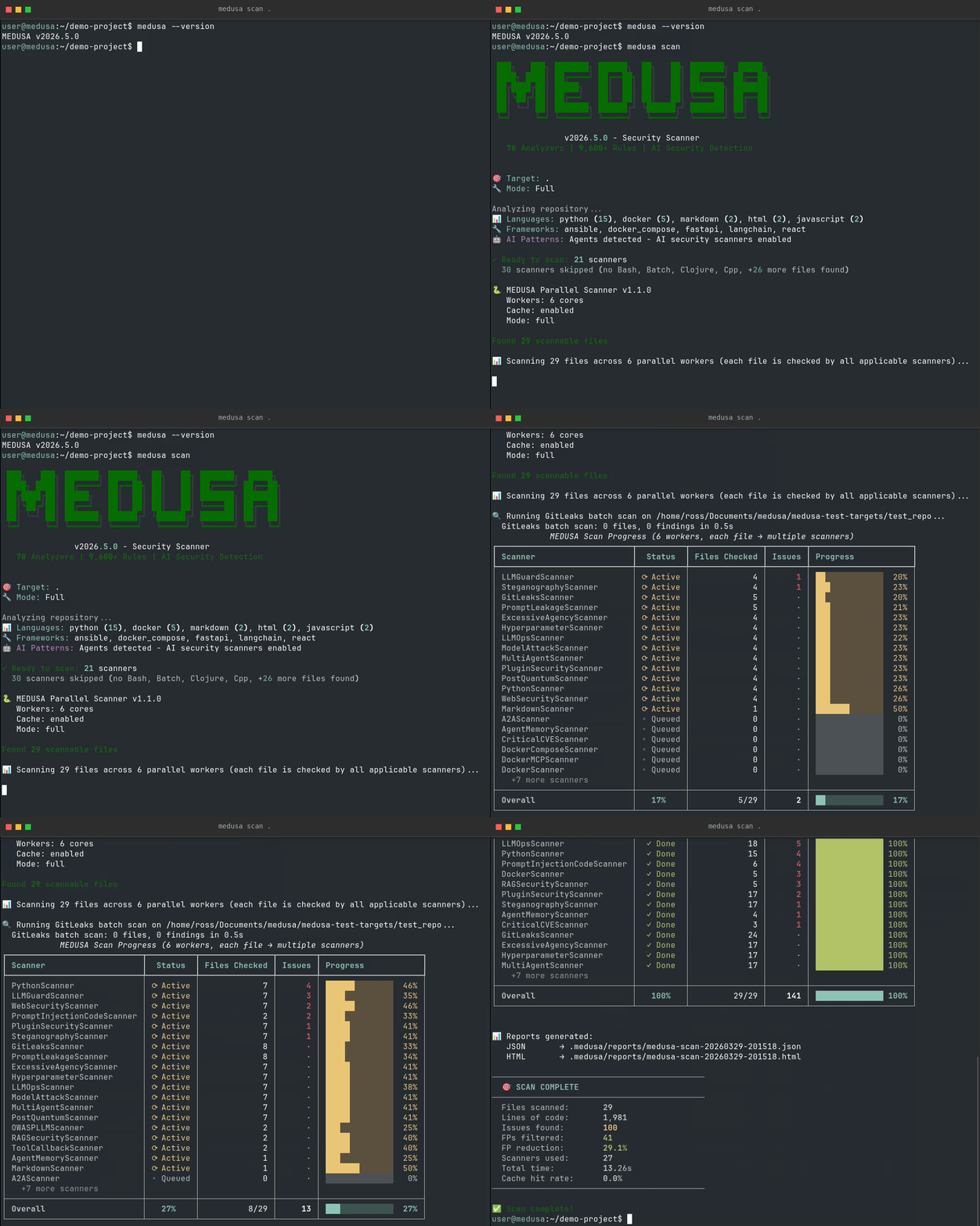
MEDUSA generates beautiful reports in multiple formats:
JSON - Machine-readable for CI/CD integration
medusa scan . --format json
HTML - Stunning glassmorphism UI with interactive charts
medusa scan . --format html
Markdown - Documentation-friendly for GitHub/wikis
medusa scan . --format markdown
All Formats - Generate everything at once
medusa scan . --format all
MEDUSA supports 79 scanner types covering AI/ML security, all major programming languages, and file formats:
| Language | Scanner | Extensions |
|---|---|---|
| Python | Bandit | .py |
| JavaScript/TypeScript | ESLint | .js, .jsx, .ts, .tsx |
| Go | golangci-lint | .go |
| Ruby | RuboCop | .rb, .rake, .gemspec |
| PHP | PHPStan | .php |
| Rust | Clippy | .rs |
| Java | Checkstyle | .java |
| C/C++ | cppcheck | .c, .cpp, .cc, .cxx, .h, .hpp |
| C# | Roslynator | .cs |
| Language | Scanner | Extensions |
|---|---|---|
| Kotlin | ktlint | .kt, .kts |
| Scala | Scalastyle | .scala |
| Groovy | CodeNarc | .groovy, .gradle |
| Language | Scanner | Extensions |
|---|---|---|
| Haskell | HLint | .hs, .lhs |
| Elixir | Credo | .ex, .exs |
| Erlang | Elvis | .erl, .hrl |
| F# | FSharpLint | .fs, .fsx |
| Clojure | clj-kondo | .clj, .cljs, .cljc |
| Language | Scanner | Extensions |
|---|---|---|
| Swift | SwiftLint | .swift |
| Objective-C | OCLint | .m, .mm |
| Language | Scanner | Extensions |
|---|---|---|
| CSS/SCSS/Sass/Less | Stylelint | .css, .scss, .sass, .less |
| HTML | HTMLHint | .html, .htm |
| Vue.js | ESLint | .vue |
| Language | Scanner | Extensions |
|---|---|---|
| Terraform | tflint | .tf, .tfvars |
| Ansible | ansible-lint | .yml (playbooks) |
| Kubernetes | kubeval | .yml, .yaml (manifests) |
| CloudFormation | cfn-lint | .yml, .yaml, .json (templates) |
| Language | Scanner | Extensions |
|---|---|---|
| JSON | built-in | .json |
| TOML | taplo | .toml |
| XML | xmllint | .xml |
| Protobuf | buf lint | .proto |
| Language | Scanner | Extensions |
|---|---|---|
| Bash/Shell | ShellCheck | .sh, .bash |
| PowerShell | PSScriptAnalyzer | .ps1, .psm1 |
| Lua | luacheck | .lua |
| Perl | perlcritic | .pl, .pm |
| Language | Scanner | Extensions |
|---|---|---|
| Markdown | markdownlint | .md |
| reStructuredText | rst-lint | .rst |
| Language | Scanner | Extensions |
|---|---|---|
| SQL | SQLFluff | .sql |
| R | lintr | .r, .R |
| Dart | dart analyze | .dart |
| Solidity | solhint | .sol |
| Docker | hadolint | Dockerfile* |
Total: 79 scanner types — 41 language/tool scanners + 38 AI/ML security scanners — covering 100+ file extensions
MEDUSA now detects CVE-2025-55182 "React2Shell" - a CVSS 10.0 RCE vulnerability affecting React Server Components and Next.js.
# Check if your project is vulnerable
medusa scan .

# Vulnerable versions detected:
# - React 19.0.0 - 19.2.0 (Server Components)
# - Next.js 15.0.0 - 15.0.4 (App Router)
# - Various canary/rc releases
Scans: package.json, package-lock.json, yarn.lock, pnpm-lock.yaml
Fix: Upgrade to React 19.0.1+ and Next.js 15.0.5+
MEDUSA provides industry-leading AI security scanning with 40,000+ detection patterns for the agentic AI era. Updated for OWASP Top 10 for LLM Applications 2025 and includes detection for 200+ CVEs across AI coding editors and MCP servers.
Full AI Security Documentation
| Category | Patterns | Detects |
|---|---|---|
| Prompt Injection | 800+ | Direct/indirect injection, jailbreaks, role manipulation |
| MCP Server Security | 400+ | Tool poisoning, schema poisoning, ATPA, sampling injection, rug-pull |
| Repo Poisoning | 150+ | Weaponized AI editor configs, Clinejection, CurXecute, IDEsaster, CamoLeak |
| RAG Security | 300+ | Vector injection, document poisoning, tenant isolation |
| Agent Security | 500+ | Excessive agency, memory poisoning, HITL bypass |
| Model Security | 400+ | Insecure loading, checkpoint exposure, adversarial attacks |
| Supply Chain | 350+ | Dependency confusion, typosquatting, lock file backdoors |
| Traditional SAST | 1,400+ | SQL injection, XSS, command injection, secrets |
|
Context & Input Attacks
Memory & State Attacks
Tool & Action Attacks
|
Workflow & Routing Attacks
RAG & Knowledge Attacks
Advanced Attacks
|
# Critical - Known RCE vectors
.cursorrules              # Cursor AI (CVE-2025-54135)
.cursor/rules/*.mdc       # Cursor rules directory
.cursor/mcp.json          # Cursor MCP (CurXecute RCE)
.clinerules/*.md          # Cline (Clinejection)
.windsurfrules            # Windsurf (CVE-2025-36730)
.windsurf/rules/*         # Windsurf workspace rules
.codex/config.toml        # Codex CLI (CVE-2025-61260)
.kiro/settings/mcp.json   # Kiro (CVE-2026-0830)
.vscode/settings.json     # VS Code (IDEsaster)
*.code-workspace          # VS Code workspace
mcp.json / .mcp.json      # MCP server configs

# High - AI instruction files
CLAUDE.md                 # Claude Code
GEMINI.md                 # Gemini CLI
AGENTS.md                 # OpenAI Codex
AGENT.md                  # Roo Code
SKILL.md                  # ClawHub/ToxicSkills
CONVENTIONS.md            # Aider
.github/copilot-instructions.md  # GitHub Copilot
.amazonq/rules/*.md       # Amazon Q Developer
.augment/rules/*          # Augment Code
.roo/rules/*.md           # Roo Code
.tabnine/guidelines/*.md  # Tabnine
.continue/config.yaml     # Continue.dev
.cody.yml                 # Sourcegraph Cody
# Scan AI configuration files
medusa scan . --ai-only

# Example output:
# 🔍 AI Security Scan Results
# ├── .cursorrules: 3 issues (1 CRITICAL, 2 HIGH)
# │   └── AIC001: Prompt injection - ignore previous instructions (line 15)
# │   └── AIC011: Tool shadowing - override default tools (line 23)
# ├── mcp-config.json: 2 issues (2 HIGH)
# │   └── MCP003: Dangerous path - home directory access (line 8)
# └── rag_config.json: 1 issue (1 CRITICAL)
#     └── AIR010: Knowledge base injection pattern detected (line 45)
# Initialize configuration
medusa init

# Scan current directory
medusa scan .

# Scan specific directory
medusa scan /path/to/project

# Quick scan (changed files only)
medusa scan . --quick

# Force full scan (ignore cache)
medusa scan . --force

# Use specific number of workers
medusa scan . --workers 4

# Fail on HIGH severity or above
medusa scan . --fail-on high

# Custom output directory
medusa scan . -o /tmp/reports
# Check tool status
medusa install --check

# Install AI tools (modelscan for ML model scanning)
medusa install --ai-tools

# Show detailed output
medusa install --ai-tools --debug
Note: MEDUSA v2026.2+ no longer installs external linters. Install them via your package manager (apt, brew, npm, pip) if needed. MEDUSA auto-detects and uses any installed linters.
# Interactive initialization wizard
medusa init

# Initialize with specific IDE
medusa init --ide claude-code

# Initialize with multiple IDEs
medusa init --ide claude-code --ide gemini-cli --ide cursor

# Initialize with all supported IDEs
medusa init --ide all

# Force overwrite existing config
medusa init --force

# Initialize and install tools
medusa init --install
# Uninstall modelscan
medusa uninstall modelscan

# Check for updates
medusa version --check-updates

# Show current configuration
medusa config

# Override scanner for specific file
medusa override path/to/file.yaml YAMLScanner

# List available scanners
medusa override --list

# Show current overrides
medusa override --show

# Remove override
medusa override path/to/file.yaml --remove
| Option | Description |
|---|---|
TARGET | Directory or file to scan (default: .) |
-g, --git URL | Clone and scan a remote git repo (GitHub URL or user/repo shorthand) |
-w, --workers N | Number of parallel workers (default: auto-detect) |
--quick | Quick scan (changed files only, requires git) |
--force | Force full scan (ignore cache) |
--no-cache | Disable result caching |
--fail-on LEVEL | Exit with error on severity: critical, high, medium, low |
-o, --output PATH | Custom output directory for reports |
--format FORMAT | Output format: json, html, sarif, junit, text (can specify multiple) |
--no-report | Skip generating HTML report |
| Option | Description |
|---|---|
--check | Check tool status |
--ai-tools | Install AI security tools (modelscan) |
--debug | Show detailed debug output |
v2026.2+ Change: MEDUSA no longer manages external linter installation. The
--allflag is deprecated. Install external linters via your system package manager if needed.
.medusa.ymlMEDUSA uses a YAML configuration file for project-specific settings:
# MEDUSA Configuration File
version: 2026.5.5

# Scanner control
scanners:
  enabled: []      # Empty = all scanners enabled
  disabled: []     # List scanners to disable

# Build failure settings
fail_on: high      # critical | high | medium | low

# Exclusion patterns
exclude:
  paths:
    - node_modules/
    - venv/
    - .venv/
    - .git/
    - __pycache__/
    - dist/
    - build/
  files:
    - "*.min.js"
    - "*.min.css"

# IDE integration
ide:
  claude_code:
    enabled: true
    auto_scan: true
  cursor:
    enabled: false
  vscode:
    enabled: false

# Scan settings
workers: null        # null = auto-detect CPU cores
cache_enabled: true  # Enable file caching for speed
medusa init
This creates .medusa.yml with sensible defaults and auto-detects your IDE.
MEDUSA supports 5 major AI coding assistants with native integrations. Initialize with medusa init --ide all or select specific platforms.
| IDE | Context File | Commands | Status |
|---|---|---|---|
| Claude Code | CLAUDE.md | /medusa-scan, /medusa-install | ✅ Full Support |
| Gemini CLI | GEMINI.md | /scan, /install | ✅ Full Support |
| OpenAI Codex | AGENTS.md | Native slash commands | ✅ Full Support |
| GitHub Copilot | .github/copilot-instructions.md | Code suggestions | ✅ Full Support |
| Cursor | Reuses CLAUDE.md | MCP + Claude commands | ✅ Full Support |
# Setup for all IDEs (recommended)
medusa init --ide all

# Or select specific platforms
medusa init --ide claude-code --ide gemini-cli
What it creates:
CLAUDE.md - Project context file.claude/agents/medusa/agent.json - Agent configuration.claude/commands/medusa-scan.md - Scan slash command.claude/commands/medusa-install.md - Install slash commandUsage:
Type: /medusa-scan
Claude: *runs security scan*
Results: Displayed in terminal + chat
What it creates:
GEMINI.md - Project context file.gemini/commands/scan.toml - Scan command config.gemini/commands/install.toml - Install command configUsage:
gemini /scan              # Full scan
gemini /scan --quick      # Quick scan
gemini /install --check   # Check tools
What it creates:
AGENTS.md - Project context (root level)Usage:
Ask: "Run a security scan"
Codex: *executes medusa scan .*
What it creates:
.github/copilot-instructions.md - Security standards and best practicesHow it helps:
What it creates:
.cursor/mcp-config.json - MCP server configuration.claude/ structure (Cursor is VS Code fork)Usage:
MEDUSA automatically monitors system load and adjusts worker count:
# Auto-detects optimal workers based on:
# - CPU usage
# - Memory usage
# - Load average
# - Available cores

# Warns when system is overloaded:
⚠️  High CPU usage: 85.3%
Using 2 workers (reduced due to system load)
Hash-based caching skips unchanged files:
# First scan
📂 Files scanned: 145
⏱️  Total time: 47.28s

# Second scan (no changes)
📂 Files scanned: 0
⚡ Files cached: 145
⏱️  Total time: 2.15s  # 22× faster!
Multi-core scanning for massive speedups:
Single-threaded:  417.5 seconds
6 workers:         47.3 seconds  # 8.8× faster
24 workers:        ~18 seconds   # 23× faster
# 1. Initialize
cd my-awesome-project
medusa init

🐍 MEDUSA Initialization Wizard

✅ Step 1: Project Analysis
   Found 15 language types
   Primary: PythonScanner (44 files)

✅ Step 2: Scanner Availability
   Available: 6/79 scanners
   Missing: 73 tools

✅ Step 3: Configuration
   Created .medusa.yml
   Auto-detected IDE: Claude Code

✅ Step 4: IDE Integration
   Created .claude/agents/medusa/agent.json
   Created .claude/commands/medusa-scan.md

✅ MEDUSA Initialized Successfully!

# 2. First scan
medusa scan .

🔍 Issues found: 23
   CRITICAL: 0
   HIGH: 2
   MEDIUM: 18
   LOW: 3

# 3. Fix issues and rescan
medusa scan . --quick

⚡ Files cached: 142
🔍 Issues found: 12  # Progress!
# .github/workflows/security.yml
name: Security Scan

on: [push, pull_request]

jobs:
  medusa:
    runs-on: ubuntu-latest
    steps:
      - uses: actions/checkout@v3

      - name: Set up Python
        uses: actions/setup-python@v4
        with:
          python-version: '3.11'

      - name: Install MEDUSA
        run: pip install medusa-security

      - name: Run security scan
        run: medusa scan . --fail-on high
Note: No tool installation step needed - MEDUSA's 40,000+ built-in rules work immediately.
All scanners follow a consistent pattern:
class PythonScanner(BaseScanner):
    """Scanner for Python files using Bandit"""

    def get_tool_name(self) -> str:
        return "bandit"

    def get_file_extensions(self) -> List[str]:
        return [".py"]

    def scan_file(self, file_path: Path) -> ScannerResult:
        # Run bandit on file
        # Parse JSON output
        # Map severity levels
        # Return structured issues
        return ScannerResult(...)
Scanners automatically register themselves:
# medusa/scanners/__init__.py
registry = ScannerRegistry()
registry.register(PythonScanner())
registry.register(JavaScriptScanner())
# ... all 79 scanners
Unified severity levels across all tools:
MEDUSA scans itself — and real-world projects:
Self-scan (473 files):
  ✅ Issues found: 114 (pre-filter) → 0 (post-filter)
  ✅ FP reduction: 100% on own codebase
  ⏱️  Time: 8.2s

OpenClaw benchmark (4,124 files, 751K LOC):
  🔍 Issues found: 825 (post-filter)
  ✅ FPs filtered: 11,436 (93.9% reduction)
  ⏱️  Time: 3.3 hours (79 scanners)
| Project Size | Files | Time | Speed |
|---|---|---|---|
| Small (MEDUSA self-scan) | 473 | ~8s | 59 files/s |
| Medium | 1,000 | ~45s | 22 files/s |
| Large (OpenClaw) | 4,124 | ~3.3h | 0.34 files/s* |
*Large project time dominated by external tool subprocesses (Semgrep, Trivy, GitLeaks). Built-in pattern scanning is near-instant.
medusa scan --git <URL> - Scan any GitHub repo for AI supply chain attacksWe welcome contributions! Here's how to get started:
# 1. Fork and clone
git clone https://github.com/yourusername/medusa.git
cd medusa

# 2. Create virtual environment
python -m venv .venv
source .venv/bin/activate  # or `.venv\Scripts\activate` on Windows

# 3. Install in editable mode
pip install -e ".[dev]"

# 4. Run tests
pytest

# 5. Create feature branch
git checkout -b feature/my-awesome-feature

# 6. Make changes and test
medusa scan .  # Dogfood your changes!

# 7. Submit PR
git push origin feature/my-awesome-feature
See docs/development/adding-scanners.md for a guide on adding new language support.
AGPL-3.0-or-later - See LICENSE file
MEDUSA is free and open source software. You can use, modify, and distribute it freely, but any modifications or derivative works (including SaaS deployments) must also be released under AGPL-3.0.
For commercial licensing options, contact: support@pantheonsecurity.io
MEDUSA Professional adds runtime protection for production LLM applications - blocking prompt injection, jailbreaking, and data exfiltration attempts in real-time before they reach your models.
| Feature | Open Source | Professional | Enterprise |
|---|---|---|---|
| Static scanning (40,000+ patterns) | Yes | Yes | Yes |
| Runtime proxy filters (1,100+) | - | Yes | Yes |
| REST API & webhooks | - | Yes | Yes |
| Custom rules & SSO | - | - | Yes |
| Price | Free | $99/dev/mo | $499/50 devs/mo |
The runtime proxy is currently in private beta. If you're protecting production LLM applications and want early access, reach out to support@pantheonsecurity.io.
Development:
Built With:
Inspired By:
Version: 2026.5.5 Release Date: 2026-04-03 Detection Patterns: 40,000+ AI security rules Analyzers: 79 specialized scanners FP Filter Patterns: 514 intelligent filters (96.8% reduction rate) CVE Coverage: 200 critical vulnerabilities (37+ AI editor CVEs) Repo Poisoning: 28+ AI editor config file types detected Language Coverage: 46+ file types Platform Support: Linux, macOS, Windows AI Integration: Claude Code, Gemini CLI, GitHub Copilot, Cursor, OpenAI Codex Standards: OWASP Top 10 for LLM 2025, MITRE ATLAS Downloads: 11,500+ on PyPI
pip install && scan)🐍🐍🐍 MEDUSA - Multi-Language Security Scanner 🐍🐍🐍
One Command. Complete Security.
medusa init && medusa scan .
Last Updated: 2026-04-03 Status: Production Ready Current Version: v2026.5.5 - Security Hardening
Run Claude Code as an MCP server so any agent can delegate coding tasks to it
 @microsoft✓ Official
Browser automation using accessibility snapshots instead of screenshots
 @googleapis✓ Official
Google's universal MCP server supporting PostgreSQL, MySQL, MongoDB, Redis, and 10+ databases
 @github✓ Official
Official GitHub integration for repos, issues, PRs, and CI/CD workflows