

Are you the author? Sign in to claim
Compile CLAUDE.md rules into trigger-bound hooks — a Claude Code plugin that delivers each rule at the moment it matters

English | 한국어
"Rules with nunchi — delivered before you have to ask."
nunchi is a Claude Code plugin that turns CLAUDE.md rules into event listeners. Instead of loading every rule at session start and hoping it survives 40 turns and a compaction, each rule is delivered at the exact moment its action fires:
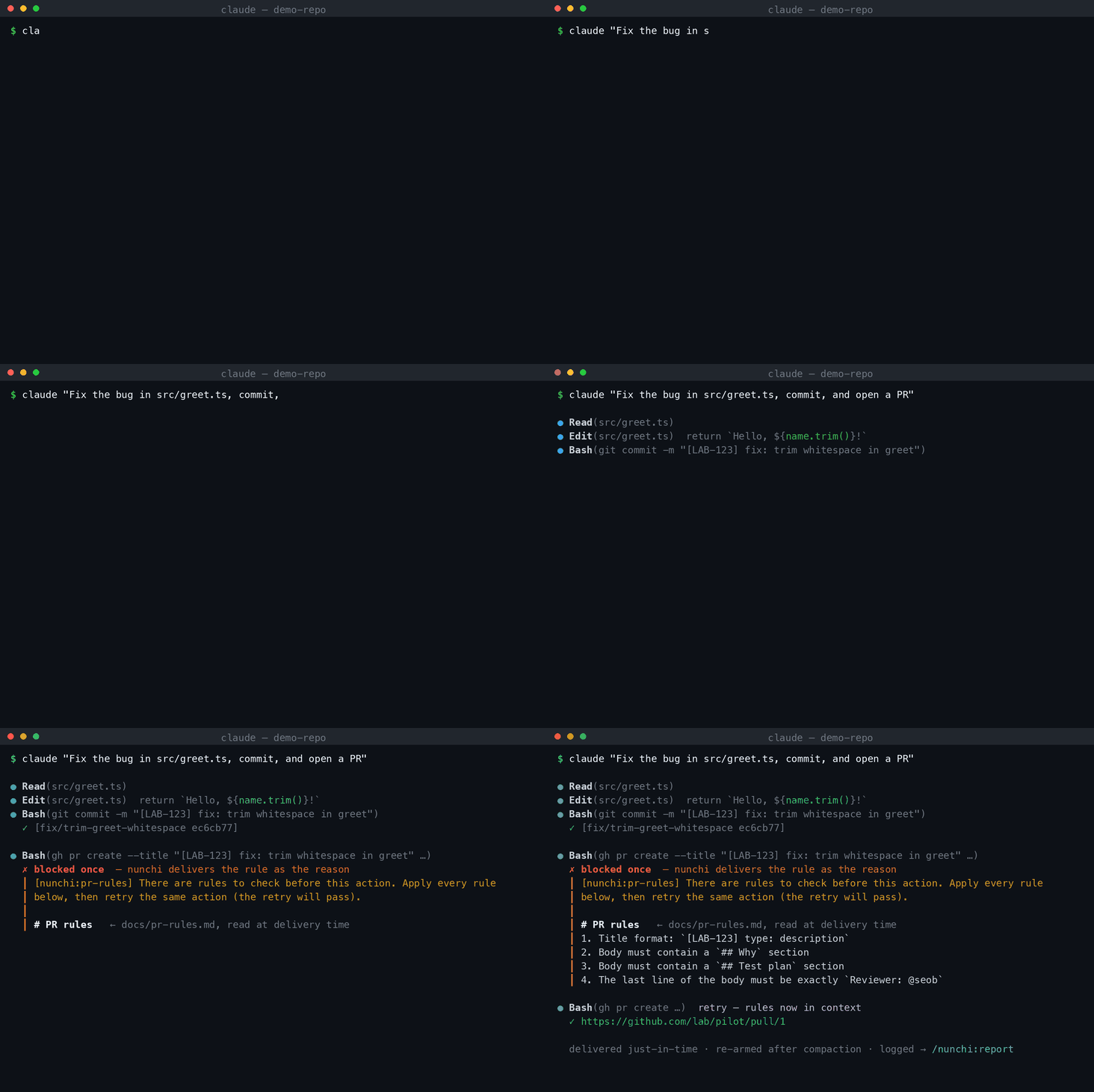
(real session, replayed — the first gh pr create is denied exactly once, with the full rules doc — read from docs/pr-rules.md at that moment — as the deny reason; the retry passes)
One /nunchi:compile turns your CLAUDE.md into trigger-bound rule files; a PreToolUse hook does the delivery from then on. What you get, all measured:
@imports saved ~34k prompt tokens per session start; the full doc is paid only in sessions where its action actually fires./compact, verified across repeated compactions./nunchi:report shows which rule fired when, and what it saved in your repo.Requires Claude Code with plugin support, and Python 3 (the hook engine runs on the standard library only — no external packages).
Option 1 — install as a plugin (recommended: a managed bundle that can stay current on its own):
claude plugin marketplace add seob717/nunchi
claude plugin install nunchi@nunchi-marketplace
(Inside a session, /plugin marketplace add seob717/nunchi and /plugin install nunchi@nunchi-marketplace do the same.)
Auto-update is off by default for third-party marketplaces. To receive each release automatically: run /plugin, open the Marketplaces tab, select nunchi-marketplace, and choose Enable auto-update. Updates ship once per release (release-please bumps the plugin version); Claude Code fetches them in the background after a session starts, and they take effect on the next launch or /reload-plugins. If you prefer manual control, /plugin marketplace update nunchi-marketplace refreshes on demand.
To set up a whole team, commit this to the project's .claude/settings.json — collaborators who trust the repository are prompted to install:
{
  "extraKnownMarketplaces": {
    "nunchi-marketplace": {
      "source": { "source": "github", "repo": "seob717/nunchi" }
    }
  },
  "enabledPlugins": {
    "nunchi@nunchi-marketplace": true
  }
}
Option 2 — clone and hack (an editable local copy: tweak the engine, commands, or triggers directly):
git clone https://github.com/seob717/nunchi.git
claude --plugin-dir /path/to/nunchi
--plugin-dir is per-invocation, so pass it on each launch. Your local edits apply the next time you start — nothing updates underneath you.
Then, inside your project:
/nunchi:compile — reads CLAUDE.md and the @referenced documents inside it, extracts rules, infers a trigger (tool, regex pattern) for each, and writes them to .claude/rules/*.md./nunchi:report shows what was delivered, when, and what it saved.A rule you write in CLAUDE.md is loaded once, at t=0 when the session starts, and that's it. But the moment that rule actually matters is usually dozens of turns later. As context piles up, the model's attention on a rule from the top of the session fades, and once a compaction (summary) passes through, an explicit rule gets demoted to blurry background. A referenced document like @docs/pr-rules.md ends up furthest from context at exactly the point where the rule is needed (e.g. when running gh pr create). nunchi compiles a rule not as a "declaration at the top of the session" but as an "event listener bound to an action," collapsing the distance between when a rule is needed and when it is delivered to zero.
/nunchi:compile — Reads CLAUDE.md and the @referenced documents inside it, extracts rules, infers a trigger (tool, regex pattern) for each rule, and compiles them into .claude/rules/*.md.source document directly at that moment (the original, not a pasted copy) and delivers it. When several rules match the same tool call, their contents are delivered together in a single block, so one action costs at most one retry.Compilation, end to end — this line in your CLAUDE.md:
All PRs follow the checklist in @docs/pr-rules.md.
becomes .claude/rules/pr-rules.md, bound to the action it governs:
---
name: pr-rules
trigger:
  tool: Bash
  pattern: gh\s+pr\s+create
source: docs/pr-rules.md
strength: require-read
enabled: true
---
Reflect docs/pr-rules.md before creating a PR.
name: lowercase letters, digits, and hyphens only ([a-z0-9][a-z0-9-]*). A file with an invalid name is rejected with a stderr warning instead of silently misbehaving.trigger.tool / trigger.pattern: which tool call to intercept, and with what regex. By default the pattern matches a Bash rule against the command string and an Edit/Write rule against the file path.trigger.field (optional): match against a specific tool_input field instead of the default. field: new_string on an Edit rule makes content rules expressible — e.g. pattern console\.log fires when the edit being written contains console.log, regardless of the file path.trigger.path (optional): a file-path regex ANDed with pattern — the rule fires only when both match. Scope content rules to code files (path: \.(ts|tsx)$) so example code inside markdown or docs doesn't trigger them; without it, a field: new_string rule blocks any file whose edit contains the pattern — including the rule's own source document.source: the path to the original document, read on the spot at delivery time. If the original changes, the change is reflected automatically from the next delivery on. When several rules share one source, the document travels in full once per session — later deliveries carry the rule's one-line body plus a pointer to the full text already in the transcript, instead of repeating the document.strength: three levels, in decreasing order of enforcement.
block — always block, delivering the rule as the reason. For actions a document marks as absolutely forbidden. Repeat attempts in the same session stay blocked, but with an abbreviated reason (one-line body + a pointer to the full text delivered earlier) — enforcement unchanged, tokens saved.require-read (default) — block once per session with the rule text as the reason, then let the retry through. One retry buys a guaranteed read.inject — deliver the rule via additionalContext alongside the tool call, with zero blocking and zero retry cost. The delivery carries a provenance framing (project-owner hook, registered rule path, source path) because we measured that unframed injected instructions get treated as prompt injection and refused, while framed ones are followed (see pilot/PROBE-inject.md). Softer than require-read: compliance rides on the model's judgment instead of a forced retry. nunchi never returns permissionDecision: allow, so your permission prompts are untouched..claude/rules/ loaderClaude Code itself (v2.0.64+) also reads .claude/rules/*.md: a file without a paths: frontmatter key gets its body loaded into context at session start (verified by probe on v2.1.206). nunchi embraces this rather than fighting it — the two loaders split the work:
This is why rule bodies must stay at one summary line: a long body would be injected at session start and delivered again at trigger time. /nunchi:compile generates bodies this way by default.
Changes to a rule's content need nothing from you — the source document is read fresh at every delivery. What can silently go stale is the trigger structure: a new rule added to the document, a rule rebound to a different action, or a changed prohibition strength, none of which take effect until /nunchi:compile <path> is re-run. Three signals cover this (from #17):
source of a compiled rule, the hook injects a once-per-session note naming the affected rules and the exact recompile command. Non-blocking (additionalContext only), and it reuses the rule list already loaded for matching, so calls that touch nothing pay nothing./nunchi:report candidates — rules whose source document is newer on disk than the compiled rule file are listed as recompile candidates (mtime heuristic; a fresh clone resets mtimes, so treat it as a prompt, not proof).docs/*-rules.md, an ordinary nunchi rule can watch the convention itself and suggest compiling newly created documents (/nunchi:compile offers to generate it; see the compile command's §5.6). No extra config surface — the watcher is just another rule file.The one gap none of these catch is trigger drift with no document change at all (the team switches gh → glab and the PR rules doc never mentions tooling) — that surfaces as a dead rule in /nunchi:report (delivered 0 times), which is why the report flags never-triggered rules.
| Command | Purpose | Argument |
|---|---|---|
/nunchi:compile | Extract rules from CLAUDE.md and its @referenced documents; write trigger-bound .claude/rules/*.md. Skipped content is reported too, split into skill candidates (procedures) and always-on guidance (stays in CLAUDE.md). | Optional document path — recompile just that one document (this is the command the edit-time reminder names). |
/nunchi:report | Aggregate the delivery log into a table: per-rule delivery counts, dead (never-triggered) rules, recompile candidates, and the estimated context savings for your repo. | None. |
Every claim in this section is measured; designs and raw results are preserved in pilot/ so they can be re-run. The map — each row is a rearrangement of the detail paragraphs below, not a new claim:
| Experiment | Headline result | Details |
|---|---|---|
| JIT delivery E2E (5 conditions) | nunchi 3/3 all-pass; a block that withholds the reason (hookify block) 0/3 | table just below |
| Pressure re-verification (24 rules, ~268KB context) | baseline ceiling held (40/40) — comparison gate not met, so no superiority claim | pilot/RESULTS-pressure.md |
| Compaction pressure | first observed baseline violation (2/3 all-pass) — gate still not met; re-arm worked 3/3 | pilot/RESULTS-compaction.md |
| Compaction follow-up | baseline violation rate 1/12 (~8%); re-arm survives double compaction (2/2) | pilot/RESULTS-compaction-followup.md |
| Context economics | −42.5% prompt tokens at session start (79,683 → 45,808) | pilot/PROBE-context-economics.md |
| Compile benchmark (12 wild CLAUDE.md files) | 100% valid format, zero fabricated rules, 35% micro-recall (measured, not hidden) | pilot/RESULTS-compile-bench.md, pilot/RESULTS-compile-recall.md |
| Multilingual compile (ko/ja/es) | no degradation vs. English; strength agreement 61% → 82%, wild Korean 88% | pilot/RESULTS-compile-multilingual.md, pilot/RESULTS-strength-guidance.md, pilot/RESULTS-compile-wild-ko.md |
Measurement harness: a sandbox repo + a mock gh (captures PRs) + 4 machine-gradable PR rules + headless claude -p (sonnet), 3 runs per condition. (The full harness is preserved in the pilot/ directory so it can be re-run.)
| Condition | Description | All-pass | Notes |
|---|---|---|---|
| A | CLAUDE.md only (short context) | 3/3 | Ceiling effect — the rule was just loaded, so it doesn't collapse under this pressure |
| AL | CLAUDE.md only + long context (~60k tokens) | 3/3 | The ceiling effect persists even in long context |
| HW | hookify warn | 3/3 | The warning message never reaches the model, so effectively the same condition as A |
| HB | hookify block | 0/3 | It doesn't populate permissionDecisionReason, so the model is blocked without knowing why, destroying 3/3 of the tasks |
| Z | nunchi JIT delivery (real engine, E2E) | 3/3 | Hook fired 3/3 — the first attempt is blocked while the reason (the rule's original text) is delivered, and all retries pass |
What this table shows is not an edge of "JIT has a higher compliance rate than CLAUDE.md" — at this pilot's pressure level (4 simple rules, a single task, sonnet), even CLAUDE.md alone (A, AL) held up with a ceiling effect, and we don't hide that result. What the measurement actually supports is three things:
source is read every time at delivery, the rule and its original never drift apart, and every trigger, delivery, and block is recorded as JSONL and aggregated by /nunchi:report.Pressure re-verification (pre-registered): we then scaled the pressure to 24 rules behind a 3-level @reference structure plus the same ~268KB long-context task and re-ran the CLAUDE.md-only condition (design and results: pilot/DESIGN-pressure.md, pilot/RESULTS-pressure.md). The ceiling held — all-pass stayed 100% across 5 valid runs (40/40 graded checkpoints), so the pre-registered gate for a confirmatory JIT-vs-CLAUDE.md comparison was not met and we did not run it.
Compaction pressure (pre-registered): we then forced a /compact mid-task and graded only post-compaction behavior (design and results: pilot/DESIGN-compaction.md, pilot/RESULTS-compaction.md). The CLAUDE.md-only condition produced its first observed rule violation across all experiments (a PR labeled with a value outside the allow-list that lives only in an @referenced doc — exactly the detail compaction discards), but at 2/3 all-pass the pre-registered gate was again not met, so no confirmatory comparison was run and no superiority claim is made. What the runs do support: the re-arm mechanism worked in 3/3 treated runs (deliver → compact → re-arm → re-deliver), and JIT delivery still didn't hurt task completion after compaction (3/3 all-pass). Whether JIT shows a compliance edge under stronger pressure remains unverified, and we don't make that claim until it is.
Compaction follow-up (pre-registered): two further arms (design and results: pilot/DESIGN-compaction-followup.md, pilot/RESULTS-compaction-followup.md). A 10-run expansion of the CLAUDE.md-only compaction condition produced no new violations in 9 valid runs, putting the observed single-compaction violation rate at 1/12 (~8%). A double-compaction preflight (3-stage task, two forced /compacts) again did not meet the pre-registered gate (all valid baseline runs passed), so no superiority comparison was run and none is claimed. What it did verify: the re-arm mechanism survives repeated compaction — deliver → compact → re-deliver → compact → re-deliver again, in 2/2 valid treated runs — and JIT delivery still didn't hurt task completion after two compactions.
Context economics (measured probe): @imported files are "expanded and loaded into context at launch" (official memory docs), and the official best practices warn that "longer files consume more context and reduce adherence" (best practices) — the official remedy, path-scoped rules, covers file-read triggers; nunchi extends the same idea to action triggers with enforcement. Moving rule documents out of CLAUDE.md @imports and into nunchi rules changes when their tokens are paid. We measured it head-to-head (pilot/PROBE-context-economics.md): the same repo with 8 rule docs (~76KB) loaded via @import cost 79,683 prompt tokens at session start; the nunchi configuration (one-line rule bodies, docs delivered just-in-time by trigger) cost 45,808 — a saving of ~34k tokens (−42.5%) per session start, with the rule-doc payload itself dropping 97% (34,878 → 1,003 tokens). The full document is then paid only in sessions where its action actually fires, at the moment it fires. Two honesty caveats: a doc that also carries always-on guidance (about half of wild rules, per the compile benchmark below) should keep its @reference — the saving applies to action-bindable docs; and in a session that triggers many rules the delivery spend adds back up, arriving as precisely-timed context rather than upfront freight. /nunchi:report computes these numbers for your own repo from your rule files and delivery logs.
Compile benchmark on wild CLAUDE.md files (pre-registered pilot): we ran the /nunchi:compile instructions over 12 real-world CLAUDE.md files (166KB total: apache/airflow, vercel/next.js, supabase, plus a deterministic sample from awesome-claude-md, with an empty-stub negative control) — design and results: pilot/DESIGN-compile-bench.md, pilot/RESULTS-compile-bench.md. Of 88 extracted rules: 100% valid regexes and tools, 100% of content rules carried the required path: scope, zero fabricated rules on the empty control, and all 8 block-strength assignments traced to explicit "Never/MUST NOT" wording in the source (verified quote-by-quote). About half of wild rules (51%) were action-bindable at all — the other half is always-on guidance, which is exactly why nunchi is designed to coexist with CLAUDE.md rather than replace it. Recall against an adversarial gold set (181 rules authored by a separate model in isolated sessions) is 35% micro-recall — measured, not hidden (pilot/RESULTS-compile-recall.md, pilot/RESULTS-compile-recall-v2.md). About a third of those misses are the compiler deliberately skipping non-action-bindable guidance (self-reported in its own output), and the gold set splits rules more finely than the spec's one-rule-per-trigger policy — but real gaps remain (rules inside tables and deep lists), and closing them is tracked openly in issues.
Multilingual compile compatibility (pre-registered pilot): the same compile instructions run over Korean/Japanese/Spanish translations of three of those documents showed no degradation in recall, output format, or over-extraction versus the English originals (pilot/RESULTS-compile-multilingual.md) — the one axis that wobbled across languages was strength: recommendation vs. prohibition nuance ("avoid" vs. "never") distorts in translation. Adding a speech-act judging principle with per-language calibration examples to the compile spec lifted gold-strength agreement from 61% to 82% with zero regression on the gated metrics (pilot/RESULTS-strength-guidance.md). The same pipeline was then run on four wild Korean CLAUDE.md files sampled deterministically from GitHub (including pinpoint-apm/pinpoint, ★13.8k): zero format violations, zero over-extraction, zero fabricated evidence, and 88% strength agreement — wild prohibitions like "master에는 절대 직접 커밋하지 않습니다" all compiled to block (pilot/RESULTS-compile-wild-ko.md). For authors writing CLAUDE.md in Korean, there is a phrasing guide: guides/writing-korean-claude-md.md (in Korean).
…shrinking CLAUDE.md? Dieting CLAUDE.md reduces the upfront token bill but keeps the delivery model: everything you kept still loads at t=0 and fades with distance and compaction. nunchi changes when a rule arrives, not just how much of it there is — the rule text lands in context milliseconds before the action it governs, and again after every compaction. Measured either way: the observed baseline failure is exactly a post-compaction violation of a rule that lived in an @referenced doc (pilot/RESULTS-compaction.md).
…Claude Code's path-scoped rules (paths: frontmatter)? Path-scoped rules trigger on reading files. nunchi triggers on actions: gh pr create, git commit, the content of the edit being written (trigger.field: new_string), with per-session delivery state and three enforcement strengths. The two compose — nunchi's rule files are native .claude/rules/ files, and the native loader injects their one-line bodies at session start while nunchi delivers the full source document at trigger time.
…a skill? Skills and nunchi share the same context shape — a one-line declaration always loaded, the full body just-in-time — but the trigger owner differs. A skill is pulled: the model must recognize from the description that it's needed and open it, and no mechanism forces a skill to fire before a given action (the official docs point to hooks when a guarantee is needed). Rule compliance fails exactly when the model has forgotten a rule exists — and a model that forgot the rule won't open its skill either. nunchi is pushed: the action itself is the trigger, so delivery doesn't depend on the model remembering anything; it can enforce (require-read/block — skills are advisory only), and every delivery is logged. In short: skills work when the model remembers; nunchi works when it forgets. The two compose — put procedures (release steps, migration workflows) in skills, and let nunchi guard the actions those procedures take: a skill that runs gh pr create mid-procedure gets the PR rules delivered right there.
…an MCP/output-compression tool like Context Mode or RTK? Those compress what flows into context (MCP output, Bash output). nunchi doesn't compress anything — it schedules rule delivery. Token saving is a side effect of not front-loading documents; the product is that the rule is provably in context at the moment of the action, and every delivery is logged so you can audit compliance instead of assuming it.
…hoping the regex matches? Triggers are deterministic regexes by design — auditable, testable, no retrieval variance. The cost is honest: a mis-scoped pattern misses or over-fires. That's why compiled rule files are plain text you review (step 2 of Quick start), why content rules are required to carry a path: scope, and why the compile spec itself is benchmarked for format validity (100%) and fabrication (0) on wild corpora.
Different tools solve different layers of "make the agent follow the rules". Static distributors (Ruler, rulesync) answer "how do I ship the same rules to every agent?". Guardrail hooks (hookify) answer "how do I stop a bad action?". Skills answer "how do I give the agent a procedure without paying for it up front?". nunchi answers "how do I get the right rule into the model's context at the moment it matters — and keep it there across compactions?". These compose: you can distribute rule documents with Ruler, put procedures in skills, and deliver the rules with nunchi.
The table below is a scope map, not a scoreboard — an empty cell or a "by design" note usually marks a deliberate design choice, and several rows go the other way (hookify covers more hook events, Writ retrieves semantically, Ruler distributes to 30+ agents — none of which nunchi does).
| Capability | nunchi | hookify | Claude Code native rules | Claude Code Skills | Ruler / rulesync | Writ |
|---|---|---|---|---|---|---|
Action (command) triggers — gh pr create, git commit | ✅ | ✅ | file-read path globs | model-pulled² | out of scope¹ | partial (built-in gates) |
| Content triggers — what's being written | ✅ trigger.field | ✅ | — | — | out of scope¹ | partial (static-analysis pre-write) |
| Delivers rule text to the model on block | ✅ reason | Stop ✅ / PreToolUse: user-facing message | — | advisory only — cannot block | out of scope¹ | ✅ rule ID + reason |
| Non-blocking JIT injection | ✅ inject | — | at file-read | ✅ at invocation² | out of scope¹ | ✅ every turn (retrieval) |
| Delivery state — once per session, no block loops | ✅ | stateless by design | — | identical re-invocation deduped | out of scope¹ | ✅ per-phase IDs + token budget |
| Re-armed after compaction | ✅ measured 5/5 | stateless by design | root CLAUDE.md documented; rules files unspecified | budgeted re-attach (oldest dropped) | out of scope¹ | ✅ PostCompact re-inject |
| Source document read at delivery time (no drift) | ✅ | message lives in the rule file | ✅ | ✅ body read at invocation | copied at generation | ✅ |
| Delivery log + report | ✅ JSONL, /nunchi:report | — | — | — | out of scope¹ | ✅ friction log + dashboard |
| Hook events beyond PreToolUse (PostToolUse, Stop, UserPromptSubmit) | not yet — Stop rules on the roadmap | ✅ 4 events | — | skill-scoped hooks in frontmatter | — | ✅ broad coverage |
| Semantic rule matching (meaning, not regex) | regex by design (deterministic) | regex | path globs | ✅ description matching | — | ✅ hybrid-RAG |
| Multi-agent rule distribution (Cursor, Cline, …) | not planned | — | — | ✅ portable SKILL.md (open standard) | ✅ 30+ agents | — |
| Runtime dependencies | Python stdlib | Python stdlib | built-in | built-in | Node | Docker + Neo4j + FastAPI |
| Published compliance measurements | pre-registered runs above | — | — | — | — | qualitative pressure-run transcripts |
¹ Ruler and rulesync are static distributors by design — they generate config files and hand off to each agent's own runtime, so runtime-delivery rows simply don't apply to them.
² Skills are model-invoked: the model matches the request against each skill's description. Nothing binds a skill to a tool call, and nothing forces it to fire before an action — invocation rides on the model's judgment, and the official docs point to hooks when a guarantee is needed. See the FAQ entry above.
Hook overhead, measured: ~24ms median per tool call (26ms when a rule is delivered). Rows verified against each tool's source or official docs as of July 2026 — corrections welcome via issue.
Credit where due: hookify pioneered markdown-frontmatter rules on Claude Code hooks and covers more hook events (PostToolUse, Stop, UserPromptSubmit); Skills are the right home for procedures — progressive disclosure at ~100 tokens per skill plus execution controls (allowed-tools, model/effort overrides, forked context) that nunchi doesn't have; Ruler and rulesync solve cross-agent distribution properly; Writ explores semantic retrieval-based delivery. nunchi's niche is deliberately narrow: deterministic, action-triggered delivery with delivery-state tracking — and only measured claims.
uvx pytest tests/              # run the test suite (stdlib-only code, pytest as the runner)
uvx pre-commit run --all-files # lint & format (ruff)
Issues and PRs are welcome. Commit messages must follow Conventional Commits (feat:, fix:, docs:, …) — release-please derives versions and the changelog from them.
This repository dogfoods nunchi: its own issue and PR rules live in .claude/rules/ and are delivered by the hook the moment you run gh issue create or gh pr create — you don't need to memorize them first.
README translations are welcome too — this English README is canonical, and translations (e.g. README.ko.md) are snapshots synced at release time, with the base commit noted at the top.
The following are not implemented yet and are on the roadmap.
/nunchi:report only aggregates the log into a table; more sophisticated analysis is in the backlog.Also, these results come from an n=3-per-condition pilot plus a pre-registered pressure preflight (6 runs). Statistically, "100%" means no more than "we observed no failure in this sample," and any claim of a JIT compliance edge still awaits a pressure level that actually breaks the baseline.
If nunchi keeps your rules alive when they matter, a ⭐ on this repo helps others find it.
Hook-based token compressor for 5 AI CLI hosts (Claude Code, Copilot CLI, OpenCode, Gemini CLI, Codex CLI). Up to 95% ba
Context window optimization for AI coding agents — sandboxes tool output for 98% token reduction
One command to install 6 essential safety hooks in 10 seconds — zero dependencies
Give Claude Code memory that evolves with your codebase via hooks and LLM-compiled knowledge
