

Are you the author? Sign in to claim
Claude Code skills suite for AI-driven Odoo 17/18/19 development: read ground truth from the running instance first (fie




odoo-ai-skills gives Claude Code / Codex fast local Odoo instance truth and a CI-bound evidence gate, so AI-written Odoo 17–19 changes are inspected, runtime-verified, and reported before PR, UAT, or release.
Static indexes suggest;
odoo-ai-skillsverifies — against your running Odoo instance.
It's the local-first verification & deploy gate for AI-written Odoo changes. Bring any coding agent, any hosted knowledge index, any grep — they propose names and patterns; this suite decides whether the patch is actually safe on this customer's instance: real fields, real MRO, real security, real runtime, real upgrade path. No SaaS, no seats, no API key, no metadata leaves your box.
🌐 Landing page: tuanle96.github.io/odoo-ai-skills
Odoo composes every model, view, security rule, and automation at runtime from the installed addon dependency graph. Field names, the method-resolution order, the super() chain, the rendered view arch, record rules — none of it is reliably knowable from memory or grep. It exists only in the running instance. Guessing it is the single biggest cause of AI-written Odoo code that looks right, runs for admin on one record, and breaks for a real user, on a second company, in a batch, or on the next upgrade.
So every skill in this suite turns on one rule:
Read ground truth from the running instance first → build the smallest correct change → prove it with a test → review it before it merges.
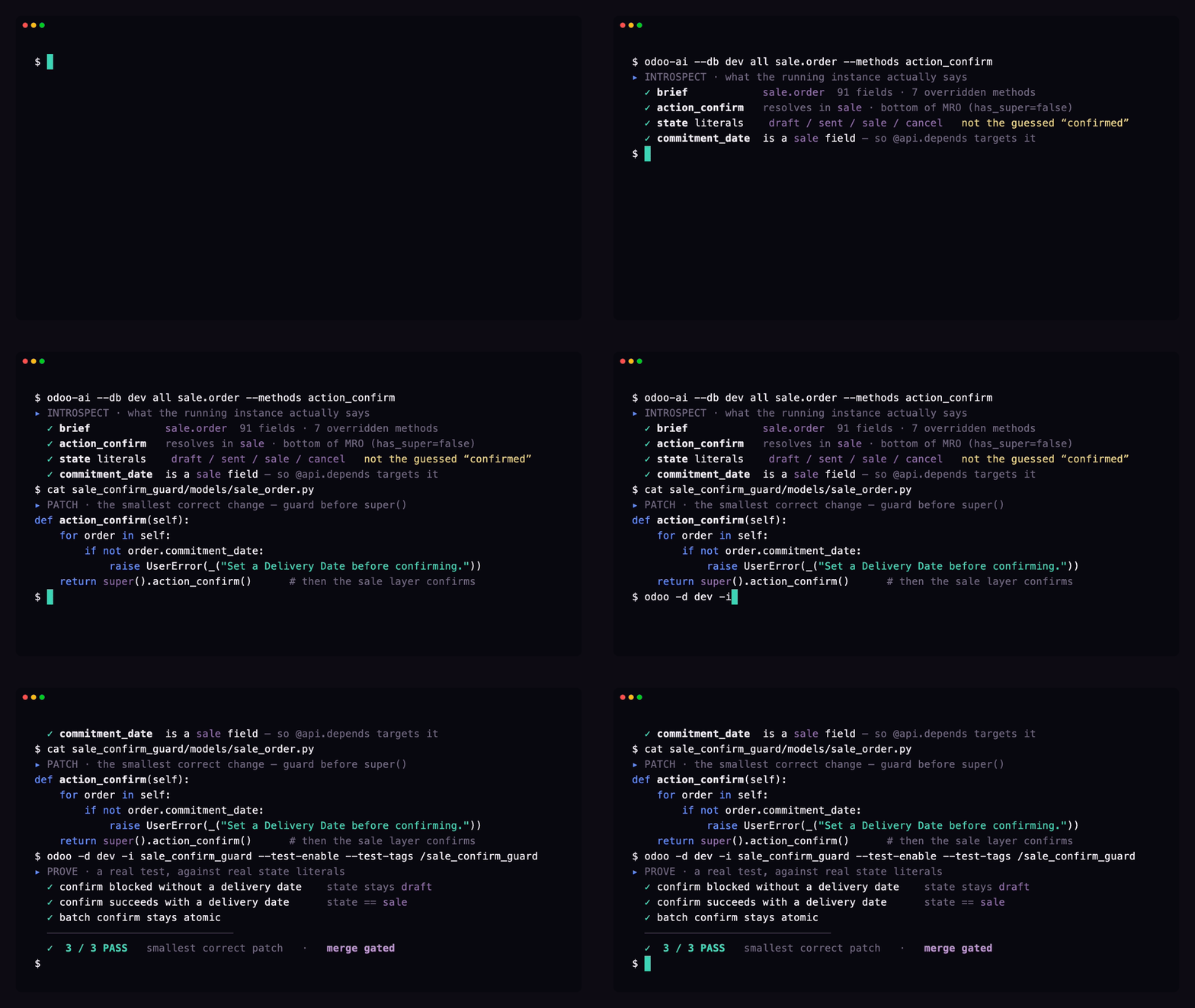
See the full worked example — a real sale.order change taken through introspect → patch → test, with its module tested in CI.
Left to memory, LLMs invent Odoo field and model names, reach for APIs that were removed (attrs/states, <tree>, name_get), call super() at the wrong MRO layer, sprinkle sudo() to silence access errors, and ship stored computes with an incomplete @api.depends. These fail silently at runtime, not at lint time — exactly where confidence is most dangerous. This suite closes that gap by making the agent read the live registry before it writes, and by encoding the Odoo-specific contracts (security, MRO, manifest wiring, version deltas) that a generic model doesn't know.
A hosted Odoo knowledge index (a cloud service that pre-indexes Odoo's source across versions) is great at breadth: "what does standard sale.order look like across v8→19? show me examples from many repos." Use one if you like — as an upstream source.
But a static index, by construction, cannot know what is true in your instance: which modules are installed, what Studio/OCA/local patches changed the final registry, the effective view arch for this group/company, per-user/per-company security, runtime behaviour, dev↔prod drift, or whether an upgrade preserves real data. Those are exactly the failures that pass review and break in production (see the high-risk playbooks).
odoo-ai-skills is the other half: it reads this running instance and turns a proposed change into proof — then gates the merge. The line is static indexes suggest; the running instance disposes.
redact exists) never leaves your environment.approve / needs-human / block verdict.Want ecosystem breadth too? Feed an external index's suggestions in as claims — odoo-ai-skills verifies each against the live instance rather than trusting it (see verify-claims). The suite's own docs lookup is just one such upstream source, built locally and existence-gated.
npx skills add tuanle96/odoo-ai-skills
One command installs the suite for Claude Code, Codex, Gemini CLI, GitHub
Copilot, and other Agent Skills-compatible agents
(bundled scripts/ ship with each skill). For the full Claude Code
experience — namespaced router, marketplace updates — use the plugin
install below.
This repo is a Claude Code plugin (a .claude-plugin/plugin.json manifest plus the skills/ directory) and its own marketplace (.claude-plugin/marketplace.json). Install it in two commands:
claude plugin marketplace add tuanle96/odoo-ai-skills   # register the marketplace
claude plugin install odoo-ai-skills@odoo-ai            # install the plugin
The 25 skills then load namespaced — /odoo-ai-skills:odoo (router), /odoo-ai-skills:odoo-introspect, etc. Update later with claude plugin update odoo-ai-skills@odoo-ai.
To try it before installing, load it straight from a local clone:
claude --plugin-dir /path/to/odoo-ai-skills    # then /plugin to browse
claude plugin validate /path/to/odoo-ai-skills # check the manifest
Running the bundled odoo-ai CLI after install. A plugin is copied into Claude's cache, so reference the CLI through the plugin-root variable rather than a relative path:
"${CLAUDE_PLUGIN_ROOT}"/skills/odoo-introspect/scripts/odoo-ai --db <DB> all sale.order
(When working in a clone, scripts/odoo-ai as shown elsewhere is fine.)
This repo also ships a native Codex adapter (.codex-plugin/plugin.json) and a
Codex marketplace (.agents/plugins/marketplace.json). Install from a local
clone:
codex plugin marketplace add /path/to/odoo-ai-skills
codex plugin add odoo-ai-skills@odoo-ai
The same skills/ directory is reused by Codex, and the bundled CLI remains at:
skills/odoo-introspect/scripts/odoo-ai --db <DB> all sale.order
odoo skill — it routes you to the right sub-skill.odoo-ai surface ranks the live entrypoints (buttons, crons, automations, routes) so you don't guess the entry method; odoo-ai esg then samples the real cross-app flow.odoo-capabilities first — odoo-ai native-check "<requirement>" (matches curated cards, existence-gated against the instance) or odoo-ai capabilities <model> for the full surface — to check what Odoo already ships before reinventing it. The best patch is sometimes no patch.odoo-introspect first to dump the model/flow as JSON (odoo-ai all <model>), then the relevant build skill, then odoo-testing, then odoo-review before you merge.odoo-ai preflight <module> before assuming a code bug.odoo-ai refs <model> <field> to see everything that depends on it first.check_access/has_access, @api.private, type='jsonrpc', _read_group/formatted_read_group, aggregator, record.env.*, odoo.Domain) are noted per-skill and in skills/odoo-introspect/references/version-matrix.md.odoo-bin shell against a dev/staging DB (self-hosted or an odoo.sh branch), or the RPC fallback for Odoo Online/SaaS — see skills/odoo-introspect/references/introspection.md.tuanle96/mcp-odoo MCP server to expose introspection as agent tools — it also ships a companion pack of 4 credentials-only business-workflow skills (data-quality gate, migration copilot, month-end close, agency fleet review): npx skills add tuanle96/mcp-odoo.Where your Odoo runs decides what this suite can do:
odoo-user-guide). On the v0.15 roadmap (an RPC-only mode for the shell-backed tools): the instance dossier, config audit, and fit-gap analysis — these currently need odoo-bin shell, so on Online they wait for the RPC fallback.The code gate targets environments where code can actually run (self-hosted, Odoo.sh). It never claims to verify custom code on Odoo Online.
| Skill | What it does |
|---|---|
| odoo-capabilities | Step 0 — before reinventing platform behavior, ask what Odoo already ships. odoo-ai native-check "<requirement>" (native-capability check, gate-then-rank) recall-matches ~34 curated capability cards (TF-IDF + intent-phrase), then existence-gates each against the live instance and returns candidates with cited evidence; odoo-ai capabilities <model> / --module <addon> maps the full native surface (wizards, actions, crons, automations, sequences, mixins, fields) with xmlids as evidence. odoo-ai native-learn "<phrase>" --card <id> teaches it mappings so recall improves from use. Fires only for additive / core-override tasks. |
| odoo-introspect | The engine every other skill calls first. JSON facts — fields+MRO+super+security · views/buttons · menu/data/reports · real runtime trace (with SQL-hotspot / write-map / exception summary) · effective per-user/company security — plus focused scanners: refs (reverse field impact, graph-resolved dotted paths), preflight (is it even loaded?), and state_capture (runtime values at a breakpoint + exception post-mortem) — and the odoo-ai CLI. Also hosts the Gate — the enforcement suite (scenario tests · env parity · static validator · redaction · upgrade harness · deploy-gate · evidence bundle · BYO-index verify-claims). |
| odoo-docs | Inspect: docs lookup — a local developer-docs index. Build a TF-IDF index of the official Odoo docs once (odoo-ai docs-build --version 18), then odoo-ai docs "<question>" returns ranked passages + canonical odoo.com URLs. Subordinate to introspection (docs propose, the instance disposes); built locally, never vendored (clean CC-BY-SA). |
| Skill | What it does |
|---|---|
| odoo-dev | Customize safely: fields, overrides, inheritance mode, the right hook, MRO layer. |
| odoo-module-scaffold | New module skeleton + correct __manifest__.py (incl. external_dependencies hygiene). |
| odoo-views | View XML (form/list/kanban/search) + inheritance/xpath; the v17/18 attrs-removal & <list>/<chatter/> changes. |
| odoo-security | ACL, record rules, groups, multi-company — authoring + the real eval order. |
| odoo-testing | The test gate: at_install/post_install, non-admin, multi-company, batch, -i/-u. Hosts the CI-bound evidence gate — CI-produced, HMAC-signed proof (diff-targets, changed-line coverage, runtime-path binding, scenario satisfaction, test-quality lint, mutation smoke, red/green replay) that makes "high coverage but runtime breaks" a block, not a green tick. Human review stays mandatory for sensitive domains — it hardens the trust boundary, it doesn't remove it. |
| odoo-review | The review gate: catch the security / data-loss / silent-correctness / perf defects AI ships before merge. |
| odoo-debug | Symptom→tool table, traceback decoder, --dev, runtime tracing + runtime state capture / exception post-mortem and debugpy/DAP step-through, "my change didn't apply" preflight. |
| Skill | What it does |
|---|---|
| odoo-owl | OWL 2 backend web client: components, custom field widgets, patching, services, assets. |
| odoo-web | Public web: HTTP controllers (http.route), website pages, the portal /my, and the publicWidget→Interactions shift. |
| odoo-reports | QWeb PDF/HTML reports: actions, templates, _get_report_values, paperformat. |
| odoo-statutory-reports | Dynamic financial statements via the account.report engine: line/expression model, engines (domain/aggregation/custom handler), date_scope semantics, the _report_custom_engine_* contract, self-verifying statutory design (catch-alls = 0, balance identities, reconciliation lines), regime versioning, xlsxwriter data-pack escape hatch. |
| odoo-valuation-repair | Broken inventory valuation, diagnosed and repaired: the Σ SVL quantity = valued physical stock invariant, the RCA query ladder (mid-stream valuation starts, config-flip archaeology, per-lot tears under lot_valuated), a fail-closed per-lot repair runbook (DRY-RUN server action, SaaS-safe, remaining-qty hygiene, stored-cost sync without double layers), and the daily drift check that catches positive-but-wrong costs no cost <= 0 alert ever sees. |
| Skill | What it does |
|---|---|
| odoo-data | Data/demo, noupdate, sequences, config parameters. |
| odoo-migration | Version upgrades & migration scripts (migrations/<version>/), reverse-impact before renames. |
| odoo-upgrade | Cross-version migration (18→19) of everything: breaking-change manifest generated from real source diffs, per-module semantic brief with file:line findings, runtime verify loop on a live target container (module_not_loaded guards the silent-skip false pass), fleet orchestrator (migrate_all.py: topo port order + S/M/L effort over a whole addons tree), and a whole-database rehearsal harness (db_upgrade.py: restore → OpenUpgrade → check, structured verdicts). Orchestrates official upgrade_code + OCA odoo-module-migrate first; data-migration hand-off to odoo-migration. |
| odoo-perf | Recordset hygiene, prefetch/cache, stored-compute cost, indexes. |
| odoo-worktree | Isolated feature dev on a LIVE dev env: git worktree branch cut from production while the container runs the main tree's uncommitted files; path-scoped sync (rsync/git restore --source), idempotent hook adopt-vs-create packaging, and the mandatory clean-install test ritual. |
| odoo-deploy | odoo.conf, workers, Docker, CI test runs — plus odoo.sh (git-push deploy, staging rehearsal) and Odoo Online limits. |
| Skill | What it does |
|---|---|
| odoo-domain-playbooks | Per-app maps (sale/stock/account/mrp/purchase/hr): key models, methods to introspect, right hooks, gotchas — plus country/regime playbooks (Vietnamese accounting: VAS, TT200→TT99 2026, e-invoice/tax calendar). |
| Skill | What it does |
|---|---|
| html-report | Render any audit / review / analysis / RCA / summary as one consistent, self-contained HTML page — shared bold "Magazine" theme, CSS inlined (no CDN, no server), auto-opens. Presentation only; not Odoo QWeb business documents (that's odoo-reports). |
| odoo-user-guide | Generate an end-user how-to guide for a flow from the running instance: ground the steps with odoo-ai (entrypoint discovery + effective per-role security), drive the real UI with Playwright on a sandbox DB, screenshot each step, assert the resulting state at the backend (the proof), then render a self-contained annotated HTML guide. Manifest-first & re-runnable; demo-DB-only, hard-fails on production mutation. Voice/MP4 are roadmap. |
| Skill | What it does |
|---|---|
| odoo | Entry point: task → skill decision table. |
odoo-ai)One command gathers ground truth for the agent before any code is written:
# everything (fields + views + data) for a model:
scripts/odoo-ai --db <DB> all sale.order --methods action_confirm,write,create

# add the real runtime trace:
scripts/odoo-ai --db <DB> all sale.order --methods action_confirm \
    --record-id 42 --method action_confirm

# focused scanners:
scripts/odoo-ai --db <DB> refs sale.order commitment_date --resolve-paths  # who breaks if I change this field
scripts/odoo-ai --db <DB> preflight my_module               # installed? loaded from where? shadowed?
scripts/odoo-ai --db <DB> security sale.order --user 7      # effective ACL + record rules + restricted fields

# runtime values — the JSON analog of an IDE's "inspect variables":
scripts/odoo-ai --db <DB> state sale.order 42 action_confirm \
    --break sale.order._action_confirm --fields state,amount_total   # args/locals/self at the breakpoint
scripts/odoo-ai --db <DB> state sale.order 42 action_confirm --on-exception   # full stack + locals if it raises
See skills/odoo-introspect/ for the JSON shape of each layer and the SaaS RPC fallback.
Reading ground truth stops the agent guessing; it doesn't yet prove the change is safe. The Gate turns that evidence into enforced checks — the realistic target is agent-written, tool-verified, human-approved, not blind autonomous deploy. Four of these are pure and local (no odoo-bin shell, no DB — they run in CI or on a laptop):
# turn introspection into the MANDATORY tests for this change (risk-tiered):
scripts/odoo-ai --db <DB> scenarios sale.order --methods action_confirm   # → required scenarios + a TransactionCase skeleton

# don't claim production safety against a divergent env:
scripts/odoo-ai --db dev  env-fingerprint   # capture each side, then:
scripts/odoo-ai env-diff dev.json prod.json                 # LOCAL — modules/edition/studio/config drift

# the odoo-review checklist, as an executable linter (LOCAL, no DB):
scripts/odoo-ai validate addons/my_module                   # attrs/sudo/N+1/batch/version anti-patterns

# make introspection JSON safe to share with an external LLM (LOCAL):
scripts/odoo-ai redact /tmp/odoo-ai/sale_order.state.json   # strip source/locals, mask PII, redact secrets
scripts/odoo-ai scan-secrets path/to/file                   # secret/key scan before it leaves the box

# upgrade safety: a RENAME (keep data) vs a DROP (lose it), + a pre-migrate scaffold:
scripts/odoo-ai --db <DB> upgrade-check sale.order --against old_brief.json
scripts/odoo-ai upgrade-diff old_brief.json new_brief.json  # LOCAL

# aggregate all the evidence into a go/no-go for high-risk modules (LOCAL):
scripts/odoo-ai deploy-gate /tmp/odoo-ai/evidence_bundle/   # → approve | needs-human | block
These came out of the v0.7 codebase evaluation (under plans/reports/), which found the suite excellent at grounding but advisory-only at enforcement. Each gate's pure logic is unit-tested without Odoo.
The steps above all assume you already know what to introspect. Entry-point discovery answers the cold-start problem — where does reality start in this instance? — and makes the tools impossible to skip:
# DISCOVER where to start — rank the live entrypoint surface (buttons, server
# actions, crons, automations, reports, HTTP routes), instance-wide or scoped:
scripts/odoo-ai --db <DB> surface                       # → ranked roots + top_trace_seeds
scripts/odoo-ai --db <DB> surface sale.order            # ...around one model

# UNDERSTAND the overall process — sample the top entrypoints' real traces and
# merge them into a cross-model / cross-app flow skeleton (NOT a static map):
scripts/odoo-ai --db <DB> esg sale.order                # → Execution Surface Graph

# MEASURE that hallucinations actually drop — score the gate on a benchmark of the
# classic LLM Odoo mistakes (account.invoice, customer_id, fields_view_get, …):
scripts/odoo-ai --db <DB> eval                          # → detection_rate / truth_recall

# ENFORCE no-introspect-no-edit (LOCAL) — block an edit until its model is read:
scripts/odoo-ai gate-edit addons/my_module/models/sale_order.py
Wire gate-edit as a Claude Code PreToolUse hook (skills/odoo-introspect/references/enforcement-hooks.md) so the agent cannot edit an Odoo model before reading its ground truth — the Oracle's "even perfect tools ≠ used tools" failure mode, closed. surface/esg stay true to runtime-grounded, never memorized: process understanding emerges from sampled traces, never a stale stored atlas. (Design rationale: the codebase analysis under plans/reports/.)
As models improve they write plausible-wrong code faster, so the leverage moves from catching bad patches to feeding the agent instance truth before it writes — and from a green tick to an evidence artifact a reviewer, partner lead, and client can all read. v0.14 adds both halves plus the consultant-facing surface:
# FAST CONTEXT — small, per-model instance facts to feed the agent BEFORE it edits
scripts/odoo-ai --db <DB> facts sale.order --kind security     # model | security | views | flows
scripts/odoo-ai --db <DB> mcp                                  # ...same facts as a bounded read-only MCP server

# INSTANCE DOSSIER — one read-only command: the takeover / pre-sales inventory
scripts/odoo-ai --db <DB> dossier                              # modules, Studio, custom fields, security,
scripts/odoo-ai dossier-report /tmp/odoo-ai/dossier/dossier.dossier.json   # data volumes → upgrade-risk flags → HTML

# VALID TEST DATA — business-record fixtures agents keep getting wrong
scripts/odoo-ai --db <DB> fixture sale_order_stockable         # paste-ready TransactionCase skeleton
scripts/odoo-ai --db <DB> fixture sale_order_stockable --exec  # ...or run it in a savepoint + roll back

# FIT-GAP (alpha) — classify requirements vs the live instance (decision support, not a consultant)
scripts/odoo-ai --db <DB> fit-gap --requirements-file reqs.json --domains sale,stock,account

# UAT PACK (alpha) — role-based UAT scripts from the live surface + risk scenarios
scripts/odoo-ai uat-pack --surface surface.json --scenarios scenarios.json --html

# THE EVIDENCE ARTIFACT — the stable, public, client-facing proof (build + validate)
scripts/odoo-ai evidence-artifact build <bundle_dir> --out evidence.json
scripts/odoo-ai evidence-artifact validate evidence.json
The snapshot cache (cache) keeps warm context fast inside the agent loop under one hard rule — warm cache never approves a merge; only a cold run is merge-eligible, and the provenance rides on every payload. The Gate now classifies every finding S0–S4 and supports an opt-in fail-closed policy (deploy-gate --policy …): an S3/S4 finding (silent data corruption, ACL bypass, multi-company leak) blocks the merge unless a human_signoff.json downgrades it — never silently to approve. A composite GitHub Action (.github/actions/odoo-gate), a sticky PR comment, and a GitLab recipe make it real in CI (docs/ci-integration.md, docs/evidence-artifact.md). And Odoo Agent Safety Bench v0 is a public, reproducible benchmark whose metric is the unsafe-change escape rate — how often an unsafe change reaches PR/UAT/release undetected — not task completion; ten severity-weighted tasks, four run modes, a living adversarial corpus, and by design no single headline score.
Consultant / BA note. The Instance Dossier, Fit-Gap, and UAT Pack are the takeover-audit, gap-fit, and UAT deliverables the functional side asks for. Fit-Gap and UAT Pack are alpha (scoped to sale/stock/account for now), and on Odoo Online the Dossier/Fit-Gap wait for the v0.15 RPC-only mode — see
docs/odoo-online-advisory.md.
Beyond the unit suite, the integration smoke runs every inspection stage and gate against live Odoo 17 / 18 / 19 in CI (.github/workflows/integration.yml) — including entry-point discovery (surface/esg/eval): 89/89 checks pass on each of 17, 18, and 19, reproducible locally in one command via docker-compose.e2e.yml (Postgres + the three Odoo versions). The eval harness scores detection_rate 1.0 / truth_recall 1.0 on all three (every classic hallucination caught, every real confirmed). The suite has also been validated end-to-end against a real 390-module Enterprise instance (Studio fields, custom addons, multi-company): all read-only inspection (fields, MRO, security, native capability), the enforcement gates, the BYO-index verify-claims (it correctly flagged an external claim about a module absent from that instance), and the write/execute layers — a runtime trace of sale.order.action_confirm captured the real cross-app cascade (stock.picking / stock.move / quality.check) and rolled back. The failures a static index can't catch are in docs/high-risk-playbooks.md.
The introspection stages dump real instance data. The state capture returns runtime args, locals, and self field values, and SOURCE=1 on the model brief includes full method bodies. This output can contain secrets, tokens, API keys, passwords, customer PII, or proprietary business logic.
state redacts common sensitive keys by default — locals/dict-keys/fields named like password, token, secret, api_key, authorization, session, etc. become <redacted>. Extend with --redact-extra ssn,iban; disable with --no-redact only on a trusted dev box. Redaction is key-name based, so it won't catch a secret stored under an innocuous name.SOURCE=1 and --fields can still surface sensitive content. Do not paste raw state / source JSON into an external LLM or a public issue unless it's been reviewed and redacted..claude-plugin/plugin.json # plugin manifest
.claude-plugin/marketplace.json # self-hosted marketplace (install source)
skills/<name>/SKILL.md # one skill per directory
skills/<name>/references/ # progressive-disclosure deep dives
skills/odoo-introspect/scripts/ # the introspection engine + odoo-ai CLI
The introspection scripts are import-safe: the env-dependent work runs only inside odoo-bin shell, while the pure helpers are unit-tested without Odoo.
python -m unittest discover -s tests -p "test_*.py"          # gate + tool suite (no Odoo, no pytest)
python -m pytest skills/odoo-introspect/scripts/tests -q     # pure-function tests
python skills/odoo-introspect/scripts/tests/test_pure_functions.py   # no-pytest fallback
CI (.github/workflows/) compiles every script and runs both suites on each push.
Integration smoke test (needs a real Odoo). scripts/tests/integration_smoke.py runs the inspection stages against a live instance and asserts on the JSON (selection literals, manifest by_location split, view inheritance_chain, seeded noupdate, state redaction). It's opt-in — skipped unless ODOO_DB is set — so it never breaks the unit CI. Run it against a dev container or let .github/workflows/integration.yml run it on the official odoo:17.0 / 18.0 / 19.0 images (with a dedicated job running the sale_confirm_guard worked example on odoo:18.0). See skills/odoo-introspect/references/introspection.md for the container wrapper and exact invocation.
CONTRIBUTING.md (project layout, the import-safe script pattern, running the unit + integration tests).CHANGELOG.md.SECURITY.md.LGPL-3.0-or-later. See LICENSE.
1000+ skills curated from Anthropic, Vercel, Stripe, and other engineering teams
Design enforcement with memory — keeps your UI consistent across a project
Detects 37 AI writing patterns and rewrites text with human rhythm across 5 voice profiles
WCAG accessibility audit — automated scanning, manual review, remediation